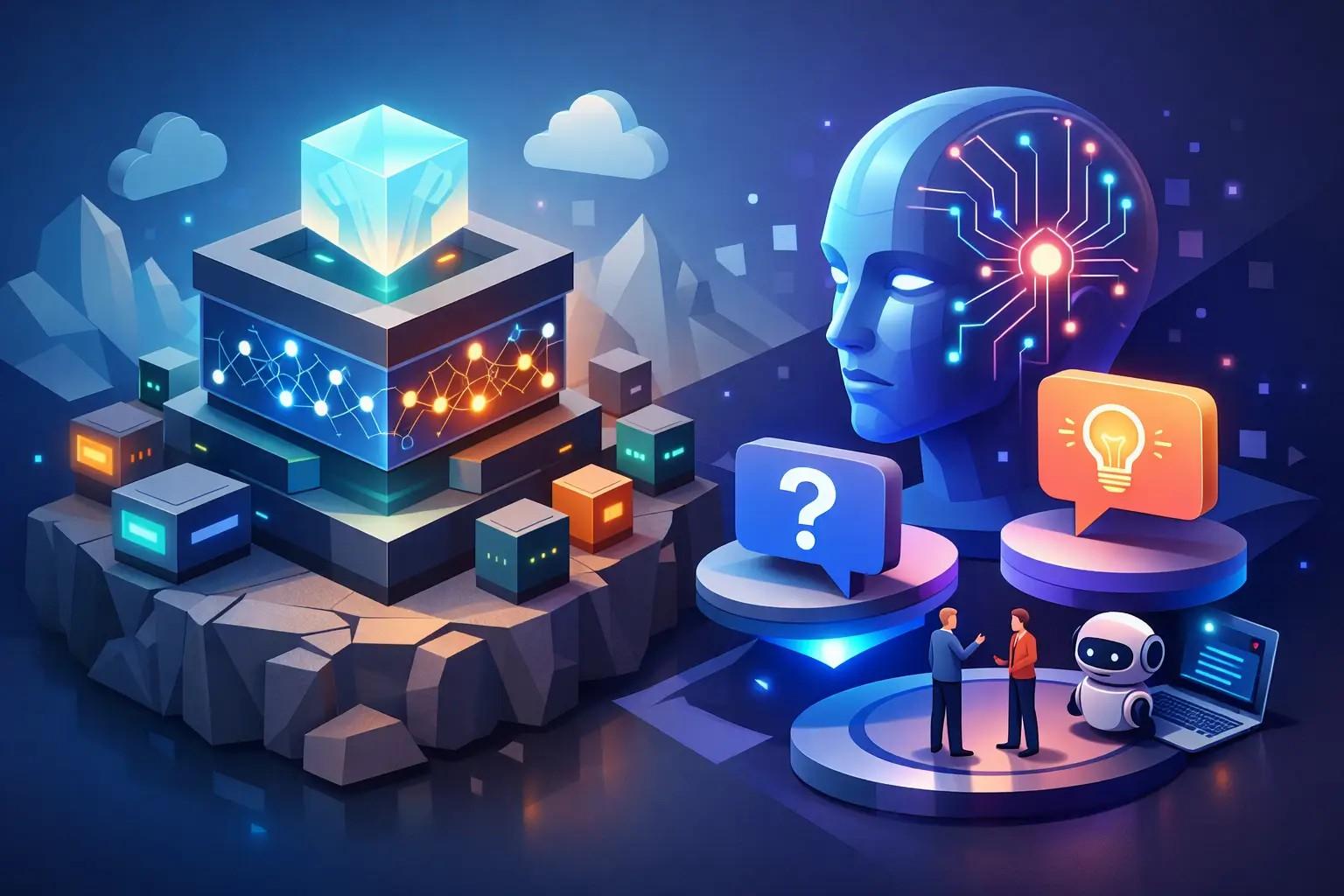
Amazon Bedrock: Foundation Models and Q&A
A useful generative AI pilot can become an operational risk the moment employees start asking it questions about contracts, customer records, engineering documentation, or internal procedures. The difference between an impressive demo and a dependable business capability is the architecture around the model. Amazon Bedrock - Generative AI foundation models plus Q&A gives AWS-focused organizations a managed way to access foundation models while keeping security, governance, integration, and cost management in view.
For small and mid-sized businesses, Bedrock is not simply a chatbot service. It is an application platform for bringing generative AI into workflows where uptime, data boundaries, auditability, and predictable operations matter. The right implementation can reduce time spent searching for answers, accelerate support and engineering work, and make institutional knowledge more accessible. The wrong implementation can produce unsupported answers, expose data too broadly, and create another tool that IT has to clean up later.
What Amazon Bedrock provides
Amazon Bedrock provides API-based access to a selection of foundation models from Amazon and third-party providers. Rather than operating GPU clusters or managing model-serving infrastructure, engineering teams can invoke models through managed AWS services and select models that fit the job: conversational assistance, summarization, classification, extraction, content generation, or multimodal analysis.
That model choice is significant. A low-cost, fast model may be appropriate for classifying incoming service requests. A more capable model may be worth the additional cost for complex policy analysis or technical Q&A. Some use cases require image understanding in addition to text. Others need consistent structured output for downstream automation. Bedrock makes experimentation easier, but it does not remove the need to define quality, latency, and cost requirements before production.
The platform also includes capabilities that matter beyond a single prompt: Knowledge Bases for retrieval-augmented generation, Guardrails for safety controls, Agents for orchestrating actions and tool use, and evaluation features for comparing model behavior. These services can shorten implementation time, especially for teams already operating on AWS. They should still be treated as components in a production architecture, not as substitutes for application design.
Generative AI foundation models plus Q&A: the architecture that matters
Most business Q&A requirements should not begin with fine-tuning. They should begin with retrieval-augmented generation, commonly called RAG. In a RAG design, the application retrieves relevant passages from approved business content, adds those passages to the model request, and instructs the model to answer from that evidence.
This approach addresses a central limitation of foundation models: the model does not automatically know your current internal documentation, and its general training data may be outdated or incomplete. More critically, a model can generate a plausible answer even when it lacks the facts. Retrieval grounds the response in controlled source material.
A well-designed Q&A flow typically looks like this:
- Documents are collected from approved repositories and processed into searchable chunks with useful metadata, such as department, document owner, effective date, classification, and access group.
- A user submits a question through an internal application, portal, or workflow integration.
- The retrieval layer finds the most relevant permitted content, using the user’s identity and authorization context where required.
- Bedrock receives the question, the retrieved context, and instructions that define how the model should respond.
- The application presents an answer with source references, captures feedback, and records operational telemetry for review.
The retrieval layer deserves as much attention as the foundation model. Poor chunking, weak metadata, duplicate documents, stale policies, or an overly broad search scope will degrade answers regardless of which model is selected. For compliance-sensitive workflows, document lifecycle ownership is a business control, not merely a data engineering task.
A useful instruction set should require the model to state when the available source material does not support an answer. That response is often more valuable than a confident guess. The application should also show users where an answer came from, so they can verify critical claims rather than treating generated text as an authority.
When RAG is not enough
RAG is best for answering from evolving internal knowledge. It is not the correct answer for every requirement. If the task is to produce a tightly controlled classification label, traditional machine learning or rules may be cheaper and easier to validate. If a workflow requires a reliable calculation, invoke a deterministic service or database query rather than asking a model to calculate from prose.
Fine-tuning may be justified when an organization needs a specialized format, tone, or behavior that prompting cannot consistently deliver. It requires a curated training set, a clear evaluation process, and ongoing governance. For many operational Q&A applications, better retrieval and better prompts deliver more value before fine-tuning enters the conversation.
Security and governance cannot be added later
Generative AI broadens the attack surface because users can submit unpredictable input and because models may influence decisions or downstream actions. A Bedrock implementation should fit into the same identity, logging, network, and change-management standards used for the rest of the AWS environment.
Start with least-privilege IAM permissions. Separate development, test, and production accounts where the organization’s operating model supports it. Limit which applications, roles, and teams can invoke specific models or access knowledge sources. Secrets used by integrations should be managed centrally and rotated under established policy.
Data access requires equal care. An internal Q&A system must not retrieve HR records for a general employee, customer information across tenants, or draft legal material for unauthorized users. Metadata-based filtering and identity-aware authorization need to be designed into the retrieval path. Simply putting all company documents in one index creates a data exposure problem waiting to happen.
Bedrock Guardrails can help define blocked topics, sensitive information handling, and allowed response patterns. They are useful controls, but they are not proof that an application is safe. Test for prompt injection, attempts to override instructions, requests for data outside a user’s authorization, and unsafe tool calls. If an agent can create tickets, modify records, or trigger infrastructure actions, require explicit confirmation and tightly limit the tools it can access.
Operational logging should capture enough information to investigate failures without unnecessarily retaining sensitive prompts or content. CloudTrail, CloudWatch, application logs, security monitoring, and observability platforms should provide a trace from user request to retrieval results, model invocation, response, and any action taken. This is essential for incident response, cost analysis, and quality improvement.
Choose models with evaluation, not assumptions
There is no universal best foundation model. A model that performs well on creative copy may be a poor economic choice for high-volume support triage. A model with excellent reasoning may exceed the response-time budget for an interactive employee assistant. Model selection should be a measured engineering decision.
Build a representative evaluation set from real, sanitized business tasks. Include straightforward questions, ambiguous questions, requests with no answer in the source material, adversarial prompts, and inputs that test your security boundaries. Score answers for factual grounding, completeness, citation quality, format compliance, latency, and cost per task.
Production monitoring should continue that work. Track failed retrievals, unsupported answers, user corrections, response latency, token consumption, and model errors. A spike in negative feedback may signal a content-ingestion problem rather than a model problem. Likewise, a growing token bill may indicate that prompts, document chunks, or conversation history need tighter controls.
A practical path to production on AWS
The strongest starting point is a narrow, measurable use case with a known content owner. An IT operations knowledge assistant, internal policy Q&A tool, support-agent copilot, or engineering runbook assistant can provide a controlled first deployment. Each has a defined user group, identifiable source content, and measurable outcomes such as reduced ticket resolution time or fewer escalations.
Before building, define the decision that the system will support, the data it may access, the actions it must never take, and how a human can intervene. Establish a baseline for the current process. Without it, teams may be able to demonstrate usage but not business value.
From there, use infrastructure as code through Terraform or AWS-native tooling to make environments repeatable. Integrate deployment into CI/CD pipelines, apply security scanning to application code and dependencies, and place cost tags on the resources supporting the workload. A Well-Architected Review can expose gaps in security, reliability, performance efficiency, and operational excellence before the pilot becomes a production dependency.
Advanced Vision IT approaches Bedrock projects as cloud operations work, not isolated AI experiments. That means connecting the application to the right AWS landing zone, identity model, network controls, observability practices, and support process from the start.
The best Q&A systems do not try to sound omniscient. They give employees fast, traceable answers from approved information, clearly identify uncertainty, and route high-risk decisions to people. That is the standard worth building toward.
Author: Yavor Y. Zlatev CEO of AdvisionIT
Date: 13.08.2026