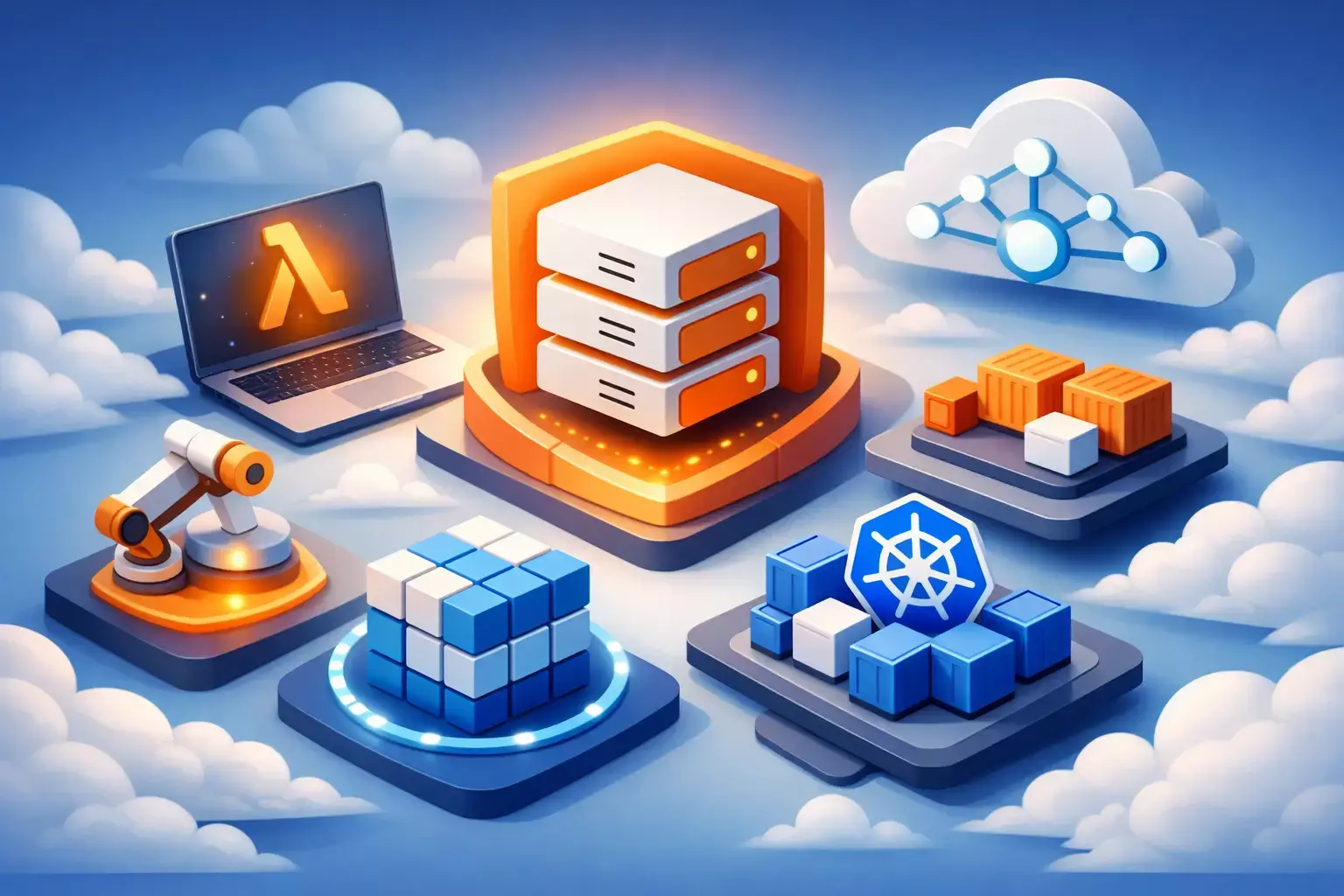
AWS Cloud Compute: EC2, Lambda, ECS, EKS, Fargate plus Q and A
A poorly matched compute service can create the same business problem in two different ways: teams either spend too much time operating infrastructure or give up too much control over performance, security, and cost. AWS Cloud compute: EC2, Lambda, ECS, EKS, and Fargate give organizations distinct ways to run workloads, but they are not interchangeable.
The right choice depends on application architecture, operational maturity, traffic patterns, compliance obligations, and the skills available to support the environment. For small and mid-sized businesses, the goal is rarely to use the newest service. It is to establish a dependable operating model that scales without creating unnecessary management overhead.
Start With the Level of Control You Need
AWS compute services sit on a spectrum. At one end, Amazon EC2 gives your team deep control over virtual servers, operating systems, network configuration, and installed software. At the other, AWS Lambda runs individual functions without servers to provision or maintain. ECS, EKS, and Fargate occupy the container-focused middle ground.
This is not simply a technical preference. More control can support specialized software, legacy workloads, custom security agents, or strict performance requirements. It also creates responsibility for patching, capacity planning, backups, hardening, monitoring, and incident response. Less infrastructure management can accelerate delivery, but may introduce runtime constraints, different cost behavior, and fewer options for troubleshooting at the host level.
A sound architecture begins by separating application requirements from platform preferences. Ask what must be managed, what can be automated, and what failure would cost the business most. A customer-facing application with steady traffic has different needs than a nightly data job or an event-driven document-processing workflow.
EC2: Maximum Flexibility for Server-Based Workloads
Amazon EC2 provides virtual machines that can run nearly any compatible operating system and application stack. It remains a practical choice for workloads that need persistent processes, custom operating system configuration, specific networking behavior, GPU capacity, licensed software, or tight control over resource allocation.
EC2 is often appropriate for traditional web applications, commercial off-the-shelf software, domain controllers, jump hosts, specialized databases, and migration workloads that cannot be refactored immediately. It can also be the least disruptive first step when moving from an on-premises environment to AWS.
The trade-off is clear: EC2 is not a set-it-and-forget-it service. Teams need a disciplined operating model for Amazon Machine Image management, patch cycles, encryption, security groups, identity controls, monitoring, backups, and scaling. Auto Scaling Groups can reduce capacity risk, but they do not replace observability or operational ownership.
For predictable, always-on workloads, Savings Plans or Reserved Instances can materially improve cost efficiency. For variable or fault-tolerant workloads, Spot Instances may be a good fit. The savings are meaningful only when interruption handling, capacity availability, and application design have been evaluated first.
Lambda: Best for Event-Driven, Short-Lived Work
AWS Lambda runs code in response to events such as API requests, file uploads, scheduled jobs, queue messages, and database changes. The service automatically scales concurrent executions, which makes it effective for intermittent or highly variable workloads.
Lambda is a strong fit for integration services, automation tasks, lightweight APIs, file processing, notifications, security remediation, and data transformations. It can reduce operational burden because there are no servers or container hosts to patch and manage. For a small internal engineering team, that reduction in infrastructure work can be substantial.
However, Lambda is not automatically the best choice for every application. Functions have execution duration limits, startup behavior that can affect latency, packaging constraints, and a stateless execution model. Workloads requiring long-running connections, intensive processing, predictable low latency, or complex local dependencies may be better suited to containers or EC2.
Cost also deserves attention. Lambda can be economical when work runs only on demand. At high, sustained utilization, a container service may offer more predictable economics. Monitor invocation volume, duration, memory settings, errors, throttles, and downstream dependency latency before assuming serverless means lower cost.
ECS, EKS, and Fargate: Choose the Right Container Operating Model
Containers package an application and its dependencies into a portable runtime unit. AWS offers two primary orchestrators: Amazon ECS and Amazon EKS. Fargate is not an orchestrator. It is a serverless compute engine that can run containers for ECS or EKS without requiring teams to manage the underlying servers.
Amazon ECS: AWS-Native Container Simplicity
Amazon ECS is AWS's native container orchestration service. It is generally the most direct option for teams that want to run containerized services, batch jobs, or workers primarily within AWS without the operational complexity of Kubernetes.
ECS integrates closely with IAM, Application Load Balancers, CloudWatch, Secrets Manager, and AWS networking. Teams define task definitions, services, desired capacity, deployment parameters, and health checks. It supports workloads on either EC2 capacity or Fargate.
For many mid-market organizations, ECS provides an effective balance of control and operational simplicity. It is particularly suitable when the team does not need Kubernetes-specific tooling, custom resources, or portability across multiple Kubernetes environments.
Amazon EKS: Kubernetes Compatibility With More Responsibility
Amazon EKS is AWS's managed Kubernetes service. It is designed for organizations that require Kubernetes APIs, an existing Kubernetes operating model, a broad ecosystem of Kubernetes tools, or portability requirements that justify the added complexity.
EKS manages the Kubernetes control plane, but it does not eliminate the need to manage cluster design, node groups or Fargate profiles, ingress, network policies, upgrades, workload security, logging, and cost allocation. Kubernetes offers significant flexibility, but it also expands the number of decisions a team must make correctly.
EKS is appropriate when Kubernetes is a deliberate platform standard, not when it is selected because it appears more modern. A small team running a few services may achieve faster and safer outcomes with ECS. Conversely, a growing platform team with established Kubernetes expertise may benefit from EKS's ecosystem and standardized deployment patterns.
AWS Fargate: Remove the Container Host Layer
Fargate allows teams to run ECS tasks or EKS pods without provisioning or patching EC2 worker nodes. You specify the CPU, memory, networking, and execution settings for each workload, while AWS manages the underlying capacity.
This is valuable when operational capacity is limited, workload demand fluctuates, or the organization wants to reduce host-level maintenance. Fargate can simplify isolation and capacity management, especially for APIs, background workers, scheduled tasks, and smaller microservices.
The trade-off is less host-level control and, in some sustained workloads, higher cost than carefully managed EC2 capacity. Fargate also has configuration limits that may matter for specialized networking, storage, privileged workloads, or hardware needs. It should be evaluated against real application requirements rather than treated as a universal default.
A Practical Selection Framework for AWS Cloud Compute
A useful starting point is to match the service to the workload's operating characteristics. EC2 fits applications that need server-level control or are being migrated with minimal change. Lambda fits event-driven work that runs in short, independent bursts. ECS fits teams seeking straightforward AWS-native container operations. EKS fits organizations with a real Kubernetes requirement and the capacity to operate it well. Fargate fits container workloads where reducing server administration is worth the platform trade-offs.
Security and governance must be part of the decision. Every option needs least-privilege IAM roles, encrypted data paths, private network design where appropriate, centralized logging, vulnerability management, backup planning, and tested recovery procedures. The implementation differs by service, but the accountability does not.
Cost management also changes by model. EC2 costs are driven by instance selection, utilization, storage, data transfer, and commitments. Lambda costs follow requests and execution consumption. ECS and EKS costs include the orchestrator, compute layer, networking, observability, and supporting services. Tagging, budgets, utilization reviews, and workload-level cost visibility should be designed in from the beginning.
Q and A: AWS Compute Decisions
Is Lambda better than EC2?
Neither service is universally better. Lambda is better for short-lived, event-driven processing with variable demand and minimal infrastructure management. EC2 is better when an application needs persistent processes, custom operating systems, specialized dependencies, or consistent server-level performance.
Should we use ECS or EKS for a new container application?
Choose ECS when your priority is simpler AWS-native operations and your application does not require Kubernetes capabilities. Choose EKS when Kubernetes is already a supported organizational standard or when its ecosystem and portability solve a documented requirement. Avoid adopting EKS solely because other companies use it.
Does Fargate replace EC2?
Fargate replaces the need to manage EC2 hosts for eligible container workloads. It does not replace EC2 for applications requiring virtual machines, custom host configuration, certain specialized hardware, or workloads that are more economical on continuously utilized EC2 capacity.
Can these services be used together?
Yes. A well-designed environment may run a legacy application on EC2, event processing on Lambda, customer-facing containers on ECS Fargate, and a specialized platform on EKS. Consistency comes from shared identity, networking, CI/CD, observability, security controls, and operational standards, not from forcing every workload onto one service.
The most resilient AWS environments are built around intentional workload placement, infrastructure as code through tools such as Terraform, measurable service health, and regular cost and security reviews. Advanced Vision IT helps organizations assess those decisions across architecture, migration, DevOps automation, observability, and ongoing managed operations.