



AWS Cost Optimization: Questions Answered
A rising AWS bill is rarely caused by one bad decision. More often, it reflects dozens of small choices left unreviewed: oversized instances, unattached storage, nonproduction environments running overnight, data transfer patterns, and services configured for peak demand that never arrives. AWS Cost Optimization (High Search Intent) - AWS plus Q&A matters because businesses need more than a list of discounts. They need a disciplined way to reduce waste without creating performance, availability, or security risk.
For growing organizations, cloud cost management is an operating practice. The goal is to make spend visible, connect it to workloads and business value, and continuously choose the right architecture and purchasing model.
What AWS cost optimization actually means
AWS cost optimization is the process of getting the required business outcome from cloud resources at the lowest responsible cost. “Responsible” is the key word. A database that costs less but cannot meet recovery requirements is not optimized. Neither is a workload moved to a cheaper instance family that increases latency and drives customer churn.
The AWS Well-Architected Framework treats cost optimization as one pillar among operational excellence, security, reliability, performance efficiency, and sustainability. This is the right lens for IT leaders: cloud spend cannot be isolated from the system it supports.
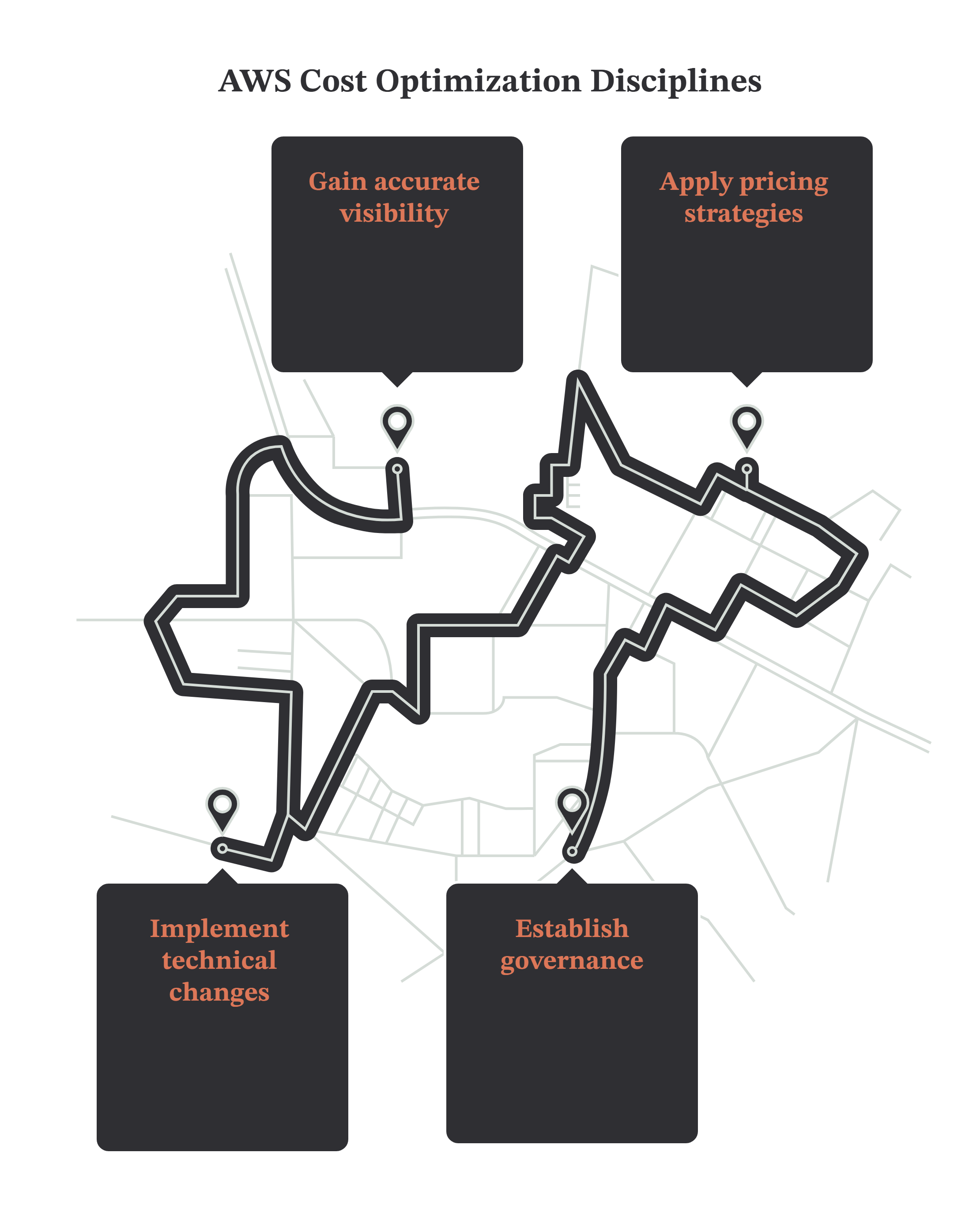
Effective optimization combines four disciplines. First, teams need accurate visibility into where money is going. Second, they need technical changes that eliminate idle or oversized capacity. Third, they need commitment and pricing strategies for stable usage. Finally, they need governance that prevents waste from returning after a cleanup project.
Start with visibility before making cuts
Cost-cutting without context can produce the wrong savings. Begin by organizing AWS accounts, cost allocation tags, and chargeback or showback reporting around the way the business operates. A useful report should answer which product, customer environment, application, team, and environment is driving spend.
At a minimum, establish consistent tags for application, owner, environment, cost center, and criticality. Tags do not reduce costs on their own, but they turn a generic invoice into an actionable operating report. If an engineering leader cannot identify the owner of an expensive EC2 fleet or S3 bucket, the team cannot make an informed decision about it.
AWS Cost Explorer, AWS Budgets, Cost and Usage Reports, and anomaly detection provide the financial data. Observability tools such as New Relic, CloudWatch, and application performance monitoring provide the operational evidence. Use both. A resource may look underutilized in a billing dashboard but be essential during a predictable month-end processing window.
Cost anomaly alerts deserve special attention. They are not a replacement for monthly reviews, but they can catch accidental scale-outs, runaway logging, compromised credentials, or unexpected cross-region transfer before a surprise becomes a material expense.
The highest-impact AWS cost optimization actions
The most valuable actions depend on the workload, but several categories consistently create meaningful savings for small and mid-sized businesses.
Rightsize compute using real utilization patterns
EC2, Amazon RDS, Amazon ECS, Amazon EKS, and AWS Lambda are common cost centers. Rightsizing means comparing provisioned capacity against actual CPU, memory, network, storage, throughput, and application latency needs. CPU alone is not enough. A memory-constrained application may have low CPU utilization while still requiring its current instance size.
For steady workloads, moving to a newer generation or more suitable instance family can reduce cost while improving price-performance. Graviton-based instances are often worth evaluating, particularly for Linux workloads, containers, and supported databases. Testing remains essential because application dependencies and architecture compatibility vary.
For variable workloads, autoscaling is frequently more valuable than a one-time resize. Configure scaling policies around the metric that reflects user demand, such as queue depth, request count, or latency, rather than relying only on CPU. Then verify minimum capacity settings. A high minimum can quietly preserve the same waste autoscaling was intended to eliminate.
Schedule nonproduction environments
Development, QA, sandbox, and training environments often run 24/7 even though teams use them only during business hours. Scheduled start-stop automation can materially lower costs for EC2 instances, RDS databases, and supporting services.
This is not appropriate for every environment. Shared global teams, overnight testing, batch processing, and disaster recovery dependencies may require different schedules. The practical approach is to assign an owner, document exceptions, and automate approved schedules through Infrastructure as Code, Lambda, or centralized operations tooling.
Remove orphaned resources and control storage growth
Unattached EBS volumes, obsolete snapshots, idle load balancers, unused Elastic IP addresses, old AMIs, and abandoned test environments are classic cloud waste. They are easy to miss because each line item may appear small. Across multiple accounts and years of growth, they add up.
Storage deserves a lifecycle policy rather than periodic cleanup. Apply S3 lifecycle rules to move eligible objects to lower-cost classes or expire them when retention requirements end. Review EBS snapshot retention, RDS backup windows, CloudWatch log retention, and data replication settings. Compliance requirements should drive retention periods, not a default setting that persists indefinitely.
Data transfer is another area where architecture decisions matter. Cross-AZ, cross-region, internet egress, NAT Gateway processing, and repeated movement of large datasets can become significant charges. The answer is not always to centralize everything. Sometimes resilience requires multi-AZ or multi-region design. The better question is whether the transfer pattern is intentional, measured, and aligned with the workload’s recovery and latency requirements.
Match discounts to predictable demand
Savings Plans and Reserved Instances can lower costs for stable, long-running usage, but they are financial commitments. Buy them after baseline utilization is understood, not before. A commitment applied to an oversized or soon-to-be-retired workload simply discounts waste.
Savings Plans generally offer flexibility across eligible compute usage, while Reserved Instances can make sense for specific services and stable configurations. Spot Instances can provide major savings for interruption-tolerant workloads such as CI/CD runners, batch jobs, stateless container workloads, rendering, and data processing. They should not be treated as a universal replacement for on-demand capacity.
A balanced model often uses committed capacity for a stable baseline, on-demand capacity for uncertainty, and Spot capacity for flexible workloads. Review coverage and utilization regularly as applications, growth plans, and architectures change.
AWS cost optimization Q&A
How quickly can an organization reduce AWS spend?
Immediate savings are often possible from idle resources, nonproduction scheduling, rightsizing obvious overprovisioning, and correcting storage retention. Larger savings from modernization, containerization, database redesign, or commitment planning take longer because they require testing and change control. A sensible first goal is to identify low-risk actions within 30 days, then build a quarterly optimization backlog for structural improvements.
Will cost optimization hurt application performance?
It can if it is approached as indiscriminate downsizing. Proper optimization starts with service-level objectives, utilization history, load tests, and rollback plans. Every recommended change should state the expected savings, operational risk, performance assumptions, owner, and validation method. This turns optimization into controlled engineering work rather than a finance-driven reduction exercise.
Is FinOps only for large enterprises?
No. A small company does not need a large FinOps department, but it does need FinOps behaviors: clear ownership, timely reporting, engineering accountability, and shared decisions between finance and technology. For many mid-market organizations, a monthly cost review with application owners and a quarterly architecture review is sufficient to create momentum.
Should we use Savings Plans or Reserved Instances?
It depends on how stable and portable the workload is. Savings Plans are often a strong fit when compute usage is consistent but instance types or regions may evolve. Reserved Instances may fit highly predictable service usage. In either case, purchase commitments only after rightsizing and after accounting for planned migrations, application retirements, and seasonal demand.
What should we optimize first: EC2, storage, or data transfer?
Start with the largest cost categories, but prioritize by savings potential and implementation risk. Compute is commonly the largest target, while storage lifecycle management may offer a safer first win. Data transfer requires deeper architectural review because reducing it can affect resilience, latency, and security boundaries. Billing data should guide the order of work rather than assumptions.
How often should AWS costs be reviewed?
Monitor budgets and anomalies continuously, review cost trends monthly, and reassess architecture and commitments quarterly. A major release, migration, acquisition, new customer launch, or rapid traffic increase should trigger an additional review. Cloud economics changes whenever the system changes.
Build optimization into cloud operations
The strongest cost programs do not depend on a once-a-year cleanup. They build cost decisions into Terraform modules, CI/CD pipelines, architecture reviews, tagging policies, and operational dashboards. For example, infrastructure templates can enforce tags and approved instance families, while deployment pipelines can flag unbounded log retention or public data transfer paths before production.
Ownership is equally important. Finance can identify a variance, but engineering teams understand the workload trade-offs. Leadership sets spending guardrails and approves risk. A managed cloud partner can provide the cross-account visibility and technical execution needed when internal teams are stretched across product delivery, security, and daily operations.
Advanced Vision IT approaches AWS optimization as part of a broader reliability and modernization program: analyze usage, validate performance requirements, automate safe changes, and keep the environment under review as business needs evolve. The most durable savings come from making cost a visible engineering signal, alongside uptime, security, and customer experience.


Written by Yavor Y. Zlatev
CEO & Founder at Advanced Vision IT Ltd | Published on
Yavor advises executive leadership teams on cybersecurity strategy, NIS2 compliance, and cloud operating models to build resilient IT environments.