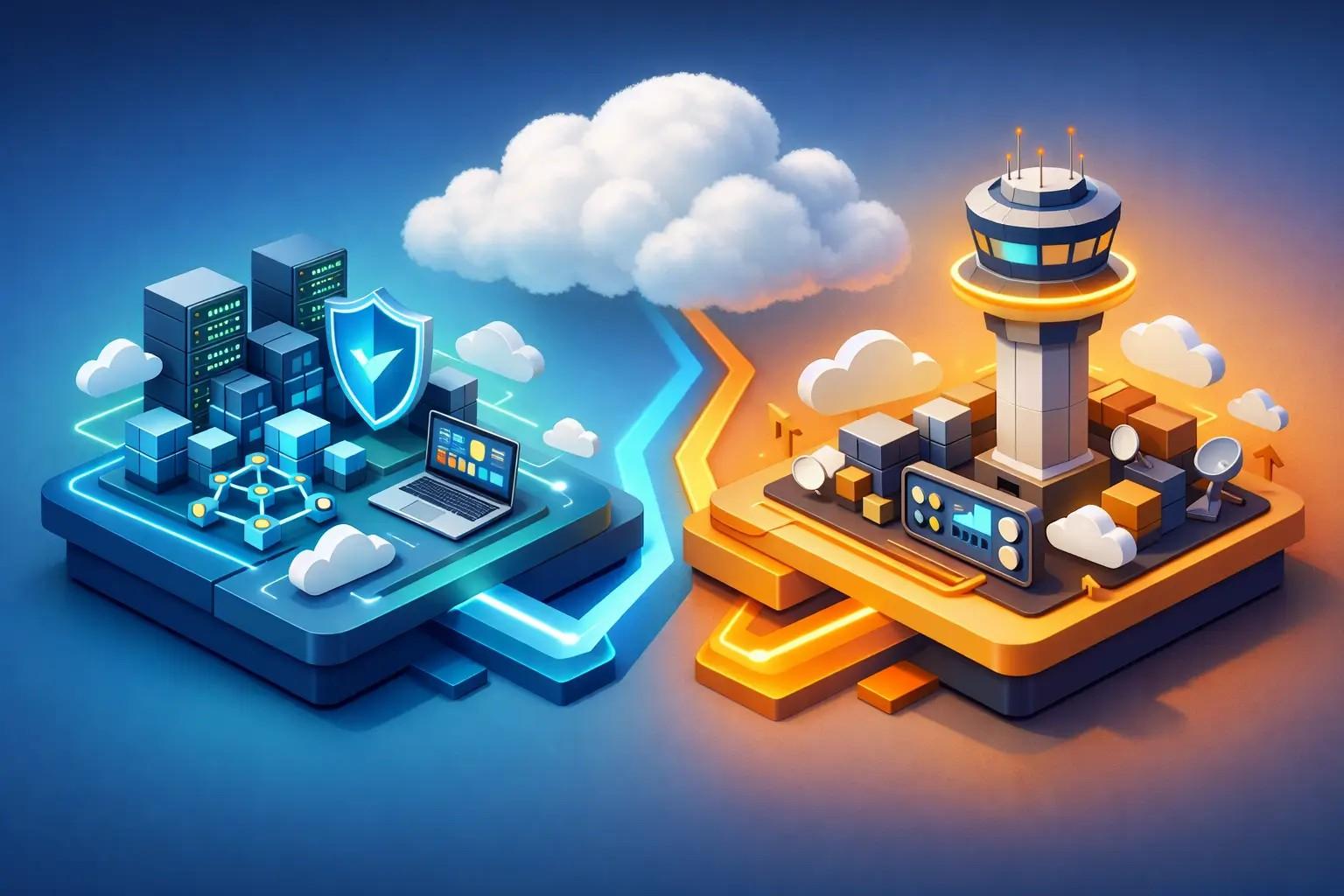
AWS Landing Zone vs Control Tower: Which Fits?
A poorly governed AWS environment rarely fails all at once. It becomes expensive, difficult to audit, and slow to change one account, one exception, and one rushed deployment at a time. The AWS Landing Zone vs Control Tower decision determines how your organization establishes multi-account governance before that operational drag becomes a business risk.
For CTOs and IT leaders, this is not simply a choice between two AWS offerings. It is a decision about how much architectural control your team needs, how quickly you must establish security guardrails, and who will operate the environment after launch. Both approaches can support secure, scalable cloud operations. The right fit depends on your compliance requirements, engineering maturity, existing AWS footprint, and appetite for customization.
AWS Landing Zone vs Control Tower: The Core Difference
An AWS landing zone is a secure, governed foundation for running workloads across multiple AWS accounts. It typically includes an account structure, identity and access management, centralized logging, network design, security controls, billing visibility, and automated account provisioning. A landing zone is an architecture and an operating model, not one fixed product.
AWS Control Tower is an AWS-managed service that builds and governs a landing zone using AWS best practices. It provides a prescriptive baseline, an account factory for provisioning new accounts, centralized governance controls, and a dashboard for visibility into the environment. In practical terms, Control Tower is one way to implement a landing zone.
That distinction matters. A custom landing zone gives your organization greater freedom to select services, define provisioning workflows, and tailor policies to internal standards. Control Tower reduces the work required to establish a governed baseline, but it also introduces opinionated patterns and service-specific constraints.
What a Custom AWS Landing Zone Provides
A custom landing zone is designed around the organization rather than a predefined framework. It is commonly built using Infrastructure as Code tools such as Terraform, AWS CloudFormation, or AWS CDK, with CI/CD pipelines managing changes across accounts and regions.
The architecture usually separates workloads by environment, business unit, sensitivity, or application domain. A mature design may include dedicated accounts for security tooling, log archival, shared networking, identity services, backups, and individual production or nonproduction workloads. Central teams can apply service control policies, permission boundaries, network segmentation, encryption standards, and logging requirements while allowing product teams to move at an appropriate pace.
This route makes sense when the environment has nonstandard networking, complex hybrid connectivity, strict regulatory needs, or established automation standards that do not map cleanly to Control Tower. For example, a company with existing Direct Connect, multiple AWS Organizations, specialized identity federation, or a large Terraform module library may benefit from preserving a purpose-built architecture.
The trade-off is operational responsibility. Your team must design the baseline, maintain the automation, test upgrades, manage policy changes, and document the operating model. Custom does not automatically mean better. It means your organization owns more of the engineering and governance lifecycle.
What AWS Control Tower Provides
AWS Control Tower accelerates the creation of a multi-account environment by applying a standardized AWS governance model. It establishes core accounts, integrates with AWS Organizations, provides account provisioning through Account Factory, and applies preventive and detective controls known as guardrails.
Preventive controls use policies to stop disallowed actions before they occur. Detective controls identify configurations that may violate standards, helping teams find issues such as missing encryption or public exposure. Control Tower also centralizes the visibility needed to understand whether enrolled accounts are operating within defined governance expectations.
For a growing company that needs a secure starting point without building every management function from scratch, this can be a substantial advantage. It shortens the path from a single-account AWS setup to an environment with clearer ownership, stronger controls, and repeatable account deployment.
However, Control Tower is not a substitute for cloud architecture. It does not decide how applications should be segmented, how every network route should be designed, which workloads need special compliance treatment, or how cost allocation should work across business units. Those decisions still require experienced design and ongoing governance.
When Control Tower Is the Better Fit
Control Tower is often the practical choice for organizations that need a well-governed AWS foundation quickly and are comfortable aligning with AWS reference patterns. It is especially effective when the team is moving from a small number of loosely managed accounts to a structured AWS Organization.
It is a strong fit when security and audit readiness are urgent, internal cloud engineering capacity is limited, and account provisioning needs to be consistent. A growth-stage SaaS company, for instance, may need separate production, development, security, and logging accounts without delaying product delivery for a lengthy platform engineering project.
Control Tower also works well when leadership wants clear governance visibility. Its dashboard and guardrail model give IT and security teams an approachable way to establish accountability across accounts. The operational model is easier to explain to stakeholders than a fully custom collection of scripts, pipelines, policies, and internal tooling.
The limitation appears when teams need to depart substantially from its operating assumptions. Workarounds can accumulate, and workarounds create support debt. Before adopting Control Tower, evaluate whether its account enrollment process, regional coverage, control model, identity design, and networking approach align with the environment you intend to operate for the next several years.
When a Custom Landing Zone Is the Better Fit
A custom landing zone is usually the better choice for organizations with advanced technical requirements or a mature platform engineering function. If your business has detailed compliance obligations, hybrid infrastructure, specialized network segmentation, or strict deployment standards, custom architecture can avoid forcing critical requirements into a prescriptive framework.
This approach also gives teams more control over how governance is delivered. Instead of relying primarily on a service dashboard and built-in controls, you can codify account baselines through Terraform, integrate workflows with ticketing and approval systems, enforce policy checks in CI/CD, and connect observability tools such as New Relic to a broader operational model.
The key question is whether your organization can sustain it. A landing zone should not become a one-time migration artifact that no one confidently changes. It needs version control, testing, documentation, ownership, monitoring, incident procedures, and a process for adapting to AWS service changes. If those capabilities are not available internally, a managed cloud partner can provide the operational discipline without requiring a large in-house team.
Evaluate the Decision Across Four Operating Areas
The best choice becomes clearer when evaluated through security, speed, flexibility, and long-term operations.
Security is not automatically stronger in a custom build or in Control Tower. Control Tower provides a reliable baseline quickly, while a custom landing zone can enforce more specific controls. The question is whether your risk profile requires controls beyond the standard baseline and whether you can continuously validate them.
Speed favors Control Tower for many organizations. Its value is reduced setup time and a standardized account governance model. Custom landing zones take longer because the design must account for requirements, exceptions, automation, testing, and support processes. That upfront investment can be justified when the resulting platform removes future constraints.
Flexibility favors custom architecture. Control Tower supports extensions and integrations, but it remains a managed, opinionated framework. Organizations with unusual account structures, network patterns, or identity requirements should validate those needs early rather than assume they can be added cleanly later.
Long-term operations depend more on ownership than product selection. A Control Tower environment still needs account lifecycle management, incident response, cost optimization, vulnerability remediation, logging review, and policy governance. A custom landing zone needs all of that plus ownership of its automation components. Choose the model your team can realistically run at 2 a.m., during an audit, and while scaling rapidly.
Migration Considerations for Existing AWS Environments
Companies rarely begin with a blank AWS account. Many already have workloads, IAM users, legacy networking, inconsistent tags, and accounts created by separate teams. In these cases, the implementation plan matters as much as the target architecture.
Start with discovery. Inventory accounts, workloads, data classifications, identity sources, network dependencies, logging coverage, backup policies, and current access paths. Then define the target organization structure and establish which workloads can move or enroll first. Nonproduction accounts are usually safer early candidates than business-critical production systems.
Avoid treating migration as a simple account move. Policies that improve governance can also disrupt applications if they block expected API calls, restrict regions, or alter identity assumptions. Test guardrails, service control policies, and network changes in controlled environments. A Well-Architected Review can help identify the resilience, security, operational excellence, and cost issues that should shape the landing zone design.
AWS Landing Zone vs Control Tower Q&A
Is AWS Control Tower the same as an AWS landing zone?
No. A landing zone is the broader multi-account architecture and governance foundation. AWS Control Tower is a managed AWS service that helps deploy and govern a landing zone using AWS-recommended patterns.
Can we use Control Tower and still customize our environment?
Yes, within reason. Organizations can add custom controls, networking components, integrations, and account-level automation. The practical issue is not whether customization is possible, but whether it remains supportable and aligned with Control Tower's lifecycle model.
Does Control Tower replace Terraform?
No. Control Tower governs core multi-account foundations, while Terraform can provision and manage infrastructure across those accounts. Many organizations use both: Control Tower for baseline account governance and Terraform for workload and platform automation.
Which option is better for compliance?
Neither is universally better. Control Tower can accelerate a consistent governance baseline, which is valuable for many compliance programs. A custom landing zone may be necessary when your controls, evidence collection, account isolation, or network requirements are highly specific. Compliance depends on continuous operation and proof, not the name of the implementation.
Can an existing AWS Organization adopt Control Tower?
Often, yes, but the process requires assessment. Existing accounts may need remediation before enrollment, and current policies, identity configurations, or network designs can affect the adoption path.
A sound AWS foundation should make every new account easier to secure, monitor, and operate than the last. Whether that foundation is built with Control Tower, custom automation, or a carefully designed combination of both, the right outcome is predictable governance that supports growth instead of slowing it down.
Author: Yavor Y. Zlatev CEO of AdvisionIT
Date: 18.08.2026