



AWS Landing Zone vs Control Tower
If your team is planning a multi-account AWS environment, the choice between aws landing zone vs control tower will shape more than account structure. It affects how fast you can deploy, how tightly you can enforce guardrails, how much customization you can support, and how much operational overhead your internal team is willing to own.
For most growing organizations, this is not a branding question. It is an operating model decision. The right answer depends on whether you need a prescriptive AWS-managed framework that gets you moving quickly, or a more customized foundation that aligns to specific security, compliance, and platform engineering requirements.
AWS landing zone vs control tower: the core difference
At a high level, both approaches are designed to help you build and govern a multi-account AWS environment. They support centralized identity, baseline security controls, logging, and account provisioning. That overlap is why teams often compare them directly.
The difference is in how those outcomes are delivered.
AWS Landing Zone originally referred to an AWS solution pattern for setting up a governed multi-account environment. In practice, many teams now use the term more broadly to mean a custom landing zone architecture built with AWS Organizations, IAM Identity Center, CloudTrail, Config, centralized logging, network segmentation, and infrastructure as code.
AWS Control Tower is AWS’s managed service for standing up and governing a multi-account environment based on AWS best practices. It provides an opinionated framework with built-in guardrails, account factory capabilities, and ongoing governance features that reduce the amount of foundational engineering your team needs to build from scratch.
So when teams ask about aws landing zone vs control tower, the real question is usually this: do you want AWS to provide the operating framework, or do you want to design and manage more of that framework yourself?
Why this choice matters to business operations
This decision has a direct impact on speed, risk, and long-term maintainability. A startup with a lean platform team may care most about getting a secure AWS foundation in place quickly. A regulated business with strict network patterns, custom compliance controls, or existing automation standards may need more flexibility than a managed framework naturally allows.
There is also a skills question. Building a landing zone yourself can produce a highly tailored environment, but it also creates an engineering and support responsibility. Someone needs to maintain account vending workflows, update policy controls, validate service changes, and keep governance aligned with the business.
Control Tower reduces much of that lift, but it also asks you to work within AWS’s structure. That trade-off is often worth it, especially for organizations that want strong defaults and lower operational complexity.
Where AWS Control Tower fits best
Control Tower is usually the better fit when speed, consistency, and managed governance matter more than deep customization.
It gives organizations a structured starting point. You can create organizational units, apply preventive and detective guardrails, provision accounts through Account Factory, and establish centralized logging and audit patterns without engineering every component independently. For many SMBs and growth-stage companies, that is a practical way to reduce cloud setup risk.
It also helps when your internal team is small. If your cloud engineers are focused on application delivery, security response, or migration work, handing foundational governance patterns to a managed AWS service can be the right operational choice.
That said, Control Tower is opinionated. If your environment depends on highly specialized account baselines, unusual network topologies, or tightly integrated third-party governance workflows, you may run into limits. It is not that Control Tower is weak. It is that it is designed to standardize the common cases.
Where a custom AWS landing zone fits best
A custom landing zone makes more sense when your business has requirements that go beyond the built-in model.
That often includes regulated workloads, advanced network segmentation, custom IAM patterns, or a need to integrate deeply with existing Terraform, Ansible, CI/CD, observability, and security tooling. In these environments, platform teams may want full control over how accounts are provisioned, how policies are enforced, and how shared services are organized.
A custom landing zone can also be the better option if you are modernizing from an existing AWS organization that already has established patterns. Reworking a mature environment to fit Control Tower may not be worth the disruption, especially if your current model already supports strong governance and operational visibility.
The trade-off is effort. Custom means design decisions, implementation complexity, and lifecycle ownership. That can pay off if the environment is central to your business model, but it should be a conscious investment rather than an assumption.
Setup speed and operational overhead
This is often where the comparison becomes practical.
Control Tower usually wins on deployment speed. It gives you a prebuilt path for setting up a secure multi-account environment, and that shortens time to value. For organizations moving from ad hoc AWS usage to a formal cloud operating model, that speed matters.
A custom landing zone takes longer because you are designing the architecture, codifying standards, testing automation, and validating governance outcomes. The setup effort is higher, and so is the responsibility for future changes.
But speed at launch is only part of the picture. Operational overhead after launch matters just as much. Control Tower can reduce ongoing maintenance for foundational controls. A custom landing zone can be easier to evolve in very specific ways if your team has the engineering maturity to support it. This is one of those areas where the right answer depends on your internal capabilities, not just on product features.
Governance, security, and compliance
Both options can support strong governance, but they do so differently.
Control Tower gives you a structured governance model with built-in guardrails. That is valuable for organizations that need enforceable standards without building every control path manually. It creates consistency across accounts and reduces the chance that a fast-growing team will drift into fragmented practices.
A custom landing zone gives you more freedom to align controls with your exact compliance posture. If your business needs custom SCP strategies, specific logging flows, specialized encryption controls, or tailored shared services boundaries, that flexibility can be critical.
The key is to avoid assuming that more customization automatically means better security. In many environments, simpler and more standardized governance produces better real-world results because it is easier to maintain, audit, and enforce. Security is not just about what can be configured. It is about what can be operated reliably.
Cost is not just licensing or service spend
Teams often ask which option is cheaper. That is the wrong first question.
The better question is which model creates lower total operational cost for your organization. Control Tower may reduce engineering hours needed to stand up and maintain a governed environment. A custom landing zone may avoid future rework if you know your business has complex needs that require bespoke architecture from day one.
There is also the cost of mistakes. Weak account structure, inconsistent logging, and poorly enforced guardrails can become expensive very quickly, whether through security incidents, compliance gaps, or unnecessary cloud spend. The least expensive path is usually the one that your team can implement and operate well over time.
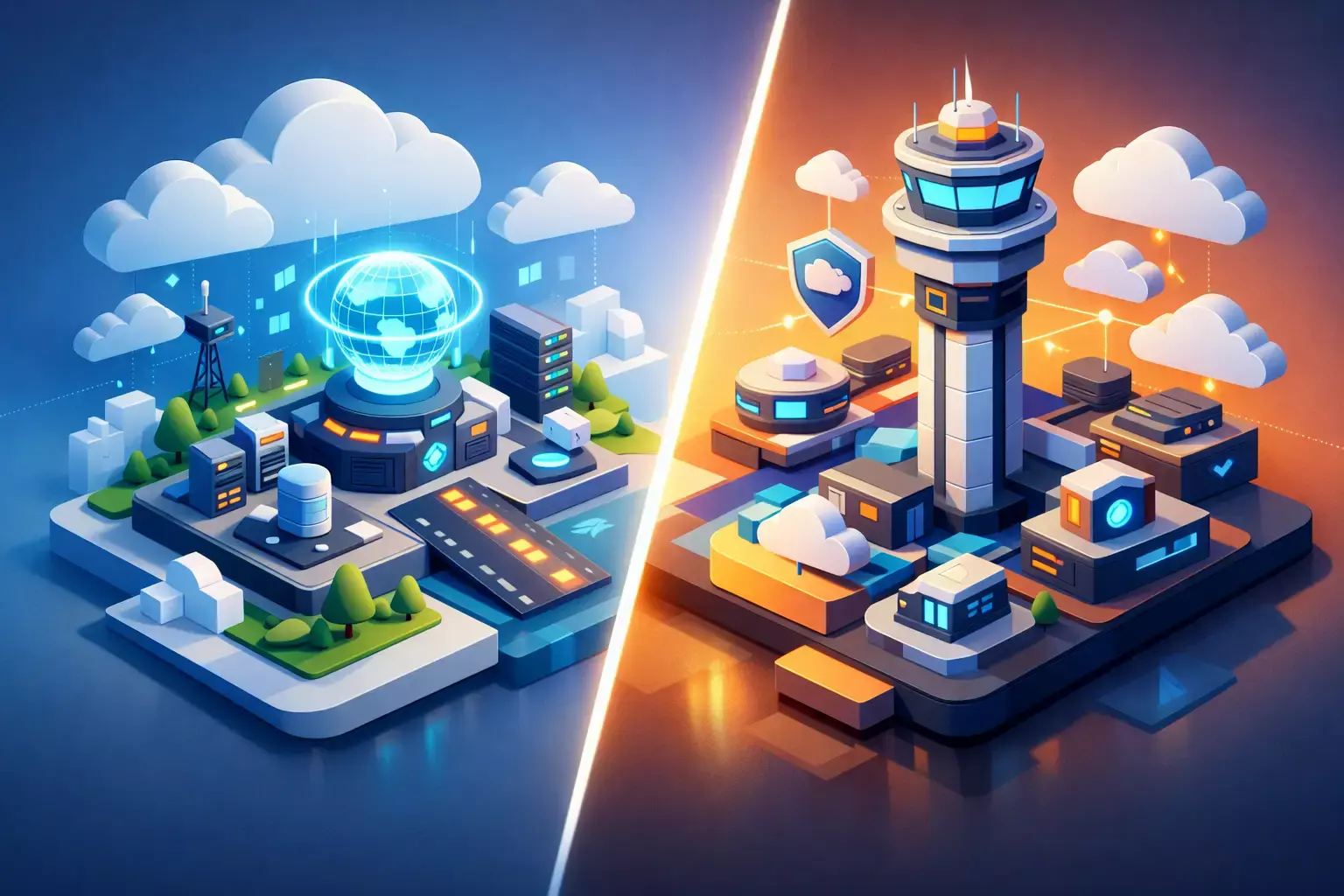
How to decide between aws landing zone vs control tower
A practical way to decide is to look at four factors: complexity, compliance, team capacity, and growth trajectory.
If you need a secure multi-account baseline quickly, want AWS-aligned best practices, and do not have a large internal platform team, Control Tower is often the right starting point. It gives you governance without turning foundational cloud architecture into a custom software project.
If your organization has strict technical requirements, established infrastructure-as-code standards, complex network design, or a mature cloud engineering function, a custom landing zone may be the better long-term fit. That is especially true when governance needs to be deeply integrated with your broader operating model.
Some businesses also take a hybrid view. They use Control Tower as the initial foundation, then extend it with custom automation, policy enforcement, and operational tooling. That can be a sensible middle ground if you want faster implementation without giving up all flexibility.
For many organizations, the best outcome comes from evaluating the target architecture before the first account is provisioned. That means mapping business risk, compliance needs, identity strategy, networking, observability, and deployment workflows up front rather than treating account structure as a minor technical detail. This is where a hands-on partner such as Advanced Vision IT can add value by connecting AWS architecture decisions to actual operating requirements, not just service diagrams.
The right foundation is the one your business can govern confidently, scale cleanly, and support without constant friction. Start there, and the platform will serve the business instead of forcing the business to work around the platform.
FAQ
1. What is the main difference between AWS Landing Zone and AWS Control Tower?
The primary difference is the level of customization and management responsibility. AWS Control Tower is a managed AWS service that provides a predefined framework for governance, security, and account provisioning. A custom AWS Landing Zone is a tailored architecture that gives organizations greater flexibility to design, implement, and manage their own multi-account AWS environment.
2. When should an organization choose AWS Control Tower?
AWS Control Tower is typically the best choice for organizations that want to quickly deploy a secure, well-governed AWS environment with minimal operational overhead. It is particularly well-suited for startups, SMBs, and growing companies that value standardized AWS best practices and have limited platform engineering resources.
3. When is a custom AWS Landing Zone a better option?
A custom AWS Landing Zone is often the better fit for organizations with complex compliance requirements, advanced network architectures, custom IAM strategies, or extensive integrations with existing infrastructure and DevOps tools. It provides greater flexibility but requires more engineering effort to build and maintain.
4. Which option offers better security and governance?
Both AWS Control Tower and a custom AWS Landing Zone can support strong security and governance. Control Tower delivers built-in guardrails and standardized governance controls, while a custom Landing Zone allows organizations to implement highly specific security and compliance requirements. The best choice depends on how much customization your business needs and your ability to manage it effectively.
5. How can businesses decide between AWS Landing Zone and AWS Control Tower?
Businesses should evaluate four key factors: complexity, compliance requirements, team capacity, and future growth plans. Organizations seeking rapid deployment and simplified governance often benefit from Control Tower, while those with mature cloud engineering teams and specialized requirements may gain more value from a custom Landing Zone. Some companies also adopt a hybrid approach by extending Control Tower with custom automation and governance features.

Written by Yavor Y. Zlatev
CEO & Founder at Advanced Vision IT Ltd | Published on
Yavor advises executive leadership teams on cybersecurity strategy, NIS2 compliance, and cloud operating models to build resilient IT environments.