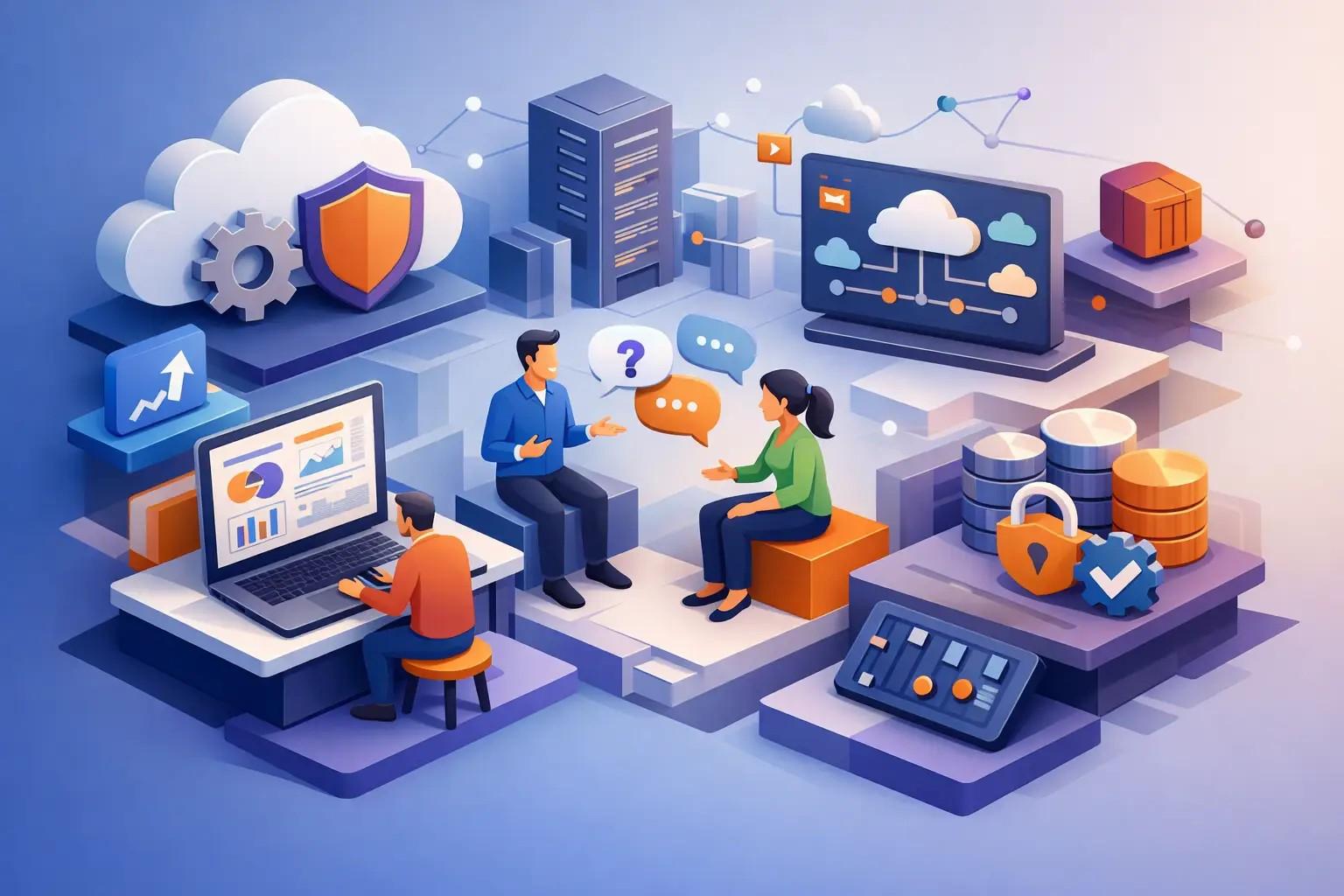
Management & Governance: AWS Operations
A cloud environment can be technically functional and still be operationally unsafe. Teams may deploy workloads quickly, but without clear visibility, auditable activity records, standardized access, and enforceable guardrails, small configuration mistakes can become costly incidents. Management & Governance — CloudWatch, CloudTrail, Systems Manager, Control Tower is not a collection of isolated AWS services. It is an operating model for keeping cloud infrastructure observable, controlled, and ready to scale.
For growing businesses, this matters because AWS complexity rises faster than most internal teams expect. More accounts, applications, environments, users, and compliance requirements create more opportunities for drift. The objective is not to slow engineering down. It is to establish repeatable controls that protect uptime, security, cost management, and accountability without creating unnecessary manual work.
Management and Governance With CloudWatch, CloudTrail, Systems Manager, and Control Tower
These four AWS services address different parts of cloud operations. CloudWatch tells teams what systems are doing. CloudTrail records who did what in AWS. Systems Manager provides a controlled way to operate infrastructure. Control Tower establishes a governed multi-account foundation.
Their value increases when they are designed together. A CloudWatch alarm can identify an unhealthy workload, while Systems Manager gives authorized operators a secure path to investigate or remediate it. CloudTrail provides the audit history needed to determine whether a recent configuration change contributed to the incident. Control Tower helps ensure the account where the event occurred follows the same baseline standards as the rest of the organization.
This approach replaces scattered administrative habits with an environment that is easier to operate, defend, and explain to customers, auditors, and leadership.
CloudWatch: Turn Infrastructure Signals Into Action
Amazon CloudWatch is the operational visibility layer for AWS workloads. It collects and presents metrics, logs, events, and alarms across services such as Amazon EC2, RDS, Lambda, containers, load balancers, and custom applications.
The most common mistake is treating monitoring as a dashboard project. Dashboards are useful, but they do not protect a business on their own. Monitoring should begin with the failure conditions that matter: an application error rate that affects customers, database storage nearing capacity, an unavailable endpoint, an unusual latency increase, or a failed backup process.
Effective CloudWatch implementation defines meaningful thresholds and routes alerts to the teams that can act on them. Not every metric needs an urgent notification. Alerting on every CPU spike or transient error creates noise, and noisy alerts eventually get ignored. A better design separates warning-level signals from actionable incidents and uses alarm logic that accounts for duration, workload patterns, and business impact.
CloudWatch Logs also supports faster troubleshooting when application, operating system, and infrastructure logs are collected consistently. For regulated organizations, log retention periods should align with legal, contractual, and security requirements. Retaining every log indefinitely can inflate costs, while retaining too little can undermine investigations and compliance evidence.
CloudTrail: Establish an Audit Trail You Can Trust
CloudTrail records AWS API activity, including console actions, command-line activity, and actions taken by AWS services. It answers critical operational questions: Who changed this security group? When was an IAM policy modified? Which account deleted a resource? Was this action performed by a person, an automation role, or an external integration?
CloudTrail is fundamental to incident response and compliance, but only if logging is centralized and protected. A trail that exists only in individual accounts leaves gaps and makes investigations difficult. In a multi-account environment, organizations should typically centralize CloudTrail logs in a dedicated log archive account with restricted access and appropriate retention settings.
Management events should be captured broadly because they record control-plane actions that change the AWS environment. Data events can add important detail for high-value resources, such as S3 objects or Lambda functions, but they can generate substantial volume and cost. The right scope depends on the sensitivity of the data, regulatory obligations, and the organization’s ability to review the information meaningfully.
CloudTrail should also be monitored. Alerts for disabled trails, altered logging configurations, root account activity, or unexpected IAM changes give security and operations teams an early warning when governance controls may be weakening.
Systems Manager: Operate Servers Without Expanding Risk
AWS Systems Manager reduces the need for direct server access, unmanaged scripts, and broad administrative permissions. Its capabilities include inventory, patch management, parameter storage, automation documents, run command execution, and Session Manager for secure shell access without opening inbound SSH or RDP ports.
For small and mid-sized businesses, Session Manager is often a high-impact early improvement. It can remove the need to manage bastion hosts and long-lived access keys while recording session activity for accountability. Access is controlled through IAM, allowing teams to apply least-privilege permissions based on role and environment.
Systems Manager Patch Manager can improve consistency across managed instances, but patching still requires planning. Production systems may depend on specific application versions, maintenance windows, or vendor validation. A sound process tests patches in lower environments, defines approved baselines, schedules maintenance windows, and documents exceptions. Automation is valuable only when it is paired with a clear rollback and escalation plan.
Parameter Store is another practical capability for configuration management. It provides a centralized location for application settings and can work with AWS Key Management Service for encrypted values. It is not a substitute for a full secrets-management strategy in every case, but it is a significant improvement over credentials and configuration values embedded in code, deployment scripts, or local files.
Control Tower: Build a Governed Multi-Account Landing Zone
AWS Control Tower helps organizations establish and govern a multi-account AWS environment using a landing zone. Rather than placing production, development, security, logging, and shared services in a single account, organizations can create clearer separation of duties and blast-radius boundaries.
Control Tower uses guardrails to apply preventive or detective controls. Preventive guardrails help stop prohibited activity before it occurs. Detective guardrails identify noncompliant configurations that require review. The right guardrails depend on the business, but common priorities include restricting public exposure, enforcing logging, protecting identity controls, and limiting activity to approved AWS Regions.
Control Tower is not a replacement for cloud architecture, IAM design, or ongoing security operations. It provides a strong baseline, but each account still needs deliberate network architecture, role design, cost tagging, backup planning, and workload-specific monitoring. Organizations also need a defined account provisioning process so new accounts receive the appropriate identity, network, security, and billing configuration from day one.
For businesses with only one or two simple workloads, Control Tower may be more structure than they need immediately. For organizations expecting acquisitions, multiple teams, regulated workloads, or continued cloud growth, implementing a landing zone early usually prevents a much harder governance cleanup later.
A Practical Implementation Sequence
The right starting point depends on the current environment, but the work should usually follow operational risk rather than service order. First, identify critical workloads, owners, data classifications, compliance obligations, and recovery objectives. These decisions determine what should be monitored, logged, restricted, and automated.
Next, establish identity and account foundations. Centralize access through IAM Identity Center where appropriate, reduce root account use, require multifactor authentication, and define roles with least-privilege access. If a multi-account model is appropriate, implement Control Tower and separate shared security and logging functions from application workloads.
Then centralize CloudTrail and configure CloudWatch monitoring around known service objectives. Teams should document who receives each alert, expected response times, escalation paths, and the exact evidence required during an investigation. An alarm without an owner is only a future surprise.
Finally, use Systems Manager to standardize operational tasks. Start with secure remote access, instance inventory, and approved patching. Expand into runbooks and automation once the team has validated the underlying processes. Advanced Vision IT often sees the best results when these controls are delivered as part of a broader AWS Well-Architected Review, DevOps modernization effort, or managed operations model rather than as disconnected configuration work.
Questions and Answers
Do CloudWatch and CloudTrail do the same thing?
No. CloudWatch focuses on operational telemetry such as metrics, logs, alarms, and application performance signals. CloudTrail records API activity and configuration actions within AWS. CloudWatch helps identify that a system is failing; CloudTrail helps establish what changed and who or what made the change.
Is AWS Control Tower required for a multi-account environment?
No. Organizations can build multi-account environments directly with AWS Organizations and supporting services. Control Tower accelerates common landing-zone patterns and guardrails, which reduces implementation effort for many teams. Highly customized environments may need additional architecture work or may choose a more tailored approach.
Can Systems Manager replace a VPN or bastion host?
Session Manager can eliminate the need for bastion hosts for many administrative access scenarios because it provides authenticated, auditable access without opening inbound management ports. It does not replace a VPN for every use case, especially when users or systems need private network connectivity to multiple internal services.
How long should CloudTrail and CloudWatch logs be retained?
Retention should reflect compliance requirements, contractual commitments, incident-response needs, and cost. Many organizations keep immediately searchable logs for a shorter period and archive longer-term records in lower-cost storage. The key is to document the policy, enforce it consistently, and test that required records can be retrieved when needed.
What is the first governance improvement for an AWS environment?
Start by confirming that administrative activity is logged centrally, root accounts are protected, and critical services have actionable monitoring. Those controls create visibility and accountability quickly. From there, a structured assessment can prioritize account design, IAM cleanup, patching, automation, and compliance guardrails based on actual business risk.
Cloud governance works best when it is treated as an ongoing operational discipline, not a one-time setup task. Review controls as workloads change, test alerts and runbooks during calm periods, and keep ownership clear. That is how AWS remains a platform for growth rather than another source of unmanaged risk.