



DevOps vs Platform Engineering Explained
If your engineering team is shipping slower as systems get more complex, the devops vs platform engineering debate stops being academic. It becomes an operating model decision with real impact on release speed, uptime, developer productivity, and cloud spend.
For growing companies, the confusion is understandable. DevOps has been the default language for modern software delivery for years. Then platform engineering entered the conversation, often presented as the next step. In practice, these are not interchangeable ideas, and treating them that way usually creates blurred ownership, tool sprawl, and frustrated teams.
DevOps vs platform engineering: what is the difference?
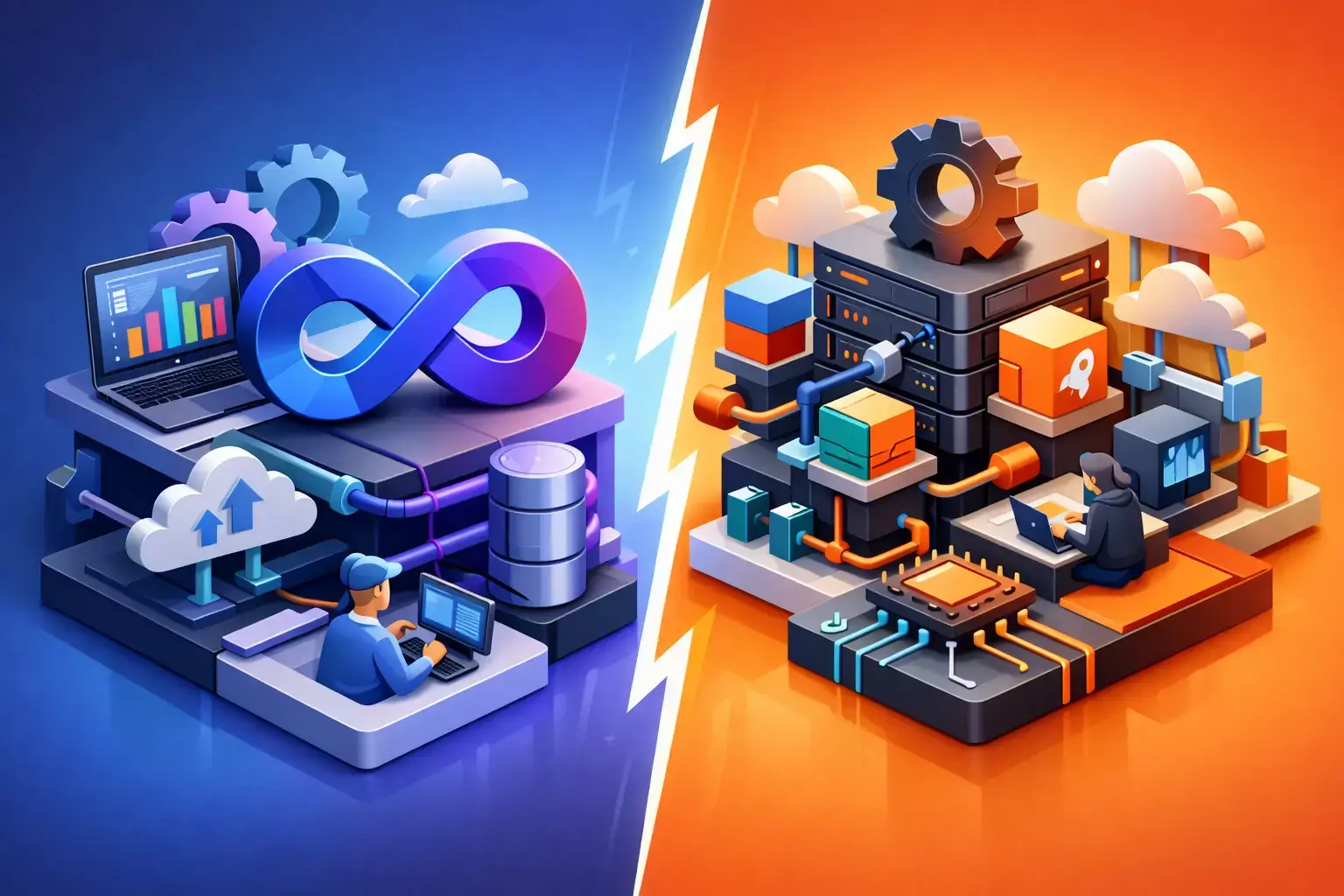
The simplest way to frame it is this: DevOps is a way of working, while platform engineering is a team and product approach that supports that way of working at scale.
DevOps focuses on breaking down the gap between software development and IT operations. The goal is faster, safer delivery through automation, collaboration, shared responsibility, and feedback loops. CI/CD pipelines, infrastructure as code, monitoring, incident response, and release management all sit comfortably inside a DevOps model.
Platform engineering takes many of those same technical practices and packages them into an internal platform. That platform is built as a product for developers. Instead of every application team assembling its own CI/CD process, cloud infrastructure patterns, access controls, observability stack, and deployment workflows, a platform team provides reusable paved roads.
That distinction matters. DevOps asks teams to work better together. Platform engineering asks a dedicated group to reduce cognitive load for everyone else by building repeatable infrastructure and delivery capabilities.
Why the distinction matters for growing companies
A small engineering team can often run effectively with a lightweight DevOps approach. A few people own application code, cloud infrastructure, deployment pipelines, and on-call responsibilities together. Communication is direct, and the system count is manageable.
As the business grows, that model starts to strain. Teams adopt different Terraform modules, duplicate pipeline logic, configure monitoring inconsistently, and handle secrets or IAM policies in ways that create risk. Delivery slows not because people are careless, but because every team is solving the same infrastructure problems separately.
This is where platform engineering becomes useful. It introduces standardization without forcing every team into a rigid central bottleneck. A strong platform team creates self-service capabilities for common needs such as environment provisioning, deployment templates, logging standards, cost visibility, and security guardrails.
For leaders, the benefit is not just cleaner architecture. It is better operational control. You get more consistent compliance, stronger security baselines, easier onboarding, and a more predictable path to scale.
What DevOps is still responsible for
One of the most common mistakes in the devops vs platform engineering conversation is assuming platform engineering replaces DevOps. It does not.
DevOps is still the operating philosophy behind fast, reliable software delivery. Teams still need shared ownership, automation discipline, observability, and close coordination between engineering, operations, and security. If those habits are weak, building a platform will not fix the culture problem.
In many organizations, DevOps responsibilities include pipeline automation, infrastructure as code, release orchestration, environment management, monitoring integration, and operational readiness. Those responsibilities may sit with product teams, a central DevOps function, an SRE group, or some mix of all three.
The point is not the org chart. The point is that DevOps remains the connective tissue between building software and running it well.
What platform engineering adds
Platform engineering becomes valuable when common infrastructure and delivery needs are mature enough to be turned into reusable services.
That can include approved Terraform modules for AWS resources, standardized CI/CD templates, opinionated Kubernetes patterns, centralized secrets management, observability defaults through tools such as New Relic, and self-service workflows for provisioning environments. It can also include policy enforcement, cost controls, backup patterns, and secure network architecture.
The platform is not just a tool bundle. It should be treated like an internal product with users, service levels, documentation, and a roadmap. If developers cannot understand it, trust it, or get value from it quickly, it becomes another layer of friction.
Well-executed platform engineering improves consistency and speed at the same time. Poorly executed platform engineering creates a ticket queue with a nicer name.
DevOps vs platform engineering in real-world team structures
There is no single correct model, and company size matters.
In an early-stage business, one cloud engineer or DevOps lead may handle AWS architecture, Terraform, CI/CD, incident response, and security automation. That is normal. A separate platform team would likely be too heavy.
In a mid-sized organization with multiple product squads, different compliance requirements, and customer uptime commitments, a shared platform capability starts to make sense. Instead of asking every squad to become experts in networking, IAM, observability, and deployment design, a platform team can provide approved building blocks and operational standards.
In larger or more regulated environments, platform engineering often works alongside DevOps, SRE, and security teams. DevOps practices shape delivery, platform engineering provides the internal systems, SRE focuses on reliability outcomes, and security teams define control requirements. There will always be overlap, so clarity in ownership is critical.
When DevOps is enough
If your environment is still relatively simple, investing in stronger DevOps practices may be the right next move.
That usually means improving CI/CD, formalizing infrastructure as code, standardizing monitoring and alerting, tightening change management, and reducing manual deployment work. For many small to mid-sized businesses, these steps deliver major gains without adding another dedicated team.
DevOps is often enough when you have a limited number of services, a small engineering organization, and a manageable compliance footprint. It is also enough when the main bottleneck is not tooling duplication but a lack of automation, weak operational discipline, or unclear ownership.
In those cases, the priority should be execution. Better pipelines, cleaner AWS architecture, improved incident visibility, and automated provisioning usually matter more than introducing platform language.
When is platform engineering the better investment
Platform engineering becomes a stronger fit when your teams are repeatedly rebuilding the same infrastructure patterns or when operational inconsistency is creating measurable risk.
A few signs stand out. Developer onboarding takes too long because every service is different. Security reviews are slow because controls are implemented inconsistently. Release pipelines vary by team and break in different ways. Infrastructure costs are hard to trace. Observability is fragmented. Teams are spending too much time maintaining delivery plumbing instead of shipping product.
That is usually the point where an internal platform starts paying off. Not because it is trendy, but because standardization, self-service, and guardrails reduce drag across the organization.
For cloud-heavy companies, especially in AWS environments, platform engineering can also improve account structure, identity controls, environment lifecycle management, backup standards, and Well-Architected alignment. Those are technical improvements, but they translate into better resilience and lower operational risk.
The trade-offs leaders should understand
Platform engineering is not free efficiency. It requires investment, product thinking, and ongoing maintenance.
A platform team can drift into over-engineering if it tries to solve every use case too early. It can also become disconnected from application teams if it designs standards without understanding delivery realities. That is why successful platform work usually starts with a narrow set of high-value services and expands based on adoption and feedback.
DevOps has trade-offs too. A pure you-build-it-you-run-it model can work well for mature teams, but it also assumes each team has enough operational depth to manage infrastructure safely. For many businesses, that assumption does not hold consistently across teams.
The right answer often is not DevOps or platform engineering. It is DevOps supported by platform engineering where scale and complexity justify it.
How to make the right call
Start with the business problem, not the label. Are you trying to reduce deployment failures, shorten release cycles, improve security controls, or make it easier for developers to work inside a growing cloud environment? The answer should shape the model.
If the issue is weak automation and inconsistent operations, strengthen DevOps foundations first. If the issue is duplicated infrastructure work and rising cognitive load across multiple teams, platform engineering may be the next practical step.
For many organizations, a phased approach works best. Standardize infrastructure as code. Improve CI/CD. Put observability and security baselines in place. Then identify the common capabilities that should become shared platform services. This avoids building an internal platform before the organization is ready to use it well.
That is also where an experienced partner can help. Advanced Vision IT often works with businesses that know they need modernization but do not need a large internal team for every specialty. In that situation, it is possible to improve DevOps maturity, establish cloud standards, and introduce platform capabilities in a way that supports growth without adding unnecessary complexity.
The better question is not which term sounds more current. It is which operating model gives your teams a clearer path to ship reliably, stay secure, and scale without constant rework. If that question is answered honestly, the right structure usually becomes obvious.

Written by Yavor Y. Zlatev
CEO & Founder at Advanced Vision IT Ltd | Published on
Yavor advises executive leadership teams on cybersecurity strategy, NIS2 compliance, and cloud operating models to build resilient IT environments.