



Cloud Infrastructure Management Guide
When cloud issues show up, they rarely stay technical for long. A missed alert becomes customer-facing downtime. An overprovisioned environment becomes a budget problem. A loose IAM policy becomes a security incident waiting to happen. That is why a cloud infrastructure management guide matters - not as theory, but as an operating model for keeping systems available, secure, and cost-effective as your business grows.
For small to mid-sized businesses, the challenge is usually not whether to use cloud. It is how to manage it well once the first migration is done, the application footprint grows, and responsibilities spread across engineering, IT, security, and finance. Cloud can increase flexibility, but it also increases the number of decisions that affect resilience and cost. If nobody owns those decisions end to end, the environment starts to drift.
What cloud infrastructure management actually includes
Cloud infrastructure management is the ongoing practice of designing, provisioning, monitoring, securing, optimizing, and supporting the cloud resources that run your business. That includes compute, storage, networking, identity, backups, logging, patching, automation, and the policies that govern how those pieces work together.
In practical terms, this goes well beyond spinning up instances or moving workloads into AWS. A well-managed environment has clear architecture standards, automated deployments, access controls tied to job function, visibility into performance and cost, and an escalation path when something breaks. It also has room to evolve. Infrastructure that works for a 20-person company often becomes a liability at 100 employees if it was built without consistency or guardrails.
The real objective is operational control. You want infrastructure that supports uptime, scales with demand, and does not depend on tribal knowledge from one engineer who knows where everything is.
A cloud infrastructure management guide for growing teams
Most organizations do not struggle because they lack cloud services. They struggle because cloud adoption outpaces cloud management. New environments are created faster than standards are defined. Teams add tools, but nobody consolidates visibility. Costs rise, but nobody can explain which workloads are worth the spend.
A workable management approach starts with four questions. Who owns architecture decisions? How are changes deployed? What is monitored continuously? What happens when risk, cost, or performance moves outside acceptable limits?
If those answers are vague, management is probably reactive. That is where avoidable outages, compliance gaps, and surprise bills tend to come from.
Start with architecture and account structure
A healthy cloud environment begins with a clean foundation. In AWS, that often means using separate accounts for production, staging, development, and shared services, along with consistent tagging, network segmentation, and centralized logging. The exact model depends on your size and regulatory requirements, but the principle is straightforward: isolation improves control.
This is also where many teams make an expensive mistake. They optimize for speed during early deployment, then inherit complexity later. A flat account structure or inconsistent VPC design can work for a short period, but it creates trouble when you need to enforce least privilege, trace costs by business unit, or support disaster recovery.
Good architecture should make operations easier, not harder. If every environment is configured differently, every patch cycle and incident response effort takes longer than it should.
Use infrastructure as code to reduce drift
Manual changes are one of the fastest ways to lose consistency in cloud operations. Infrastructure as code, using tools such as Terraform and Ansible, helps you standardize provisioning and make changes auditable. It does not eliminate mistakes, but it makes them easier to catch before they hit production.
This matters for more than efficiency. It supports repeatability across environments, speeds up recovery, and creates a reliable baseline for compliance reviews. When infrastructure lives in code, you can test, review, and version changes the same way you handle application releases.
That said, infrastructure as code is not automatically mature just because it exists. If templates are outdated, loosely governed, or copied across teams without review, you can scale bad patterns quickly. Governance still matters.
Security and access control cannot be a side project
Cloud management and cloud security are tightly connected. Identity and access management, network controls, encryption, key handling, vulnerability management, and audit logging all sit inside the infrastructure layer. If those controls are bolted on after deployment, gaps are almost guaranteed.
The first priority is access discipline. Roles should be based on actual responsibilities, not convenience. Privileged access should be limited, reviewed, and monitored. Service accounts should have narrow permissions. Multi-factor authentication should be standard for administrative users.
The second priority is visibility. You need to know what assets exist, how they are exposed, and whether they are aligned with policy. This is where continuous monitoring and Security as a Service can help organizations that do not have a fully staffed internal security team. Security posture should not depend on quarterly manual reviews in an environment that changes weekly.
Compliance adds another layer. Whether you are dealing with HIPAA, SOC 2, PCI, or internal governance requirements, the infrastructure has to support evidence collection and policy enforcement from the start. Retrofitting compliance is slower and more expensive than building with those controls in mind.
Observability is how you protect uptime
A cloud environment is only manageable if you can see what it is doing. Basic monitoring is not enough. CPU and memory graphs have value, but they do not explain customer impact on their own. Observability means connecting infrastructure health, application behavior, logs, traces, and alerts so teams can identify issues quickly and understand root cause.
This is especially important in distributed systems, where one degraded dependency can show up as latency somewhere else. Tools such as New Relic can provide the telemetry layer needed to track services across infrastructure and applications, but the tooling itself is only part of the answer. Alert thresholds, escalation workflows, and ownership boundaries need to be designed with care.
Too many alerts create fatigue. Too few create blind spots. The right balance depends on workload criticality, service-level expectations, and your internal response capacity. A customer-facing SaaS platform needs a different alerting model than a back-office reporting system.
Incident response should be operational, not improvised
When something fails, the goal is not just to restore service. It is to restore service quickly, document what happened, and reduce the chance of recurrence. That requires runbooks, defined response roles, backup validation, and tested recovery procedures.
Many companies believe they have disaster recovery because backups exist. That is not enough. If restore processes are untested, recovery time objectives are theoretical. Real resilience comes from practice, not policy language.
Cost control is part of infrastructure management
Cloud cost optimization is not a one-time cleanup project. It is an ongoing management discipline tied to architecture, utilization, and governance. Idle resources, oversized instances, unreviewed storage growth, duplicate tools, and poor purchasing strategy can quietly erode the business case for cloud.
The fix is not always aggressive rightsizing. Sometimes paying more for managed services reduces operational overhead and risk. Sometimes reserved capacity makes sense. Sometimes it is better to redesign a workload than squeeze another 10 percent out of compute spend. Cost decisions should be made in context, not in isolation.
A mature practice maps spend to business value. Which applications generate revenue? Which systems are mandatory for operations? Which environments are temporary but left running? Tagging standards, budget alerts, and monthly review cadences are simple controls that often reveal issues early.
Automation supports scale, but only if the process is sound
Automation is one of the clearest advantages in cloud operations. CI/CD pipelines, patch workflows, configuration management, autoscaling, policy enforcement, and scheduled remediation all reduce manual effort and improve consistency. For growing teams, automation is often the difference between stable operations and constant firefighting.
But automation can also spread failure faster if the underlying process is weak. A bad deployment pipeline does damage at machine speed. The answer is not to avoid automation. It is to pair automation with testing, approvals where needed, rollback plans, and clear ownership.
This is where DevOps modernization tends to deliver measurable value. Better pipelines shorten release cycles, reduce change failure rates, and improve coordination between infrastructure and application teams. The business outcome is not just faster deployment. It is more predictable delivery.
When to manage internally and when to bring in a partner
Some organizations have the scale and staffing to manage cloud infrastructure fully in-house. Others have strong engineers but limited coverage in areas like security operations, observability, compliance, or 24x7 support. There is no universal model that fits every business.
What matters is whether your current setup can support growth without increasing risk. If core infrastructure knowledge lives with one or two individuals, if incidents take too long to resolve, or if the environment has grown faster than your standards, outside support can be the more controlled option. The right partner should add engineering depth and operational discipline, not just tickets and tooling.
For many mid-market companies, the best model is shared ownership. Internal teams retain application and business context, while a specialized provider handles architecture support, automation, monitoring, security operations, and optimization. That approach often gives companies better coverage without the cost of hiring across every infrastructure specialty. Advanced Vision IT typically works in that lane, helping clients close capability gaps while keeping the operating model aligned to business priorities.
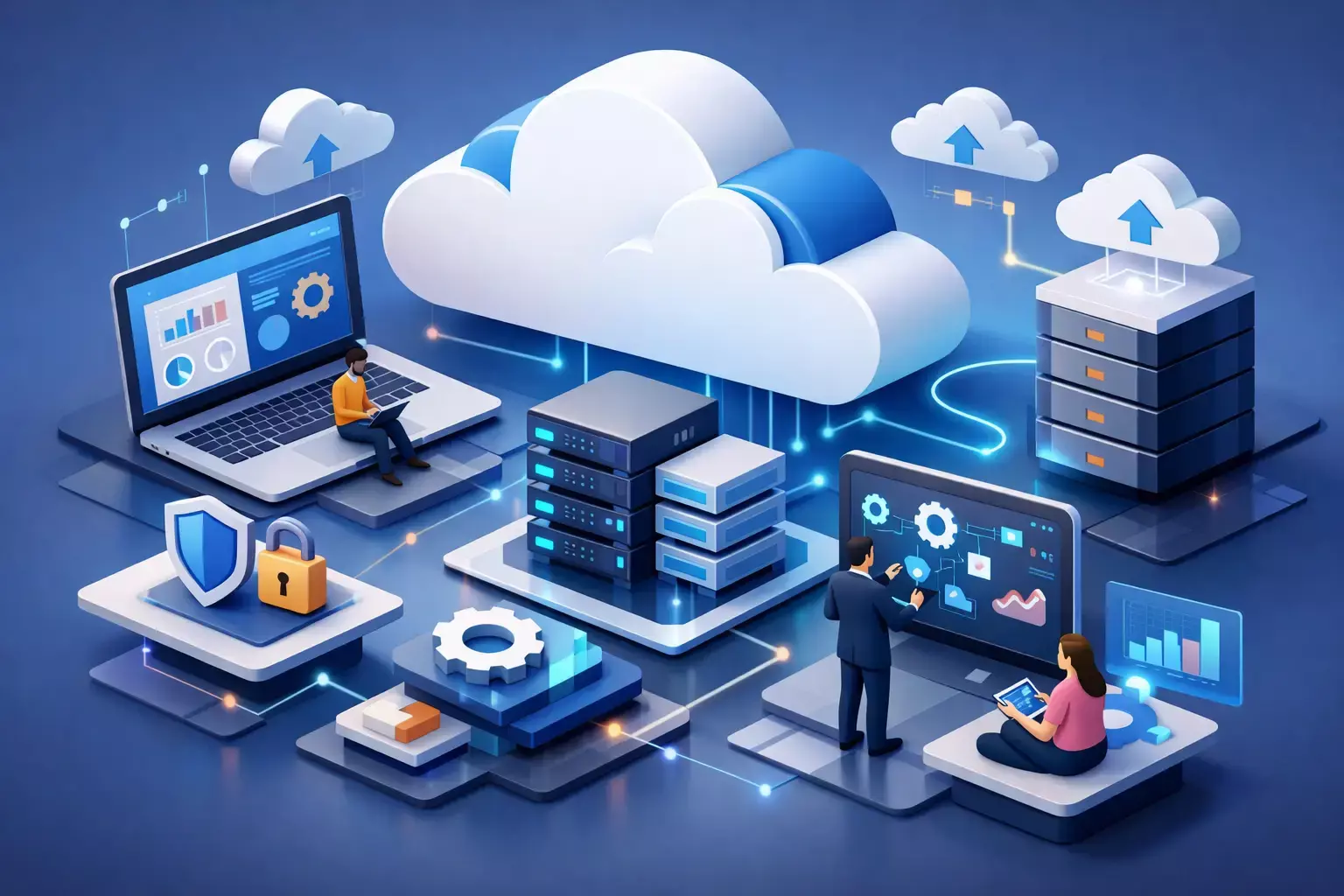
How to use this cloud infrastructure management guide
If you are evaluating your current environment, start by looking for weak signals instead of waiting for a major event. Repeated access exceptions, inconsistent deployments, noisy alerts, unclear recovery procedures, and unexplained spend increases are all signs that management practices need attention.
Then prioritize based on risk and business impact. A startup preparing for rapid growth may need account restructuring and deployment automation first. A healthcare organization may need tighter access control, logging, and compliance evidence. A company running customer-facing applications may get the fastest return from observability and incident response maturity.
Cloud infrastructure does not need to be perfect to be well managed. It needs to be intentional, visible, and maintainable. When the environment is built around those principles, you spend less time reacting to preventable issues and more time using technology to move the business forward.
FAQ: Cloud Infrastructure Management
1. What is cloud infrastructure management and why does it matter?
Cloud infrastructure management is the ongoing practice of designing, provisioning, monitoring, securing, and optimizing cloud resources such as compute, storage, networking, and access control. It matters because issues in the cloud quickly evolve beyond technical problems—affecting uptime, security, and cost—making structured management essential for maintaining reliable and scalable systems.
2. What challenges do small to mid-sized businesses face in managing cloud environments?
Most SMBs struggle not with adopting the cloud, but with managing it as complexity grows. As teams expand and responsibilities spread across engineering, IT, security, and finance, lack of clear ownership and standards can lead to inefficiencies, rising costs, and operational drift.
3. What are the core components of an effective cloud infrastructure management approach?
A strong approach includes clear architecture standards, automated deployments (often via infrastructure as code), role-based access controls, continuous monitoring and observability, incident response processes, and cost optimization practices. Together, these provide operational control and help maintain consistency across environments.
4. How does infrastructure as code (IaC) improve cloud management?
Infrastructure as code reduces manual changes and configuration drift by allowing teams to define and manage infrastructure through version-controlled code. This improves consistency, repeatability, and auditability, while also speeding up deployments and recovery processes.
5. When should a company consider external support for cloud infrastructure management?
Organizations should consider outside support when internal resources are limited, key knowledge is concentrated in a few individuals, or when areas like security, monitoring, or compliance are underdeveloped. A shared ownership model—combining internal expertise with external specialists—often provides stronger coverage and scalability.

Written by Yavor Y. Zlatev
CEO & Founder at Advanced Vision IT Ltd | Published on
Yavor advises executive leadership teams on cybersecurity strategy, NIS2 compliance, and cloud operating models to build resilient IT environments.