



Cloud Monitoring vs Observability Platform
If your team is getting alerts but still struggling to explain why a service slowed down, failed, or spiked in cost, the cloud monitoring vs observability platform question is not academic. It usually shows up when incident response is taking too long, teams are working from different dashboards, and business leaders are hearing, "We know something is wrong, but we are still tracing the cause."
That distinction matters because monitoring and observability solve related problems, but they do not solve the same problem in the same way. For a growing business running workloads in AWS or across hybrid environments, choosing the wrong approach can leave gaps in uptime, security visibility, and operational efficiency.
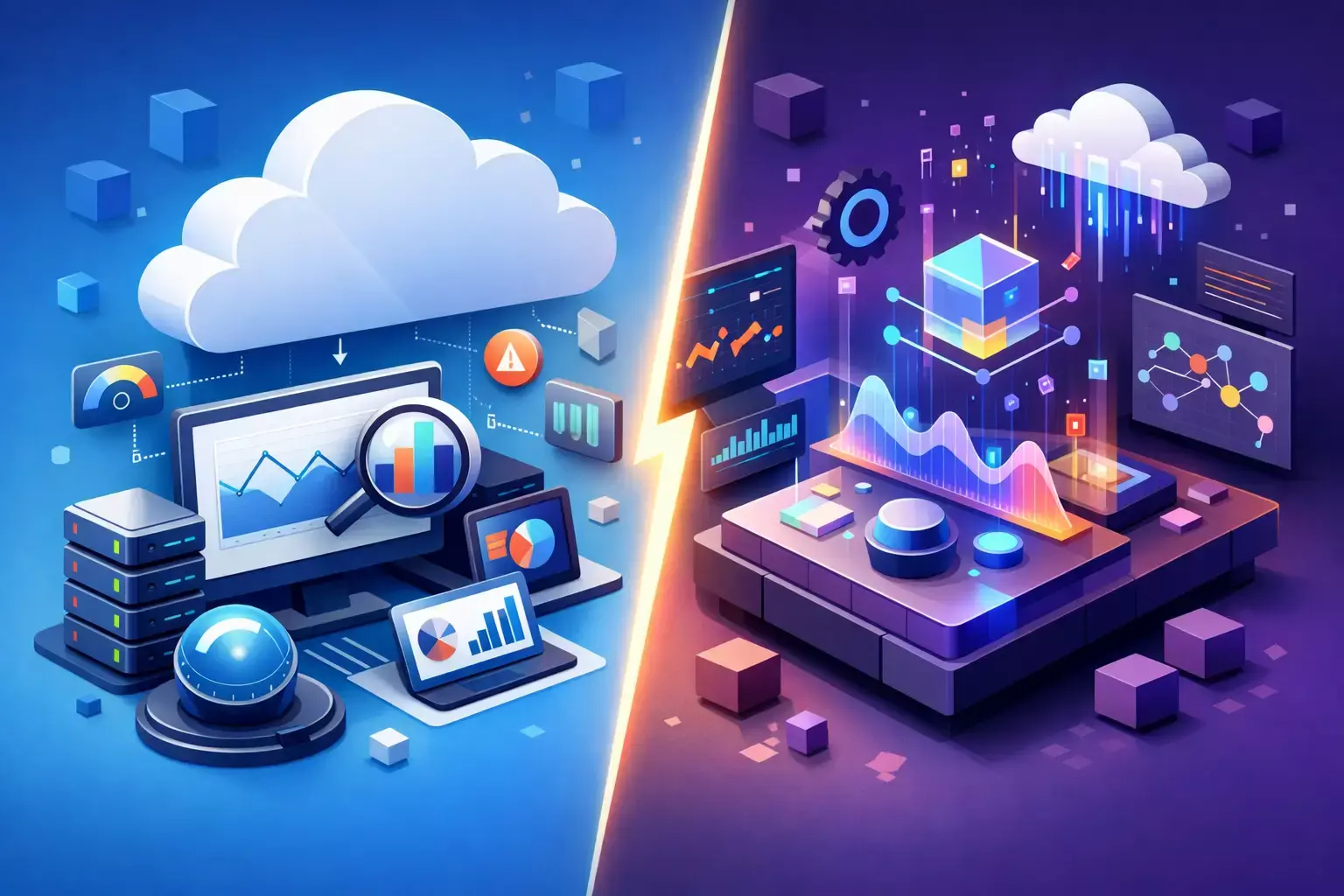
Cloud monitoring vs observability platform: the core difference
- Cloud monitoring is primarily about tracking known signals. You define what matters ahead of time, such as CPU usage, memory consumption, API latency, disk pressure, service availability, or error rates. Then you set thresholds, dashboards, and alerts so your team can respond when those signals move outside acceptable ranges.
- An observability platform goes further. It helps teams investigate unknown issues by correlating telemetry across metrics, logs, traces, events, and sometimes configuration and dependency data. Instead of asking only, "Did the app cross a threshold?" observability asks, "Why did this specific request fail for this customer in this service path under these infrastructure conditions?"
That is the practical divide. Monitoring tells you when a known condition happens. Observability helps you understand complex behaviour when the condition was not obvious in advance.
Why cloud monitoring still matters
Monitoring is not outdated, and it is not a lesser practice. For many environments, it is the operational baseline. If you do not have strong monitoring, observability will not rescue you.
A mature cloud monitoring setup gives teams immediate value. It supports uptime reporting, capacity planning, SLA tracking, and basic alerting. It is often the fastest way to answer straightforward questions:
- Is the server healthy?
- Is the database overloaded?
- Is the website available?
- Did latency increase after deployment?
For smaller environments or stable workloads, that may be enough. A business running a handful of well-understood applications can often achieve strong results through disciplined monitoring, good runbooks, and on-call procedures. If your architecture is simple, your failure modes are familiar, and your team is cost-conscious, monitoring can be the right operational foundation.
There is also a business case for starting here. Monitoring is usually easier to implement, easier to explain to stakeholders, and easier to align with basic managed service operations. It helps control risk without forcing a full telemetry strategy on day one.
Where monitoring starts to fall short
Monitoring becomes less effective as systems become more distributed and dynamic. That usually happens when organizations adopt microservices, containers, autoscaling, managed cloud services, CI/CD pipelines, third-party APIs, or hybrid infrastructure.
In those environments, symptoms often show up far away from the root cause. A latency alert in one service may actually be caused by a downstream dependency, a bad deployment, a noisy tenant, an IAM misconfiguration, or an intermittent network issue. Traditional monitoring can tell you something is wrong, but not how the problem moved through the system.
This is where teams start adding more dashboards and more alerts, hoping coverage will improve. Instead, they often create noise. Alert fatigue grows, triage gets slower, and engineers spend too much time switching between tools that do not share context.
That is usually the signal that you need observability, not just more monitoring.
What an observability platform changes
An observability platform is designed for context. It combines multiple telemetry types so teams can move from symptom to cause faster.
- Metrics still matter, but they are only one piece.
- Logs help explain what happened inside workloads and services.
- Distributed traces show how requests travel across systems.
- Dependency maps reveal service relationships.
- Change events tie incidents to deployments or infrastructure updates. When these signals are correlated, your team can ask better questions during an incident and get usable answers faster.
This has a direct operational impact. Mean time to detect is important, but mean time to resolve is where cost and customer experience often improve. If an engineer can quickly isolate whether a slowdown came from code, infrastructure, a database query, or a third-party service, the business avoids longer outages and less productive incident response.
Observability also supports modernization. As organizations adopt Terraform, containers, serverless functions, or more automated delivery pipelines, they need visibility that matches that complexity. Static threshold-based monitoring alone rarely keeps pace.
Cloud monitoring vs observability platform: which one do you need?
The honest answer is that most growing businesses need both, but not at the same maturity level.
- If your environment is relatively simple, cloud monitoring may be the right first investment. That is especially true if your current gaps are basic, such as missing alerts, limited infrastructure visibility, poor uptime reporting, or no centralized dashboarding. In that case, observability can wait until the business has more complexity to justify it.
- If your team is already monitoring infrastructure and applications but still losing hours during incident triage, an observability platform is likely the next step. The trigger is not just scale. It is operational ambiguity. When your team cannot explain issues fast enough, the business is absorbing that cost in downtime, engineering interruption, and customer risk.
There is also an organizational factor. Observability creates more value when development, operations, and security teams all use shared telemetry. If each function is isolated and working from different tooling, the platform may be underused unless you also improve workflows.
The trade-offs decision-makers should weigh
- Monitoring is usually simpler to deploy and cheaper to maintain. It supports predictable use cases and helps smaller teams stay focused. But if used alone in a complex environment, it can create blind spots and reactive operations.
- Observability delivers deeper insight, but it comes with added design decisions. Teams need to think about instrumentation, data volume, retention, alert strategy, ownership, and cost governance. More visibility is not automatically better if telemetry is collected without purpose.
- Cost is a real consideration. Observability platforms can become expensive when log ingestion, trace sampling, and long retention periods are not managed carefully. That does not make them a poor choice. It means implementation should be tied to business priorities, service criticality, and an operating model your team can sustain.
This is why vendor-neutral guidance matters. The right solution is not always the platform with the most features. It is the one that gives your team actionable insight without creating operational overhead or uncontrolled spend.
How to make the right choice for your environment
- Start with the questions your team cannot answer today. If you cannot reliably detect outages, monitor capacity, or enforce basic service health alerting, strengthen monitoring first. If you can detect problems but cannot trace them across systems, build toward observability.
- Next, assess architecture complexity. A single application stack has different needs than a distributed environment spanning AWS services, Kubernetes clusters, managed databases, CI/CD workflows, and third-party integrations. The more moving parts you have, the more valuable correlated telemetry becomes.
- Then look at incident patterns. Repeated Sev 1 and Sev 2 events with slow root cause analysis usually point to a visibility problem, not just a staffing problem. Better telemetry often reduces operational drag more effectively than adding headcount.
- Finally, tie the decision to business outcomes. If the goal is stronger uptime, faster change velocity, lower cloud waste, or better audit readiness, your monitoring and observability strategy should support those goals directly. Technology choices are easier when they are anchored in service reliability and business risk.
A practical path forward
For many SMBs and growth-stage teams, the best path is phased. Establish strong cloud monitoring for infrastructure, application health, availability, and alerting. Standardize dashboards, escalation rules, and response expectations. Once that foundation is dependable, add observability where complexity is highest, such as customer-facing services, production APIs, critical workloads, or fast-changing DevOps pipelines.
That approach gives you immediate operational value without overengineering. It also lets you control spending while building a telemetry model that reflects how your environment actually works.
At Advanced Vision IT, this is often where a hands-on partner makes the difference. Tool selection is only part of the job. The larger challenge is designing visibility around architecture, risk, cost, and the way your teams respond during real incidents.
The better question is not whether monitoring or observability wins. It is whether your current visibility strategy helps your team act with confidence when systems are under pressure. If the answer is no, that is the place to start.

Written by Yavor Y. Zlatev
CEO & Founder at Advanced Vision IT Ltd | Published on
Yavor advises executive leadership teams on cybersecurity strategy, NIS2 compliance, and cloud operating models to build resilient IT environments.