



Cloud Security Assessment Review for Growing Teams
A single overly broad IAM role can turn a minor application issue into an account-wide incident. An unencrypted backup, public storage bucket, or missing log trail can create the same exposure. A cloud security assessment review gives leadership a clear view of those risks before an attacker, auditor, customer, or failed deployment finds them first.
For growing organizations, the challenge is rarely a complete absence of security controls. More often, controls were configured during a fast migration, inherited from an early architecture, or added by different teams over time. The result is a cloud environment that may work well operationally while carrying hidden security, compliance, and recovery risk.
What a Cloud Security Assessment Review Should Deliver
A useful review is not a generic scan followed by a long spreadsheet of findings. It should connect technical configuration to business impact, identify the conditions most likely to create an incident, and provide an ordered remediation plan that the internal team can realistically execute.
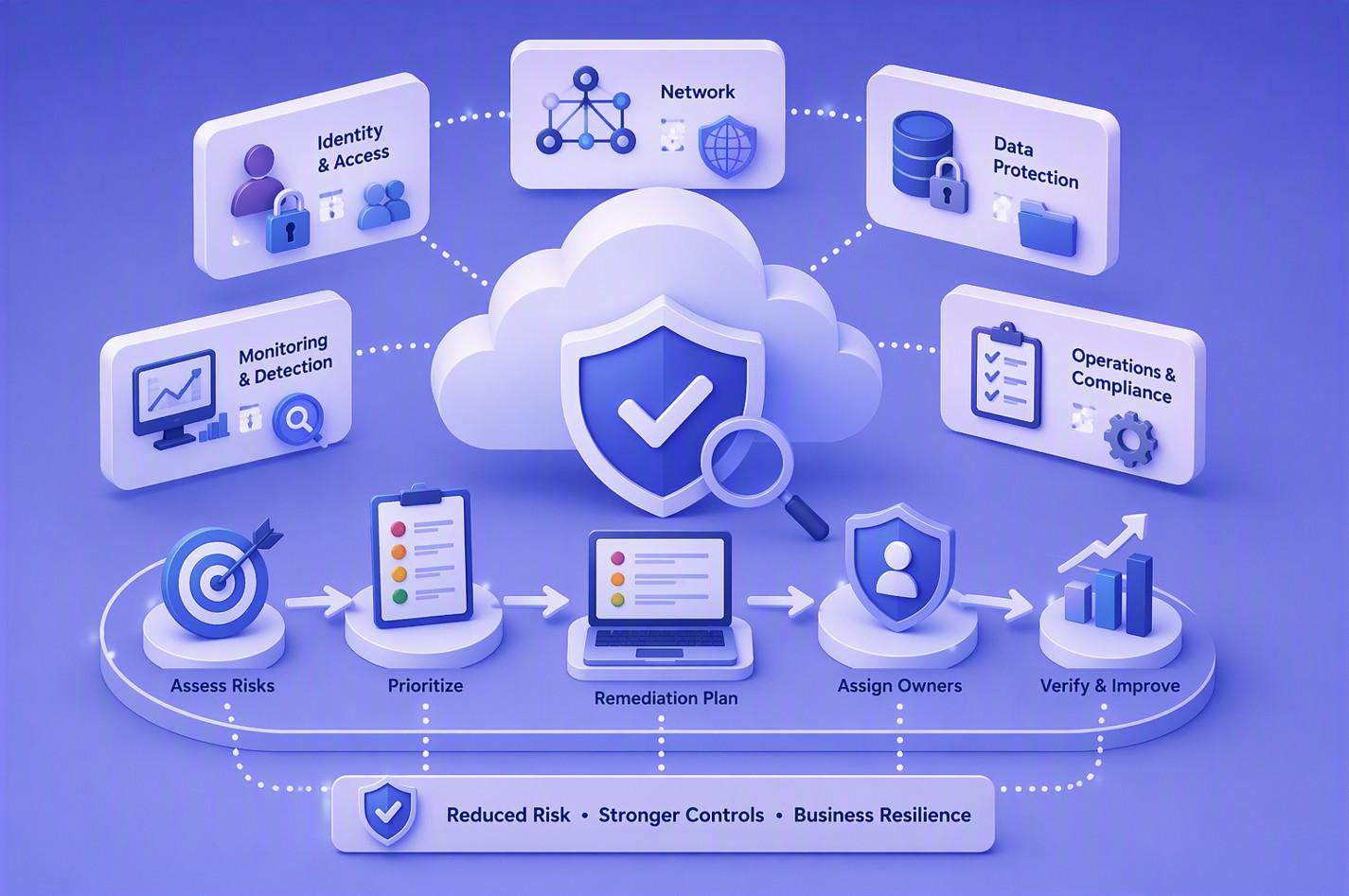
In AWS environments, that means examining how identities access accounts and workloads, how networks segment traffic, where data resides, whether encryption is consistently enforced, and whether teams can detect and investigate suspicious activity. It also means reviewing the operational layer: patching, infrastructure-as-code practices, backup recovery, CI/CD permissions, third-party integrations, and ownership of critical controls.
The outcome should answer practical questions. Which risks require immediate action? Which findings are accepted trade-offs? What can be automated through Terraform, AWS Config, policy controls, or CI/CD guardrails? Who owns each corrective action, and how will the organization verify that the issue stays fixed?
Start With the Business Context, Not the Tool Output
Security findings only become useful when they are evaluated against the systems the business depends on. A public-facing production application with customer data requires a different risk threshold than an isolated development sandbox. A healthcare platform, financial services provider, or company preparing for a SOC 2 review may also need evidence that controls are operating consistently, not merely configured once.
A strong assessment begins by mapping critical workloads, data classifications, regulated information, external dependencies, and recovery expectations. This establishes what must be protected and what a disruption would cost. It also prevents teams from spending weeks resolving low-impact alerts while a privileged service account remains poorly controlled.
This context is especially valuable for hybrid environments. Identity may begin in an on-premises directory, extend into AWS IAM Identity Center, and reach SaaS tools through federated access. Security cannot be assessed effectively by treating each platform as a separate island.
Review Identity and Access Before Anything Else
Identity is the control plane for cloud security. If an attacker gains administrative access, well-designed network rules and encrypted storage offer limited protection. The review should therefore examine human access, machine identities, emergency access, and the paths used to assume privileged roles.
Look closely at whether multi-factor authentication is enforced, whether root account access is protected and rarely used, and whether permissions follow least-privilege principles. Long-lived access keys, shared accounts, unused users, and broad administrator policies are common sources of unnecessary exposure. So are service roles that have accumulated permissions as applications changed.
The right answer is not always to remove every broad permission immediately. A legacy workload may genuinely need temporary elevated access while it is being refactored. The assessment should document that exception, limit its duration, apply compensating controls, and assign an owner. Unmanaged exceptions are far more dangerous than visible, time-bound ones.
Test Network, Data, and Workload Controls Together
Cloud environments are built from connected services, so individual settings do not tell the whole story. A private database can still be exposed through an overly permissive application role. An encrypted S3 bucket can still create risk if its contents are replicated to an unmanaged destination. A security group may appear restrictive while a load balancer, VPN, peering connection, or third-party integration creates an unexpected route.
A meaningful review traces those relationships. It checks internet-facing endpoints, security groups, network ACLs, VPC segmentation, private connectivity, DNS controls, and egress paths. For data, it validates encryption at rest and in transit, key ownership and rotation, retention settings, public access protections, backup locations, and lifecycle policies.
Workload security deserves the same attention. Amazon EC2 instances need a reliable patching process, hardened images, endpoint protection where appropriate, and controlled administrative access. Containers require image scanning, registry governance, runtime visibility, and tightly scoped task or pod roles. Serverless functions need dependency management, secret handling, and permissions that do not extend far beyond their intended service calls.
This is where a Well-Architected Review can complement a security assessment. The Well-Architected Security Pillar provides a disciplined framework, but the most valuable work comes from translating its principles into specific architecture and operating changes.
Verify Detection, Logging, and Response Readiness
Many organizations have logs. Fewer can use them quickly during an incident. A cloud security assessment should verify that relevant logs are enabled, centralized, retained long enough, protected from unauthorized alteration, and connected to a monitoring process.
For AWS, this commonly includes CloudTrail, VPC Flow Logs, CloudWatch logs, load balancer logs, DNS query logging, and application-level audit events. The exact combination depends on the environment, but the objective is consistent: establish who did what, from where, and what changed when something goes wrong.
Detection also needs an operating model. Security Hub, GuardDuty, AWS Config, vulnerability scanners, and observability platforms can produce valuable signals, yet alert volume becomes a liability when no one owns triage. Define severity levels, escalation paths, response time expectations, and after-hours responsibilities. A managed security partner can provide coverage, but the business should still know who can authorize containment actions that affect production systems.
Test incident response through realistic scenarios. Can the team disable compromised credentials? Can it isolate an affected instance without losing critical evidence? Can it determine whether customer data was accessed? A documented incident response plan that has never been exercised is an assumption, not a capability.
Include Backup and Recovery in the Security Scope
Ransomware, accidental deletion, malicious insiders, and faulty automation can all compromise availability and integrity. That makes recovery a security concern, not merely an infrastructure concern.
The review should validate backup frequency, retention, encryption, access controls, cross-account or cross-region copies, and protection against deletion. It should also test whether systems can actually be restored within the recovery time objective. A successful backup job does not prove that an application can be recovered with correct dependencies, configuration, secrets, and data consistency.
Immutable or logically isolated backups can materially reduce ransomware impact, but they add cost and operational complexity. The appropriate design depends on the value of the data, required recovery speed, and regulatory obligations. The assessment should make those trade-offs visible so leaders can make informed investment decisions.
Turn Findings Into an Executable Roadmap
A report is only valuable if it changes the environment. Findings should be ranked by likelihood, potential impact, exploitability, and affected business service. Each item should include a clear remediation action, accountable owner, target date, and evidence needed to confirm closure.
The first phase usually focuses on high-consequence issues: exposed credentials, public data access, missing multi-factor authentication, unrestricted management ports, weak privileged access, absent backups, or logging gaps. The next phase can address systemic improvements such as account segmentation, policy-as-code, centralized identity, automated patching, and security checks built into CI/CD pipelines.
Automation helps prevent recurring drift. Terraform modules can standardize encryption and logging. Ansible can enforce operating system baselines. AWS Config rules and policy controls can detect or block noncompliant resources. New Relic and other observability tools can connect application behavior with infrastructure events, improving both reliability and investigations.
Advanced Vision IT approaches this work as an operational improvement program, not a one-time compliance exercise. The goal is to leave teams with clearer ownership, better visibility, and controls that can scale alongside cloud usage.
Make the Review a Regular Management Practice
Cloud risk changes whenever a new account, vendor integration, deployment pipeline, employee, or data set is introduced. A thorough assessment is valuable before a migration, audit, acquisition, major product launch, or after a security event. For most growing businesses, a formal review at least annually, supplemented by continuous monitoring and quarterly control checks, is a practical baseline.
The best time to address cloud security gaps is while the architecture is still flexible and the remediation choices are affordable. Treat the assessment as a decision tool for protecting revenue, customer trust, and uptime - then give the resulting actions the same operational discipline as any other business-critical engineering work.
User Story: How a Minor IAM Issue Became a Major Risk
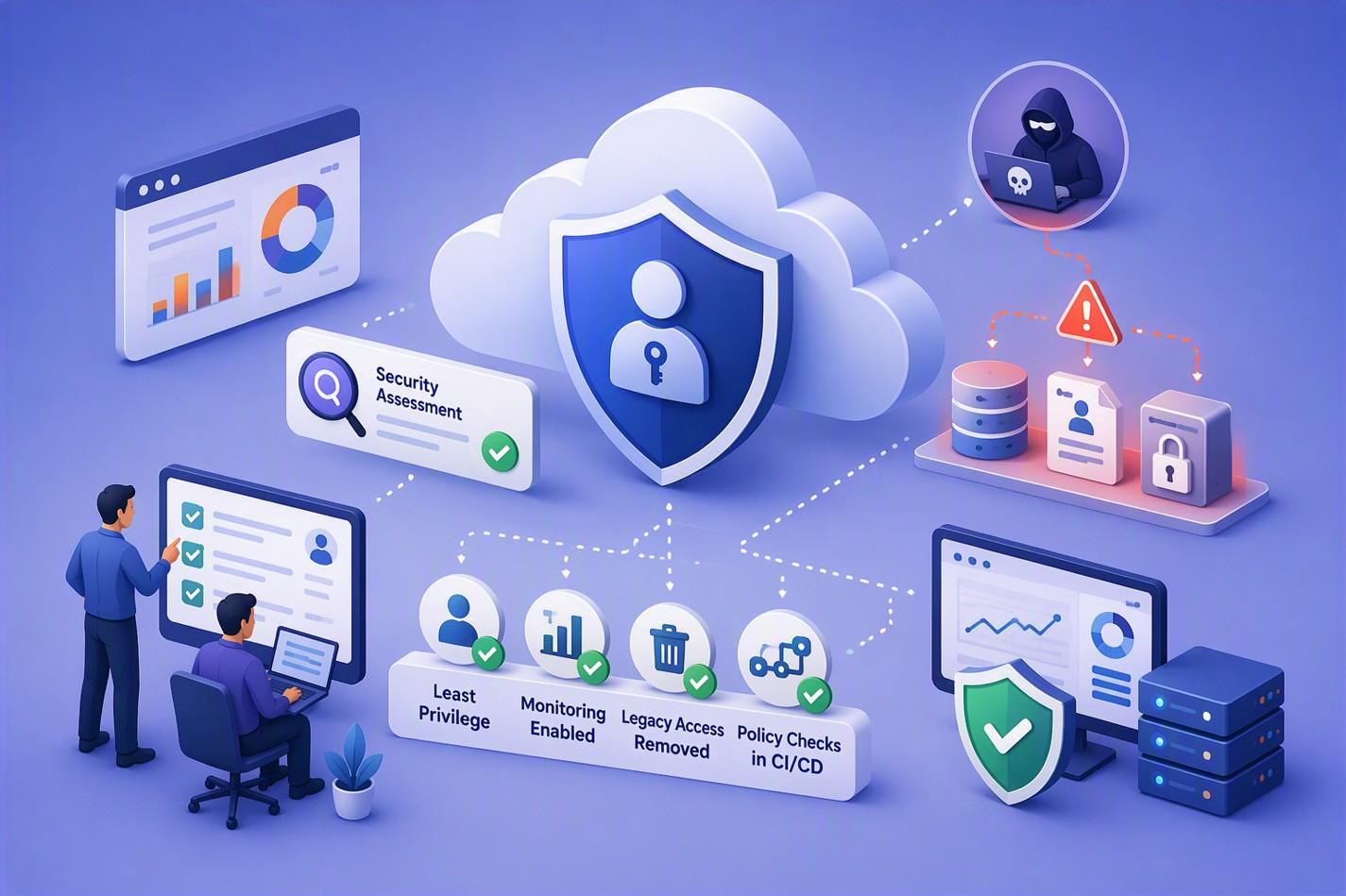
A mid-sized SaaS company had recently expanded its AWS environment to support new customer-facing services. During a cloud security assessment, the review team discovered that an application support role had accumulated permissions over multiple development cycles. What started as temporary troubleshooting access had evolved into a role with administrative privileges across several production workloads.
No incident had occurred. The application was operating normally, monitoring showed no obvious alerts, and internal teams assumed existing controls were sufficient.
However, the assessment revealed that if an attacker compromised the application through a routine vulnerability, the excessive permissions would have allowed access to customer data, backup repositories, and critical infrastructure resources. The potential impact extended far beyond the original application.
Rather than waiting for an actual breach, the organization implemented least-privilege access controls, enabled additional monitoring, removed legacy permissions, and introduced automated policy checks in its CI/CD pipeline.
What could have become a reportable security incident was reduced to a manageable remediation project because the exposure was identified during a proactive cloud security assessment rather than during an emergency response effort.
This scenario is common in growing cloud environments. Security risks are often not caused by a single critical vulnerability, but by the accumulation of small configuration decisions that create unintended pathways for compromise.
Why This Matters
Cloud environments evolve constantly. New applications, infrastructure changes, third-party integrations, acquisitions, and development projects can introduce security risks faster than most organizations can manually review them.
The consequences extend beyond cybersecurity teams:
- Business leaders face potential revenue loss, regulatory penalties, customer churn, and reputational damage following a security incident.
- Technology teams must balance innovation and speed while maintaining secure architectures.
- Compliance stakeholders require evidence that controls are operating effectively and consistently.
- Operations teams depend on reliable backup, recovery, monitoring, and incident response capabilities to maintain service availability.
A cloud security assessment provides a structured way to identify hidden risk before it affects customers, auditors, partners, or critical business operations. It transforms cloud security from a reactive exercise into a proactive management practice that supports resilience, compliance, and long-term growth.
Organizations that regularly assess their cloud environments typically gain:
- Greater visibility into security and compliance risks.
- Clear ownership of security responsibilities.
- Improved readiness for audits and certifications.
- Faster incident detection and response.
- Better alignment between security investments and business priorities.
- More confidence in their ability to recover from operational disruptions or cyberattacks.
Ultimately, cloud security assessments help organizations protect revenue, customer trust, and operational continuity while supporting ongoing digital transformation initiatives.
Frequently Asked Questions (FAQ)
1. How often should a cloud security assessment be performed?
Most organizations should conduct a comprehensive cloud security assessment at least annually. Additional reviews are recommended after major cloud migrations, significant architectural changes, acquisitions, compliance initiatives, or security incidents. Continuous monitoring and quarterly control reviews can help maintain visibility between formal assessments.
2. What is the difference between a cloud security assessment and a vulnerability scan?
A vulnerability scan identifies known technical weaknesses such as missing patches or software vulnerabilities. A cloud security assessment goes much further by evaluating identity management, network architecture, data protection, logging, monitoring, backup and recovery capabilities, governance, compliance requirements, and overall business risk.
3. What are the most common AWS security issues discovered during assessments?
Common findings include overly permissive IAM roles, inactive accounts, missing multi-factor authentication, public S3 buckets, unrestricted security group rules, unencrypted resources, inadequate logging, excessive service account permissions, weak backup protections, and insufficient monitoring coverage.
4. How long does an AWS cloud security assessment take?
The duration depends on the size and complexity of the environment. Smaller environments may be assessed within a few days, while larger multi-account AWS organizations with compliance requirements may require several weeks. The most valuable assessments focus not only on discovery but also on remediation planning and business prioritization.
5. What should the final assessment report include?
A useful report should provide:
- An executive summary for leadership.
- Business-focused risk prioritization.
- Technical findings with supporting evidence.
- Recommended remediation actions.
- Assigned ownership and timelines.
- Compliance and governance observations.
- Recovery and resilience recommendations.
- A practical roadmap for improving the overall security posture.
The goal is not to generate a list of findings, but to deliver actionable guidance that helps the organization reduce risk, improve resilience, and maintain secure cloud operations over time.

Written by Alexander Boychev
Business Executive & Digital Marketing Manager at Advanced Vision IT Ltd | Published on
Alexander advises insights on business development, strategic key account management, and digital marketing in the IT sector.