



DevOps Maturity Model Guide for Growing Teams
A deployment that succeeds only because the right engineer is online is not a dependable delivery process. Neither is a cloud environment that scales until a billing surprise, security audit, or production incident exposes gaps in ownership and control. A devops maturity model guide gives technology leaders a practical way to identify those gaps, prioritize the right improvements, and connect engineering work to uptime, risk, speed, and cost.
For growing businesses, maturity is not a race to adopt every platform or copy the operating model of a large enterprise. It is the ability to release and run software predictably with controls that fit the organization. The best model is useful because it turns broad goals such as "improve DevOps" into clear operating decisions: what to automate, what to measure, where to standardize, and where human review still belongs.
What DevOps Maturity Actually Measures
DevOps maturity measures how consistently an organization can build, deploy, secure, monitor, and improve its technology services. It is not a score for how many tools a team owns. A company can use Kubernetes, Terraform, and a modern CI/CD platform while remaining immature if deployments are manual, alerts lack owners, and changes are difficult to audit.
A useful assessment looks across five connected capabilities: delivery practices, infrastructure automation, security and compliance, observability and incident response, and team operating models. Weakness in one area tends to constrain the rest. Fast deployment without security checks increases risk. Strong monitoring without defined incident procedures creates noise rather than faster recovery. Infrastructure automation without cost controls can reproduce waste at scale.
The goal is not perfection. A regulated healthcare provider may need more approval gates than a SaaS startup. A small internal application may not require the same recovery objectives as a customer-facing platform. Maturity means making these choices deliberately, documenting them, and validating that the controls work under real operating conditions.
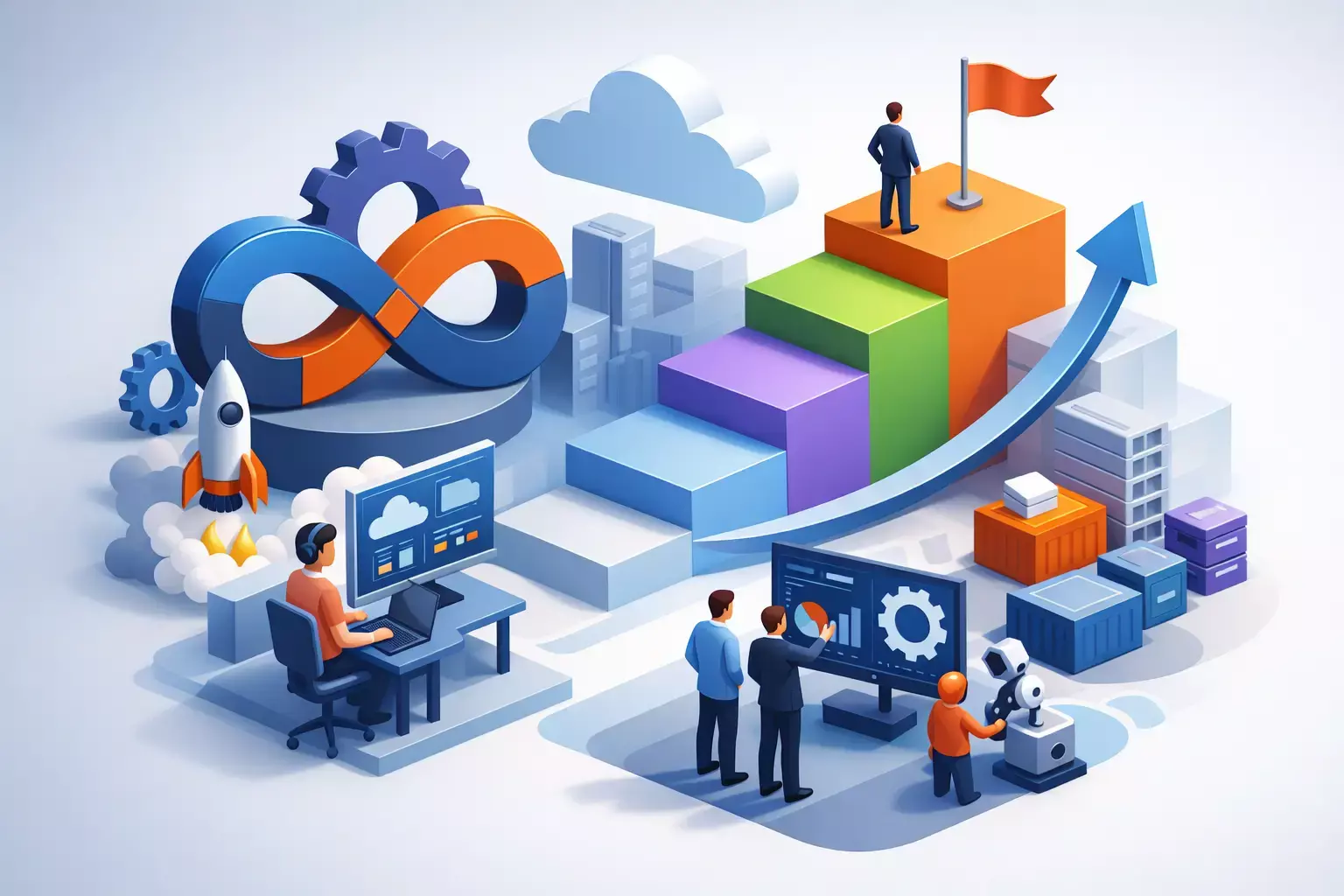
The Five Stages in a DevOps Maturity Model Guide
Most organizations progress unevenly. A development team may be advanced in CI/CD but early-stage in observability or infrastructure governance. That is normal. The stages below provide a shared language for planning improvements without assuming every workload must advance at the same speed.
1. Ad Hoc: Work Depends on Individual Knowledge
At the ad hoc stage, deployments rely on manual steps, informal handoffs, and a small number of people who understand the environment. Configuration may live in tickets, chat threads, local scripts, or undocumented console changes. Production access is often broad because it is the fastest path to resolving problems.
This approach can support an early product, but it creates business exposure as customer demand grows. Releases become stressful, recovery takes longer, and turnover becomes a technical risk. The first priority is not an elaborate platform rebuild. It is establishing a baseline: source control, documented deployment steps, asset ownership, backups, access controls, and a clear inventory of critical services.
2. Repeatable: Core Processes Are Documented
Repeatable teams have defined procedures for common work. They use version control consistently, have basic build and deployment workflows, and document how systems are supported. Environments begin to look more consistent, even if setup still involves manual work.
This stage reduces dependency on tribal knowledge, but documentation alone does not prevent drift. A runbook that is never tested can be as unreliable as no runbook. Teams should focus next on converting the most frequent and highest-risk tasks into automated workflows, particularly deployments, account provisioning, backups, and standard infrastructure changes.
3. Standardized: Automation Becomes the Default
At the standardized stage, infrastructure and application delivery follow approved, reusable patterns. Infrastructure as code with tools such as Terraform or Ansible replaces one-off configuration changes. CI/CD pipelines build, test, scan, and deploy applications with consistent controls. Teams use templates and shared modules instead of rebuilding the same solution for every project.
Standardization improves delivery speed, but its larger value is control. Changes become reviewable, repeatable, and easier to audit. For AWS environments, this often includes standardized account structures, identity policies, network patterns, tagging, backup policies, and workload baselines aligned to Well-Architected principles.
The trade-off is that standards require governance. If platform teams make the approved path difficult to use, engineers will create workarounds. Mature standardization provides paved roads: secure defaults that are faster than doing everything from scratch.
4. Measured: Operations Are Managed With Evidence
Measured teams do more than collect logs and dashboards. They use telemetry to make operational decisions. Metrics, logs, traces, synthetic checks, and service-level indicators show whether a system is meeting the experience promised to customers and internal users.
At this stage, observability platforms such as New Relic can correlate application behavior with infrastructure performance. Teams define meaningful alert thresholds, identify service owners, and reduce alerts that do not require action. Incident response is documented and practiced, with post-incident reviews focused on systemic improvement rather than individual blame.
Business leaders should expect evidence here. How often do deployments fail? How long does it take to restore service? Which cloud services drive cost growth? Are critical vulnerabilities fixed within the agreed window? These answers help teams direct investment toward the constraints that affect revenue, customer trust, and operational resilience.
5. Optimizing: Improvement Is Continuous and Controlled
Optimizing teams treat delivery and operations as feedback systems. They use deployment, reliability, security, and cost data to improve engineering practices continuously. Automated policy checks prevent common issues before production. Capacity planning, resilience testing, and disaster recovery exercises are routine rather than emergency projects.
This stage does not mean zero incidents or unrestricted release velocity. Mature organizations still pause releases when risk is high, use approvals for sensitive changes, and maintain fallback plans. The difference is that these controls are designed into the workflow, measured over time, and refined based on outcomes.
How to Assess Your Current State
Start with a representative business service rather than evaluating the whole company at once. Choose a customer-facing application, a revenue-critical internal system, or the workload that creates the most operational effort. Map its path from code change to production and its path from alert to recovery.
Ask direct questions. Can the team recreate the environment from code? Does every production change have a reviewable record? Are security scans and dependency checks part of the pipeline? Is there a named owner for each service and alert? Can leadership see recovery performance, deployment quality, and cloud spend without assembling data manually?
Score each capability based on demonstrated practice, not intentions. A pipeline is only automated if teams use it for normal releases. A disaster recovery plan is only credible if it has been tested. This distinction prevents a common assessment failure: overrating maturity based on purchased tools or unfinished initiatives.
Build a Roadmap Around Business Risk
The most effective DevOps roadmap starts with a specific business constraint. If failed deployments disrupt customers, improve pipeline testing, deployment strategies, and rollback procedures first. If a compliance review is approaching, prioritize identity management, audit logging, configuration baselines, and evidence collection. If cloud costs are unpredictable, establish tagging, budget alerts, rightsizing reviews, and environment lifecycle controls.
Avoid attempting a complete transformation in one quarter. A staged roadmap creates progress while protecting service continuity. First, establish a secure and documented baseline. Next, automate the repetitive work that causes the most delay or risk. Then add observability and service-level objectives so the team can verify results. Once these foundations are in place, optimize architecture, delivery flow, and cost based on operational data.
Ownership matters as much as tooling. Engineering, IT operations, security, and finance should agree on decision rights for production changes, exceptions, incident escalation, and cloud spending. For organizations without a large internal platform team, a hands-on technology partner can help establish these operating patterns while transferring knowledge to internal staff.
Metrics That Show Whether Maturity Is Improving
Use a small set of metrics that reveal both delivery performance and operational safety. Deployment frequency and lead time for changes show whether improvements reduce friction. Change failure rate and mean time to restore service show whether speed is creating instability. Vulnerability remediation time, backup recovery success, and policy compliance reveal whether security controls work in practice.
Cloud cost should be considered alongside these metrics. Lower spend is not automatically better if it reduces resilience or slows product delivery. The stronger goal is accountable spend: teams understand what each workload costs, why it costs that amount, and which technical choices can improve efficiency without compromising service levels.
A maturity model is most valuable when it changes the next decision. Choose one critical service, assess it honestly, and improve the control that most directly protects customers or removes operational drag. That disciplined approach builds capability faster than a tool-first transformation plan.
Frequently Asked Questions (FAQ)
1. What is a DevOps maturity model?
A DevOps maturity model is a framework that helps organizations assess how effectively they build, deploy, secure, monitor, and improve their technology services. Rather than measuring the number of tools in use, it evaluates the consistency, reliability, and governance of delivery and operational practices.
2. What are the five stages of DevOps maturity?
The five common stages are:
- Ad Hoc – Processes depend on individual knowledge and manual work.
- Repeatable – Core procedures are documented and consistently followed.
- Standardized – Automation and approved patterns become the default approach.
- Measured – Decisions are guided by operational metrics and observability data.
- Optimizing – Continuous improvement is driven by feedback, automation, and business outcomes.
3. Why is DevOps maturity important for growing businesses?
DevOps maturity helps organizations deliver software more predictably while improving uptime, security, compliance, and cost control. It reduces reliance on individual employees, minimizes operational risk, and creates a foundation for sustainable growth.
4. How can a company assess its current DevOps maturity level?
Organizations should evaluate a representative business service and examine key areas such as deployment processes, infrastructure automation, security controls, observability, incident response, and team ownership. Assessments should be based on demonstrated practices and measurable results rather than planned initiatives or tool adoption.
5. Which metrics should be used to measure DevOps maturity improvements?
Key metrics include deployment frequency, lead time for changes, change failure rate, mean time to restore service (MTTR), vulnerability remediation time, backup recovery success rates, policy compliance, and cloud cost accountability. Together, these metrics provide visibility into both delivery performance and operational resilience.

Written by Yavor Y. Zlatev
CEO & Founder at Advanced Vision IT Ltd | Published on
Yavor advises executive leadership teams on cybersecurity strategy, NIS2 compliance, and cloud operating models to build resilient IT environments.