



How to Build a Cloud Disaster Recovery Plan
When a critical system goes down, the problem is rarely just technical. Orders stop processing, employees lose access, customer trust takes a hit, and leadership wants answers immediately. A cloud disaster recovery plan exists to keep that moment from turning into a prolonged business interruption.
For small and mid-sized organizations, disaster recovery is often treated as something to revisit after a migration, an audit, or a security incident. That delay is expensive. The right plan does more than restore infrastructure - it defines how your business will keep operating when applications, data, networks, or cloud dependencies fail.
What a cloud disaster recovery plan actually covers
A cloud disaster recovery plan is the documented strategy for recovering systems, applications, and data after a disruptive event. That event might be a ransomware attack, accidental deletion, cloud misconfiguration, regional outage, failed deployment, or loss of a critical third-party service.
The plan should answer a few practical questions.
- Which systems matter most?
- How quickly do they need to be restored?
- What data loss is acceptable, if any?
- Who is responsible for failover, communications, security review, and validation?
If those answers only live in one engineer's head, you do not have a recovery plan. You have a dependency.
This is also where cloud environments can be misunderstood. Running workloads in AWS or another cloud platform does not automatically give you full disaster recovery coverage. Cloud providers offer resilient infrastructure options, but customers still need to design backup strategy, cross-region architecture, identity protection, configuration recovery, and application-level restoration.
Start with business impact, not tooling
The most common mistake in disaster recovery planning is starting with technology before defining business priorities. Teams debate snapshots, replication, and automation pipelines before agreeing on what actually needs to come back first.
- A better starting point is a business impact analysis. Identify the systems that directly affect revenue, operations, compliance, and customer service.
- For one organization, that may be an ecommerce platform and payment workflow. For another, it may be a line-of-business application tied to warehouse operations or patient records.
- Once critical systems are identified, define two numbers for each one: recovery time objective and recovery point objective:
- Recovery time objective, or RTO, is how long the application can be down.
- Recovery point objective, or RPO, is how much data loss is acceptable.
These are not just technical targets. They are business decisions with cost implications.
A near-zero RPO usually requires more replication, more automation, and more infrastructure spend. A four-hour RTO may be acceptable for an internal reporting tool but unacceptable for customer-facing authentication. Good planning requires honest trade-offs, not idealized expectations.
Core components of a cloud disaster recovery plan
A useful plan is detailed enough to execute under pressure but structured enough to maintain over time. It should document your production architecture, dependencies between systems, backup methods, recovery workflows, and validation steps.
That includes infrastructure definitions, network configurations, IAM roles and policies, DNS settings, encryption keys, secrets management, and deployment pipelines. If your environment is built with Terraform, Ansible, or CI/CD automation, those assets should be part of the recovery strategy, not separate from it. Rebuilding infrastructure from code is often faster and more reliable than trying to reconstruct systems manually.
Data recovery needs its own section. Backups should be classified by retention, immutability, restoration method, and test frequency. Database recovery, object storage recovery, and file restoration each carry different constraints. Snapshot availability does not guarantee application consistency, especially for transactional systems.
The plan also needs an operational chain of command. During an incident, decision latency can be as damaging as system downtime. Define who declares a disaster, who approves failover, who communicates with customers or internal stakeholders, and who validates that recovered systems are safe to return to production.
Choosing the right recovery pattern
There is no single architecture that fits every business. The right cloud disaster recovery plan depends on system criticality, budget, compliance obligations, and internal maturity.
- Backup and restore is the lowest-cost model and works well for less critical workloads. Data is backed up regularly, and systems are rebuilt when needed. The trade-off is longer recovery time.
- Pilot light keeps core services such as databases or essential infrastructure running in a secondary environment while the rest of the application stack can be scaled up during a disruption. This reduces recovery time without the cost of a fully mirrored environment.
- Warm standby maintains a scaled-down but functional version of production in a secondary region or cloud environment. It is more expensive than pilot light, but it supports faster failover and more predictable recovery.
- Multi-site or active-active design provides the highest availability but also introduces more complexity in data consistency, traffic management, observability, and cost control. For many SMBs, this is unnecessary unless the application has strict uptime requirements or regulatory expectations.
The point is not to buy the most elaborate setup. It is to align the recovery design with business risk.
Security and compliance cannot be separate
Disaster recovery and security are tightly connected, especially now that ransomware and credential abuse are common causes of operational outages. If your recovery environment uses the same weak identity controls as production, you may simply replicate the original failure.
Recovery planning should include privileged access controls, MFA enforcement, isolated backup storage, key management protections, and procedures for recovering after a security event. This matters because restoring from backup after ransomware is not only about availability. You also need confidence that the restored environment is clean, monitored, and compliant.
For organizations in regulated industries, the plan should map to compliance requirements around retention, auditability, incident response, and data handling. A recovery environment that lacks logging, encryption, or access controls may restore service but still create regulatory exposure.
Testing is where most plans break down
A plan that has never been tested is mostly a document. Real recovery readiness comes from rehearsal.
Testing should go beyond checking whether backups completed successfully. You need to verify:
- whether entire applications can be restored
- whether the infrastructure code can rebuild dependencies
- whether DNS failover works
- and whether teams can execute the runbook without improvising critical steps.
Not every test needs to be a full-scale simulation.
- Tabletop exercises are useful for leadership alignment and decision workflows.
- Partial failover tests validate specific services.
- Scheduled restoration drills confirm data integrity.
- Periodic game day exercises can expose hidden dependencies between systems, vendors, and teams.
Testing also reveals something many organizations underestimate: documentation drift. Environments change constantly. New services are added, pipelines are updated, network rules evolve, and ownership shifts across teams. If the recovery plan is not reviewed after those changes, it becomes inaccurate fast.
Common gaps in cloud disaster recovery planning
Most recovery weaknesses are not caused by a total lack of planning. They come from partial planning.
- One common gap is assuming backups equal recoverability. Backups matter, but they do not cover application dependencies, IAM recovery, configuration state, or third-party integrations.
- Another is focusing only on infrastructure while ignoring communication plans and business process continuity.
- There is also a tendency to overlook cost management. Secondary environments, cross-region storage, replication, and continuous monitoring all add spend. That does not mean you should avoid them. It means your architecture should be intentional. A well-designed plan balances resilience with financial discipline.
- Another frequent issue is fragmented ownership. Security owns one part, infrastructure owns another, engineering owns the deployment process, and no one owns the full recovery outcome. This is where a single operating model helps.
Recovery planning works best when architecture, operations, security, and automation are treated as one system.
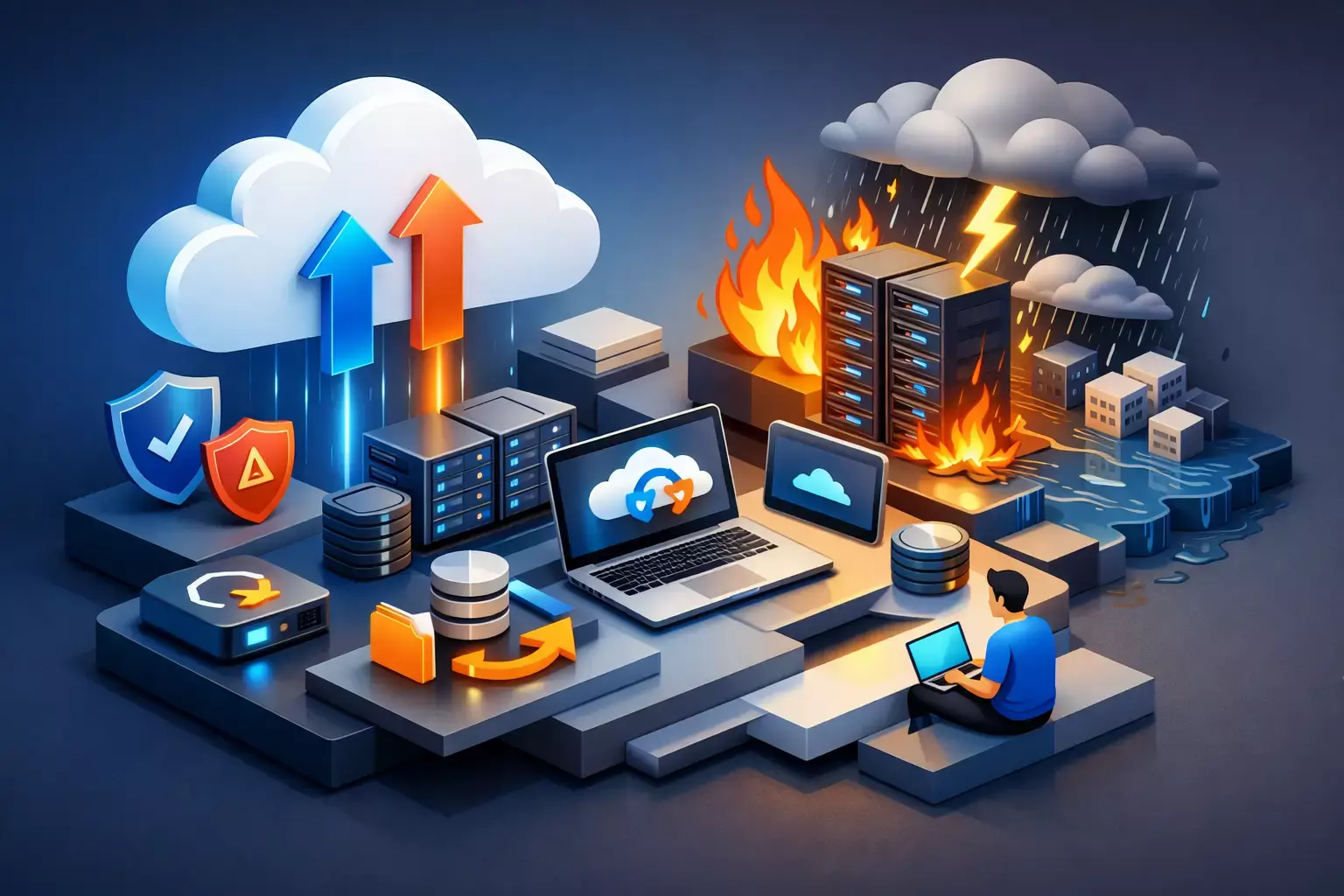
Building a cloud disaster recovery plan that can hold up under pressure
If you are building or revising your plan, focus on execution. Start by ranking systems by business impact. Define realistic RTOs and RPOs. Choose a recovery model that fits each workload rather than forcing one policy across the entire estate.
Then document the environment thoroughly and automate wherever possible. Infrastructure as code, configuration management, observability, and tested backup workflows make recovery faster and less dependent on tribal knowledge. Teams using AWS should also evaluate region strategy, storage class choices, native backup options, and architecture alignment against Well-Architected guidance.
Finally, make disaster recovery part of normal operations. Review it after major releases, cloud migrations, security incidents, compliance audits, and organizational changes. Recovery planning should evolve with the environment, not trail behind it.
For organizations that do not have deep internal cloud operations capacity, this is often where a hands-on partner adds value. Advanced Vision IT helps businesses design recovery strategies that fit their architecture, risk profile, and budget rather than forcing a generic template.
The best disaster recovery plan is not the one with the most pages. It is the one your team can execute confidently on a bad day, when the clock is running and every decision counts.

Written by Yavor Y. Zlatev
CEO & Founder at Advanced Vision IT Ltd | Published on
Yavor advises executive leadership teams on cybersecurity strategy, NIS2 compliance, and cloud operating models to build resilient IT environments.