



How to Reduce Cloud Downtime
A cloud outage rarely starts as a dramatic event. More often, it begins with something small: a failed deployment, a misconfigured security group, an overloaded database, or an alert nobody owned. For teams asking how to reduce cloud downtime, the real answer is not a single tool or provider feature. It is a discipline that combines architecture, observability, automation, security, and operational accountability.
For small and mid-sized businesses, downtime is rarely just a technical inconvenience. It affects revenue, customer trust, internal productivity, and, in some cases, compliance obligations. If your applications support transactions, customer portals, internal operations, or time-sensitive workflows, cloud resilience has to be designed into the environment from the start.
How to reduce cloud downtime starts with design
The biggest mistake many organizations make is treating uptime as a monitoring problem. Monitoring matters, but it only tells you that something is broken. It does not compensate for brittle infrastructure.
Reducing downtime starts with architecture decisions that remove single points of failure. In AWS and other cloud environments, that usually means distributing workloads across multiple availability zones, separating application tiers, and using managed services where they meaningfully reduce operational risk. A single virtual machine running your application and database may be inexpensive, but it also creates a single failure domain. When that instance fails, the service fails with it.
A more resilient design uses load balancing across multiple instances, replicated data services, and infrastructure that can be replaced automatically. That does increase complexity and sometimes cost. But the trade-off is predictable: lower short-term spend versus higher outage exposure. For customer-facing systems, the cost of downtime often outweighs the cost of redundancy.
This is also where workload classification matters. Not every system needs the same level of resilience. A public SaaS platform, payment workflow, or client portal may justify multi-zone or multi-region planning. A low-impact internal reporting tool may not. The goal is not to overbuild everything. It is to align resilience with business criticality.
Build for failure, not for perfect conditions
Many environments look stable until a change occurs. That is why deployment risk is one of the most common causes of downtime. If infrastructure changes, application releases, or configuration updates are handled manually, failure becomes a matter of timing.
Teams that want to reduce downtime should standardize changes through infrastructure as code and deployment automation. Tools such as Terraform, Ansible, and CI/CD pipelines help reduce variation between environments and make changes repeatable. Just as important, they create traceability. When something breaks, you can see what changed and roll back with more confidence.
Release strategy matters here. Blue-green and canary deployments can significantly reduce outage risk by limiting the blast radius of a bad release. Instead of replacing everything at once, you shift traffic gradually and verify health before full cutover. That approach may require more engineering effort upfront, but it gives operations teams room to catch problems before users feel them at scale.
The same principle applies to patching and maintenance. If your environment depends on planned downtime for routine updates, the architecture is already telling you where resilience is weak. Cloud-native systems should be able to tolerate instance replacement, node rotation, and service restarts without taking the entire application offline.
Observability is different from basic monitoring
A lot of companies have alerts. Fewer have observability.
Basic monitoring tells you whether a server is up, CPU is high, or storage is filling up. Observability gives you enough context to understand why performance is degrading and where the failure is propagating. For modern cloud systems, that means collecting metrics, logs, traces, and dependency data across infrastructure and applications.
Platforms such as New Relic can help teams correlate latency spikes, database pressure, failed requests, and service dependencies in real time. That visibility shortens mean time to detect and mean time to resolve, which directly reduces downtime impact. A ten-minute outage and a two-hour outage may start from the same incident, but observability changes the recovery curve.
Alert quality matters as much as alert volume. If your team is buried in noisy notifications, critical issues get missed or acknowledged too late. Alerts should map to service health and customer impact, not just raw infrastructure thresholds. It is better to have a smaller set of well-tuned, actionable alerts than hundreds of events nobody trusts.
Protect availability from security failures
One uncomfortable truth about cloud downtime is that security incidents often present as availability incidents. Ransomware, compromised credentials, denial-of-service events, and accidental privilege misuse can all take systems offline.
That is why cloud resilience and cloud security cannot be separated. Strong identity and access management, least-privilege controls, MFA enforcement, network segmentation, backup integrity, and continuous vulnerability management all contribute to uptime. If an attacker can disable services, encrypt data, or alter infrastructure configurations, you do not just have a security problem. You have an outage problem.
Misconfiguration is also a major issue in growing cloud estates. As teams move quickly, permissions expand, temporary exceptions become permanent, and manual workarounds accumulate. Regular reviews of IAM roles, security groups, exposed services, and policy drift help reduce avoidable downtime caused by human error.
For regulated businesses, compliance requirements often reinforce this discipline. Logging, access control, backup validation, and incident response procedures are not just audit items. They support operational continuity when systems are under pressure.
Backup and disaster recovery need real testing
Backups do not reduce downtime unless recovery is fast and proven.
Many businesses assume they are protected because snapshots are running or backup jobs report success. That assumption falls apart when a restore takes too long, critical dependencies are missing, or recovery steps exist only in one engineer's head. A backup strategy is only as useful as its restore process.
This is where recovery objectives matter. The recovery time objective tells you how quickly a service needs to return. The recovery point objective tells you how much data loss is acceptable. Those numbers should drive backup frequency, replication strategy, and failover design.
For some workloads, point-in-time restore is sufficient. For others, especially customer-facing or revenue-generating platforms, warm standby or automated failover may be justified. Multi-region resilience can reduce exposure to major regional outages, but it adds cost, data consistency considerations, and operational overhead. It is worth doing when the business case supports it, not as a default checkbox.
The critical step is testing. Run restore drills. Simulate database recovery. Validate DNS failover. Confirm that secrets, certificates, application dependencies, and network paths are included in recovery procedures. If it has not been tested, it is still a theory.
Operational ownership is what keeps systems available
Technology alone does not keep downtime low. Clear ownership does.
Every critical service should have an operational model: who monitors it, who responds to incidents, who approves changes, and who is accountable for resilience improvements. Many outages last longer than necessary because responsibility is fragmented between developers, cloud engineers, IT support, and outside vendors.
This is one reason many businesses move toward a single strategic cloud and managed services partner. When architecture, observability, security, support, and automation are treated as separate contracts, incident response becomes slower and root-cause correction gets delayed. A coordinated operating model closes those gaps.
Runbooks also matter. During an incident, teams do not need abstract guidance. They need clear steps for triage, escalation, failover, rollback, and communication. Good runbooks reduce guesswork and speed up coordinated action, especially outside normal business hours.
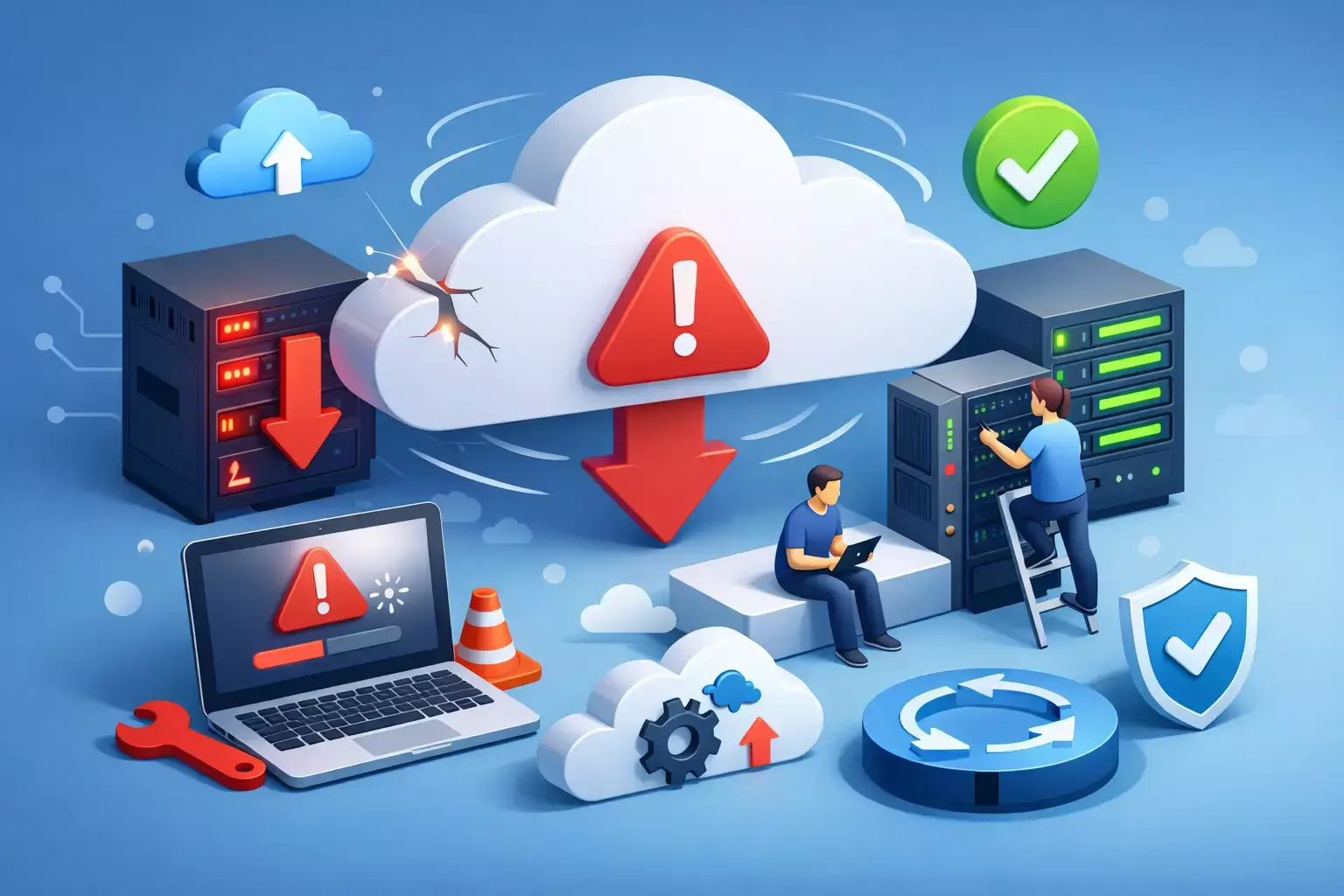
How to reduce cloud downtime over time
Cloud resilience is not a one-time project. Environments change, applications grow, and risk shifts with every deployment, integration, and business dependency.
The most effective teams review downtime and near-miss events with discipline. They do not stop at the immediate fix. They ask whether the incident exposed weak architecture, poor alerting, insecure access, undocumented processes, or missing automation. That is how uptime improves over time.
Periodic Well-Architected Reviews are useful here because they force a broader assessment of reliability, security, performance, and operational excellence. Done properly, these reviews turn resilience from a reactive concern into a planned capability.
For organizations that lack in-house cloud depth, outside expertise can make this process much more practical. Advanced Vision IT often works with businesses that have already migrated to the cloud but still deal with recurring service interruptions, alert fatigue, and unclear recovery procedures. In those cases, the path to better uptime is usually not a full rebuild. It is targeted modernization: redesigning weak components, tightening observability, automating operations, and aligning support with actual business risk.
If you want less downtime, think beyond uptime percentages. Look at design, change management, visibility, security, and response readiness as one operating system. When those pieces work together, outages become shorter, rarer, and much less disruptive to the business.
FAQ
1. What are the most common causes of cloud downtime?
Cloud downtime typically starts with small issues such as failed deployments, misconfigurations, overloaded databases, or unaddressed alerts. These problems often escalate due to weak architecture, lack of automation, and unclear operational ownership.
2. How does cloud architecture impact availability?
Architecture plays a critical role in uptime. Distributing workloads across multiple availability zones, using load balancers, and leveraging managed services helps eliminate single points of failure and improves system resilience.
3. How can deployment risks be reduced in cloud environments?
Deployment risks can be minimized through automation and standardization. Using Infrastructure as Code (e.g., Terraform, Ansible) and CI/CD pipelines ensures consistency, while strategies like blue-green and canary deployments reduce the impact of faulty releases.
4. What is the difference between monitoring and observability?
Monitoring shows what is happening (e.g., high CPU usage or downtime), while observability helps explain why it is happening. Observability combines metrics, logs, and traces to provide deeper insights, enabling faster issue detection and resolution.
5. Why is testing backup and disaster recovery critical?
Backups are only effective if recovery is fast and reliable. Without regular testing, restore processes may fail or take too long. Testing ensures systems meet Recovery Time Objectives (RTO) and Recovery Point Objectives (RPO) during real incidents.

Written by Yavor Y. Zlatev
CEO & Founder at Advanced Vision IT Ltd | Published on
Yavor advises executive leadership teams on cybersecurity strategy, NIS2 compliance, and cloud operating models to build resilient IT environments.