



Managed IT Services vs Outsourcing Compared
A failed deployment at 9 p.m., an exposed administrator account, or an AWS bill that rises without a clear explanation quickly reveals the limits of an unclear support model. The managed IT services vs outsourcing decision is not simply about finding outside help at the lowest hourly rate. It determines who owns operational accountability, how quickly issues are resolved, whether security controls are maintained, and how well technology supports the next stage of growth.
For small and mid-sized businesses, the distinction matters most when infrastructure becomes more complex. A company may have a mix of SaaS platforms, remote users, cloud workloads, custom applications, compliance obligations, and limited internal IT capacity. The right model can reduce friction and risk. The wrong one can create a rotating queue of vendors, undocumented systems, and costly gaps in responsibility.
Managed IT Services vs Outsourcing: The Core Difference
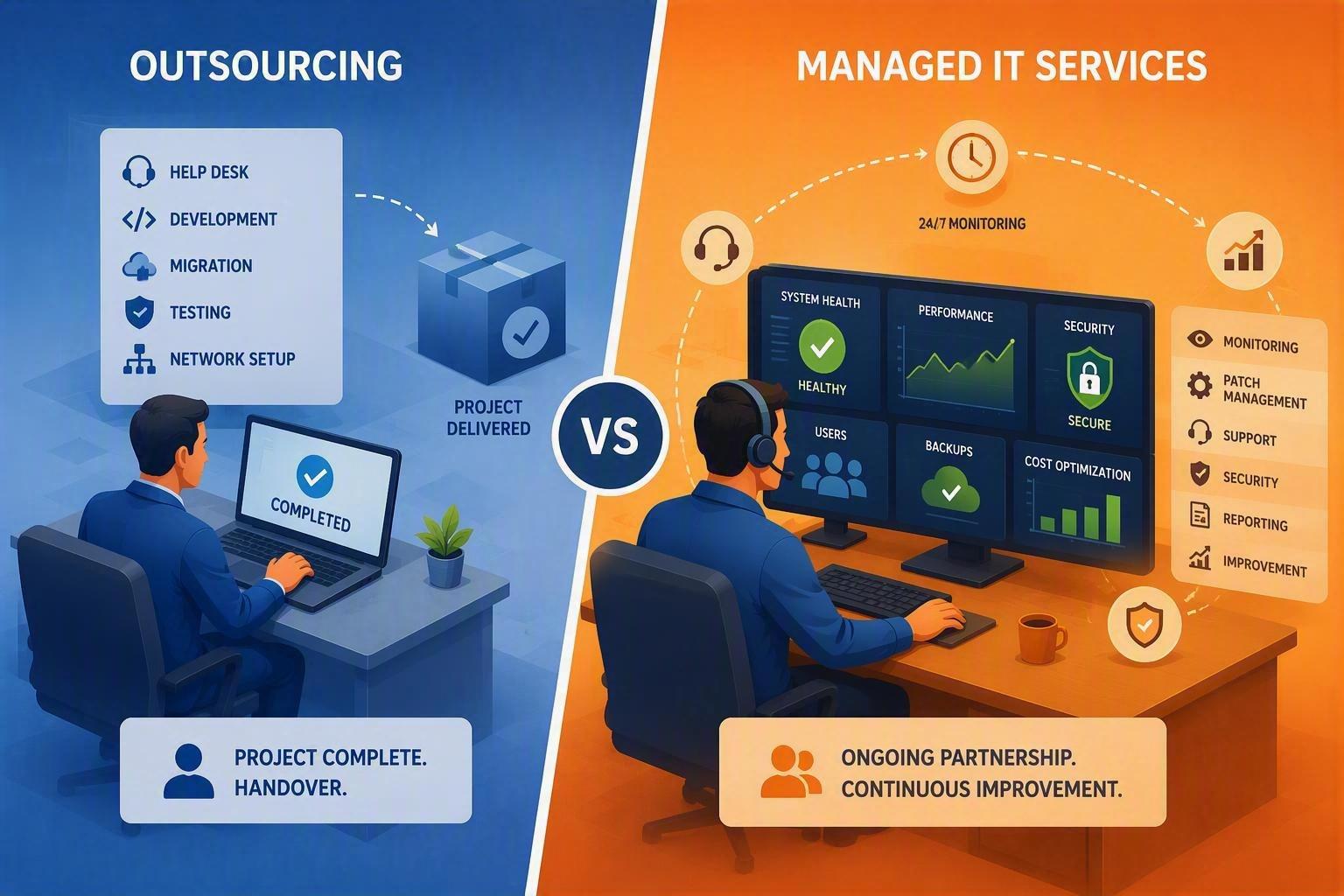
Outsourcing is a broad purchasing model. It means assigning a defined IT task, function, or project to an external provider. That could include help desk coverage, software development, a cloud migration, penetration testing, network installation, or a temporary DevOps engagement. The relationship is often scoped around deliverables, hours, or a statement of work.
Managed IT services are an ongoing operating model. A managed service provider assumes continuing responsibility for agreed portions of the IT environment, usually through a recurring monthly arrangement. The provider monitors systems, manages patches and backups, supports users, maintains security controls, documents the environment, and reports on service performance. The work is proactive as well as responsive.
That distinction sounds straightforward, but the practical difference is ownership. A project outsourcer may successfully complete a migration and hand over the environment. A managed services partner remains involved after cutover, watching performance, resolving incidents, controlling access, optimizing costs, and planning improvements as business needs change.
Neither model is automatically better. Outsourcing can be the right choice for a contained initiative with a clear end state. Managed services are usually more effective when uptime, security, support quality, and infrastructure health require continuous attention.
Where Traditional IT Outsourcing Works Well
Traditional outsourcing is valuable when the scope is narrow, specialized, or temporary. A business may need a development team to build a customer portal, a consultant to perform a Well-Architected Review, or an AWS specialist to design a landing zone. In these cases, the organization benefits from targeted expertise without carrying the cost of a full-time hire.
It also works when internal leadership has strong operational control. If an experienced IT team already owns architecture, vendor coordination, documentation, security policies, and incident response, it can outsource individual workstreams while retaining accountability internally. The outside provider supplies capacity or a specific skill set, not day-to-day technology leadership.
The trade-off is coordination. Each vendor needs clear access boundaries, documentation standards, escalation paths, and ownership rules. When a network partner, cloud consultant, cybersecurity firm, software agency, and internal team all touch the same environment, incident resolution can slow down. The issue is rarely a lack of technical talent. It is the time spent determining who owns the problem.
Outsourcing also tends to be reactive unless the contract explicitly includes ongoing management. A provider engaged for a migration is not necessarily monitoring the environment six months later. A development agency may ship code without owning observability, vulnerability remediation, or production support. Those responsibilities must be assigned before they become urgent.
What Managed IT Services Add Beyond Support
Managed IT services are often mistaken for outsourced help desk support. User support is part of the service, but a mature managed model extends much further. It connects everyday operations with architecture, cybersecurity, cloud governance, and business continuity.
For example, a managed provider can monitor infrastructure through platforms such as New Relic, investigate recurring performance issues, and identify whether the root cause sits in application code, database capacity, network configuration, or AWS resource sizing. It can manage identity and endpoint controls, verify backups, coordinate patching, and maintain an incident playbook. These activities are less visible than a completed project, but they are what protect uptime and reduce operational surprises.
A strong provider also creates a reliable system of record. Asset inventories, access controls, network diagrams, runbooks, vendor contacts, and recovery procedures should not live only in one employee's memory or a former contractor's inbox. Documentation gives the business continuity when people, platforms, and priorities change.
The best managed relationships are not rigid bundles of tickets. They combine a consistent operational baseline with engineering expertise when deeper work is needed. That might mean using Terraform to standardize infrastructure, Ansible to automate configuration, CI/CD pipelines to improve release quality, or cloud cost controls to reduce waste without weakening performance.
A Real-World Example: When Accountability Matters
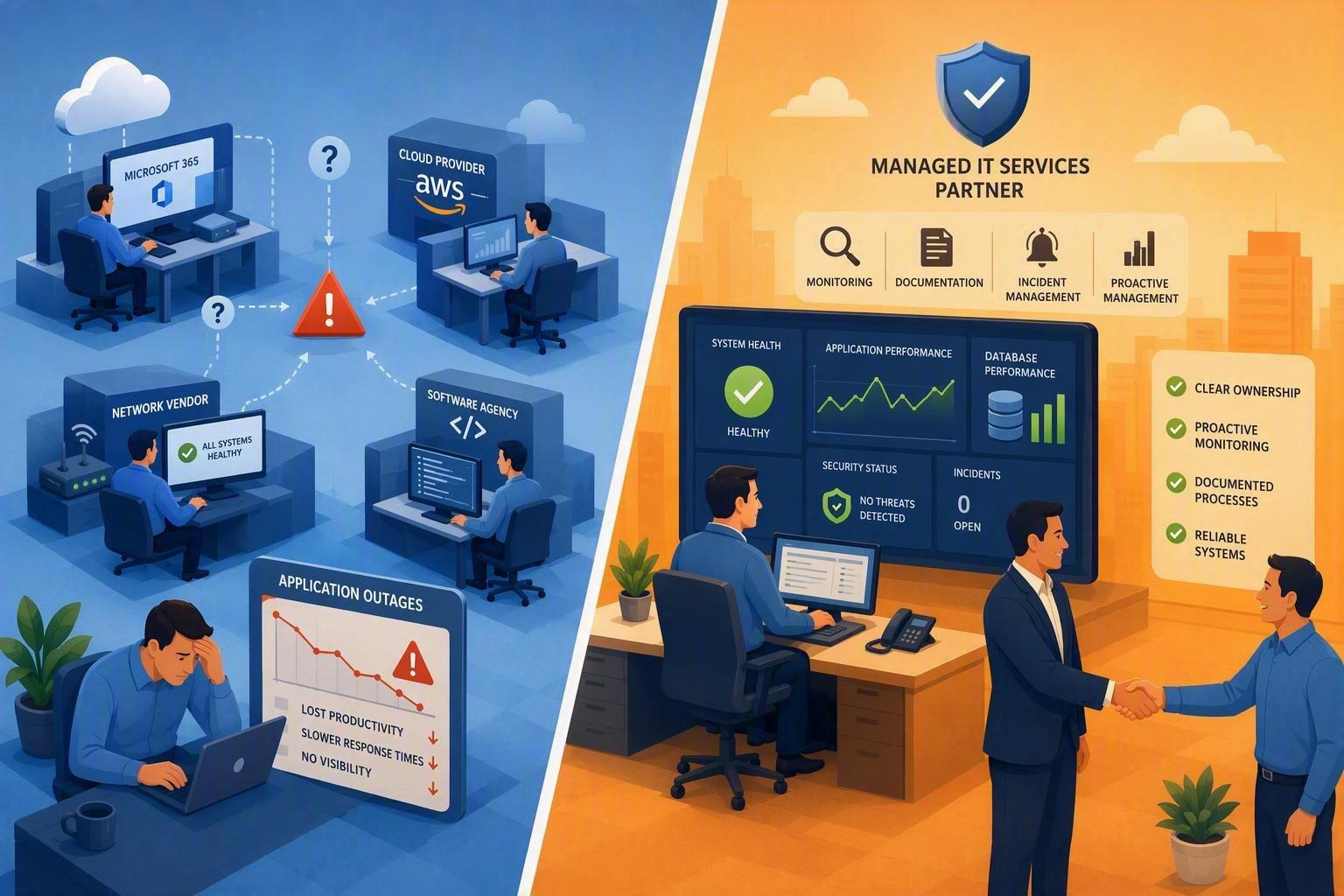
Consider a growing professional services company with 120 employees spread across multiple locations. Over several years, the business worked with different IT vendors for different needs: one provider managed Microsoft 365, another handled network infrastructure, a cloud consultant supported AWS workloads, and a software agency maintained a customer-facing application.
When users began experiencing intermittent application outages, resolving the issue became difficult. The cloud provider pointed to the application, the software agency blamed network latency, and the network vendor reported that all systems appeared healthy. Meanwhile, employees lost productivity, customer response times increased, and leadership had no clear visibility into who was responsible for fixing the problem.
The company eventually engaged a managed IT services provider to take ownership of infrastructure operations, monitoring, documentation, and incident management. Within weeks, centralized monitoring identified a database performance bottleneck that had been affecting application response times for months. The issue was remediated, escalation procedures were documented, and ongoing monitoring was established to prevent repeat incidents.
The technology itself had not changed dramatically. What changed was accountability. Instead of coordinating multiple vendors during every incident, the business had a single operational partner responsible for identifying, managing, and resolving issues across the environment.
Why This Matters
The managed IT services vs outsourcing decision directly affects business continuity, security, and operational efficiency. As organizations adopt more cloud services, remote work capabilities, SaaS applications, and cybersecurity controls, technology environments become increasingly interconnected. A problem in one area can quickly affect multiple systems, users, and business processes.
When responsibility is fragmented across several vendors, issues can take longer to diagnose and resolve because each provider sees only part of the environment. This often leads to delays, communication gaps, and uncertainty during critical incidents.
A managed services model helps reduce that risk by establishing clear ownership, proactive monitoring, documented procedures, and defined service levels. Rather than reacting only when something breaks, the provider continuously works to maintain system health, reduce security exposure, control costs, and improve reliability.
For growing businesses, the question is no longer whether to seek external IT support. The more important question is whether that support model gives the organization clear accountability, operational visibility, and confidence that critical systems are being actively managed every day. Those factors often have a greater impact on long-term business performance than the hourly rate of any individual vendor.
How to Choose Between the Two Models
The decision should begin with the operating problem, not the service label. Ask whether the business needs a completed piece of work or a partner accountable for keeping critical technology healthy over time.
Choose outsourcing for defined outcomes
A project-based outsourcing model is usually appropriate when the result can be clearly described, accepted, and handed off. Examples include building a mobile application, replacing a firewall, conducting a compliance assessment, or migrating a known set of workloads to AWS. Define the deliverables, acceptance criteria, security requirements, knowledge transfer process, and post-project support period before work begins.
This approach is particularly useful for organizations with capable internal teams that need extra capacity. It can also be a sensible first engagement when a business wants to evaluate a provider's technical depth before committing to a longer relationship.
Choose managed services for continuous accountability
Managed IT is generally the better fit when systems are business-critical and internal staff cannot consistently cover operations. This includes organizations that need 24/7 monitoring, recurring security management, reliable employee support, cloud cost optimization, compliance evidence, or a clear escalation path during an incident.
The monthly cost is not merely payment for available technicians. It funds a managed operating discipline: monitoring, maintenance, reporting, documentation, tooling, and access to specialists who can address problems before they interrupt the business.
For a growth-stage company, this can be more predictable than hiring separate network, cloud, security, and support roles. It also avoids forcing a small internal team to spend most of its time resetting passwords, chasing alerts, and coordinating vendors instead of improving products and processes.
Consider a hybrid model when strategy stays in-house
Many businesses need both. An internal CTO or engineering leader may retain authority for product architecture and technical strategy while a managed partner operates core infrastructure, security, endpoint management, and cloud environments. The company can then bring in project specialists for a major application build, data platform initiative, or compliance certification.
This hybrid model works only when responsibilities are explicit. The internal team, managed provider, and project vendors need agreed boundaries for production changes, access management, monitoring, incident escalation, and documentation. Shared accountability is useful; vague accountability is not.
Compare Cost by Risk and Responsibility, Not Just Rates
Hourly outsourcing can appear less expensive because the business pays only when work is requested. However, this comparison can hide the cost of downtime, delayed patching, weak documentation, duplicated tools, and internal time spent managing vendors. A low project rate is not a low total cost if every issue becomes a new scope discussion.
Managed services create a more predictable operating expense, but they should be evaluated carefully. A provider that offers a flat fee without defining service levels, security responsibilities, technology coverage, or exclusions may create the same uncertainty under a different billing model. Ask what is actively monitored, how alerts are handled, what response times apply, and which strategic reviews are included.
Security deserves special attention. A project vendor can implement a control, but someone must continuously verify that it remains effective. Identity permissions change, new endpoints appear, software vulnerabilities emerge, and cloud configurations drift. Security as a Service is most valuable when it is connected to daily operations rather than treated as an annual checklist.
Build the Relationship Around Measurable Operations
Whether you select managed IT services, outsourcing, or a blend of both, establish practical measures from the start. Define who owns incident response, how quickly critical issues are acknowledged, how changes are approved, where documentation is maintained, and how security events are escalated. Review service trends regularly, including recurring tickets, backup results, patch status, cloud spending, availability, and unresolved risks.
Advanced Vision IT approaches managed operations as an extension of the client's technology team, combining support with cloud, security, automation, and infrastructure expertise. That model is especially useful when a business needs one accountable partner across hybrid environments instead of separate vendors for each operational layer.
The most useful question is not whether to outsource IT. It is whether your business has a clear, accountable operating model for the technology it depends on every day. Choose the arrangement that gives your team the visibility, expertise, and ownership needed to move forward with confidence.
Frequently Asked Questions (FAQ)
1. What is the main difference between managed IT services and IT outsourcing?
The primary difference is accountability. IT outsourcing typically focuses on completing a specific project, task, or function with a defined scope and end date. Managed IT services provide ongoing operational responsibility, including monitoring, maintenance, security management, user support, documentation, and continuous improvement.
2. When should a business choose IT outsourcing?
Outsourcing is often the best choice for short-term, specialized, or project-based needs. Examples include cloud migrations, software development, compliance assessments, penetration testing, or network implementations. It works particularly well when an internal IT team can maintain long-term ownership and coordination after the project is complete.
3. What additional value do managed IT services provide beyond help desk support?
Managed IT services go far beyond resolving user issues. A managed service provider proactively monitors infrastructure, manages cybersecurity, maintains backups and patching, documents systems, optimizes cloud environments, and helps ensure business continuity. The goal is to prevent problems before they affect operations.
4. Can a company use both managed services and outsourcing together?
Yes. Many organizations adopt a hybrid model where an internal IT leader or team retains strategic control while a managed services provider handles day-to-day operations. Specialized outsourcing partners can then be engaged for projects such as application development, cloud modernization, or compliance initiatives.
5. How should businesses compare the cost of managed IT services versus outsourcing?
Businesses should evaluate more than hourly rates or monthly fees. Consider factors such as downtime risk, security management, response times, documentation quality, vendor coordination, compliance requirements, and operational accountability. A lower upfront cost can become more expensive if unresolved issues, security gaps, or unclear ownership create business disruptions.

Written by Alexander Boychev
Business Executive & Digital Marketing Manager at Advanced Vision IT Ltd | Published on
Alexander advises insights on business development, strategic key account management, and digital marketing in the IT sector.