



Managed IT vs In-House: Which Fits Best?
A single outage can change how a leadership team thinks about IT. What looked cost-effective on paper suddenly becomes expensive when sales stop, employees stall, or a security incident exposes weak coverage. That is usually when the managed IT vs in-house question becomes urgent.
For small to mid-sized businesses, this is not just a staffing decision. It affects resilience, speed of execution, cloud performance, compliance readiness, and whether your team spends time moving the business forward or reacting to preventable issues. The right answer depends on your environment, your risk profile, and how much specialized expertise you need day to day.
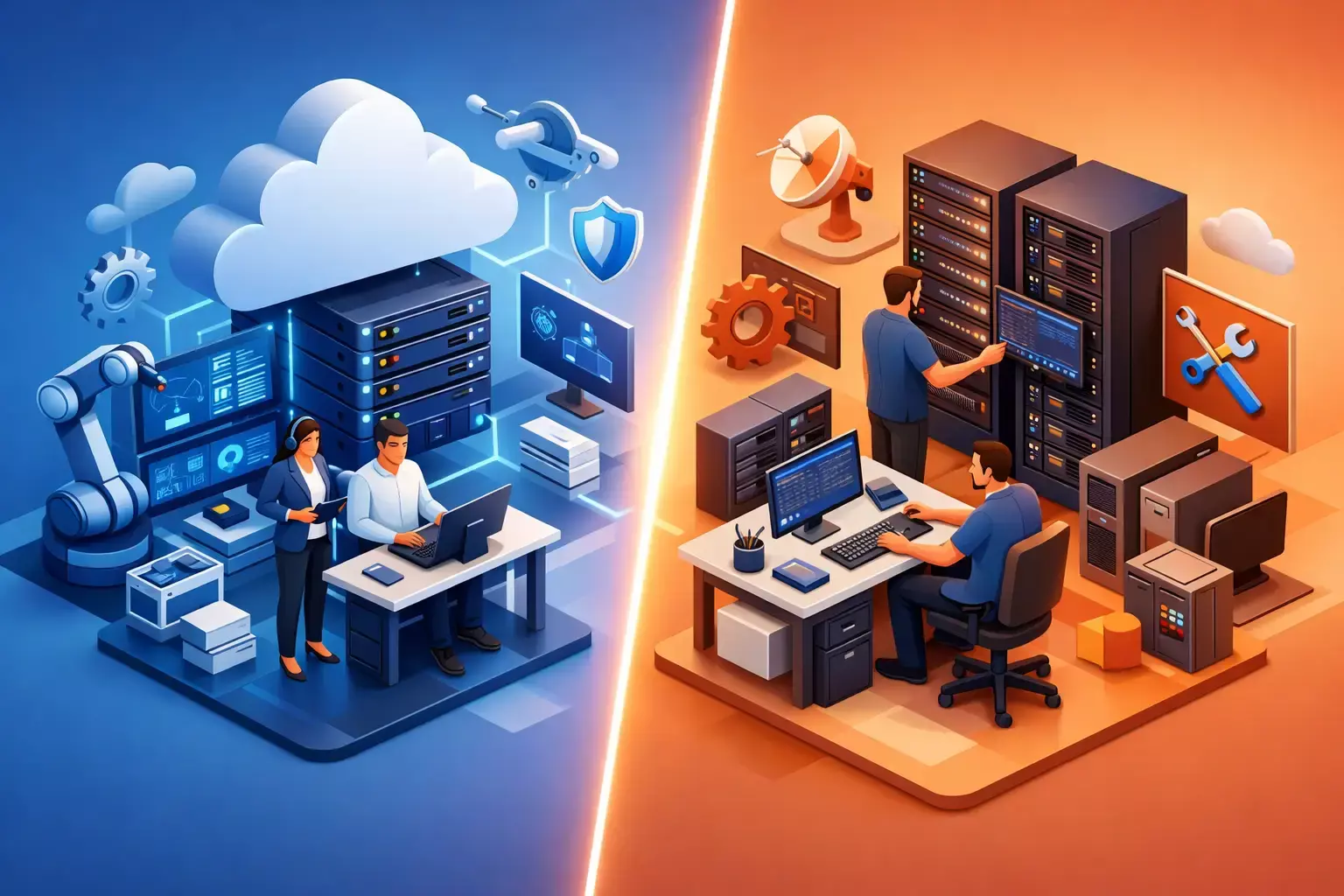
Managed IT vs in-house: the real difference
At a surface level, the difference seems simple. In-house IT means you hire employees to manage systems, support users, maintain infrastructure, and handle security internally. Managed IT means you work with an external partner that delivers some or all of those functions as a service.
In practice, the gap is much wider than payroll versus contract spend. An in-house team gives you direct control, internal context, and immediate proximity to business stakeholders. A managed provider gives you broader technical coverage, established processes, deeper specialization, and usually a more predictable operating model.
That distinction matters more as environments become more complex. A business running Microsoft 365, AWS workloads, endpoint protection, backups, identity controls, observability tooling, and compliance requirements is not managing a simple help desk anymore. It is managing an interconnected operational stack where one weak point can affect performance, security, and customer trust.
Cost is rarely as simple as salary versus service fee
Many organizations start with the assumption that in-house IT is cheaper because the expense is easier to recognize. A salary, benefits package, and equipment budget feel straightforward. But actual cost includes much more than headcount.
- An internal hire may be strong in user support but not cloud architecture. Another may know networking well but lack experience with DevOps pipelines, SIEM tooling, or compliance controls. As a result, companies often need multiple hires, outside consultants, or delayed projects because the required skills are fragmented.
- Managed IT changes that equation by giving access to a wider bench of specialists for a recurring fee. That may include infrastructure engineers, security practitioners, cloud architects, automation experts, and support resources without the cost of building that team one role at a time.
This does not mean managed services are always less expensive. If your organization has stable needs, low complexity, and enough scale to keep a full internal team fully utilized, in-house can make financial sense. But for many growth-stage companies, the more accurate comparison is not one IT generalist versus one monthly invoice. It is limited internal coverage versus access to a structured operating capability.
Security and compliance usually expose the biggest gap
Security is where many businesses discover the limits of an in-house model.
- A lean internal team may be capable and committed, but still stretched too thin to cover patching, access reviews, endpoint controls, backup verification, incident response planning, vulnerability management, and continuous monitoring at the level modern environments require. The issue is not effort. It is bandwidth and specialization.
- Managed providers that work across cloud, infrastructure, and security tend to build repeatable controls into service delivery. That can include baseline hardening, log monitoring, alerting, backup oversight, MFA enforcement, privileged access management, and policy-driven remediation. If your business must align with frameworks or customer security demands, that structure becomes even more valuable.
In-house teams can absolutely build strong security programs, especially in mature organizations with dedicated leadership and budget. But if your current team is already juggling tickets, vendor coordination, procurement, and day-to-day support, security often becomes reactive. That is a dangerous place to operate from.
Speed and scalability favour managed models
When companies grow, IT complexity usually grows faster than expected. New users, new locations, SaaS sprawl, cloud migrations, hybrid infrastructure, and tighter customer requirements all add operational load. The question is whether your support model scales with that growth.
- In-house teams often scale linearly. More demand means more hiring, more onboarding, and more management overhead. That can work, but it tends to lag behind business needs, especially when hiring for cloud and security roles is competitive and expensive.
- A managed model can scale more flexibly. If you need AWS support during a migration, CI/CD guidance for a release process, or expanded monitoring after deploying critical workloads, a capable partner can extend coverage faster than a business can assemble specialized internal talent.
This is one reason many companies use managed services not just for support, but for modernization. They need execution capacity as much as they need operational stability.
Where in-house IT still makes strong sense
There are clear cases where building internally is the right move. If your company has highly specialized internal systems, strict data handling needs, or a product environment tightly connected to business operations, internal ownership may be essential. The same is true if leadership wants complete organizational control over processes, priorities, and institutional knowledge.
In-house teams are also valuable when day-to-day alignment with users and departments is critical. An internal team often develops a strong understanding of company workflows, informal dependencies, and political realities that external partners need time to learn.
For larger businesses, the strongest model is often internal leadership supported by selective external expertise. That preserves strategic control while adding capacity where it matters most.
Where managed IT delivers the most value
Managed IT tends to perform best when a business needs dependable outcomes across multiple domains without building a large internal team. That includes user support, cloud operations, infrastructure management, cybersecurity, backup and disaster recovery, monitoring, compliance support, and vendor coordination.
It is especially effective for organizations in transition. Maybe you are moving into AWS, standardizing with Terraform and Ansible, improving observability with New Relic, or tightening release processes through CI/CD. Those changes require skills that many internal teams only need periodically, which makes permanent hiring inefficient.
A strong managed partner can bridge that gap by handling operations while also guiding architecture, optimization, and long-term planning. That is very different from a basic outsourced help desk model. It is closer to adding an operationally mature engineering function that supports the business at both strategic and implementation levels.
The hybrid model is often the most practical answer
The managed IT vs in-house debate is often framed as an either-or decision, but many businesses get better results from a hybrid structure.
- In this model, internal staff retain ownership of business priorities, stakeholder alignment, and selected systems, while a managed partner handles infrastructure operations, cloud management, security monitoring, after-hours support, or project delivery. This reduces pressure on internal teams without removing control.
- For example, an internal IT manager may lead policy, budgeting, and executive communication, while an external partner manages AWS infrastructure, patching, backup oversight, endpoint security, and escalation support. That approach gives leadership one accountable internal owner without forcing one person or a small team to cover every technical domain.
This is often the best fit for businesses that have some internal capability but need stronger execution, broader expertise, or better operational coverage.
Questions to ask before choosing
The best decision usually becomes obvious when leadership stops asking who will "handle IT" and starts asking what the business truly needs IT to deliver.
- If uptime is business-critical, ask whether your current team can provide monitoring, incident response, and remediation coverage consistently.
- If cloud cost and performance matter, ask whether you have the skills to optimize architecture rather than simply maintain it.
- If compliance is on the horizon, ask whether controls are documented, repeatable, and audit-ready.
- You should also look at concentration risk. If one or two internal people hold most of the environment knowledge, turnover becomes an operational threat. A managed model can reduce that dependency by formalizing documentation, process, and shared ownership.
Finally, consider whether your team is spending time on strategic work or getting buried in maintenance. If talented internal staff are resetting passwords, chasing alerts, and coordinating vendors instead of driving modernization, your operating model may be holding the business back.
The right choice is the one that lets your team spend less time compensating for gaps and more time building a stronger, more resilient operation.
Choosing a model that supports growth
There is no universal winner in managed IT vs in-house. The better model is the one that aligns technical coverage with business risk, growth plans, and operational complexity.
If your environment is straightforward and your internal team is experienced, in-house may be enough. If your business depends on cloud performance, security maturity, and scalable support across a changing environment, managed services can offer more stability and depth. And if you want strategic control without carrying the full burden internally, a hybrid model often delivers the strongest balance.
At Advanced Vision IT, that is where many client relationships start - not with a full handoff, but with a practical assessment of what should stay internal, what should be operationalized externally, and how to build an IT model that can keep up with the business.

Written by Miroslav Sultanov
Technical Account Management Team Lead & Senior SEO Specialist at Advanced Vision IT Ltd | Published on
Miroslav advises strategic digital marketing insights, search optimization strategies, and technical team leadership.