



MDR vs SECaaS for SMB: Which Model Fits?
A suspicious sign-in at 2:13 a.m. is not a cybersecurity strategy. For a small or mid-sized business, the real question is who will recognize the event, determine whether it matters, contain the threat, and document what happened before business operations are affected. That is why the MDR vs SECaaS for SMB decision deserves more attention than a comparison of feature lists.
Both models can improve security without building a large internal security operations center. But they solve different operational problems. Choosing well requires a clear view of your environment, regulatory exposure, internal IT capacity, and tolerance for security risk.
MDR vs SECaaS for SMB: The Core Difference
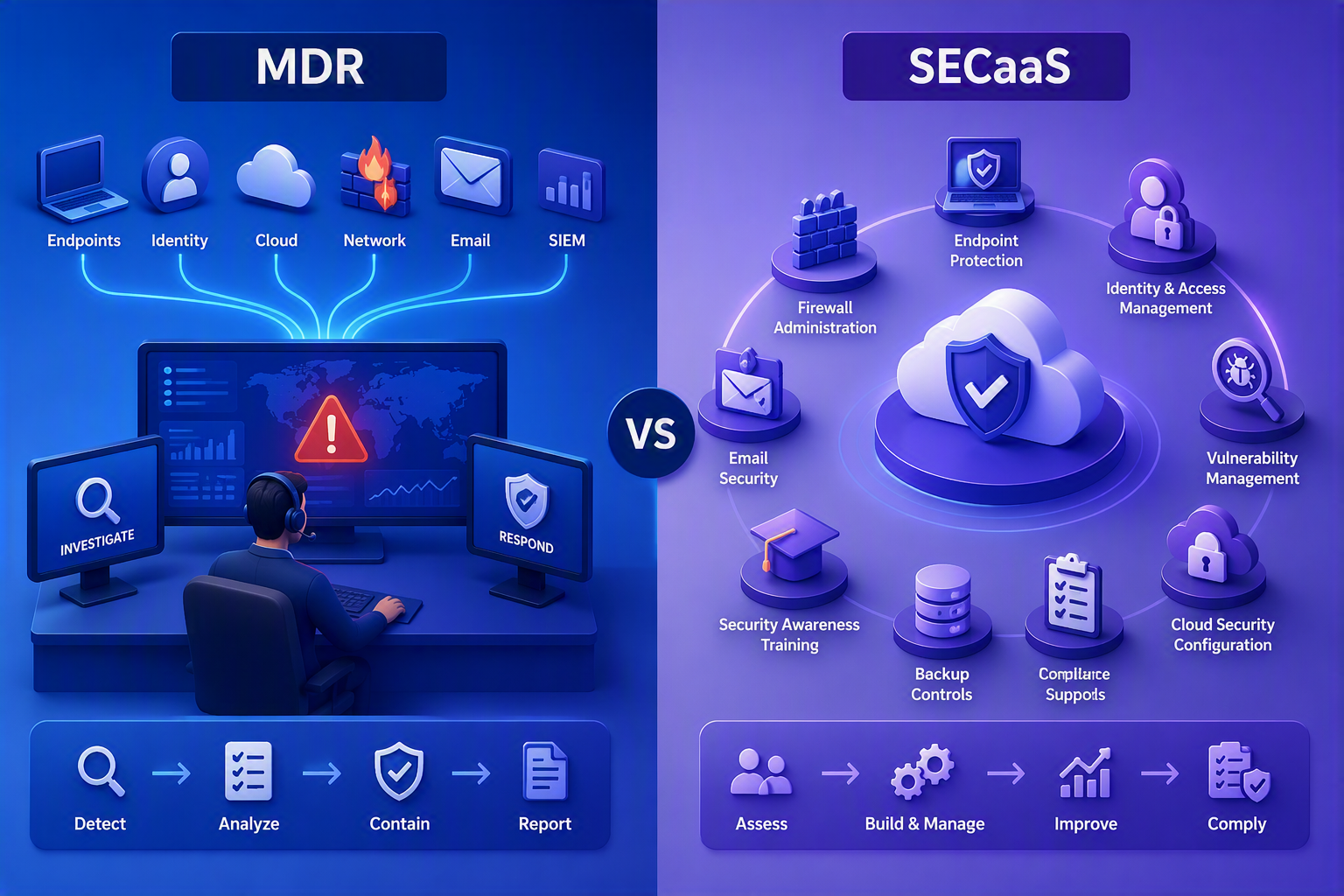
Managed Detection and Response, or MDR, is a focused security service built around continuous threat monitoring, investigation, and response. An MDR provider collects and analyzes telemetry from sources such as endpoints, identity platforms, cloud workloads, firewalls, email systems, and security information and event management tools. Security analysts then validate alerts and take agreed-upon response actions.
In practical terms, MDR answers a high-pressure question: when an attacker gets past a preventive control, who is watching and what happens next?
Security as a Service, or SECaaS, is broader. It is a delivery model for outsourced security capabilities, often provided as a managed monthly service. Depending on the provider and service design, SECaaS can include endpoint protection, identity and access management, vulnerability management, firewall administration, email security, security awareness training, compliance support, cloud security configuration, backup controls, and incident response planning.
MDR can be part of a SECaaS program. SECaaS does not automatically include a mature MDR function. That distinction matters because many businesses assume 24/7 monitoring is included when they have purchased a collection of security tools and ongoing administration.
What MDR Is Designed to Do
MDR is strongest when detection and response are the immediate gap. A business may already have Microsoft 365 security controls, endpoint protection, a firewall, AWS logging, and multifactor authentication, yet still lack people who can assess alerts around the clock. Tools generate signals. MDR provides the analyst-led process that turns those signals into decisions and action.
A capable MDR service usually includes telemetry onboarding, threat detection engineering, continuous monitoring, alert triage, investigation, threat hunting, escalation procedures, and documented response workflows. Some providers can isolate a compromised endpoint, disable a suspicious account, block an indicator, or initiate containment under preapproved authority. Others notify your team and wait for approval. The difference should be explicit in the service agreement.
For an SMB, MDR can sharply reduce alert fatigue. Internal IT teams often receive too many alerts from too many consoles and have limited time to investigate them. MDR filters routine noise, identifies confirmed threats, and presents incidents with useful context: what occurred, which systems are affected, the likely impact, and the recommended next action.
MDR is not a substitute for foundational security. It cannot compensate for unmanaged endpoints, missing identity controls, inadequate backups, exposed remote access, or a cloud environment with weak permissions and incomplete logs. It works best when it is connected to an environment that has defined ownership, reliable telemetry, and a practical incident response process.
What SECaaS Is Designed to Do
SECaaS addresses a wider operational challenge: building and maintaining a security baseline across the business without hiring specialists for every domain. It is especially useful for organizations with fragmented technology management, growing cloud use, compliance pressure, or no dedicated security leader.
A well-scoped SECaaS engagement begins with the assets and workflows that matter most. That may include employee laptops, SaaS applications, AWS accounts, production databases, customer data, network infrastructure, and backup systems. From there, the provider can establish security controls, manage them over time, identify gaps, and align operations with business requirements.
For example, a growth-stage company moving customer-facing services to AWS may need secure account architecture, least-privilege identity design, centralized logging, vulnerability remediation, configuration monitoring, backup validation, and ongoing operational support. An MDR service may watch for active threats across parts of that environment. A broader SECaaS program can help build, operate, and improve the controls that reduce exposure before an alert is ever generated.
This broad scope is valuable, but it also creates a buying risk. SECaaS can mean very different things between providers. One offering may be largely tool resale with limited management. Another may include hands-on engineering, recurring security reviews, compliance evidence collection, incident readiness, and integrated cloud and IT operations. SMB leaders should look past the label and assess the actual responsibilities, response commitments, and technical coverage.
Choosing Based on Your Operating Reality
The right model depends less on company size than on the maturity and complexity of your environment. An organization with a capable IT team and established controls may primarily need MDR to close its monitoring and response gap. A business with aging infrastructure, inconsistent patching, unmanaged SaaS access, and unclear cloud ownership will generally gain more from a broader SECaaS foundation.
Consider an MDR-first approach if your organization already has a documented security baseline, properly deployed endpoint and identity tools, centralized logs, tested backups, and an internal team able to remediate issues. In that situation, the biggest concern may be after-hours monitoring and access to experienced incident responders.
Consider a broader SECaaS approach if security work is reactive, systems are managed by several vendors, policies do not match technical reality, or compliance requirements are increasing. The priority is not only spotting active threats. It is establishing accountable security operations across people, processes, infrastructure, and cloud services.
Many SMBs ultimately need both. The practical model is often SECaaS as the operating framework, with MDR as a defined detection-and-response component. This gives leadership one accountable partner for core security controls while ensuring high-priority alerts are assessed by a specialized team.
Evaluate the Response Model, Not Just the Toolset
Security proposals often emphasize familiar products. Those products matter, but software alone does not define service quality. The most revealing questions concern operational execution.
Ask which data sources are monitored, whether coverage is truly 24/7, and how long it typically takes for a validated incident to reach your team. Confirm whether the provider can contain threats directly, what approvals are required, and which actions remain your responsibility. Review how incidents are documented, how post-incident lessons are converted into improvements, and whether security findings connect to patching, cloud configuration, identity, and business continuity work.
For regulated organizations, ask how the service supports evidence collection and control validation. A provider may deliver excellent endpoint monitoring but offer little help with access reviews, asset inventories, change records, risk assessments, or audit documentation. Those responsibilities are often central to frameworks such as HIPAA, PCI DSS, SOC 2, and CMMC-related requirements.
Cost should be evaluated in the same operational context. MDR may have a lower and more predictable starting cost because its scope is narrower. SECaaS can cost more because it includes additional technologies and management activities, but it may replace fragmented contracts, reduce internal administrative load, and limit the cost of security gaps. The lowest monthly quote is rarely the lowest total risk.
Build a Security Roadmap Before You Buy
Before selecting either service, create a concise inventory of critical systems, data types, user identities, cloud accounts, business applications, and existing security controls. Identify where visibility is missing and who owns remediation when a risk is found. This exercise often exposes the real issue: not a lack of products, but a lack of operational accountability.
Then prioritize in the order that reduces practical risk. Secure identity and privileged access. Ensure endpoint coverage and patch management. Protect backups and test recovery. Centralize meaningful logs. Establish incident response authority. Add continuous detection and response where your internal team cannot provide it. For cloud environments, include configuration governance, workload visibility, and cost-aware logging design from the beginning.
Advanced Vision IT can help organizations connect these decisions across managed IT, AWS operations, cloud security, observability, and compliance rather than treating each control as a separate vendor project. That integrated approach is especially useful when a security finding requires an infrastructure, DevOps, or application-level fix.
The useful decision is not whether MDR or SECaaS sounds more comprehensive. It is whether your chosen service gives the business clear ownership of prevention, detection, response, recovery, and continuous improvement. When those responsibilities are defined before an incident, security becomes a managed operating capability instead of an urgent problem waiting for the next alert.
User Story: When an Alert Appears After Everyone Has Gone Home
Consider a growing professional services company with 120 employees. The business relies heavily on Microsoft 365, cloud-based applications, and remote workers. The internal IT team consists of two people who are responsible for everything from onboarding users to supporting business applications.
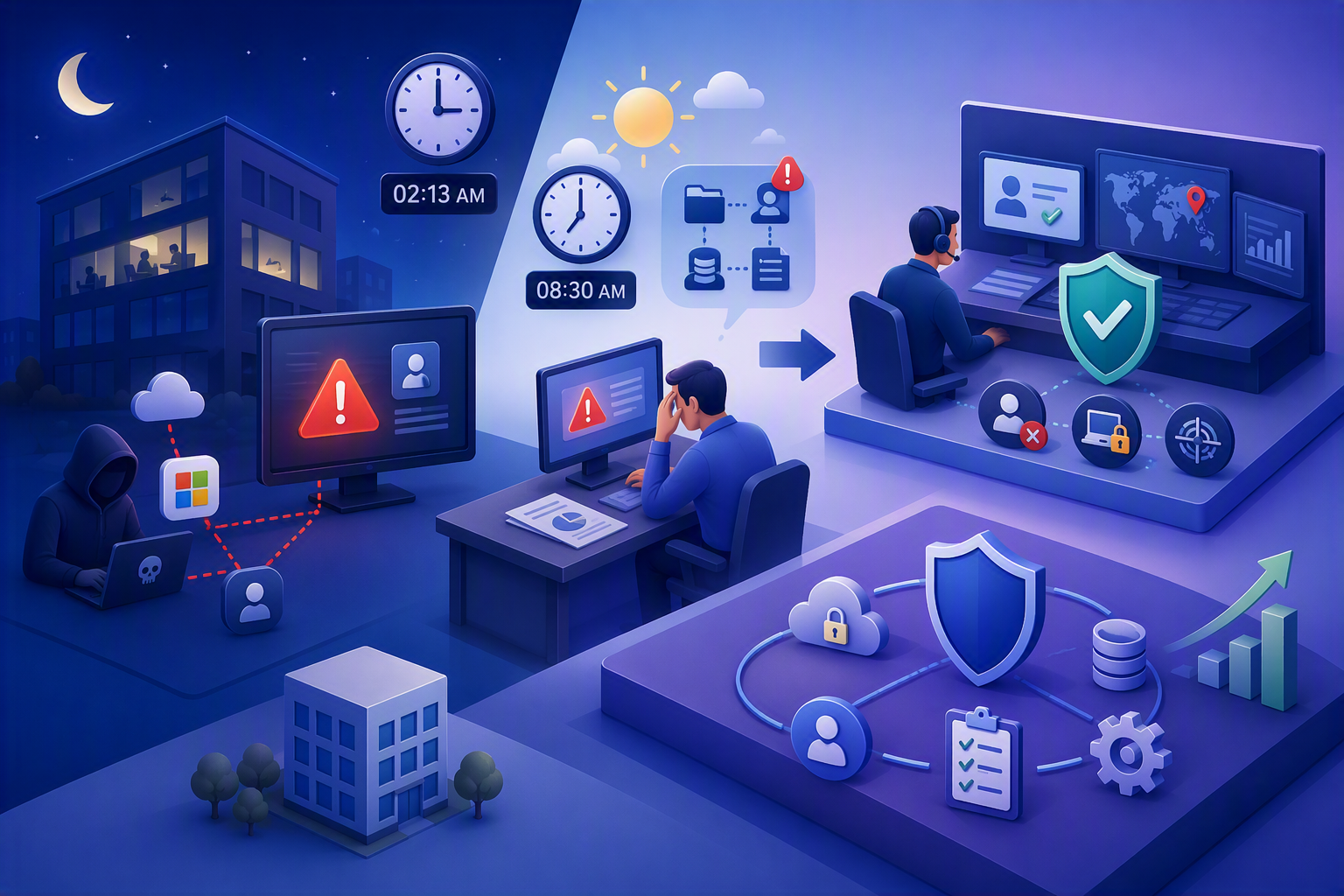
At 2:13 a.m., a suspicious sign-in alert appears for a senior manager's account. The login originates from an unfamiliar location and is followed by several failed attempts to access sensitive files. The alert is generated correctly, but there is nobody available to review it until the next business morning.
By 8:30 a.m., the attacker has already established persistence in the account and attempted to access customer information. The IT team now faces a difficult task: determining what happened, identifying affected systems, containing the threat, and documenting actions for management and potential compliance requirements.
If the company had implemented an MDR service, trained analysts could have investigated the alert in real time, validated the activity, disabled the compromised account, and initiated containment before significant damage occurred.
However, as the post-incident review revealed, the company also had broader security challenges. Several SaaS applications lacked consistent access controls, user permissions had not been reviewed in months, and logging coverage was incomplete. Those issues pointed to a larger operational gap that a broader SECaaS program could help address.
The lesson was clear: MDR would have helped stop the immediate threat, while SECaaS would have strengthened the overall security foundation that allowed the risk to develop in the first place.
Why This Matters
For many SMBs, cybersecurity decisions are often driven by product comparisons, vendor marketing, or compliance deadlines. The more important question is operational responsibility.
When a security incident occurs, businesses rarely suffer because they lacked one specific tool. They suffer because nobody owned the process of detection, investigation, response, remediation, and continuous improvement.
Understanding the difference between MDR and SECaaS helps business leaders align security investments with actual business risks.
- MDR reduces response risk by ensuring suspicious activities are investigated and acted upon quickly.
- SECaaS reduces operational risk by building and maintaining the controls that prevent many incidents from occurring in the first place.
- Together, they improve resilience by covering both prevention and response across people, processes, and technology.
- They help support compliance efforts by providing documented security activities, evidence collection, and governance processes.
- They allow SMBs to access specialized expertise without building an expensive in-house security operations function.
Ultimately, the goal is not to purchase more security technology. The goal is to create accountability for security outcomes so that business operations can continue even when threats emerge.
Frequently Asked Questions (FAQ)
1. What is the main difference between MDR and SECaaS?
MDR focuses specifically on threat detection, investigation, and incident response. SECaaS is a broader service model that can include multiple security functions such as endpoint protection, identity management, vulnerability management, compliance support, security awareness training, cloud security, and MDR itself.
2. Can an SMB use MDR without SECaaS?
Yes. Organizations that already have a mature security baseline, centralized logging, endpoint protection, and an IT team capable of handling remediation may only need MDR to provide 24/7 monitoring and incident response capabilities.
3. Does SECaaS automatically include 24/7 monitoring?
Not necessarily. SECaaS offerings vary significantly between providers. Some include full MDR capabilities and round-the-clock monitoring, while others focus primarily on security tools and administrative management. Always verify exactly what monitoring and response services are included.
4. Which option is better for organizations with limited IT resources?
In many cases, SECaaS provides greater value because it addresses a broader set of security challenges and operational gaps. However, organizations facing immediate concerns about after-hours monitoring or alert management may prioritize MDR first.
5. Should SMBs choose MDR or SECaaS?
For many organizations, the answer is both. A common approach is to use SECaaS as the overarching security operating model while incorporating MDR as the dedicated detection-and-response capability. This provides comprehensive security coverage while ensuring critical threats are investigated by specialized analysts.
Key Takeaway
MDR and SECaaS are not competing solutions as much as complementary ones. MDR answers the question, "Who responds when a threat gets through?" SECaaS answers the broader question, "Who is responsible for managing security across the business?" The right choice depends on your current security maturity, operational requirements, and risk exposure. For many SMBs, sustainable cybersecurity requires both capabilities working together.

Written by Alexander Boychev
Business Executive & Digital Marketing Manager at Advanced Vision IT Ltd | Published on
Alexander advises insights on business development, strategic key account management, and digital marketing in the IT sector.