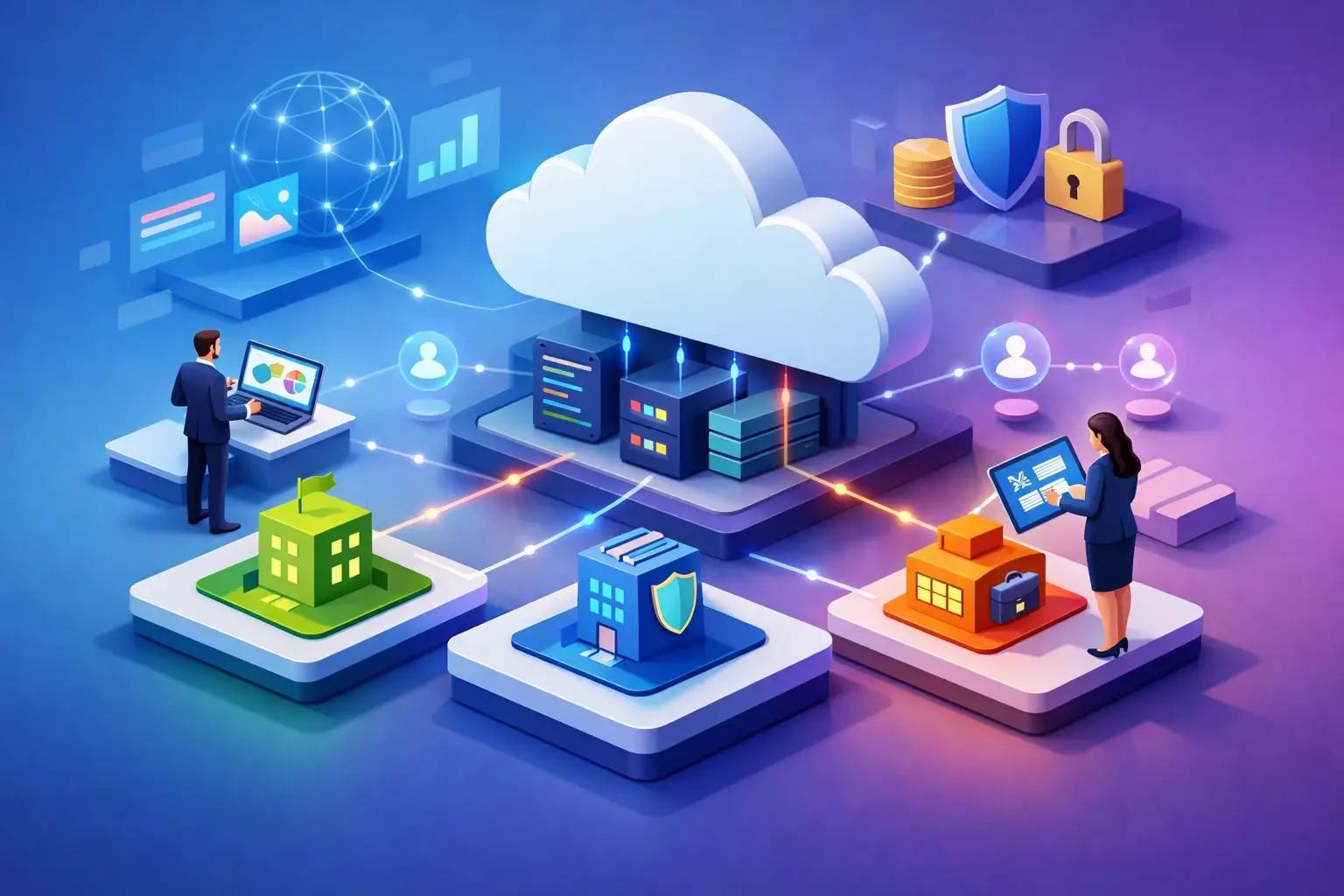
Multi‑Account Strategy Best Practices for Enterprise
A single cloud account may feel efficient at first. Then production workloads, experiments, third-party integrations, compliance requirements, and separate teams begin competing for the same permissions, budgets, and operational attention. Multi‑Account Strategy Best Practices give organizations a practical way to separate risk without creating an unmanageable maze of accounts.
For AWS-based environments, a multi-account model is not simply an organizational preference. It is an operating model for security, cost control, and delivery speed. The goal is not to create an account for every minor distinction. The goal is to establish boundaries that make the environment easier to govern, recover, audit, and evolve.
Start with business boundaries, not account counts
The most common early mistake is treating account structure as a technical taxonomy. Teams create accounts based on individual applications, temporary projects, or every possible environment before agreeing on who owns the workload, what data it handles, and what level of risk it creates.
Start with durable business and operational boundaries. Most organizations need separate accounts for production, non-production, security, logging, shared services, and networking. From there, add workload or business-unit accounts when ownership, data sensitivity, billing, or compliance requirements justify a stronger boundary.
A production customer portal that processes regulated data should not share an account with a developer sandbox. Similarly, centralized identity, network transit, security tooling, and audit logs should not depend on the same account as an application team’s release pipeline. Separation limits blast radius and prevents operational convenience from becoming a security exposure.
The trade-off is overhead. Every account needs baseline controls, monitoring, access configuration, and cost visibility. If a boundary does not improve security, ownership, financial accountability, or operational resilience, it may be unnecessary. Good architecture uses enough accounts to establish meaningful isolation, not enough accounts to impress an architecture diagram.
Multi‑Account Strategy Best Practices for AWS foundations
AWS Organizations should be the control plane for a multi-account environment. It provides centralized billing, consolidated governance, and a structure for applying policies at scale. Organizational units, or OUs, should represent governance tiers rather than a loose folder structure.
A practical model often includes a Security OU, Infrastructure OU, Production OU, Non-Production OU, Sandbox OU, and Suspended or Quarantine OU. The exact names matter less than the policy intent. A sandbox OU may allow more experimentation while limiting access to sensitive data and expensive services. A production OU should have tighter controls, stronger monitoring, and more restrictive service control policies.
Service control policies are guardrails, not substitutes for identity permissions. They define the maximum permissions an account can grant. Use them to prevent actions that conflict with organizational policy, such as disabling centralized logging, leaving approved regions, or creating public resources outside established controls. Test policies carefully in a non-production OU before applying them broadly. An overly restrictive policy can stop a deployment pipeline or block a necessary recovery action.
Every account should begin from a documented baseline. That baseline should include centralized logging, required security services, encryption standards, approved regions, tagging requirements, backup expectations, alert routing, and access to shared network services. Automating account provisioning with AWS Control Tower, Terraform, or a custom account-vending workflow reduces configuration drift and shortens the time between a business request and a usable, governed account.
Centralize identity, logs, and security visibility
Multi-account environments fail when each account becomes its own administrative island. Centralization is essential for the controls that must remain independent from application owners.
Use federated workforce access through a central identity provider and AWS IAM Identity Center. Avoid long-lived IAM users wherever possible. Permission sets should map to job functions, with elevated access granted through a controlled process and reviewed regularly. Break-glass access still has a place, but it should be tightly documented, monitored, and limited to genuine incident or recovery scenarios.
Centralize CloudTrail logs, AWS Config history, VPC Flow Logs, and critical application security events in a dedicated log archive account. The team investigating an incident should be able to reconstruct what happened even if the affected workload account has been compromised or altered. Retention periods should reflect contractual, regulatory, and operational needs rather than default settings.
Security findings also need aggregation. Services such as Security Hub, GuardDuty, Inspector, and centralized vulnerability management can provide cross-account visibility, but alerts alone do not improve security. Define ownership for triage, severity thresholds, escalation paths, and remediation timelines. A finding routed to a shared inbox without a named responder is not a control.
Build networking as a shared platform service
Network design is where account sprawl can turn into unnecessary complexity. A centralized network account can manage Transit Gateway, shared DNS services, ingress and egress patterns, VPN or Direct Connect connectivity, and firewall controls. Application accounts then consume approved network services without needing full control over the underlying connectivity model.
This approach improves consistency, but centralization should not create a bottleneck. Network teams need documented self-service patterns for common requests such as private connectivity, DNS entries, certificate issuance, and application ingress. Infrastructure as code can make these patterns repeatable while preserving review and audit requirements.
Not every workload needs the same network topology. Public-facing services, internal line-of-business systems, data platforms, and development environments have different exposure and connectivity needs. Standardize the control objectives, then allow implementation choices that fit the workload. For example, a low-risk development account may not need the same private connectivity model as a regulated production application, but it should still meet baseline logging and access standards.
Treat cost allocation as an engineering requirement
Consolidated billing is valuable, but it can hide waste when costs are not assigned to accountable owners. Each account should have a clear owner, cost center, environment label, application identifier, and business service tag. Enforce tags through provisioning templates and policy where practical, while recognizing that some AWS charges cannot be tagged at the individual resource level.
Set budgets and anomaly detection at the account level, then roll reporting up by product, department, or customer-facing service. This makes it easier to distinguish a legitimate scale event from an unplanned cost increase caused by unbounded logging, oversized compute, idle non-production environments, or a misconfigured data transfer path.
FinOps works best when engineering and finance share the same data. A monthly bill review is useful, but operational teams also need near-real-time signals in their observability workflow. Cost alarms should be actionable and connected to the people who can change the architecture, schedule resources, or adjust capacity.
Standardize delivery without forcing identical workloads
A multi-account strategy should improve delivery, not turn cloud changes into ticket-driven administration. Establish reusable Terraform modules, approved CI/CD templates, security scanning steps, and deployment roles that can operate across designated accounts. This gives teams a safe path to provision infrastructure without granting broad console access.
Standardization does not mean every application uses the same compute service or deployment pattern. A container platform, serverless workflow, and virtual machine-based legacy application can all fit within the same governance model. The shared requirements are traceability, least-privilege access, backup and recovery expectations, monitoring, and defined ownership.
Observability should be designed across accounts as well. Central dashboards and alert routing help operations teams identify service dependencies during an incident, while workload teams retain detailed visibility into their applications. Tools such as New Relic can provide a common view across infrastructure, application performance, and user experience when telemetry standards are established early.
Measure whether the model is working
Account count is not a success metric. The better measures are operational: how quickly a new account can be provisioned, how many resources meet baseline compliance, how long it takes to detect and contain an incident, how accurately teams can allocate cloud spend, and whether developers can deploy approved changes without manual exceptions.
Run periodic Well-Architected Reviews and access reviews to identify where controls have become outdated or delivery teams have built workarounds. Multi-account governance must change as the company changes. A structure that works for two product teams may be insufficient after an acquisition, a compliance milestone, or a move into a new market.
Questions leaders ask about multi-account environments
How many AWS accounts should an organization have?
There is no universal number. Begin with the core control-plane accounts and separate production from non-production. Add accounts when they create a meaningful security, ownership, compliance, or billing boundary. Avoid using accounts as a substitute for clear application architecture or team accountability.
Is a multi-account strategy only for large enterprises?
No. Growth-stage organizations often benefit early because they can establish controls before cloud usage becomes fragmented. The model should be proportionate to the business. A small team may operate a concise structure with centralized identity and logging, while a larger organization may need OUs, account-vending automation, delegated administration, and formal policy management.
Can teams still move quickly with centralized governance?
Yes, if governance is delivered as automation and approved self-service patterns. Teams slow down when every new account, permission, network change, or deployment requires manual intervention. They move faster when secure defaults, reusable infrastructure modules, and clear escalation paths are already in place.
What should be centralized versus owned by application teams?
Identity, audit logs, security visibility, core networking, organization-level policies, and common platform services are usually centralized. Application teams should own their workloads, application-level monitoring, deployment configuration, resource sizing, and remediation of findings within their accounts. The boundary should be explicit so that responsibility does not disappear during an outage.
A well-designed multi-account environment gives leadership clearer risk ownership and gives technical teams room to build. The strongest next step is to document the current account landscape, identify where controls or accountability are missing, and turn the highest-risk gaps into an automated baseline.
Author: Yavor Y. Zlatev CEO of AdvisionIT
Date: 18.08.2026