



Security Operations Center Example Explained
A security alert at 2:13 a.m. rarely arrives as a clean, obvious breach. More often, it starts as something small - a suspicious login from an unusual location, a disabled endpoint agent, or a service account making changes it never made before. A useful security operations center example is not a glossy diagram. It is a working model of how those signals get detected, investigated, contained, and translated into business decisions before they become downtime, data loss, or compliance trouble.
For small and mid-sized businesses, that distinction matters. Many teams know they need stronger security monitoring, but they do not need a Hollywood version of a SOC with massive screens and a room full of analysts. They need a practical operating model that fits their environment, budget, risk profile, and internal capability.
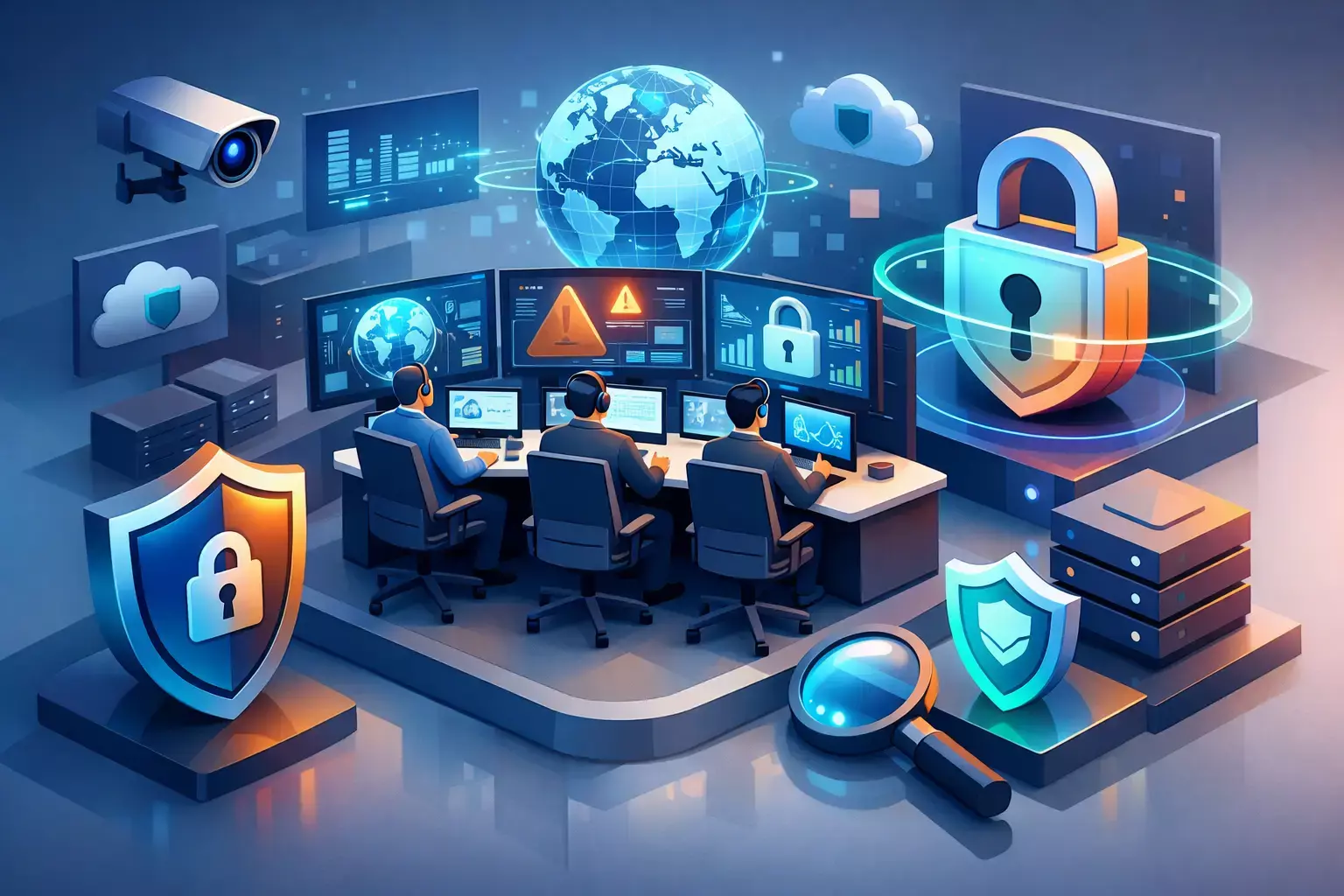
A practical security operations center example
Consider a 250-person SaaS company running most of its infrastructure in AWS, with Microsoft 365 for productivity, a handful of critical SaaS platforms, remote employees, and a small internal IT team. The business handles customer data, needs reliable uptime, and has growing compliance requirements. It does not have the headcount to staff 24/7 security internally.
In this security operations center example, the SOC is built as a hybrid function. A managed security partner monitors the environment around the clock, while the client’s IT and engineering leaders retain decision-making authority for business-impacting actions. This setup is common because it balances cost control with real coverage.
The SOC ingests logs and telemetry from AWS CloudTrail, VPC Flow Logs, endpoint detection tools, identity providers, Microsoft 365, firewalls, and vulnerability scanners. Those signals feed into a SIEM for correlation and alerting. A SOAR platform may handle some repetitive response actions, such as isolating an endpoint, disabling a compromised account, or opening a ticket with the right context.
What makes this work is not the tool stack alone. It is the process around triage, escalation, ownership, and response timing. Without that, expensive tools simply create expensive noise.
What happens inside the SOC each day
Day-to-day operations usually break into monitoring, triage, investigation, response, and reporting. The analysts are not just watching dashboards. They are validating whether alerts are real, checking related activity across systems, and deciding whether an event is benign, suspicious, or actively malicious.
A typical morning might include reviewing overnight alerts for failed login spikes, privileged access changes, unusual outbound traffic, malware detections, or misconfigurations introduced through cloud changes. In a mature environment, many low-level alerts are tuned or automated away. In an immature one, the backlog can become unmanageable very quickly.
That is one reason a SOC should be designed around use cases, not just collection. If the organization cares most about ransomware, account compromise, insider misuse, and cloud misconfiguration, the SOC should prioritize detections for those risks first. Coverage should expand over time, but the initial focus should reflect business exposure.
Example incident flow
An analyst sees an alert for impossible travel tied to a finance employee’s Microsoft 365 account. A few minutes later, there is a second alert showing mailbox rule creation and an OAuth app consent event. On their own, each event may look moderate. Correlated together, they suggest account compromise.
The analyst checks recent login sources, MFA status, and related identity events. They review whether the user approved the app, whether email forwarding was established, and whether lateral movement appears elsewhere in the environment. The incident is raised to high priority.
At that point, the SOC may disable the session, force a password reset, revoke tokens, and notify the client’s point of contact. If predefined playbooks exist, the response can happen in minutes. If no playbook exists and no one knows who owns approval, response time slows down exactly when speed matters most.
The core components behind a working model
People, process, and technology still apply, but the useful question is how those pieces support operational outcomes.
On the people side, you need clear roles. Level 1 analysts handle alert review and initial triage. More experienced analysts or engineers investigate complex incidents, tune detections, and improve playbooks. Someone must also own threat intelligence, reporting, and coordination with infrastructure or compliance teams. In smaller organizations, several of these responsibilities may sit with a managed provider.
On the process side, escalation paths matter more than most teams expect. Who approves endpoint isolation on an executive laptop? Who gets called if production AWS credentials are exposed? When does legal or compliance need to be involved? These are not details to figure out during an incident.
On the technology side, the stack should match the environment. For a cloud-first business, that often includes SIEM, EDR, identity monitoring, cloud security telemetry, vulnerability scanning, and ticketing or workflow automation. If the company already uses AWS-native logging, Terraform, and observability platforms such as New Relic, the SOC design should align with those systems rather than forcing disconnected tooling.
Where security operations center examples often go wrong
The most common mistake is assuming that buying tools equals building capability. It does not. A SIEM without log quality, tuning, and response ownership is little more than a billing line item.
Another issue is overcollecting data without knowing why. Teams ingest everything, produce thousands of alerts, and then discover they cannot distinguish a real attack from ordinary administrative behavior. More logs are not automatically better. Better context is better.
There is also a trade-off between fully in-house and fully outsourced operations. An internal SOC can provide deep institutional knowledge, but it is expensive to staff and hard to run 24/7. A managed SOC can extend coverage and expertise quickly, but it works best when the provider understands the client’s infrastructure, change patterns, and business priorities. If that relationship is shallow, escalations become generic and slower than they should be.
How to tell if a SOC model fits your business
A good security operations center example should help you answer a basic question: what level of security operations do we actually need?
If you run regulated workloads, have customer-facing applications, manage distributed endpoints, or depend heavily on AWS and SaaS platforms, you likely need more than antivirus and periodic audits. You need continuous visibility, incident response readiness, and a way to detect misuse across identity, cloud, endpoint, and network layers.
That does not always mean a full enterprise SOC buildout. For many SMBs, the right model is a managed or co-managed SOC with well-defined coverage, tuned alerting, and tested incident playbooks. The key is whether the service can integrate with your actual operating environment and support your internal team rather than create more overhead.
This is where a boutique, engineering-led partner can be more effective than a high-volume vendor. If the same provider understands your cloud architecture, CI/CD workflows, observability stack, and compliance requirements, security operations become more actionable. Alerts are interpreted in context, not in isolation.
What decision-makers should ask before investing
Start with coverage. Ask which systems are monitored, what detections are in place, and what gaps remain. Then ask about response. Who investigates? Who acts? How fast? What is automated, and what still depends on manual approval?
You should also ask how detections are tuned over time. Security operations is not a set-and-forget function. As your infrastructure changes, attack paths change too. New AWS services, remote access patterns, third-party integrations, and internal admin workflows all affect what normal looks like.
Reporting matters as well, but only if it is useful. Good SOC reporting should show incident trends, response times, recurring weaknesses, and recommended improvements. If the monthly report is just a pile of alert counts, it is not helping leadership make better decisions.
For organizations modernizing infrastructure, security operations should also connect with broader reliability goals. The same discipline that improves cloud visibility, configuration management, and operational readiness tends to improve security outcomes too. That is one reason companies often benefit from a provider that can support observability, cloud operations, and managed security together, rather than splitting those responsibilities across disconnected vendors.
A strong SOC is not defined by how impressive it looks on paper. It is defined by whether the right people see the right signal at the right time and know exactly what to do next. If your current model cannot answer that with confidence, the next step is not more complexity. It is a clearer operating design.

Written by Alexander Boychev
Business Executive & Digital Marketing Manager at Advanced Vision IT Ltd | Published on
Alexander advises insights on business development, strategic key account management, and digital marketing in the IT sector.