



What Are Managed Detection Services for Business?
A security alert at 2:13 a.m. is only useful if someone can determine whether it is a failed login, a misconfigured application, or the first sign of a ransomware incident. For organizations without a staffed security operations center, that distinction often waits until business hours. That is where the question, what are managed detection services, becomes practical rather than theoretical.
Managed detection services provide continuous security monitoring, expert threat investigation, and guided or direct incident response through an external security team. They help businesses identify meaningful threats across cloud environments, endpoints, identities, networks, and applications without building an internal 24/7 SOC from scratch.
What Are Managed Detection Services?
Managed detection services, commonly called Managed Detection and Response or MDR, combine security technology with human analysts who monitor and investigate suspicious activity. The provider collects and correlates telemetry from sources such as endpoint detection tools, AWS logs, firewall events, identity platforms, email security systems, and SIEM platforms. When signals indicate real risk, analysts investigate the activity and take action according to the agreed response model.
The distinction matters because most businesses do not suffer from a lack of alerts. They suffer from too many alerts, incomplete visibility, and limited time to determine which events require immediate attention. A managed detection service is designed to reduce that operational gap.
For example, an endpoint tool might detect PowerShell activity on an employee laptop. On its own, that event may be harmless. A managed detection team can examine whether the user signed in from an unusual location, whether the command contacted a known malicious destination, whether credentials were used elsewhere, and whether similar activity occurred across the environment. Context turns raw telemetry into a defensible security decision.
How Managed Detection Services Work
An effective service begins with onboarding and visibility. The provider connects the agreed data sources, validates log quality, understands the business environment, and establishes escalation paths. This initial work is not merely administrative. Detection quality depends heavily on whether systems, identities, cloud accounts, and critical workloads are visible to the security team.
Once monitoring is active, the service typically performs four connected functions:
- Collects and correlates security data from endpoints, cloud platforms, identity systems, networks, and applications.
- Detects suspicious behavior using analytics, threat intelligence, behavioral patterns, and security rules.
- Investigates alerts to identify false positives, scope affected assets, and determine likely attacker activity.
- Responds through notification, recommendations, or approved containment actions such as isolating a device, disabling an account, or blocking a malicious connection.
The response model varies. Some organizations want the provider to notify their internal IT team before any action is taken. Others authorize predefined containment actions for high-confidence events because minutes matter during credential compromise or ransomware activity. The right approach depends on the organization’s risk tolerance, internal skills, compliance obligations, and operating hours.
A mature managed detection service also produces incident records, escalation guidance, and recurring reporting. These outputs give IT and leadership teams more than a list of alerts. They show where risk is recurring, which controls need improvement, and whether the environment is becoming easier or harder to defend.
Managed Detection vs. Traditional Managed Security
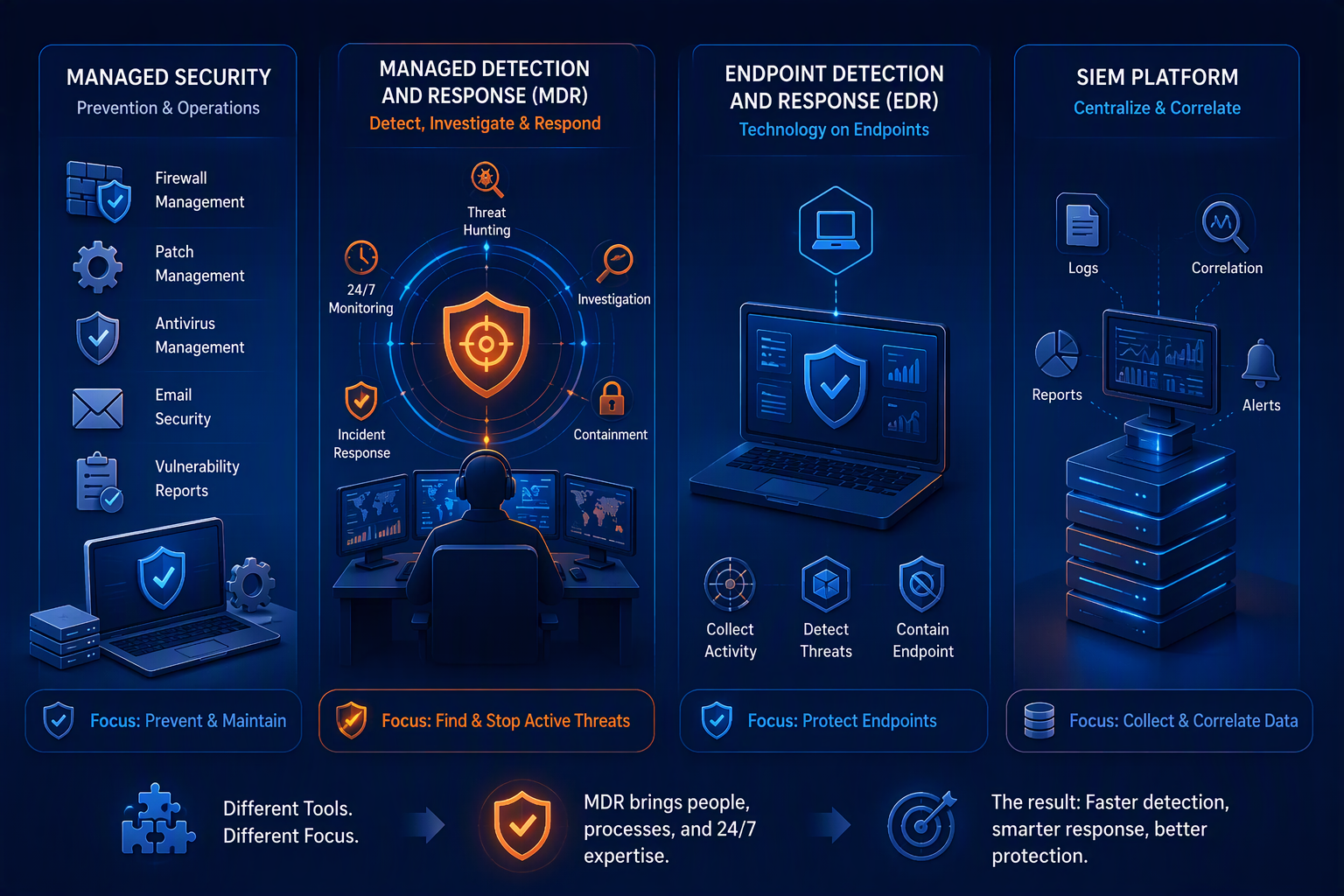
Managed detection services are sometimes confused with managed security services, and there is overlap. A managed security provider may operate firewalls, apply patches, manage antivirus, administer email security, or review vulnerability reports. Those are valuable preventative and operational controls.
MDR has a narrower but deeper focus: finding and responding to active threats that get past preventive layers. It assumes that users will click suspicious links, credentials may be exposed, cloud permissions can be misconfigured, and attackers may use legitimate tools to avoid detection. The service looks for the behavior that indicates an intrusion is underway.
Endpoint Detection and Response, or EDR, is also different from MDR. EDR is a technology platform installed on endpoints that collects activity and can support containment. MDR adds the people, processes, continuous monitoring, investigation, and incident expertise required to operate those tools effectively. Buying EDR without defining who will monitor it after hours can leave a critical capability underused.
A SIEM is another related component. It centralizes log data and supports correlation, reporting, and investigation. But a SIEM does not automatically create a 24/7 security function. It requires data engineering, detection tuning, analysts, playbooks, and ongoing maintenance. For many small and mid-sized businesses, managed detection services offer a more attainable path to those capabilities.
Why Detection and Response Matter in Cloud Environments
Cloud adoption changes the security perimeter. Workloads may run across AWS accounts, employees may access systems through SaaS identity providers, infrastructure may be deployed through Terraform and CI/CD pipelines, and business data may move between managed services. Traditional perimeter-only monitoring is not enough.
In AWS, meaningful detection may involve reviewing CloudTrail activity, VPC flow logs, GuardDuty findings, IAM policy changes, unusual API calls, access key use, and workload behavior. A suspicious administrative action is especially concerning when it follows a new identity login, a public exposure change, or an attempt to disable logging. Seeing these events together is far more valuable than receiving them as separate alerts.
Managed detection services can also support better coordination between security and cloud operations. If an analyst identifies a risky security group rule, overly broad IAM permission, or compromised workload, the remediation may require infrastructure knowledge, change control, and automation. Teams that understand AWS, DevOps practices, and observability can help address the root cause rather than simply closing the ticket.
What Businesses Should Expect From a Provider
Not every MDR offering delivers the same depth of service. Some providers primarily forward alerts from a tool. Others conduct full investigations, provide response support, and work with IT teams to strengthen controls over time. Before selecting a service, business leaders should clarify who monitors alerts, what data sources are covered, how quickly incidents are escalated, and which actions the provider can take without waiting for approval.
Ask how the provider distinguishes high-priority incidents from ordinary noise. Ask whether analysts can access the evidence behind an alert and explain their findings in business terms. It is also worth asking whether the service covers cloud identities, SaaS platforms, and AWS activity, not only employee laptops.
Integration matters as much as detection. A provider should fit into existing operations, including IT service management, incident response procedures, compliance documentation, vulnerability management, and executive reporting. For organizations subject to requirements such as HIPAA, PCI DSS, SOC 2, or customer security reviews, the ability to demonstrate monitoring, investigation, and response processes can be as important as the technology itself.
Cost should be evaluated against the operating model, not only the per-device price. A low-cost service that sends unfiltered alerts to an already overextended IT team may not meaningfully reduce risk. A higher-touch service may be more valuable when it reduces alert fatigue, shortens incident response time, and provides experienced guidance during high-pressure events.
When Managed Detection Services Are a Good Fit
MDR is especially useful for organizations that have valuable digital assets but do not have the budget or staffing model for a round-the-clock internal security team. This includes growing companies running customer-facing applications, professional services firms handling sensitive data, healthcare and financial organizations with compliance pressure, and businesses expanding their AWS footprint.
It can also help internal IT and security teams that already have tools but lack capacity. Even skilled teams can struggle to monitor alerts continuously while also supporting users, delivering cloud migrations, maintaining infrastructure, and advancing modernization projects. Managed detection gives those teams a specialist escalation layer without replacing their authority over the environment.
However, MDR is not a substitute for basic security hygiene. It works best alongside strong identity controls, multifactor authentication, patching, backups, least-privilege access, asset management, security awareness, and tested incident response plans. Detection identifies problems sooner. It cannot compensate indefinitely for unmanaged devices, missing logs, or unrestricted administrator access.
Building a Practical Detection Strategy
The most effective approach is to start with the systems that would cause the greatest business disruption if compromised. For many organizations, that includes identity providers, cloud management accounts, customer data platforms, production workloads, endpoint fleets, email, and backup systems. Establish visibility first, then define who receives escalations and what decisions can be made after hours.
Advanced Vision IT approaches managed security as part of broader operational resilience. Detection data should inform cloud hardening, infrastructure automation, observability, access design, and compliance readiness. When security findings reach the teams that can implement durable improvements, each incident becomes an opportunity to reduce future exposure.
A managed detection service should give your team more than another dashboard. It should provide the confidence that when suspicious activity appears, qualified people can assess it quickly, contain it appropriately, and help your business keep operating.
A Real-World User Story: Turning an Alert Into Action
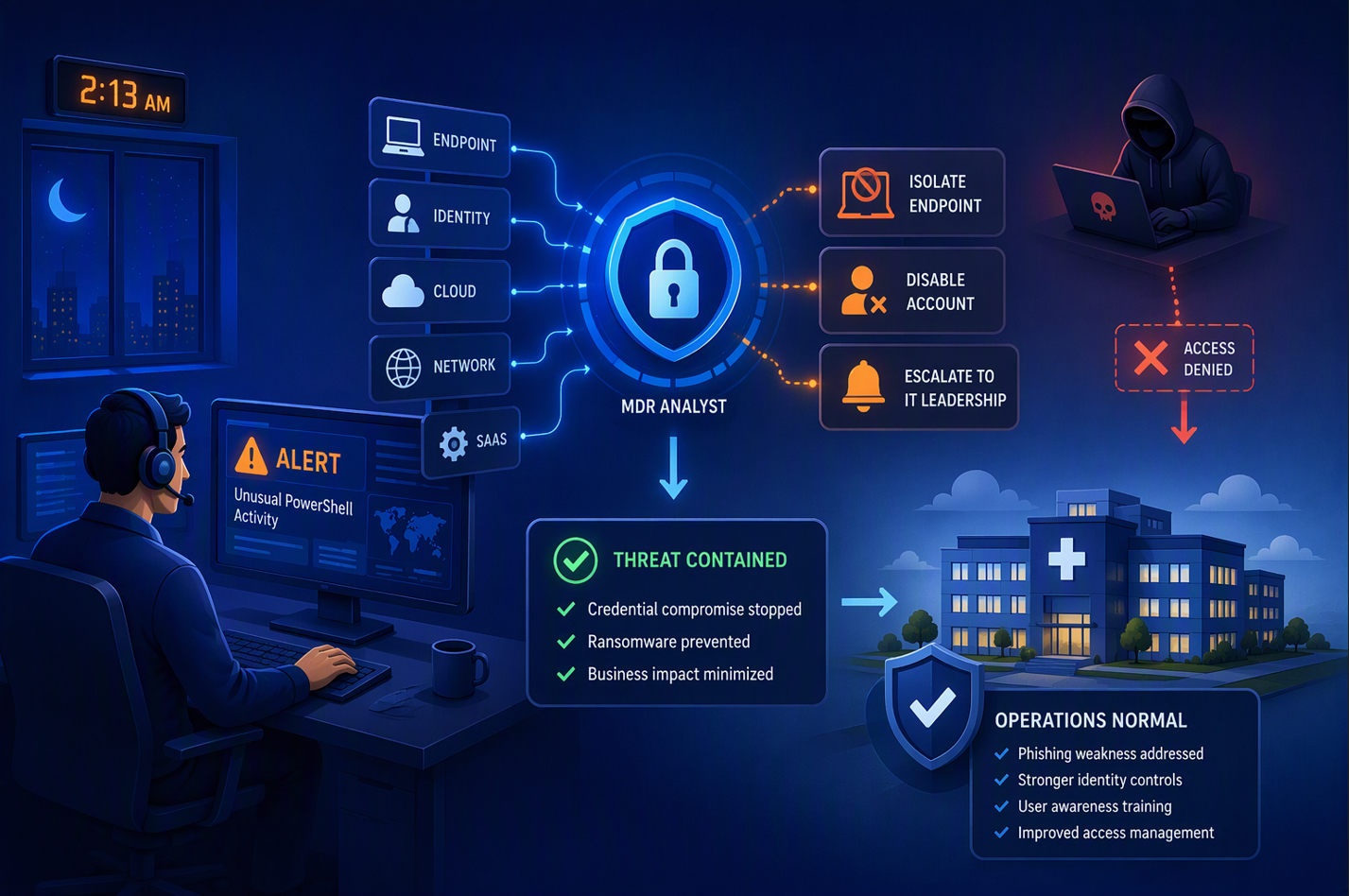
Consider a growing healthcare services company with approximately 250 employees and a small internal IT team. At 2:13 a.m., an alert is generated indicating unusual PowerShell activity on a finance department laptop. The event alone does not clearly indicate whether the activity is legitimate administration, software maintenance, or a potential cyberattack.
Because the organization uses a managed detection service, an analyst immediately investigates the event. By correlating endpoint telemetry with identity logs and cloud activity, the analyst discovers that the affected user account had authenticated from an unfamiliar geographic location earlier that evening. Additional investigation reveals suspicious attempts to access sensitive financial systems using the same credentials.
Within minutes, the MDR team isolates the compromised endpoint, disables the affected account, and escalates the incident to the organization's IT leadership. Further analysis confirms a credential compromise that could have resulted in ransomware deployment if left unchecked until business hours.
The organization resumes normal operations the next morning with minimal disruption. More importantly, the incident provides visibility into a phishing weakness, leading to stronger identity controls, enhanced user awareness training, and improved access management practices.
Without continuous monitoring and expert investigation, the alert would likely have remained unattended for several hours, giving the attacker valuable time to expand access and increase potential business impact.
Why This Matters
Cyberattacks rarely occur at convenient times. Threat actors often target organizations during evenings, weekends, and holidays when internal resources are limited and response times are slower.
Managed detection services help organizations:
- Reduce the time between threat detection and response, limiting potential damage.
- Gain around-the-clock security monitoring without the cost of building a 24/7 internal SOC.
- Separate genuine threats from thousands of routine security alerts.
- Improve visibility across cloud environments, endpoints, identities, SaaS platforms, and networks.
- Access specialized security expertise that may be difficult or expensive to hire internally.
- Support compliance requirements by providing documented monitoring, investigation, and incident response processes.
- Strengthen overall cyber resilience by identifying trends, recurring risks, and opportunities for long-term security improvements.
In a modern cloud-first environment, the difference between a contained incident and a major breach often comes down to how quickly suspicious activity is identified, investigated, and addressed.
Frequently Asked Questions (FAQ)
1. What is the difference between MDR and a traditional Managed Security Service Provider (MSSP)?
An MSSP typically focuses on operational security functions such as firewall management, antivirus administration, patching, and security tool maintenance. An MDR service focuses specifically on detecting, investigating, and responding to active threats using a combination of security technologies and human analysts.
2. Can managed detection services monitor AWS environments?
Yes. Most modern MDR providers can monitor AWS environments by analyzing sources such as CloudTrail logs, VPC Flow Logs, GuardDuty findings, IAM activity, cloud workloads, and identity-related events. This helps organizations detect threats that may not be visible through endpoint monitoring alone.
3. Do managed detection services replace an internal IT or security team?
No. MDR services are designed to complement internal teams, not replace them. They provide continuous monitoring, threat investigation, and incident response expertise while allowing internal IT and security personnel to maintain control over infrastructure, business systems, and strategic initiatives.
4. How quickly do MDR providers respond to security incidents?
Response times vary by provider and service agreement. Many MDR providers operate 24/7 and can investigate alerts immediately after detection. Some services also offer predefined containment actions that can be executed automatically for high-confidence threats.
5. Is MDR only suitable for large enterprises?
No. MDR is often most valuable for small and mid-sized organizations that lack the budget, staffing, or expertise required to build and operate a dedicated 24/7 Security Operations Center (SOC). It provides enterprise-level detection and response capabilities without the overhead of maintaining a full internal security team.

Written by Alexander Boychev
Business Executive & Digital Marketing Manager at Advanced Vision IT Ltd | Published on
Alexander advises insights on business development, strategic key account management, and digital marketing in the IT sector.