



What Causes Cloud Cost Overruns in AWS?
A cloud bill rarely becomes a problem because someone launched one expensive resource. The more common answer to what causes cloud cost overruns is a series of reasonable technical decisions that were never revisited: an environment built for a launch, a database sized for a peak that did not persist, or a data pipeline that quietly began processing more information every month.
For growing organizations, cloud cost control is not simply a finance exercise. It is an operational discipline tied to architecture, engineering practices, security, and visibility. AWS gives teams the ability to provision capacity quickly. Without equally mature governance, that flexibility can turn into unpredictable spend.
What causes cloud cost overruns?
Cloud overruns happen when consumption grows faster than a company’s ability to observe, assign, and optimize it. The invoice is the result. The root cause is usually a gap in ownership or operational process.
A development team may have authority to deploy services but no clear budget accountability. Finance may see total spend but lack the technical context to distinguish a productive scale-up from waste. Infrastructure may be managed across several vendors, with no single team responsible for connecting application behavior, cloud usage, and business demand.
The result is familiar: costs rise, no one can immediately explain why, and optimization begins only after the bill has arrived.
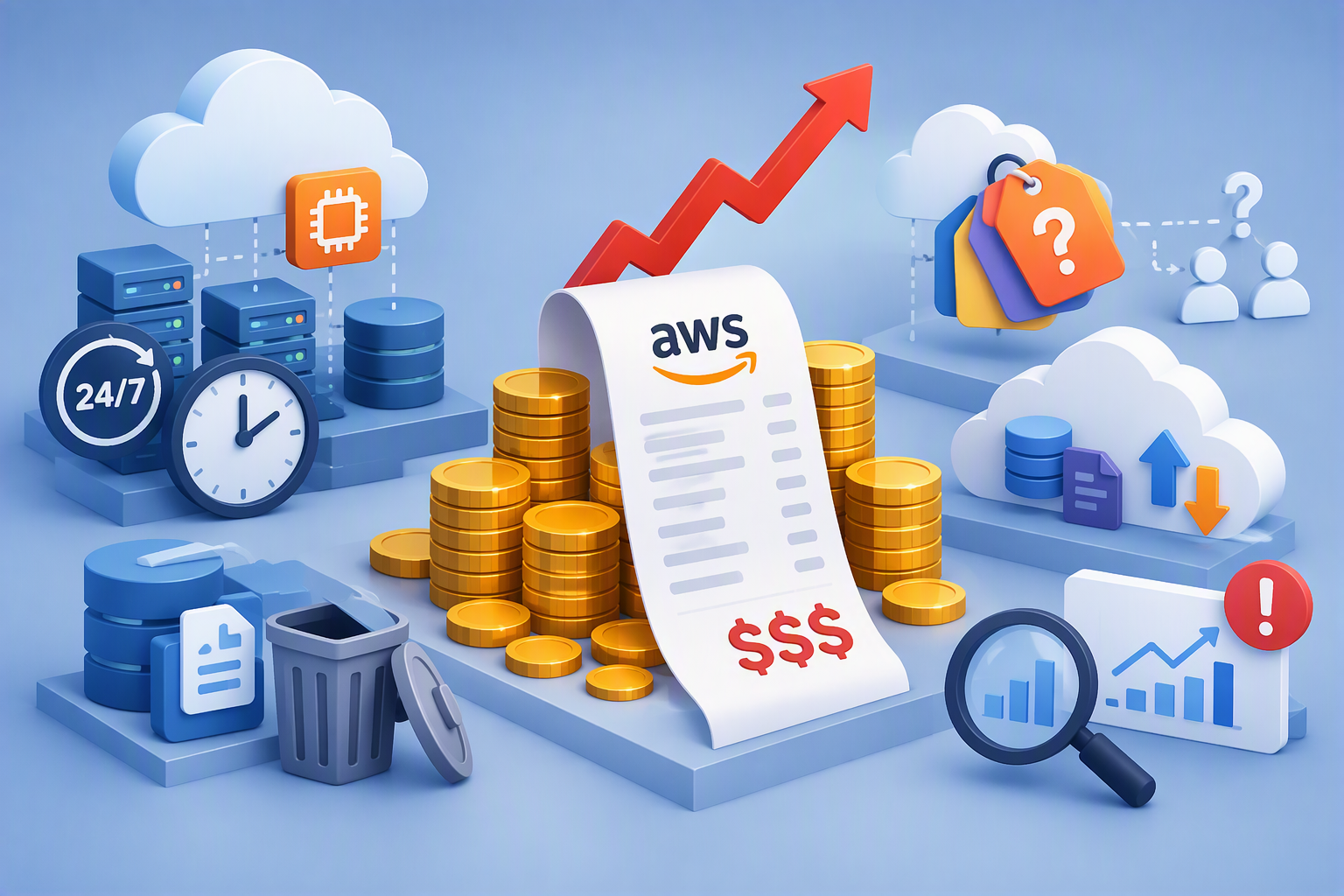
Always-on capacity for intermittent workloads
Overprovisioning is one of the most persistent sources of unnecessary spend. Teams often select instance sizes, database classes, storage tiers, and Kubernetes node counts based on anticipated growth or a one-time performance event. That caution can be justified for customer-facing systems, especially where latency and uptime are nonnegotiable. The problem begins when temporary headroom becomes the permanent baseline.
Non-production environments are particularly vulnerable. Development, QA, sandbox, and training accounts may run nights and weekends even when nobody is using them. Large EC2 instances may remain online to support a short testing window. Managed databases may retain production-grade sizing because reducing capacity feels risky.
Scheduling can reduce these costs, but schedules should not be applied blindly. A system supporting overseas staff, automated test runs, or overnight batch processing may need different controls. The right approach starts with workload behavior, service-level requirements, and clear environment ownership.
Poor tagging and weak cost allocation
An AWS invoice without meaningful allocation data is difficult to manage. If an organization cannot identify which product, customer, department, environment, or owner generated a charge, every review turns into an investigation.
Consistent tagging creates a shared operating language between engineering, finance, and leadership. Tags such as application, environment, cost center, owner, and data classification allow teams to map infrastructure spending to real business activity. They also make it possible to identify orphaned resources, charge back shared costs where appropriate, and assess the economics of a specific product or customer segment.
Tagging is not a one-time cleanup. Manually applied tags tend to drift as teams move quickly. Policy-driven enforcement through infrastructure as code, AWS Organizations controls, and CI/CD checks is more dependable. Terraform and Ansible can help standardize deployment patterns so required metadata is applied at provisioning rather than repaired later.
Storage and data transfer that go unmonitored
Compute is visible because teams think about servers. Storage and network charges are more likely to accumulate in the background. Old EBS volumes, unattached snapshots, duplicate Amazon Machine Images, log archives, retained backups, and objects left in expensive storage tiers can create a long-running cost burden.
Data transfer is another frequent surprise. Cross-Availability Zone traffic, cross-region replication, NAT Gateway processing, public egress, and poorly designed application communication patterns can all increase costs. A distributed design may improve resilience, but it also introduces trade-offs. High availability should be intentional and measured against the actual recovery and performance requirements of the workload.
Observability data deserves the same scrutiny. Detailed logs, traces, and metrics are essential for diagnosing performance and security events. Yet indefinite retention or overly verbose logging can become expensive at scale. Teams need retention rules that reflect compliance requirements, incident-response needs, and the operational value of the data.
No lifecycle management for idle resources
Cloud environments accumulate leftovers. A project ends, a contractor leaves, a proof of concept is abandoned, or an application is replaced. The resources remain because deletion was not included in the handoff process.
Common examples include unattached IP addresses, unused load balancers, idle EC2 instances, dormant databases, old snapshots, underused containers, and licenses associated with systems no longer in service. Individually, many of these charges look small. Across multiple accounts and months, they become material.
A regular cleanup process is necessary, but automation is better. Identify resources with no activity, notify owners, establish an approval period, then retire what is no longer needed. This approach lowers waste without creating the operational risk of deleting resources based solely on a single utilization metric.
Architecture choices that increase AWS spend
Not every higher bill represents a failure. A cloud environment built for availability, security, and growth may cost more than a minimal deployment. The question is whether the architecture is producing enough business value for its cost.
For example, running workloads across multiple Availability Zones can be appropriate for critical applications. Maintaining duplicate systems in several regions may be appropriate for strict recovery objectives or regulatory requirements. But copying these patterns into every internal tool or early-stage product can create costs that exceed the risk being mitigated.
Managed services also require careful evaluation. They reduce administrative effort and can improve reliability, but their pricing models differ from self-managed alternatives. Serverless services may be economical for variable workloads and expensive for consistently high-volume processing. Reserved capacity or Savings Plans can reduce predictable usage costs, but they require confidence in future demand. Spot Instances can offer meaningful savings for fault-tolerant batch workloads, but they are not suitable for every application.
A Well-Architected Review helps teams examine these decisions across cost optimization, reliability, security, performance efficiency, and operational excellence. The goal is not to select the cheapest service. It is to make deliberate choices that meet business requirements without carrying unnecessary complexity or idle capacity.
Engineering practices that hide cost growth
Cloud costs are often determined by application behavior. An inefficient query, a chatty service-to-service call pattern, an unbounded retry loop, or an oversized container image can affect infrastructure spend as much as an instance type decision.
When cost data is separate from engineering telemetry, teams miss these connections. A sudden increase in database read capacity, API requests, data transfer, or log ingestion may be an early signal of an application defect. Observability platforms such as New Relic, combined with AWS-native metrics and billing data, can help correlate a cost spike with a deployment, traffic change, or performance regression.
Cost awareness should be part of the delivery lifecycle. During architecture reviews, teams should discuss expected usage patterns and scaling limits. In CI/CD pipelines, they can validate approved instance families, required tags, and deployment guardrails. After release, teams should measure whether consumption aligns with the forecast.
This is not about making engineers responsible for every line item on an invoice. It is about giving them enough visibility to understand the cost implications of the systems they build.
Governance gaps turn surprises into recurring overruns
The organizations that struggle most with cloud spend usually lack a defined cloud operating model. Accounts are created informally. Teams use personal payment methods for experiments. Budgets are broad enough to be meaningless. Alerts notify people after a large increase instead of warning them as a threshold approaches.
Effective governance establishes practical controls without slowing delivery. At a minimum, businesses need account structure, role-based access, budget owners, cost anomaly detection, tagging standards, and regular review cadences. They also need escalation paths: who investigates a sudden spike, who can approve a commitment purchase, and who decides whether a workload should be retired or rearchitected.
For companies with lean internal teams, a managed cloud partner can provide the operational coverage needed to sustain these practices. Advanced Vision IT works across cloud operations, DevOps automation, observability, and security, helping organizations connect cost optimization to the same processes that protect uptime and compliance.

A practical way to regain control
Start by separating immediate waste from structural cost. Immediate waste includes idle resources, expired projects, unattached storage, and environments running outside their required hours. Structural cost includes architecture, application design, data movement, commitments, and scaling strategy. Both matter, but they require different decisions.
Next, assign an owner to every meaningful workload and establish a monthly review that includes engineering and finance. Review cost changes alongside utilization, releases, incidents, and business metrics. A 20 percent increase in spend may be an issue, or it may reflect healthy customer growth. Context determines the response.
Finally, treat optimization as an ongoing reliability practice rather than a one-time savings project. The best cloud environment is not the one with the lowest bill in a single month. It is the one where leaders can explain spending, engineers can act on the data, and infrastructure continues to support growth without unpleasant surprises.
User Story: When Cloud Growth Outpaces Cloud Visibility
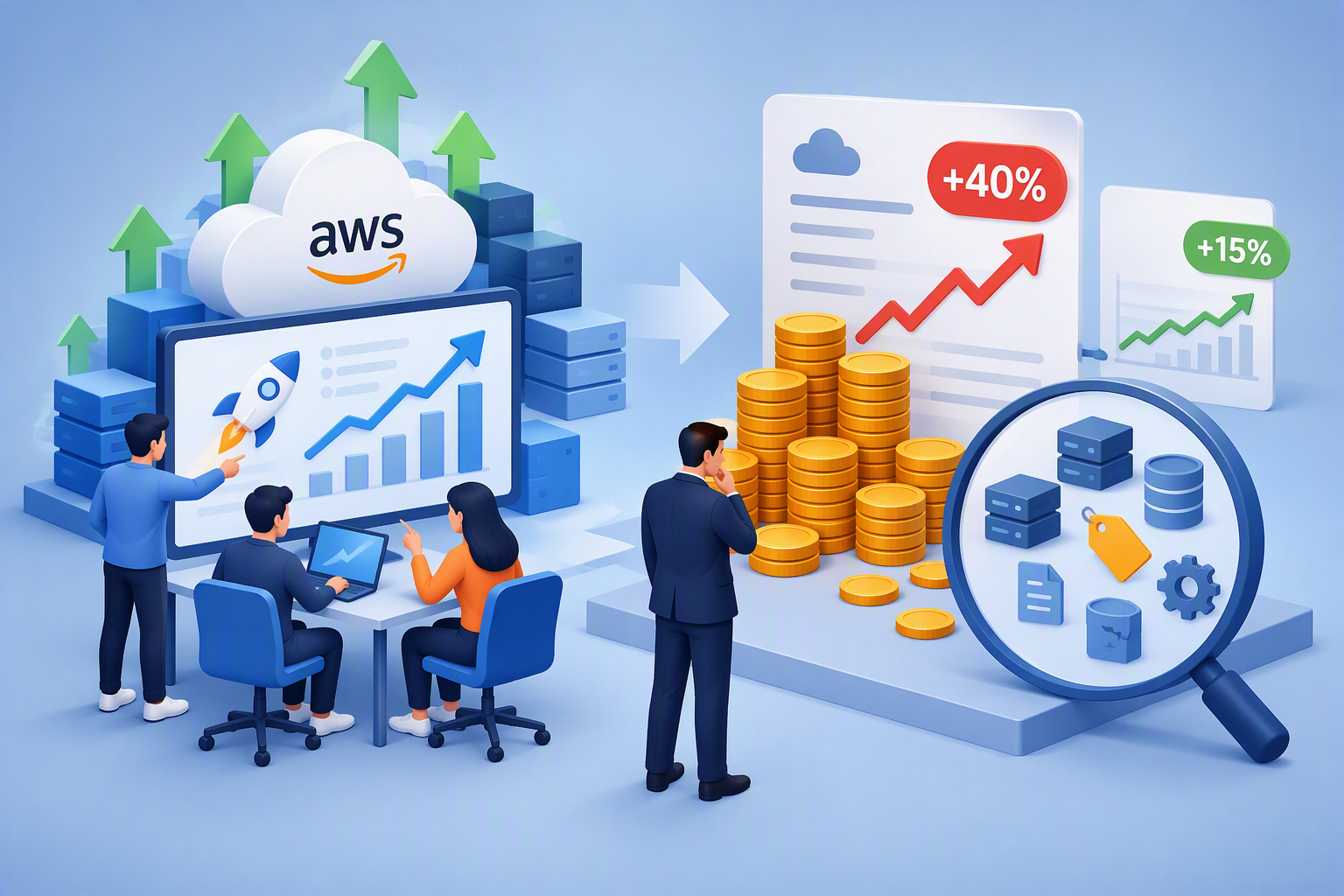
A SaaS company experiencing rapid customer growth celebrated a successful product launch. Traffic increased steadily, new features were released every sprint, and engineering teams expanded the cloud environment to support demand.
Six months later, leadership noticed that AWS spending had increased by nearly 40%, while revenue had grown by only 15%.
An investigation revealed that no single resource was responsible. Instead, costs had accumulated through a combination of factors:
- Development environments were running 24/7 despite being used only during business hours.
- Multiple teams deployed resources without consistent tagging, making ownership unclear.
- Log retention settings had never been reviewed after the initial deployment.
- Unused snapshots, abandoned test environments, and duplicated storage volumes remained active.
- Several high-availability design choices implemented during launch remained in place even though actual usage patterns had changed.
None of these decisions were unreasonable when they were made. The problem was that they were never revisited.
By introducing workload owners, enforcing tagging standards, implementing automated cleanup policies, and reviewing cloud consumption as part of monthly operational meetings, the company reduced cloud waste by more than 25% without affecting performance, security, or customer experience.
The biggest advantage was not the immediate savings. Leadership gained the ability to understand, forecast, and confidently explain cloud spending as the business continued to grow.
Why This Matters
Cloud cost overruns are rarely just a budgeting problem. They are often a symptom of deeper operational issues such as limited visibility, weak governance, unclear ownership, or architectural decisions that no longer match business requirements.
Organizations that fail to address these issues face several risks:
- Reduced profitability as infrastructure costs consume a larger share of revenue.
- Limited forecasting accuracy, making budgeting and growth planning more difficult.
- Inefficient use of engineering resources when teams spend time investigating unexpected bills instead of improving products.
- Higher operational complexity caused by unmanaged environments and unnecessary infrastructure.
- Difficulty scaling confidently because leaders cannot predict how cloud costs will change as demand grows.
Conversely, organizations that treat cloud cost management as an operational discipline gain better visibility, more predictable spending, stronger collaboration between engineering and finance, and greater confidence in their cloud strategy.
Cost optimization is not about spending less at all costs. It is about ensuring that every cloud dollar supports a measurable business outcome.
Frequently Asked Questions (FAQ)
1. What is the most common cause of cloud cost overruns?
The most common cause is not a single expensive resource but the gradual accumulation of overlooked costs. Overprovisioned infrastructure, idle resources, poor tagging, inefficient architectures, and growing data volumes often contribute to rising cloud bills over time.
2. How can I identify what is driving my AWS costs?
Start by using AWS Cost Explorer, tagging reports, cost allocation dashboards, and workload-level monitoring. Combining billing information with observability data helps connect cost increases to application behavior, infrastructure changes, or business growth.
3. Are cloud cost overruns always a sign of waste?
No. Increased spending may reflect legitimate growth, higher customer demand, improved resilience, or new business initiatives. The key question is whether the additional spending creates business value and aligns with operational objectives.
4. How often should cloud costs be reviewed?
Most growing organizations benefit from monthly cloud cost reviews involving both engineering and finance teams. Critical workloads, high-growth environments, or rapidly changing applications may require weekly monitoring and automated alerting.
5. What is the fastest way to reduce unnecessary AWS spending?
Begin by identifying obvious waste such as idle EC2 instances, unattached storage volumes, unused snapshots, abandoned environments, and resources running outside required business hours. These areas often provide immediate savings before larger architectural optimization efforts begin.

Written by Alexander Boychev
Business Executive & Digital Marketing Manager at Advanced Vision IT Ltd | Published on
Alexander advises insights on business development, strategic key account management, and digital marketing in the IT sector.