



What Is Co-Managed IT Services?
Your internal IT team is buried in tickets, a cloud migration is stalling, security expectations keep rising, and the business still expects faster delivery. That is usually when the question comes up: what is co-managed IT services, and is it a better fit than fully outsourcing IT?
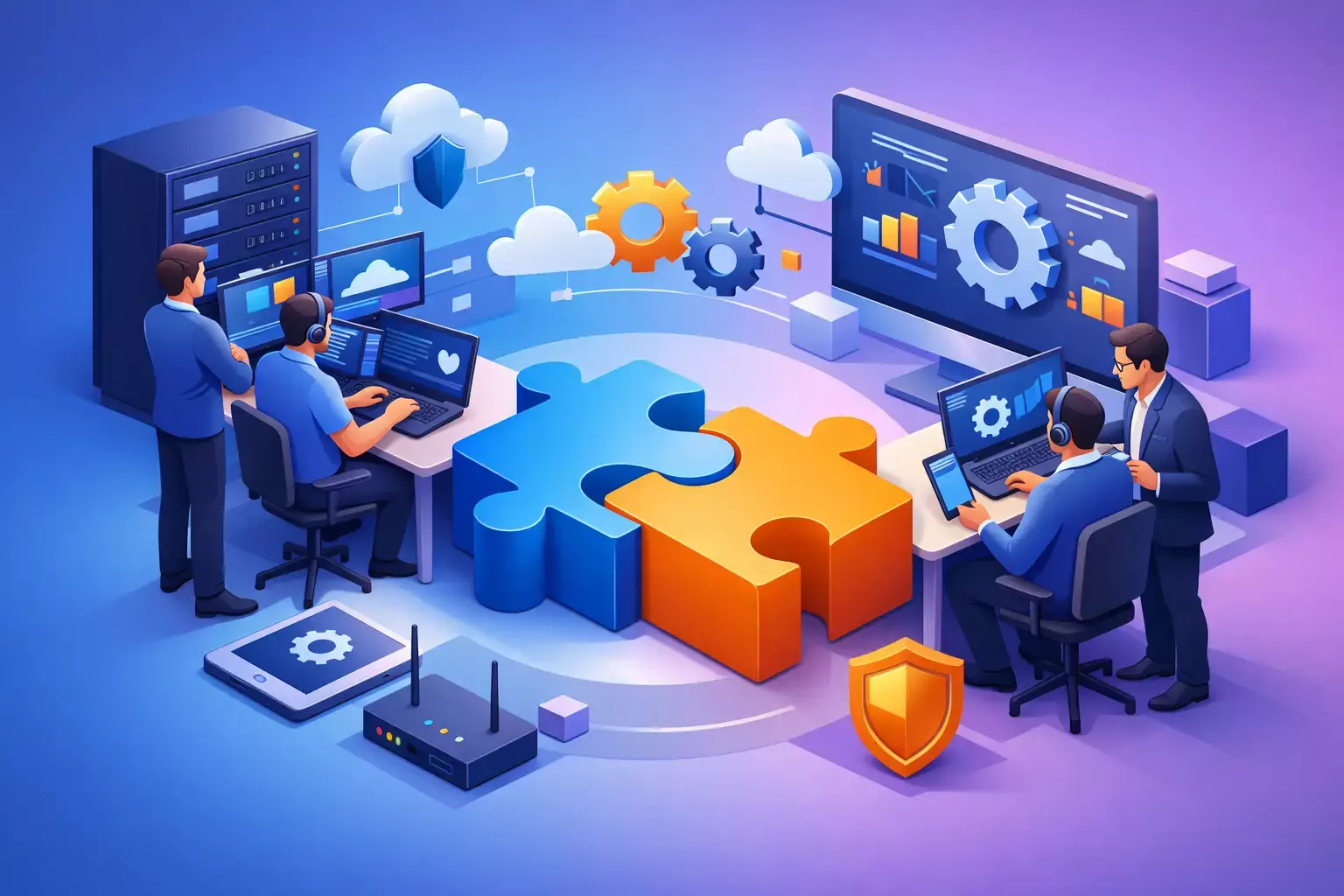
Co-managed IT services is a shared operating model where your internal IT staff and an outside IT partner work together under a defined split of responsibilities. Instead of replacing your team, the provider fills capability gaps, expands capacity, and adds specialised expertise in areas like cloud infrastructure, cybersecurity, compliance, monitoring, and after-hours support. For growing businesses, it is often the middle ground between doing everything in-house and handing everything off to a managed service provider.
What is co-managed IT services in practical terms?
In practical terms, co-managed IT means your business keeps ownership of IT strategy, priorities, and internal knowledge while a service partner takes on agreed parts of execution and support. That split can be broad or narrow depending on your environment.
For one company, the provider may handle endpoint management, patching, backup oversight, and security operations while the internal team owns business applications and user relationships. For another, the internal team may run day-to-day support while the provider manages AWS infrastructure, observability tooling, disaster recovery, and compliance controls. The model is flexible by design.
That flexibility matters because most small and midsize businesses do not have the same pressure in every area. Some have a capable help desk but no cloud engineering depth. Others have strong infrastructure leadership but need 24/7 monitoring or better security coverage. Co-managed IT lets you add the missing pieces without rebuilding the whole department.
How co-managed IT differs from fully managed IT
Fully managed IT usually means an outside provider takes primary responsibility for most or all IT operations. That can work well for companies without an internal IT function or for organizations that want a single external team to own support, maintenance, and roadmap execution.
Co-managed IT is different because your internal team stays in the picture. They remain active participants in planning, operations, vendor decisions, and support workflows. The outside provider acts as an extension of your team rather than a replacement.
That distinction affects control, speed, and institutional knowledge. With a co-managed model, internal staff often retain direct visibility into systems, policies, and business context. At the same time, they gain access to engineering depth and operational maturity that would be expensive to build internally. The trade-off is that co-management requires clear communication and defined ownership. If roles are vague, tasks can slip or get duplicated.
Why businesses choose co-managed IT services
Most companies do not move to co-managed IT because the concept sounds appealing. They do it because the current model is under strain.
One common driver is staffing. Hiring experienced cloud engineers, security specialists, and compliance talent is difficult and expensive. Even when a company has strong internal IT leadership, that team may not have enough bandwidth to manage endpoint support, identity controls, monitoring, incident response, vendor coordination, and infrastructure modernization at the same time.
Another driver is risk. Security expectations have changed. Cyber insurance requirements, audit pressure, and customer due diligence now demand stronger controls, better logging, tested backups, and more disciplined access management. Internal teams often know what needs to happen, but do not have enough time to operationalize it.
Growth also changes the equation. A business that was fine with a lean internal team at 50 users may struggle at 150 users, multiple locations, hybrid cloud workloads, and a larger compliance footprint. Co-managed IT helps scale support and governance without forcing a disruptive handoff.
What services are usually included?
The exact scope depends on the provider and your internal capabilities, but co-managed engagements often include a mix of operational support and specialized engineering.
On the operational side, that can mean patching, device lifecycle support, endpoint management, backup oversight, identity and access administration, Microsoft 365 support, ticket overflow, and network monitoring. On the engineering side, it may include AWS architecture support, Terraform automation, CI/CD improvements, observability with tools like New Relic, security hardening, vulnerability remediation, and disaster recovery planning.
Some organizations also use co-managed IT for governance-heavy areas. Compliance preparation, policy development, asset inventory, log retention, and security review processes are common examples. If your business is trying to mature its environment without building a large internal team, this is often where a co-managed partner adds the most value.
Where the shared model works best
Co-managed IT works best when the business wants support, not surrender. If your team understands the business well and wants to stay close to systems and decision-making, co-management preserves that involvement.
It is especially effective for companies with a few internal IT professionals who are capable but stretched thin. They may be good at handling user support and day-to-day administration, but less equipped for cloud optimization, security operations, automation, or major infrastructure projects. A co-managed partner can take on those heavier technical layers while internal staff stay focused on business continuity and internal relationships.
This model also fits organizations going through change. Cloud migration, M&A integration, security remediation, compliance preparation, office expansion, and modernization projects all create temporary spikes in workload. Rather than overhire for a short-term need, businesses can use co-managed services to extend capacity in a controlled way.
What to watch for before you sign
The biggest risk in co-managed IT is not the concept. It is a poor operating design.
If there is no clear division of responsibility, your team and the provider can end up assuming the other side owns an issue. That is how backups go untested, patching falls behind, or security alerts sit too long. A good co-managed relationship needs a documented responsibility matrix, escalation paths, communication cadences, and access boundaries.
Tooling alignment matters too. Some providers insist on replacing everything with their standard stack. Standardization can be useful, but forced changes are not always in the client’s best interest. A strong partner should be able to work within your environment, where practical, while improving it over time.
You should also ask how strategic the service really is. Some providers advertise co-management but only offer reactive help desk support. Others can support architecture reviews, cloud cost optimization, observability, security operations, and roadmap planning. The right fit depends on whether you need more hands, more expertise, or both.
How to know if your business needs it
If your internal team is consistently in reactive mode, that is a strong signal. When skilled staff spend most of their time clearing tickets and fighting fires, strategic work gets delayed. Security posture weakens, technical debt grows, and projects slip.
You may also need co-managed IT if your infrastructure has become more complex than your current staffing model. Hybrid cloud, remote work, identity sprawl, compliance requirements, and increasing vendor overlap all add operational weight. Many businesses can absorb that complexity for a while, but eventually the strain shows up in outages, slower response times, and rising risk.
Another sign is dependency on one or two key employees. If critical knowledge sits with a single systems administrator or IT manager, that creates operational fragility. Co-managed IT can reduce that concentration risk by adding process discipline, documentation, and broader technical coverage.
What a good co-managed provider should bring
A good provider should bring more than labour. They should improve the way IT runs.
That means mature processes, measurable service levels, stronger documentation, clearer escalation, and technical depth across infrastructure, cloud, security, and support. It also means business awareness. The provider should understand whether your top priorities are uptime, audit readiness, faster product delivery, lower cloud spend, or all of the above.
For many organizations, the most valuable co-managed partner is one that can operate across layers. Not just endpoint support, but also AWS architecture, DevOps automation, observability, security controls, and compliance support. That broader capability reduces fragmentation and keeps decisions aligned.
This is where a provider such as Advanced Vision IT can make the model more effective. If one partner can support managed IT, cloud operations, security, and modernization work under a shared operating structure, the client gets fewer handoff points and better continuity between strategy and execution.
The business case behind co-managed IT services
The financial case is usually not about replacing salaries with a cheaper contract. It is about getting better coverage and higher-value capability without carrying the full cost of building every function in-house.
A co-managed model can reduce downtime, improve security posture, accelerate projects, and help internal staff focus on work that directly supports the business. It can also delay or reduce hiring pressure, which matters when specialized infrastructure and security roles are difficult to fill.
That said, it is not always the right move. If your business has a large, well-staffed IT department with strong cloud and security maturity, you may only need project-based consulting. If you have no internal IT team at all, fully managed services may be the cleaner fit. Co-management is strongest in the middle, where you want to keep control but need more depth and capacity than your current team can sustainably provide. The right question is not whether co-managed IT is better than fully managed IT in every case. It is whether your current operating model gives the business the coverage, resilience, and execution speed it now requires. If the answer is no, a shared model may be the most practical way to strengthen IT without slowing the business down.

Written by Alexander Boychev
Business Executive & Digital Marketing Manager at Advanced Vision IT Ltd | Published on
Alexander advises insights on business development, strategic key account management, and digital marketing in the IT sector.