



What Is Hybrid Cloud Management for Growing Teams?
When a customer-facing application runs in AWS, identity services remain on-premises, and backups live in a separate environment, the issue is no longer simply where workloads run. The real question is: what is hybrid cloud management, and how can your team operate that environment without creating security gaps, support delays, or unpredictable costs?
Hybrid cloud management is the coordinated practice of monitoring, securing, governing, automating, and optimizing infrastructure across public cloud platforms and private cloud or on-premises systems. It gives IT and engineering teams a consistent operating model even when the underlying environments use different technologies, ownership models, and deployment patterns.
For a growing business, hybrid cloud is often a practical reality rather than a deliberate architecture choice. A legacy line-of-business system may need to stay in a data center. A new digital product may be built in AWS. Compliance requirements, data residency, latency, acquisitions, or software licensing may add more complexity. Management is what turns that mix from a collection of disconnected platforms into a dependable service foundation.
Hybrid Cloud Management Is an Operating Discipline
Hybrid cloud management is not a single dashboard or a tool purchased to make infrastructure look unified. Those tools can help, but the core work is operational. Teams need clear standards for identity, network access, backups, patching, incident response, change control, and cost accountability across every environment.
The goal is not to force every system into the same technical stack. Public cloud and on-premises platforms have different strengths. AWS may provide elastic capacity, managed databases, and rapid deployment options, while a local environment may support specialized hardware, low-latency workloads, or systems that cannot be moved quickly. Effective management accepts those differences while applying consistent controls where they matter.
That distinction matters because hybrid environments fail at the handoffs. A cloud application might be healthy while its connection to an on-premises database is failing. An administrator may have access to one platform but not another. A security team may receive alerts from several systems without a shared incident workflow. The infrastructure itself can be sound while the operating model is fragmented.
Why Hybrid Environments Become Hard to Run
Complexity grows quickly when each environment is managed as its own island. Different identity directories, monitoring tools, firewall rules, backup policies, and ticketing procedures make routine work slower. During an outage or suspected security event, teams spend valuable time determining who owns which component and where the evidence lives.
Visibility is a common weak point. Infrastructure metrics alone do not show whether a business service is working end to end. Teams need to understand the relationship between cloud compute, network paths, APIs, on-premises dependencies, and user experience. Observability platforms such as New Relic can help correlate telemetry, but the organization still needs defined service ownership, actionable alert thresholds, and escalation procedures.
Security also becomes harder when controls differ by location. A workload in AWS may use tightly managed IAM roles and centralized logging, while a connected on-premises server relies on broad local administrator access and inconsistent patching. Attackers do not care which platform a system occupies. They look for weak identity controls, exposed services, unpatched software, and gaps between teams.
Cost management has its own hybrid challenge. Public cloud spending is variable and detailed, while on-premises costs may be spread across hardware, support contracts, power, facilities, and labor. Without a complete view of service costs, leaders can make poor decisions based on only one side of the equation. Moving a workload to the cloud is not automatically cheaper, and keeping one on-premises is not automatically safer.
What Hybrid Cloud Management Includes
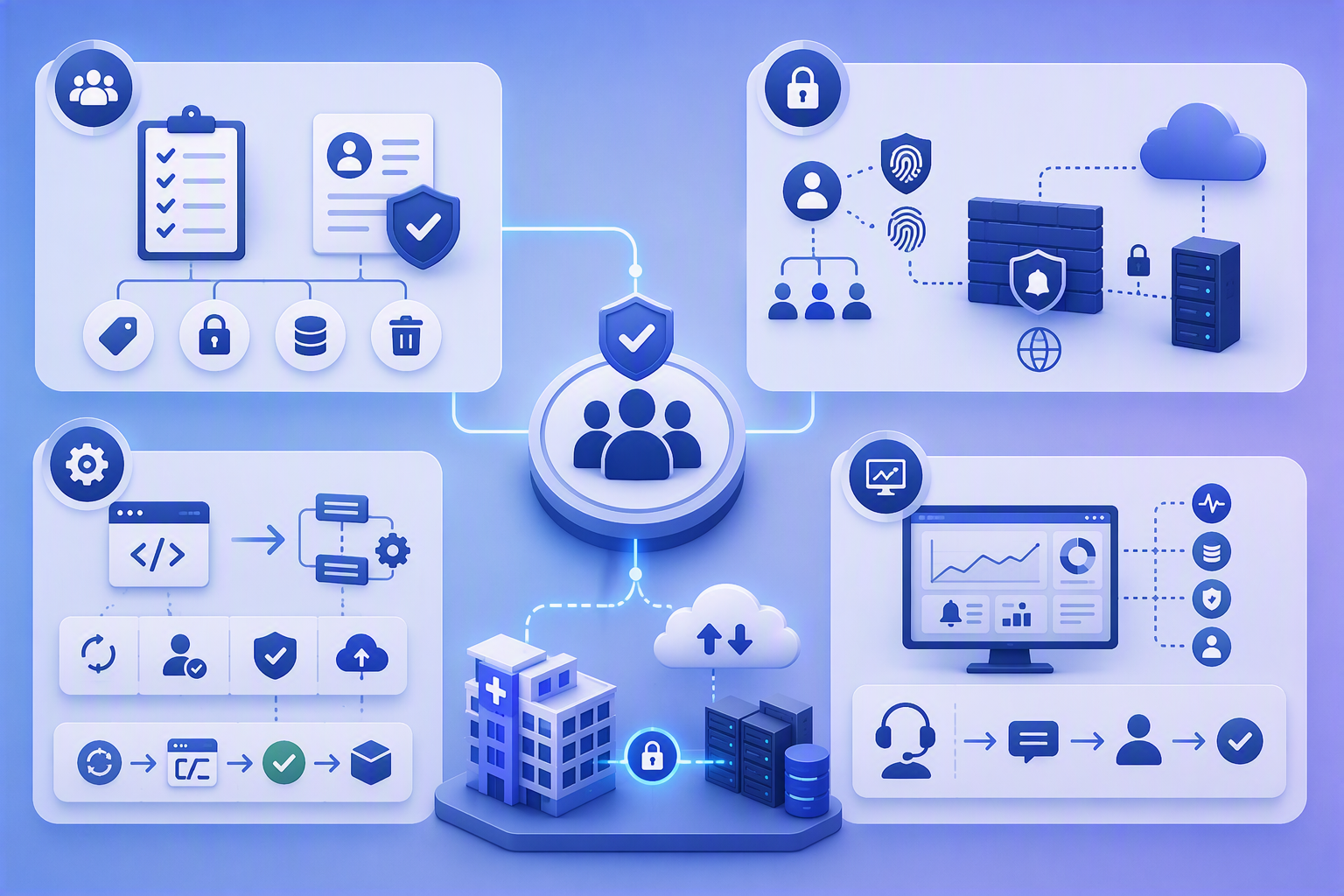
Shared governance and service ownership
A managed hybrid environment starts with decisions that are easy to understand and enforce. Each workload should have an owner, a defined business purpose, documented dependencies, recovery requirements, and an approved location. Governance should establish standards for provisioning, tagging, access, data classification, backups, and retirement.
This does not mean creating a bureaucracy that slows delivery. Good governance gives teams approved patterns they can use repeatedly. For example, a development team should know how to request a network connection, deploy a new application environment, store secrets, and meet logging requirements without negotiating every control from scratch.
Identity, network, and security controls
Centralized identity is one of the highest-value improvements in a hybrid model. Users, administrators, service accounts, and automated processes should receive the least access required for their work. Multi-factor authentication, role-based access, privileged access review, and lifecycle management should apply across cloud and local systems as consistently as possible.
Network architecture needs the same discipline. Secure connections between environments should be designed for availability, segmentation, inspection, and performance, not treated as a one-time connectivity project. Clear rules for inbound access, egress, DNS, certificates, and third-party connections reduce the chance that a temporary exception becomes a permanent exposure.
Security management also includes continuous vulnerability remediation, log retention, endpoint protection, and tested incident response. Compliance obligations may affect how long data is retained, where it can be processed, and how access is documented. A Well-Architected Review can expose gaps in security, reliability, and operational processes before those gaps become an incident.
Automation and configuration consistency
Manual configuration is difficult to track in any environment. Across a hybrid estate, it creates drift fast. Infrastructure as code tools such as Terraform can define cloud resources consistently, while Ansible can automate configuration and maintenance across servers and supporting systems. The precise toolset can vary, but the principle is stable: repeatable changes are safer, faster, and easier to audit.
Automation should extend beyond initial deployment. Patch workflows, account creation, certificate renewal, backup validation, configuration checks, and recovery procedures all benefit from automation. CI/CD pipelines can apply testing and approval controls before changes reach production, reducing the risk of undocumented fixes during high-pressure support events.
Monitoring, observability, and support
A useful hybrid monitoring strategy connects infrastructure health to application and business service health. It tracks availability, latency, capacity, error rates, backup status, security events, and the dependencies between them. Alerts should be meaningful enough to prompt action, not so noisy that critical signals disappear in a flood of notifications.
Operational support should also be designed around the whole service. If a business application relies on an AWS-hosted API, a VPN connection, an on-premises ERP system, and a SaaS identity provider, the support process must account for all four. A single accountable partner or clearly defined ownership model can prevent the familiar cycle of vendors blaming one another while users wait.
A Practical Model for Managing Hybrid Cloud
Start by building an accurate inventory. Identify workloads, data stores, interfaces, owners, dependencies, locations, access methods, and recovery objectives. Many organizations discover that their biggest risk is not an aging server or an expensive cloud instance, but a poorly documented connection that only one person understands.
Next, classify workloads by business and technical requirements. Consider sensitivity of data, required uptime, latency, scalability, licensing, integration needs, and regulatory obligations. This helps determine whether a workload should remain where it is, be modernized in place, move to the cloud, or be replaced entirely.
Then establish a common control baseline. Identity, logging, encryption, backup verification, vulnerability management, tagging, patching, and change management should have written standards. The implementation will not look identical across every platform, but the outcome should be equivalent: accountable access, recoverable data, visible activity, and controlled change.
Finally, make optimization a recurring process rather than a migration cleanup task. Review cloud consumption, right-size resources, retire unused assets, test disaster recovery, examine alert quality, and measure service performance against business needs. Hybrid management is continuous because applications, risks, and operating costs continue to change.
When Hybrid Cloud Is the Right Choice
Hybrid cloud makes sense when an organization has valid reasons to keep some systems local while using public cloud capabilities for others. This may include a staged modernization program, factory or healthcare workloads with local latency needs, strict data requirements, specialized hardware, or an acquisition that brings a separate environment into the business.
It is not the right answer simply because a company has not decided what to do with legacy systems. Maintaining two operating models indefinitely can be costly. If a workload has no technical, financial, or compliance reason to remain on-premises, a planned migration or retirement may reduce long-term complexity.
The best architecture is therefore situational. A hybrid strategy should be intentional, reviewed regularly, and tied to business outcomes rather than attachment to a particular platform.

What Good Hybrid Operations Look Like
A well-managed hybrid environment gives leaders a reliable view of risk, spending, capacity, and service health. Engineering teams can deploy changes through defined patterns. Security teams can investigate activity across environments. Support teams can resolve incidents using shared telemetry and documented ownership. Most importantly, users experience dependable services without needing to know where the underlying workload runs.
For businesses without a large internal cloud operations team, this is where an experienced managed services partner can add practical value. Advanced Vision IT approaches hybrid operations as a full lifecycle responsibility, combining AWS expertise, DevOps automation, observability, cybersecurity, and hands-on support around the systems that keep the business moving.
The right next step is not to chase a fully cloud-only future by default. It is to make every environment you operate visible, governed, secure, and purposeful - then modernize from a position of control.
How a Regional Healthcare Provider Gained Control of Its Hybrid Environment
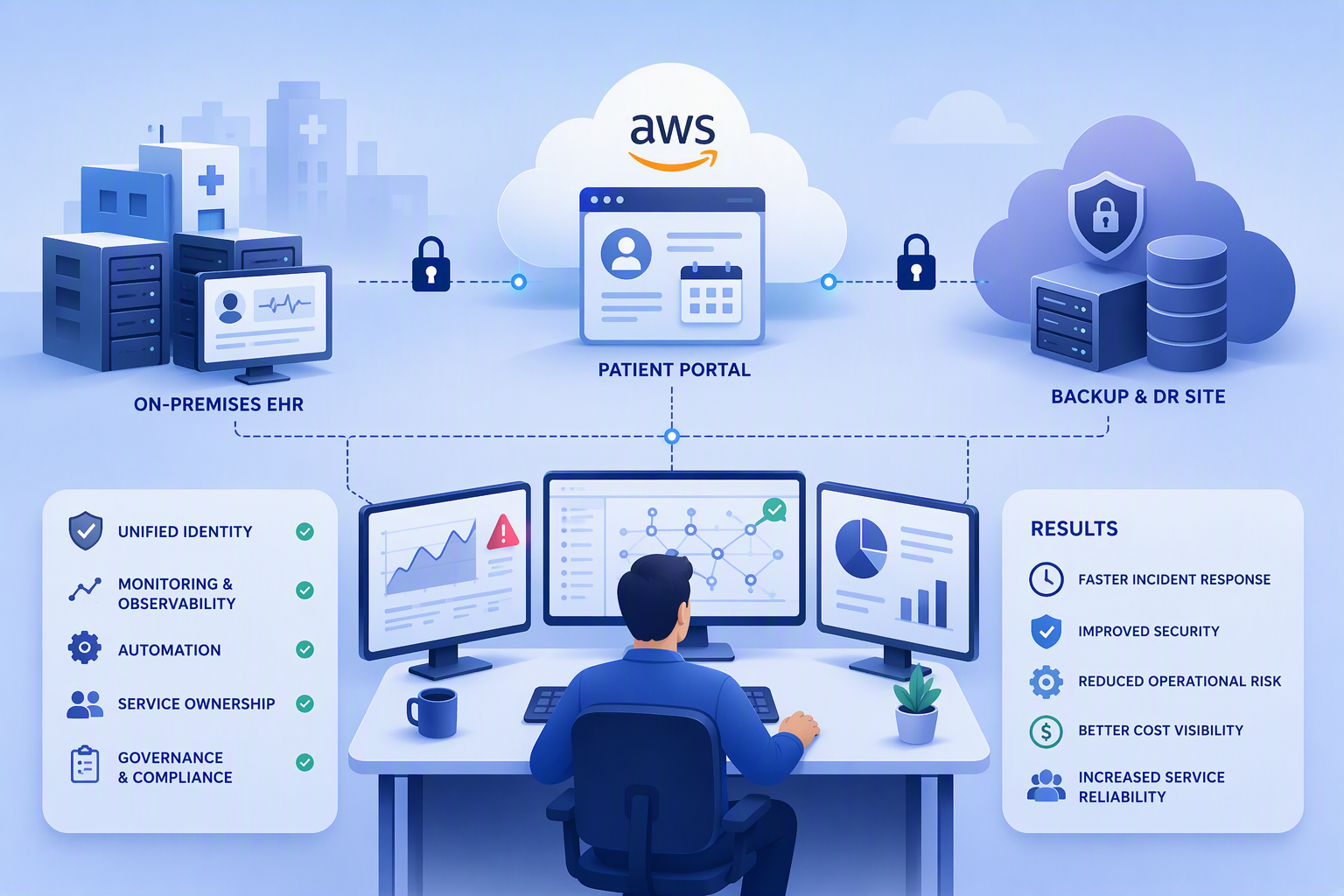
A regional healthcare provider operated a patient portal in AWS, maintained electronic medical record systems on-premises, and relied on a separate backup and disaster recovery environment. Over time, each platform was managed independently by different teams using different tools and processes.
The problems became visible during a service outage. Patients could access the portal, but appointment scheduling failed because the cloud-hosted application could not reliably communicate with an on-premises database. The infrastructure monitoring tools reported that individual systems were healthy, yet users were experiencing service disruptions. It took several hours to identify the root cause because responsibility was spread across multiple teams.
The organization also discovered security inconsistencies. AWS resources were protected by strict IAM policies and multi-factor authentication, while several on-premises systems still relied on broad administrative privileges and manual access reviews. Meanwhile, cloud costs continued to increase because resources that were no longer needed remained active without clear ownership.
To address these challenges, the provider implemented a structured hybrid cloud management model. It standardized identity management across environments, established shared monitoring and observability, automated configuration management, documented service ownership, and introduced consistent governance controls for both cloud and on-premises resources.
The results included:
- Faster incident response through centralized monitoring and shared operational procedures.
- Improved security with unified identity and access controls.
- Reduced operational risk through automated patching and configuration management.
- Better visibility into infrastructure and application costs.
- Increased service reliability for patients and staff.
Rather than forcing every workload into the cloud, the organization focused on creating a consistent operating model across all environments. The outcome was a more secure, manageable, and resilient hybrid infrastructure that supported both business and compliance requirements.
Why This Matters
Many organizations already operate in a hybrid cloud model whether they planned to or not. New applications are often deployed in public cloud platforms while critical business systems, databases, or legacy applications remain on-premises. As environments grow, the challenge shifts from infrastructure deployment to operational consistency.
Without effective hybrid cloud management:
- Security controls become inconsistent across platforms.
- IT teams struggle with fragmented monitoring and incident response.
- Compliance requirements become harder to demonstrate and audit.
- Operational costs become less predictable.
- Service outages take longer to diagnose and resolve.
Effective hybrid cloud management provides a framework for governing cloud and on-premises systems as a single service ecosystem. It gives organizations better visibility, stronger security, clearer accountability, and greater operational efficiency without forcing every workload into the same environment.
Most importantly, it allows technology decisions to be driven by business requirements rather than infrastructure limitations. Organizations can place workloads where they make the most sense while maintaining consistent controls, support processes, and user experience across the entire estate.
Frequently Asked Questions (FAQ)
1. What is hybrid cloud management?
Hybrid cloud management is the practice of monitoring, securing, governing, automating, and optimizing workloads across public cloud, private cloud, and on-premises environments. Its purpose is to provide consistent operations and visibility regardless of where applications or data reside.
2. Why is hybrid cloud management important?
Hybrid environments often contain multiple platforms, teams, and technologies. Without a unified management approach, organizations can experience security gaps, operational inefficiencies, higher costs, and slower incident resolution.
3. What are the biggest challenges in managing a hybrid cloud environment?
The most common challenges include fragmented visibility, inconsistent security controls, identity management complexity, configuration drift, compliance requirements, and difficulty tracking costs across cloud and on-premises resources.
4. Does hybrid cloud management require specialized tools?
Tools can help, but they are only part of the solution. Successful hybrid cloud management depends on governance, service ownership, operational processes, security policies, automation, and monitoring practices. The right tools support these disciplines rather than replace them.
5. When should an organization choose a hybrid cloud approach?
A hybrid cloud approach is often appropriate when workloads have different technical, compliance, latency, data residency, or business requirements. It allows organizations to take advantage of public cloud capabilities while retaining systems that are better suited to private infrastructure or on-premises environments.

Written by Yavor Y. Zlatev
CEO & Founder at Advanced Vision IT Ltd | Published on
Yavor advises executive leadership teams on cybersecurity strategy, NIS2 compliance, and cloud operating models to build resilient IT environments.