



Amazon VPC Networking Foundation and Q&A
A cloud workload can be perfectly deployed and still fail the business if its network design prevents users, partners, or critical services from reaching it. Amazon VPC is where availability, security boundaries, connectivity, and much of your AWS operating cost begin. This Amazon VPC networking foundation plus Q&A explains the decisions that matter before a small configuration issue becomes an outage, exposure, or expensive redesign.
Amazon VPC: the networking foundation
Amazon Virtual Private Cloud, or Amazon VPC, is the logically isolated network you create inside an AWS Region. It provides the IP address space, routing, traffic controls, and connectivity patterns for applications running on AWS services such as Amazon EC2, containers, databases, load balancers, and private endpoints.
A VPC is not simply a container for servers. It is a business control point. Its design determines whether a customer-facing application can remain available during an Availability Zone failure, whether production databases can be reached only by approved application tiers, and whether on-premises systems can communicate with AWS without exposing traffic to the public internet.
For most organizations, the right starting point is one VPC per major environment or security boundary, with a defined address range that will not conflict with existing corporate networks or future acquisitions. A VPC is regional, while subnets are tied to individual Availability Zones. That distinction is central to designing for high availability.
Design the network before deploying workloads
The first architectural decision is the CIDR block, which defines the VPC's available private IP address range. Choosing an overly small range creates an avoidable growth problem, especially for container platforms, autoscaling groups, private endpoints, and development environments. Choosing a range that overlaps with office, data center, partner, or acquired-company networks can make VPN and hybrid connectivity difficult or impossible without translation.
Address planning should account for future use, not just the first application migration. A business with a handful of EC2 instances may later introduce Amazon EKS, CI/CD runners, additional environments, analytics tooling, or private connectivity to SaaS providers. Each can consume addresses quickly. Expanding an address plan after teams have deployed dependencies is possible, but it is rarely painless.
Next, divide the VPC into subnets across at least two Availability Zones for production workloads that require continuity. Public and private subnets are defined by their routing, not by a label. A public subnet has a route to an internet gateway and contains resources that need direct public connectivity, such as an internet-facing load balancer. Private subnets do not have direct inbound internet exposure and are the appropriate location for application servers, worker nodes, and databases.
A common pattern places load balancers in public subnets, application services in private subnets, and data services in more restricted private subnets. This is not a rule for every workload. A private internal application may require no public subnets at all, while a simple static site may not need application servers. The principle is to grant each component only the network path it genuinely needs.
Route tables make that intent operational. They determine where traffic goes after a workload decides it needs to reach a destination. Routes may send traffic locally inside the VPC, to an internet gateway, through a NAT gateway for outbound internet access, across a VPN connection, or through a transit gateway to another network. Route tables deserve peer review because a single overly broad route can bypass an intended security boundary.
Security groups, network ACLs, and layered controls
Security groups are the primary firewall control for most AWS workloads. They are stateful, meaning return traffic for an allowed connection is automatically permitted. The strongest security group rules reference other security groups rather than broad IP ranges. For example, a database security group can allow its database port only from the application security group, rather than from an entire subnet or every internal address.
Network ACLs operate at the subnet level and are stateless. They can be useful for explicit boundary controls, but they require matching inbound and outbound rules and can become difficult to manage at scale. In most environments, security groups should carry the detailed application policy, while network ACLs serve a limited, intentional role.
Network security does not stop at packet filtering. Sensitive workloads also need identity-based access controls, encryption, audit trails, patching, vulnerability management, and monitoring. A VPC design can reduce blast radius, but it cannot compensate for publicly exposed credentials or an application that authorizes users incorrectly.
For regulated systems, document why each public endpoint, route, security group rule, and hybrid connection exists. That documentation helps with compliance evidence, incident response, and the practical work of identifying unused exposure as systems change.
Private connectivity and DNS need an operating model
Many AWS environments become harder to manage when every service calls external endpoints over the internet. VPC endpoints can provide private access to selected AWS services without requiring traffic to traverse a NAT gateway or public internet path. They can improve control and, in some cases, reduce recurring NAT data-processing costs.
Hybrid organizations often need a site-to-site VPN or AWS Direct Connect to connect office, data center, or colocation environments to AWS. A VPN is usually faster to deploy and suitable for many workloads. Direct Connect offers more predictable private connectivity and can be appropriate for sustained traffic volumes, latency-sensitive systems, or stricter operational requirements. The best choice depends on traffic profile, resilience requirements, geography, budget, and the consequence of a connection interruption.
DNS is equally important. Private hosted zones, service discovery, and consistent internal naming prevent teams from relying on fragile IP addresses or manually maintained host files. Treat DNS changes as production changes: review them, automate them where possible, and monitor resolution failures.
Operate Amazon VPC networking as code
A VPC should not be a collection of console changes known only to one administrator. Use infrastructure as code with Terraform, CloudFormation, or a comparable controlled deployment process to create subnets, route tables, security groups, endpoints, and network logs consistently. Version control provides an audit trail and makes peer review possible before changes affect production.
Enable VPC Flow Logs for the VPC or critical subnets and network interfaces. Flow Logs do not show packet contents, but they provide valuable metadata about accepted and rejected traffic. During an incident, that evidence can identify whether a connection failed because of a security group, network ACL, route, DNS issue, or an application-level problem.
Observability should connect network signals with workload health. A load balancer's target failures, increased NAT gateway traffic, rejected flows, DNS errors, and rising application latency may all describe the same issue from different angles. Tools such as New Relic, CloudWatch, and centralized log platforms are more useful when alerts are tied to defined service ownership and an actionable response path.
Cost management also belongs in the operating model. NAT gateways, cross-Availability Zone traffic, data transfer, idle Elastic IP addresses, and unnecessary endpoint choices can produce surprising charges. Cost optimization should not mean eliminating redundancy blindly. It means measuring traffic patterns, understanding the availability trade-off, and selecting the least costly architecture that still meets the application's recovery and uptime needs.Amazon VPC networking Q&A
Does every AWS account need a VPC?
Every AWS account has a default VPC in most Regions, but relying on it for production is not always appropriate. Default VPCs are convenient for testing, yet a purpose-built VPC provides clearer segmentation, intentional address planning, controlled routing, and repeatable deployment. Organizations with multiple accounts should establish network standards early so environments do not evolve into incompatible islands.
What is the difference between a public and private subnet?
The difference is the route table. A subnet is public when its route table sends internet-bound traffic to an internet gateway. A private subnet has no such direct route. Resources in a private subnet can still reach the internet outbound through a NAT gateway when required, but they do not accept unsolicited inbound traffic from the internet through that path.
Should databases ever be in a public subnet?
For most business systems, no. A database should be private and accessible only from approved application services, administrative paths, and backup or monitoring systems. Exceptions are rare and should be formally justified, tightly controlled, and continuously monitored.
Do we need one NAT gateway or one per Availability Zone?
One NAT gateway can lower cost, but it introduces an Availability Zone dependency and can create cross-zone data transfer charges for workloads in other zones. A NAT gateway in each Availability Zone improves resilience and keeps local outbound traffic local, but costs more. Production systems with meaningful uptime requirements generally justify the multi-zone design; lower-risk development environments may not.
When should we use VPC peering versus Transit Gateway?
VPC peering works well for a small number of direct, simple connections. It does not support transitive routing, so it becomes harder to operate as the number of VPCs grows. AWS Transit Gateway provides a centralized routing model for larger multi-VPC and hybrid environments. It adds cost and design considerations, but it often reduces long-term complexity for organizations with multiple accounts, regions, or network domains.
What is the first VPC control to review after a security incident?
Start with public exposure: internet gateway routes, public IP assignments, load balancers, security group rules, and recently changed network paths. Then review CloudTrail activity, VPC Flow Logs, identity permissions, and the affected workload's logs. Network review is necessary, but incident containment should also address credentials, application vulnerabilities, and unauthorized configuration changes.
The most effective VPC designs are not the most complicated ones. They make traffic paths understandable, enforce the fewest necessary permissions, and give operations teams evidence when something changes. For teams modernizing AWS infrastructure, Advanced Vision IT can translate those principles into a documented, automated network foundation that supports growth without creating unnecessary operational drag.
User Story: Amazon VPC Networking Foundation
As a cloud platform team responsible for secure, scalable infrastructure, I want a well‑designed Amazon VPC networking foundation that defines IP address space, subnet layout, routing, and connectivity patterns across multiple Availability Zones,So that all current and future workloads can operate reliably, securely, and without costly redesigns caused by CIDR conflicts, misconfigured gateways, or fragmented network governance.
Acceptance Criteria
-
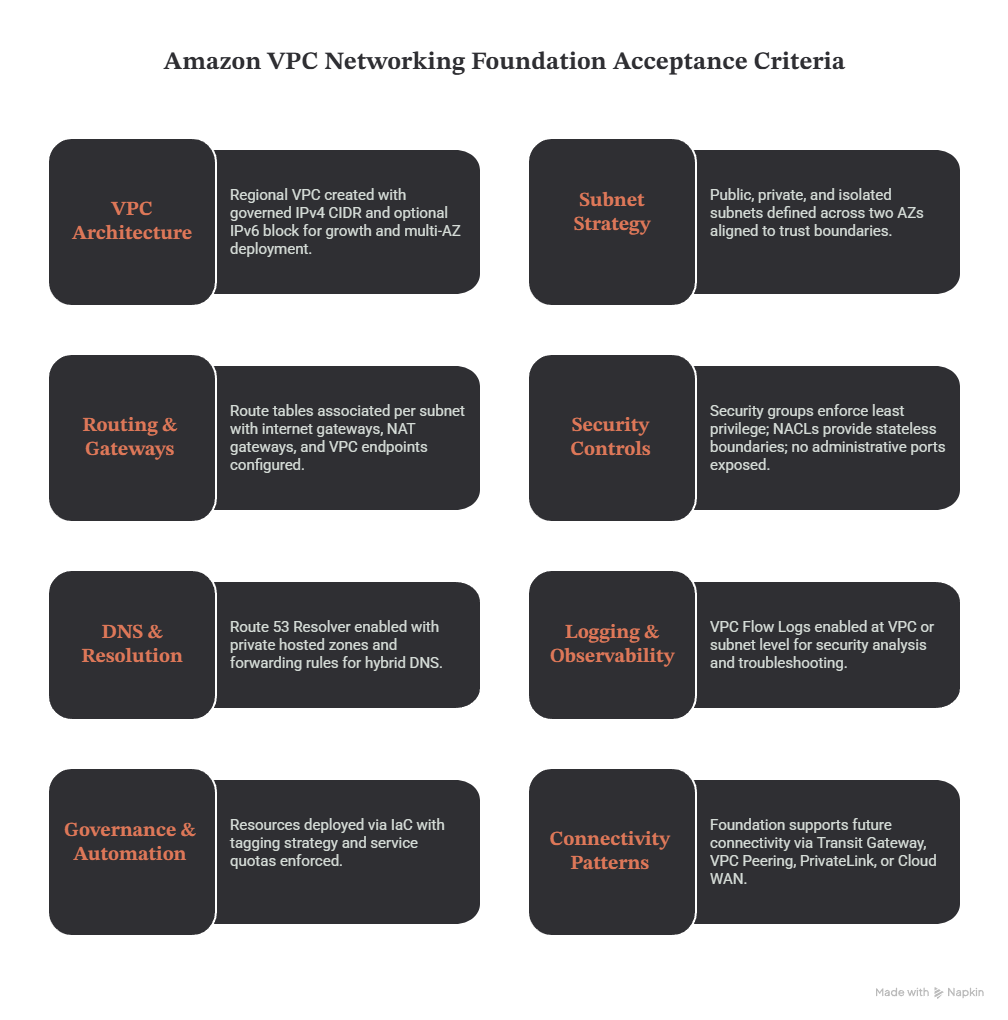
VPC Architecture A regional VPC is created with a clearly governed IPv4 CIDR (e.g., /16) and optional IPv6 block, sized for long‑term growth and multi‑AZ deployment.
-
Subnet Strategy Public, private, and isolated subnets are defined across at least two AZs, aligned to trust boundaries (public-facing, application tier, data tier).
-
Routing & Gateways Route tables are explicitly associated per subnet; internet gateways, NAT gateways, and VPC endpoints are configured according to workload needs.
-
Security Controls Security groups enforce least privilege using SG-to-SG references; NACLs provide stateless boundaries; no administrative ports exposed to 0.0.0.0/0.
-
DNS & Resolution Route 53 Resolver is enabled; private hosted zones and forwarding rules support hybrid DNS if required.
-
Logging & Observability VPC Flow Logs are enabled at VPC or subnet level for security analysis and troubleshooting.
-
Governance & Automation All networking resources are deployed via IaC (Terraform/CloudFormation/CDK); tagging strategy and service quotas are enforced.
-
Connectivity Patterns The foundation supports future connectivity via Transit Gateway, VPC Peering, PrivateLink, or Cloud WAN without redesign.
Narrative (Why This Matters)
Building an AWS network is not just drawing subnets — it is establishing the security boundary, routing domain, and connectivity model for every application that will ever run in the cloud. A poorly planned VPC leads to years of operational friction, while a strong foundation enables clean scaling, multi-account growth, and secure workload isolation.

Written by Yavor Y. Zlatev
CEO & Founder at Advanced Vision IT Ltd | Published on
Yavor advises executive leadership teams on cybersecurity strategy, NIS2 compliance, and cloud operating models to build resilient IT environments.