



AWS ECS vs EKS for Growth-Stage Cloud Teams
A container platform decision becomes expensive when it is treated as a developer preference. AWS ECS vs EKS determines who owns orchestration complexity, how security controls are applied, what skills your team must retain, and how reliably applications can scale under pressure.
For many small and mid-sized organizations, the right answer is not the platform with the longest feature list. It is the platform that delivers the required portability, automation, uptime, and governance without creating an operational burden the business cannot sustain.
AWS ECS vs EKS: The Core Difference
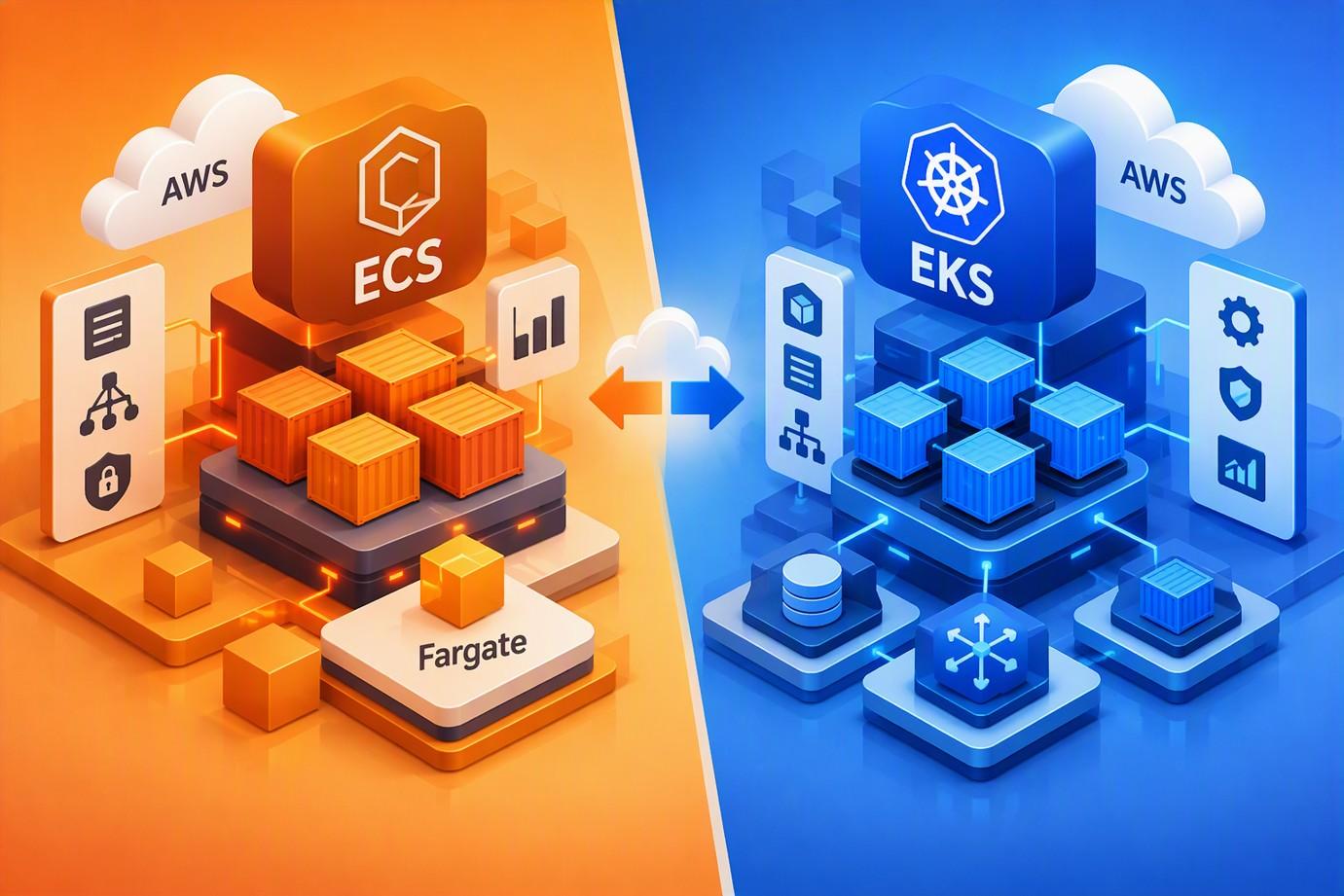
Amazon Elastic Container Service (ECS) is AWS's native container orchestrator. It uses AWS concepts such as task definitions, services, clusters, IAM roles, load balancers, and CloudWatch. ECS is designed to make it straightforward to deploy and operate containers within the AWS ecosystem.
Amazon Elastic Kubernetes Service (EKS) is AWS's managed Kubernetes offering. AWS operates the Kubernetes control plane, while your team configures and manages Kubernetes resources such as pods, deployments, services, ingress controllers, namespaces, network policies, and add-ons. EKS gives teams the Kubernetes API and ecosystem while reducing the work of operating the control plane itself.
The practical distinction is simple: ECS favors AWS-native operational simplicity. EKS favors Kubernetes compatibility, flexibility, and portability. Neither is automatically the more mature choice. The better choice depends on the workload and the operating model behind it.
Choose ECS When Operational Simplicity Is the Priority
ECS is often the stronger fit for organizations running primarily on AWS, especially when engineering teams want to focus on application delivery rather than Kubernetes administration. A team can deploy containerized APIs, background workers, scheduled tasks, and web applications using familiar AWS services without introducing the Kubernetes control plane and its supporting components.
ECS works particularly well with AWS Fargate, which runs containers without requiring the team to manage EC2 worker nodes. This reduces work around capacity planning, operating system patching, node autoscaling, and host-level monitoring. Teams still need to define CPU and memory limits, configure networking, manage image security, and observe workloads, but the infrastructure layer is materially simpler.
ECS also integrates cleanly with IAM task roles, Application Load Balancers, AWS Secrets Manager, Amazon CloudWatch, and autoscaling policies. For a business building a reliable application platform in AWS, those integrations can reduce delivery time and make access controls easier to audit.
That does not mean ECS is only for simple workloads. It can support serious production environments with multiple services, blue-green deployments, service discovery, private networking, and infrastructure-as-code deployment through Terraform or AWS CloudFormation. The limitation is less about scale and more about ecosystem choice. ECS is AWS-specific, so moving the same orchestration design to another cloud requires rework.
Choose EKS When Kubernetes Is a Business Requirement
EKS is the better fit when Kubernetes capabilities are central to the platform strategy. This is common for software companies with established Kubernetes expertise, teams operating across multiple cloud environments, or organizations that depend on tooling built around the Kubernetes ecosystem.
Kubernetes offers a broad set of patterns for multi-tenant environments, custom scheduling, policy enforcement, service meshes, GitOps workflows, and platform engineering. Tools such as Helm, Argo CD, Karpenter, Prometheus, and policy engines are widely used across Kubernetes environments. For teams that already have mature practices around these tools, EKS can provide consistency without giving up AWS infrastructure services.
EKS is also compelling when workload portability matters. Portability should be evaluated honestly, however. Kubernetes manifests may be portable, but load balancing, identity, storage, DNS, observability, and CI/CD integrations often still contain cloud-specific decisions. EKS reduces platform lock-in at the orchestration layer. It does not eliminate architectural dependency on AWS.
The trade-off is operational depth. Managed Kubernetes does not mean maintenance-free Kubernetes. Someone must own cluster upgrades, version compatibility, add-on lifecycle management, ingress configuration, node strategy, workload security, resource quotas, network policies, and incident response. AWS manages the control plane, but the shared responsibility model remains active throughout the cluster.
Cost Is More Than the Monthly Compute Bill
A comparison based only on container runtime pricing can lead to the wrong decision. ECS and EKS can both run on Fargate or EC2, and both can use Spot capacity for suitable workloads. Compute cost therefore depends heavily on resource requests, utilization, scaling behavior, and architecture.
EKS adds a direct cost for each managed Kubernetes cluster, along with potential costs for supporting components such as load balancers, logging, metrics retention, and NAT gateways. More significantly, it can create an indirect cost through engineering time. An under-resourced team may spend considerable time diagnosing Kubernetes networking, autoscaler behavior, version upgrades, or add-on conflicts.
ECS usually has lower platform overhead for AWS-only environments, but it can still become costly when services are oversized, autoscaling thresholds are poorly tuned, or logs and data transfer are not managed carefully. Fargate is convenient, but always-on workloads with predictable demand may be more economical on properly managed EC2 capacity.
A sound cost model includes infrastructure spend, engineering effort, security operations, observability, support requirements, and the cost of downtime. The least expensive platform on paper is not always the least expensive platform to operate.
Security and Compliance Need Different Controls
Both services can support strong security and compliance programs when configured deliberately. In either model, teams should use private subnets where appropriate, least-privilege IAM, encrypted storage, image scanning, centralized logging, secrets management, vulnerability remediation, and infrastructure-as-code controls.
ECS has an advantage for teams that want a smaller set of moving parts. IAM task roles provide a clear method for granting application-level AWS permissions without storing static credentials in containers. Security boundaries are easier to explain when the environment relies on standard AWS primitives and a limited set of deployment patterns.
EKS provides more granular Kubernetes-native controls, including namespaces, role-based access control, admission policies, network policies, and pod security controls. Those capabilities are valuable in complex environments, but they also demand disciplined configuration. A permissive cluster role, exposed Kubernetes API endpoint, or poorly configured ingress can create a broad attack surface.
For regulated businesses, the decision should account for evidence collection and operational ownership. Ask which platform makes it easier for your team to demonstrate access control, change management, vulnerability response, logging, backup practices, and recovery testing. A control that exists but is not monitored is not a dependable compliance control.
The Deployment Experience Matters More Than the Orchestrator
Container orchestration is only one layer of a production platform. Reliable delivery also requires a secure image pipeline, tested infrastructure changes, controlled releases, meaningful alerts, and a rollback path that works under pressure.
With ECS, a typical pipeline builds an image, scans it, pushes it to Amazon ECR, updates a task definition, and deploys the revised service. With EKS, the pipeline often builds and scans an image, updates deployment manifests or Helm values, and lets a GitOps or CI/CD process reconcile the desired state. Both models can support progressive delivery. The key is making deployment practices repeatable and observable.
For either service, define health checks that reflect application readiness, not just process availability. Set resource requests and limits based on measured behavior. Send logs, metrics, traces, and deployment events to a central observability platform. Establish service-level objectives for the applications that matter to customers and revenue.
A Practical Decision Framework
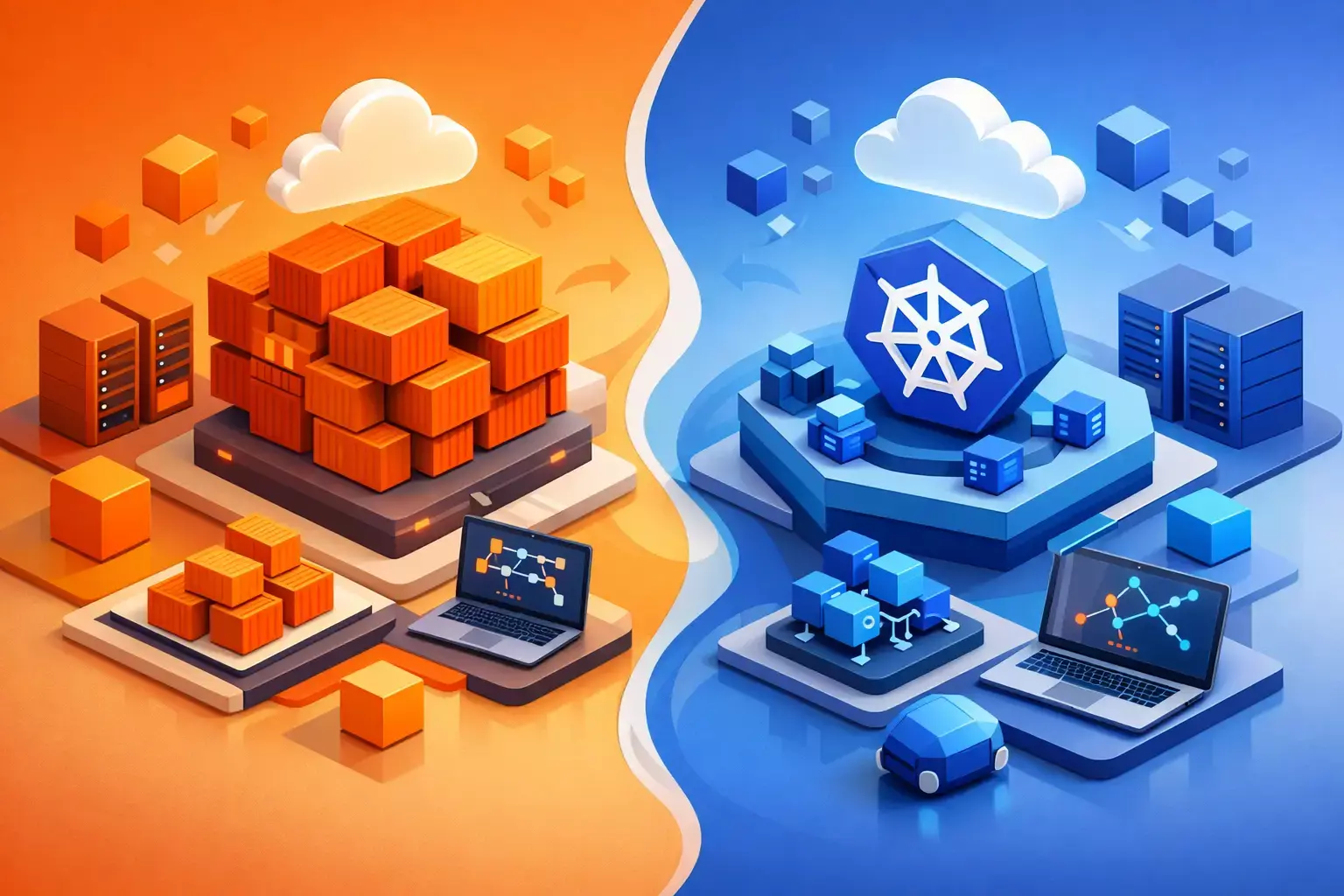
ECS is usually the right starting point if your organization is AWS-focused, has a lean operations team, and needs dependable container delivery without building Kubernetes expertise. It is especially effective for microservices, APIs, workers, and internal platforms that benefit from close AWS integration.
EKS is usually justified when your organization already has Kubernetes operating experience, requires Kubernetes-native tooling, supports multiple teams with sophisticated platform needs, or has a credible multi-cloud and portability requirement. It can be an excellent foundation, but it should be funded and staffed as a platform, not treated as a managed service that runs itself.
There are also valid hybrid approaches. A business may run straightforward web services on ECS while using EKS for a product platform that depends on Kubernetes operators or specialized workloads. The concern is not using two services. The concern is creating two operational models without clear ownership, standards, and monitoring.
The most reliable choice is the one your team can secure, monitor, upgrade, and recover consistently. Advanced Vision IT helps organizations evaluate these decisions through AWS architecture, DevOps automation, observability, and ongoing managed operations, so the container platform supports growth rather than becoming the next source of infrastructure friction.
User Story: Choosing the Right Container Platform Without Creating Operational Drag
Consider a growing SaaS company that recently migrated its applications to AWS. The engineering team consisted of eight developers and one cloud engineer. As container adoption increased, the team faced a familiar question: should they standardize on Amazon ECS or adopt Amazon EKS because "everyone seems to be using Kubernetes"?
Initially, Kubernetes appeared to be the more future-proof option. The team appreciated the flexibility, ecosystem tooling, and perceived portability. However, during a technical assessment they discovered that most of their workloads were AWS-native APIs, scheduled jobs, and internal services. They had no immediate multi-cloud strategy, no Kubernetes platform engineers, and limited operational bandwidth.
After evaluating operational responsibilities, security requirements, support costs, and team skills, they selected ECS with AWS Fargate as their primary platform. The result was faster deployment cycles, lower operational overhead, simpler IAM integration, and reduced time spent maintaining infrastructure. As the business grew, they were able to focus resources on application features and customer experience rather than cluster administration.
The key lesson was that the most capable platform was not necessarily the most appropriate platform. The best platform was the one the team could operate securely, reliably, and efficiently over time.
Why This Matters
Container platform selection affects far more than deployment mechanics. It influences staffing requirements, operational risk, security governance, compliance readiness, platform costs, troubleshooting complexity, and long-term scalability.
Many organizations are attracted to Kubernetes because of its extensive ecosystem and industry popularity. However, adopting Kubernetes without a clear business requirement can introduce significant operational complexity, requiring specialized expertise for cluster management, upgrades, networking, security policies, observability, and incident response.
Conversely, selecting a platform solely for simplicity can limit future flexibility if portability, advanced orchestration patterns, or Kubernetes-native tooling become strategic requirements.
The AWS ECS vs EKS decision should therefore be driven by business objectives rather than technology trends. Organizations that align their container platform with their operating model typically achieve:
- Faster application delivery and deployment cycles
- Lower operational overhead and infrastructure management effort
- More predictable platform costs
- Improved security governance and auditability
- Better reliability during scaling events and production incidents
- Clear ownership and accountability for platform operations
- Reduced risk of investing in technology that exceeds actual business needs
Ultimately, the wrong platform can become a long-term operational burden, while the right platform becomes an enabler for growth, innovation, and resilience.
Frequently Asked Questions (FAQ)
1. Is ECS only suitable for small or simple workloads?
No. ECS can support large-scale production environments, including microservices architectures, multi-tier applications, service discovery, blue-green deployments, autoscaling, private networking, and Infrastructure-as-Code automation. The primary difference is that ECS uses AWS-native constructs rather than Kubernetes abstractions.
2. Does EKS eliminate Kubernetes management responsibilities?
No. AWS manages the Kubernetes control plane, but organizations remain responsible for cluster configuration, worker nodes (if not using Fargate), upgrades, networking, security policies, add-ons, observability, and operational governance. EKS reduces infrastructure burden but does not eliminate Kubernetes operational responsibilities.
3. Is Kubernetes portability a sufficient reason to choose EKS?
Not always. While Kubernetes workloads can move more easily between environments, many surrounding services such as identity, storage, load balancing, DNS, monitoring, and CI/CD pipelines often remain cloud-specific. Organizations should validate whether they have a genuine multi-cloud requirement before using portability as a primary decision factor.
4. Which option is typically more cost-effective?
For AWS-centric organizations with lean operations teams, ECS often results in lower total operational costs because it requires less platform administration. However, actual costs depend on workload design, scaling behavior, infrastructure utilization, observability requirements, support needs, and engineering effort rather than orchestration technology alone.
5. How should an organization decide between ECS and EKS?
A practical approach is to evaluate four factors:
- Team experience and available operational skills
- Need for Kubernetes-native tools and workflows
- Portability and multi-cloud requirements
- Long-term operational and compliance responsibilities
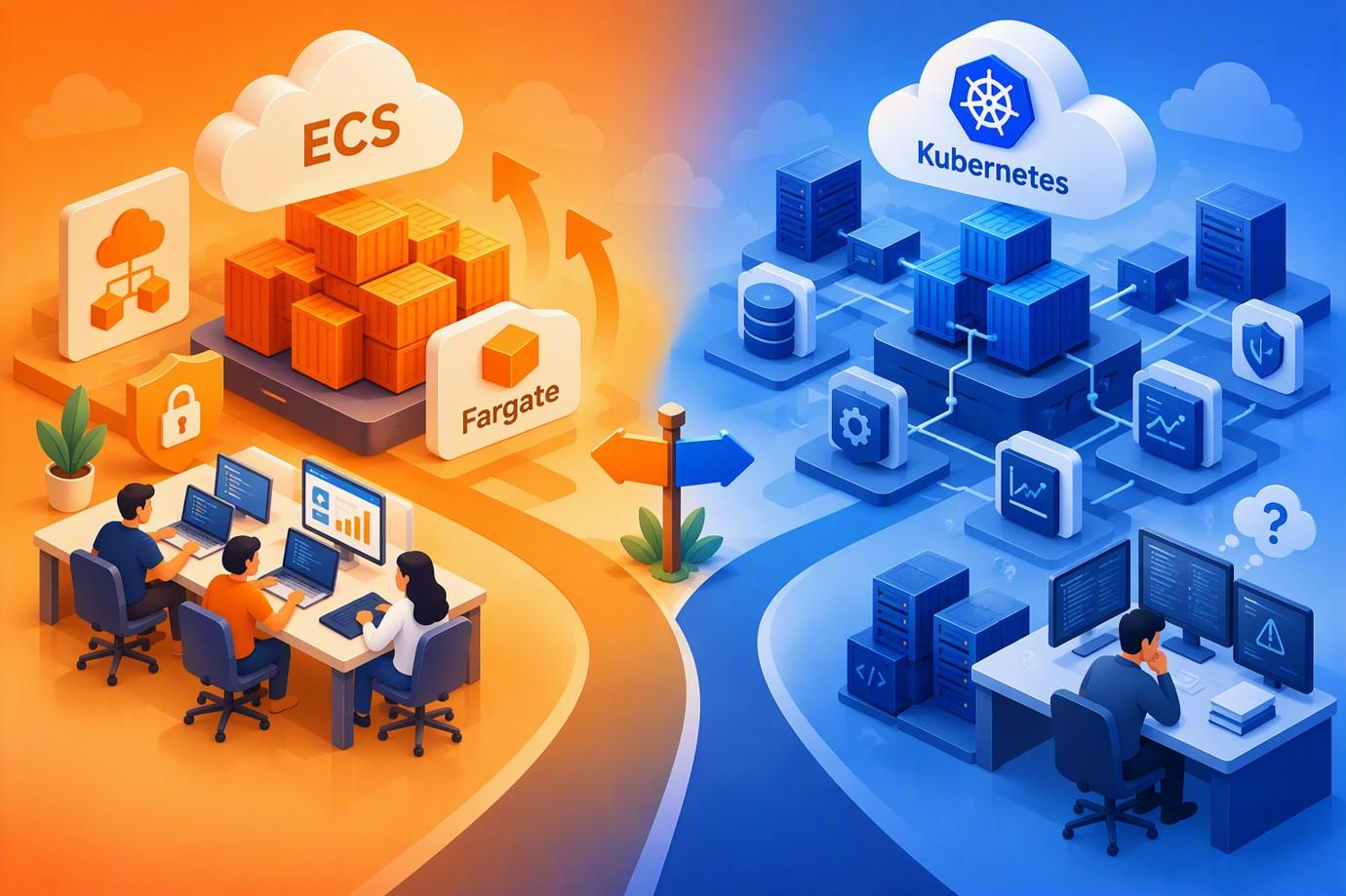
If AWS simplicity and operational efficiency are the primary goals, ECS is often the strongest choice. If Kubernetes capabilities, platform engineering practices, and ecosystem integration are strategic requirements, EKS is typically the better fit.
Key Takeaway
The ECS vs EKS decision is not fundamentally about containers. It is about choosing the operational model your organization can consistently secure, monitor, scale, upgrade, and support. The most successful platform strategy aligns technology choices with business capabilities, not industry trends.

Written by Yavor Y. Zlatev
CEO & Founder at Advanced Vision IT Ltd | Published on
Yavor advises executive leadership teams on cybersecurity strategy, NIS2 compliance, and cloud operating models to build resilient IT environments.