



AWS Migration vs Replatforming: Which Fits?
A legacy application can be running reliably enough to support the business while still creating unacceptable risk: slow releases, rising infrastructure costs, limited disaster recovery, and a growing backlog of security patches. The AWS migration vs replatforming decision determines whether an organization moves that workload quickly or changes how it operates before it lands in the cloud.
For CTOs and IT leaders, this is not simply a technical choice. It affects delivery timelines, downtime exposure, cloud spend, compliance posture, and the internal capacity required to support the environment after cutover. The right path depends on the workload's business value, technical condition, and the outcome the organization needs from AWS.
AWS Migration vs Replatforming: The Core Difference
AWS migration is the broader initiative of moving applications, data, and supporting infrastructure from an on-premises data center, another cloud provider, or a hosted environment into AWS. It can include several migration strategies, from a near-identical move to a full application rebuild.
Replatforming is one migration strategy. Sometimes called "lift, tinker, and shift," it moves the application while making selected changes that allow it to take advantage of managed AWS services. The application is not fundamentally redesigned, but key operational dependencies are improved.
A straightforward rehosting approach, often called lift and shift, might move a Windows or Linux server from a virtualized data center to Amazon EC2 with minimal code or architecture changes. Replatforming may move the same application tier to EC2 while replacing a self-managed database with Amazon RDS, externalizing session state, introducing automated backups, or putting static assets behind Amazon S3 and CloudFront.
That distinction matters because the two approaches solve different problems. Rehosting prioritizes speed and reduced data center dependency. Replatforming seeks a better operating model without accepting the cost, risk, and timeline of a full cloud-native refactor.
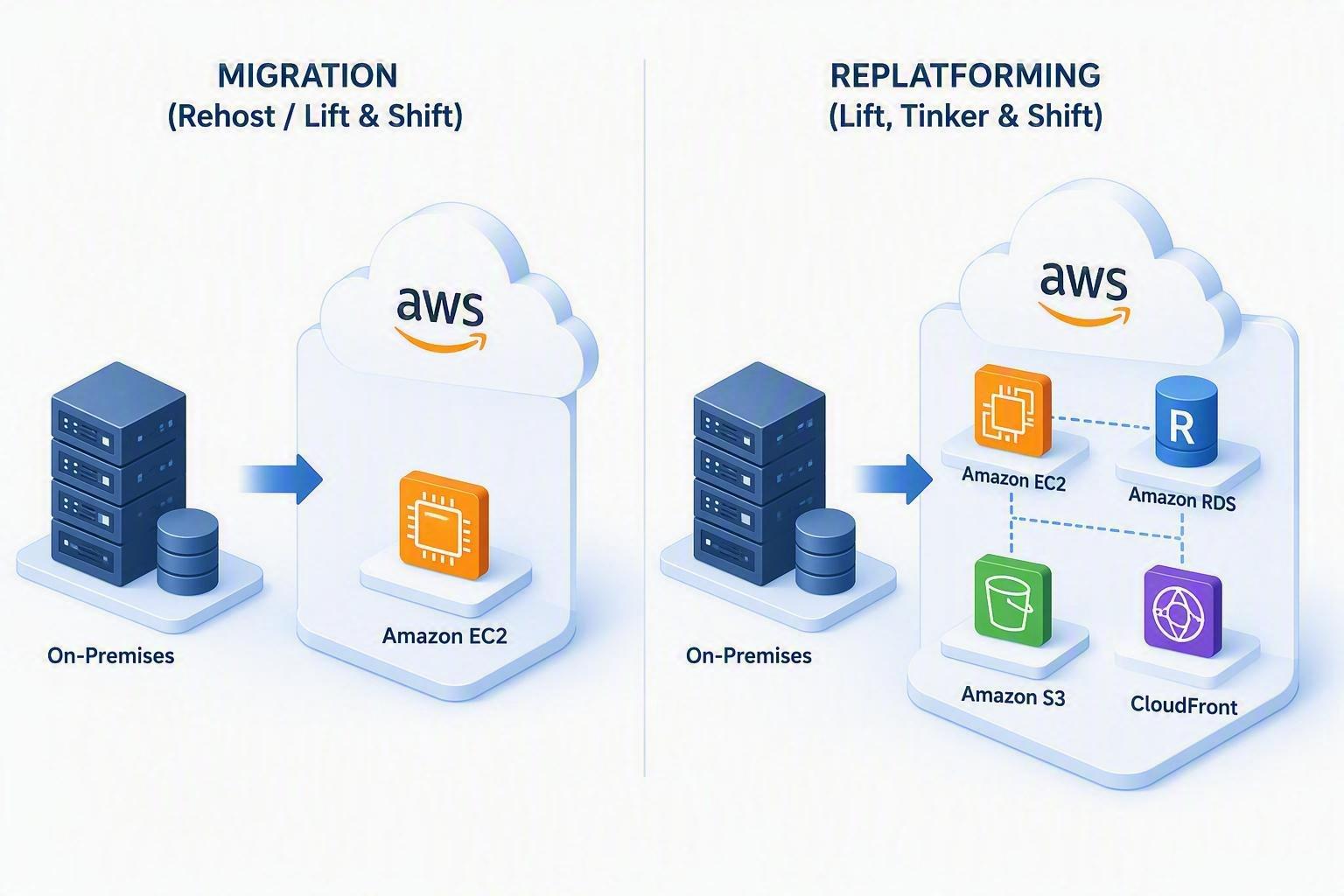
When a Standard AWS Migration Is the Better Choice
A minimally changed migration is often the right decision when time is the binding constraint. A company leaving an expiring colocation contract, retiring unsupported hardware, responding to a facility risk, or completing an acquisition may need to establish a stable AWS landing zone quickly. In these cases, reducing infrastructure exposure can be more valuable than optimizing every workload on day one.
This approach also works well for applications with uncertain long-term value. If a system may be replaced within 12 to 24 months, investing heavily in modernization can be hard to justify. Moving it to AWS, applying baseline security controls, and operating it under a clear retirement plan may be the financially responsible move.
However, lift and shift should not be mistaken for a finished cloud strategy. An EC2-based copy of an on-premises environment can preserve the same patching burden, sizing assumptions, database administration, and single points of failure. It may also lead to avoidable spend when workloads remain oversized or run continuously despite variable demand.
The practical objective is to migrate safely first, then optimize deliberately. That requires an inventory of applications and dependencies, a tested migration wave plan, backup validation, identity and access controls, network segmentation, and post-migration monitoring. Without these foundations, a fast move can simply transfer operational debt to a different location.
When Replatforming Delivers More Value
Replatforming is a strong fit when the application remains strategically important but its supporting infrastructure is consuming too much time and budget. The goal is not to rewrite everything. It is to remove the parts of the stack that create recurring operational friction.
A common example is a customer-facing application running on virtual machines with a self-managed SQL database. Moving the database to Amazon RDS can reduce administrative work around backups, patching, failover, and recovery. The application may need connection-string changes, compatibility testing, and performance tuning, but it avoids the larger effort of redesigning every service.
Similarly, a container-ready application may move from manually maintained servers to Amazon ECS or EKS. That work is more involved than rehosting, yet it can establish repeatable deployments, better workload isolation, and a clearer path to autoscaling. The application code may change only where needed to support configuration, health checks, or stateless execution.
Replatforming is particularly valuable where compliance and availability requirements are increasing. Managed services can strengthen controls when configured correctly, but they do not eliminate responsibility. Teams still need least-privilege IAM policies, encryption design, audit logging, vulnerability management, tested recovery procedures, and observability across the application and infrastructure layers.
User Story: A Real-World AWS Replatforming Example
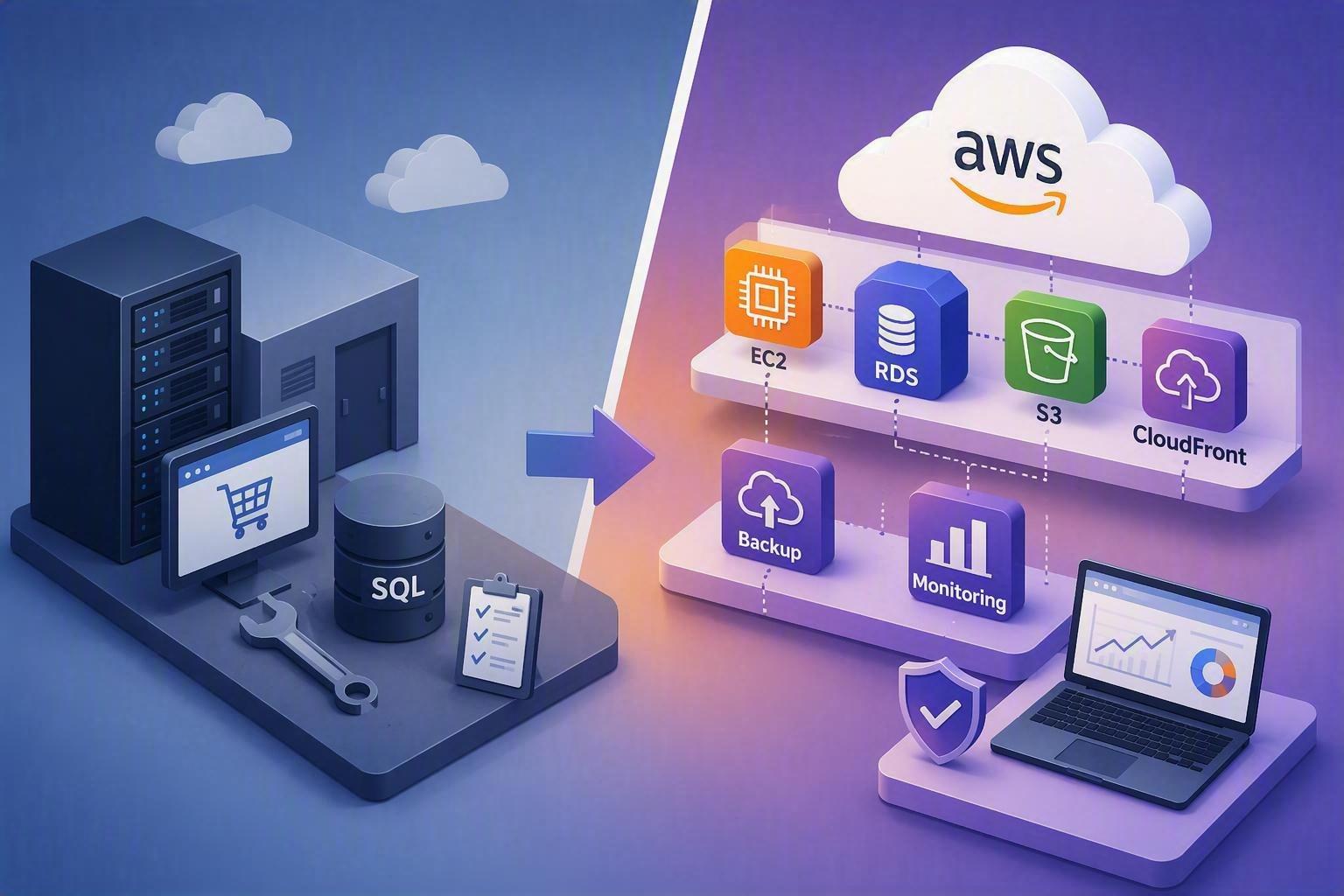
Consider a mid-sized eCommerce company whose online platform generates most of its revenue through digital sales. The application has been running for years on virtual machines in a private data center and relies on a self-managed SQL database. While stable, the environment requires frequent maintenance, database patching, backup verification, and manual recovery testing. Release cycles have slowed because infrastructure updates must be coordinated carefully to avoid service disruptions.
As the company expands into new markets, traffic spikes during seasonal promotions begin exposing performance limitations. Leadership initially evaluates a lift-and-shift migration to AWS to meet an upcoming data center exit deadline. However, after assessing long-term operational costs, the team chooses a targeted replatforming approach instead.
The application servers are migrated to Amazon EC2, while the database is moved to Amazon RDS. Static assets are served through Amazon S3 and CloudFront, and automated backup and monitoring capabilities are introduced as part of the migration. The business avoids the cost and risk of a complete application rewrite while reducing administrative overhead, improving recovery capabilities, and creating a foundation for future modernization initiatives.
Six months after migration, the organization is spending less time on infrastructure maintenance, releasing updates more frequently, and responding to customer demand more effectively without significantly changing the application itself. The project succeeds not because the application was reinvented, but because the operating model was improved in ways that directly supported business goals.
Why This Matters
Choosing between AWS migration and replatforming has consequences that extend well beyond infrastructure decisions. The wrong approach can lock an organization into unnecessary operational costs, delay modernization efforts, or increase business risk for years after the migration is complete.
A simple rehost may achieve short-term objectives such as meeting a data center closure deadline or reducing on-premises infrastructure exposure. However, if critical workloads continue to depend on manually managed databases, complex maintenance procedures, or limited disaster recovery capabilities, many of the operational challenges remain unchanged.
Replatforming requires additional planning and effort, but it can deliver measurable improvements in reliability, security, scalability, and operational efficiency without the expense of a full application refactor. For business-critical systems, these gains often translate into faster releases, reduced downtime, stronger compliance controls, and lower total cost of ownership.
Ultimately, the migration strategy should align with business outcomes rather than technical preferences. Organizations that evaluate workloads based on risk, value, and long-term operating requirements are more likely to create an AWS environment that supports growth, innovation, and sustainable cloud operations.
Compare the Decision Through Business Constraints
The right choice rarely comes from a single architecture diagram. Leaders should evaluate each workload through a set of operational and business constraints.
First, consider urgency. If a deadline is fixed and the application has many unknown dependencies, a controlled rehost may be safer. If the business has enough runway to test targeted changes, replatforming can prevent the organization from carrying known infrastructure problems forward.
Second, examine the workload's strategic importance. Revenue-generating platforms, systems handling sensitive data, and applications with frequent release needs generally deserve more than a server-for-server relocation. Internal tools with stable usage and a short remaining life may not.
Third, model total cost of ownership rather than comparing only monthly infrastructure estimates. Self-managed databases, manually patched servers, failed deployments, incident response, and engineering time all have cost. Replatforming can lower those costs, but managed services must still be sized, monitored, and governed to avoid waste.
Finally, assess organizational readiness. A platform change requires operating discipline. Teams need infrastructure as code through Terraform or similar tooling, reliable CI/CD workflows, centralized logs, actionable alerting, and defined ownership after go-live. If those practices are absent, build them into the migration program rather than treating them as optional follow-up work.
A Practical Path for AWS Replatforming
Successful replatforming begins with discovery, not service selection. Map the application's runtime environment, upstream and downstream dependencies, database behavior, batch jobs, integrations, authentication flows, data classification, and recovery requirements. An application that appears simple can depend on a scheduled file transfer, a hard-coded IP address, or a legacy license server that changes the entire migration sequence.
Next, establish the AWS foundation. This typically includes account structure, IAM and single sign-on controls, network design, security groups, encryption standards, centralized logging, backup policies, and budget controls. A Well-Architected Review before major migration waves helps identify gaps in security, reliability, performance efficiency, cost optimization, and operational excellence.
Then choose only the platform changes that produce measurable value. A database migration may reduce recovery risk. Moving deployment configuration into a CI/CD pipeline may reduce release errors. Adding New Relic or another observability platform may expose transaction bottlenecks before users report them. Each change should have a clear operational reason.
Testing must cover more than whether the application starts. Validate data integrity, performance under expected load, integrations, permissions, backup restoration, failover behavior, and rollback procedures. For critical workloads, parallel operation or staged traffic cutover can reduce business risk. A cutover plan without a tested rollback path is not a complete plan.
After migration, optimize based on evidence. Review utilization, database performance, log patterns, alert quality, and security findings. Rightsize compute, use autoscaling where it matches demand, set retention policies, and document operating procedures. Cloud value compounds when the environment is actively managed rather than treated as a completed project.
Avoid Treating Every Workload the Same
Portfolio-level programs work best when applications are grouped by risk and value, not moved in arbitrary order. A low-risk internal application can validate migration tooling and processes. A high-value customer platform may justify a dedicated replatforming workstream with deeper testing and change management. A legacy system approaching retirement may be migrated with minimal investment or retained temporarily while a replacement is developed.
This is where an experienced cloud partner adds practical value. Advanced Vision IT helps organizations connect AWS architecture choices to the operating model required to support them, including DevOps automation, observability, security controls, cost management, and managed operations after cutover.
The useful question is not whether rehosting or replatforming is universally better. It is whether the next dollar and week of engineering effort will reduce meaningful business risk, improve service reliability, or create a platform your team can operate confidently. Start there, and the migration strategy becomes much clearer.
FAQ
1. What is the difference between AWS migration and AWS replatforming?
AWS migration is the overall process of moving applications, data, and infrastructure to AWS. Replatforming is a specific migration strategy that involves moving an application to AWS while making targeted improvements, such as adopting managed services like Amazon RDS, without completely redesigning the application.
2. When is a lift-and-shift migration the best option?
A lift-and-shift migration is often the best choice when time is critical, such as during data center exits, hardware retirement projects, acquisitions, or other situations with fixed deadlines. It enables organizations to move workloads to AWS quickly with minimal application changes.
3. What are the main benefits of replatforming?
Replatforming can reduce operational overhead, improve reliability, strengthen disaster recovery capabilities, and support scalability. By replacing self-managed components with AWS managed services, organizations can spend less time on maintenance tasks like patching, backups, and failover management.
4. How should organizations decide between migration and replatforming?
Organizations should evaluate factors such as project urgency, business importance of the application, total cost of ownership, compliance requirements, and internal operational readiness. Strategic, customer-facing applications often benefit from replatforming, while lower-value or soon-to-be-retired systems may only require a simple migration.
5. What are the key steps for a successful AWS replatforming project?
Successful replatforming starts with application discovery and dependency mapping, followed by establishing a secure AWS foundation. Organizations should then implement only the platform changes that provide measurable business value, thoroughly test performance and recovery processes, and continuously optimize the environment after migration based on operational data.

Written by Yavor Y. Zlatev
CEO & Founder at Advanced Vision IT Ltd | Published on
Yavor advises executive leadership teams on cybersecurity strategy, NIS2 compliance, and cloud operating models to build resilient IT environments.