



Best Managed Detection Solutions for Growing Teams
A security alert at 2:13 a.m. is not a cybersecurity strategy. For many growing businesses, the gap between collecting alerts and stopping an active threat is where risk becomes downtime, data loss, regulatory exposure, and an expensive recovery effort. The best managed detection solutions close that gap by combining continuously monitored security telemetry with skilled analysts who investigate, validate, and help contain real threats.
This is not simply another software purchase. Managed detection and response, commonly called MDR, is an operating model. It gives internal IT and security teams a specialized extension that can watch endpoints, cloud workloads, identities, networks, and critical applications around the clock. The right service reduces alert fatigue while improving the speed and quality of incident response.
What Managed Detection Actually Delivers
A capable MDR provider does more than forward alerts from endpoint protection tools. Its analysts correlate activity across data sources, apply threat intelligence and behavioral analysis, determine whether suspicious activity is meaningful, and guide or execute a response based on agreed procedures.
That distinction matters. An endpoint detection and response platform can be highly effective, but it still requires people with the time and expertise to tune detections, investigate events, and act when an incident occurs. A managed security information and event management service can centralize logs, yet the value depends on detection engineering and analysts who understand the environment. MDR combines technology, process, and human judgment into a service designed for action.
For a small or midsized organization, that can mean having experienced security operations coverage without building a 24/7 security operations center internally. For a larger engineering-led business, it can mean giving the existing security team more time for architecture, governance, secure development, and risk reduction instead of repetitive triage.
The Best Managed Detection Solutions Start With Coverage
There is no universal best provider because the right solution depends on your environment, risk profile, internal capabilities, and response requirements. A company operating primarily in AWS has different visibility needs from an organization centered on on-premises Windows servers, SaaS applications, and remote endpoints.
Start by mapping the assets that could materially affect operations. This typically includes employee endpoints, production servers, cloud accounts, identity providers, email platforms, VPN or zero-trust access controls, firewalls, and business-critical SaaS applications. If an MDR service cannot see a meaningful portion of those systems, it cannot provide a complete picture of an incident.
Cloud visibility deserves particular scrutiny. In AWS environments, useful MDR coverage should account for signals such as CloudTrail activity, identity and access management events, GuardDuty findings, VPC flow logs, workload telemetry, and suspicious changes to storage, permissions, or infrastructure configuration. The service should also understand how cloud-native architectures behave. A container workload, serverless function, and traditional virtual machine do not produce the same evidence or require the same containment approach.
Visibility must be paired with context. A failed login may be routine. The same login failure followed by an impossible-travel event, a newly created privileged account, unusual API activity, and data access from an unfamiliar location is a very different situation. Effective detection connects those signals quickly enough to matter.
Evaluate Response, Not Just Detection
A long list of supported integrations can look impressive in a proposal. The more important question is what happens after the provider identifies a credible threat.
Ask whether the service merely notifies your team, recommends response steps, or has authority to take defined actions. Those actions might include isolating a compromised endpoint, disabling a user account, revoking active sessions, blocking a malicious domain, or escalating an incident through an agreed call tree. The appropriate model depends on your tolerance for operational disruption and the maturity of your internal team.
Notification-only services provide control, but they can leave a dangerous delay if no one is available to respond. Fully managed containment is faster, but it requires trust, clear rules of engagement, and thoughtful change controls. Many businesses choose a middle path: the provider can automatically isolate clearly compromised endpoints, while higher-impact actions such as disabling privileged accounts require approval.
Response quality is also measured by communication. During an active incident, your team should receive a plain-language explanation of what happened, what evidence supports the conclusion, which business systems may be affected, what actions have been taken, and what decisions remain. Raw alert exports do not help a CTO, operations leader, or executive make timely decisions.
Questions That Separate Real MDR From Alert Forwarding
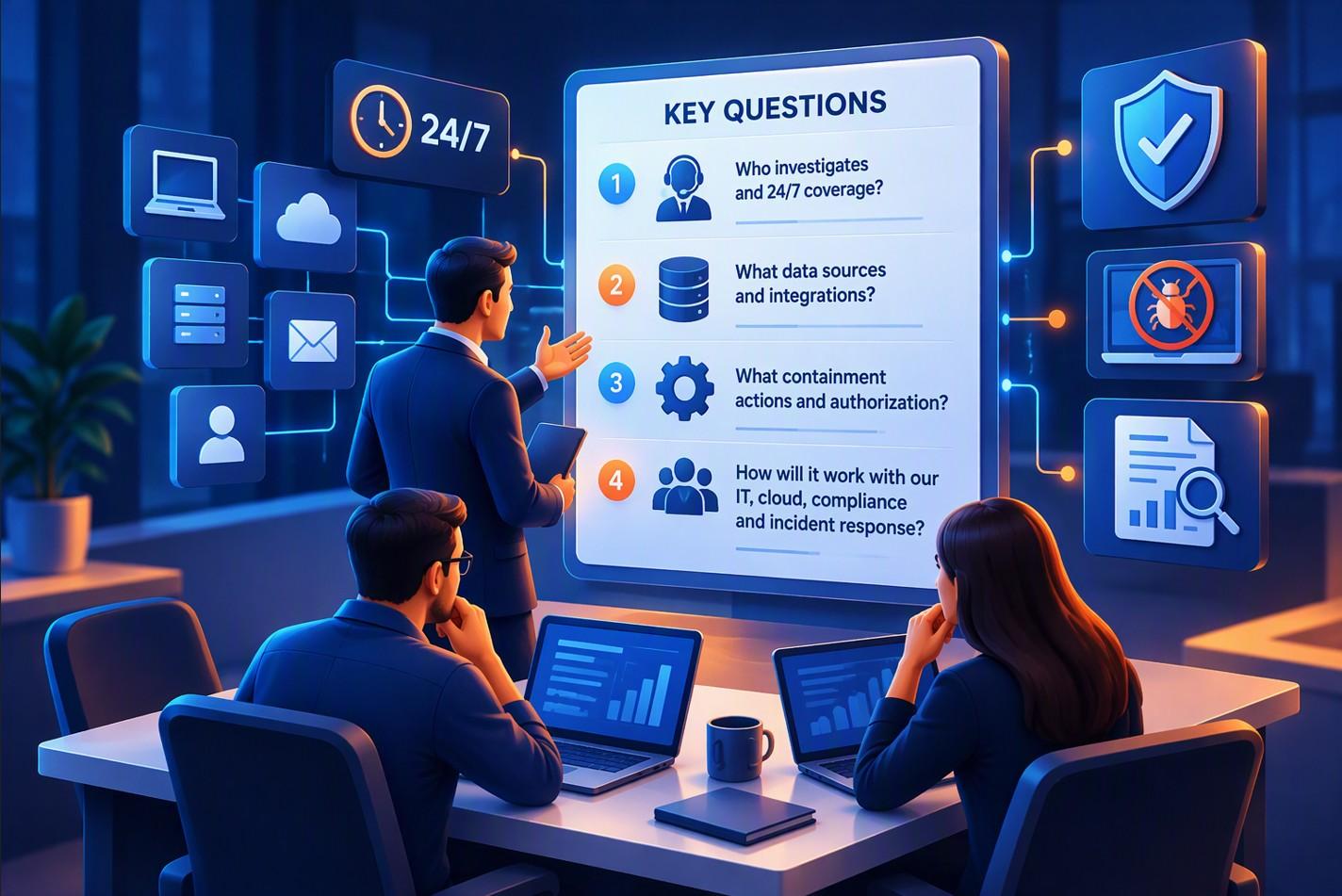
During evaluation, ask prospective providers to explain their service in operational terms. Four questions tend to reveal the most:
- Who investigates alerts, and is coverage truly available 24/7?
- What data sources are included, and what integrations create additional cost or complexity?
- What containment actions can the provider perform, and how are those actions authorized?
- How will the service work with our IT operations, cloud engineering, compliance, and incident-response processes?
Also ask for examples of high-confidence detections relevant to your environment. A provider should be able to discuss scenarios such as ransomware behavior, credential theft, business email compromise, suspicious cloud account activity, lateral movement, and data exfiltration without relying on vague marketing language.
It is reasonable to ask about false positives, too. A service that generates frequent escalations with little investigation can consume as much internal time as an unmanaged tool. The goal is not zero alerts. The goal is well-supported, prioritized incidents that your team can act on.
Integration Is a Security and Operations Requirement
MDR delivers stronger outcomes when it fits the way your business already operates. Security tools should not become another disconnected portal that only one person understands.
Look for alignment with your identity platform, endpoint management, ticketing system, cloud logging strategy, vulnerability management process, and business continuity plan. If your engineering teams use Terraform, Ansible, CI/CD pipelines, and infrastructure-as-code practices, security findings should be translated into remediation work that can be tracked, tested, and repeated. A recurring misconfiguration should result in a guardrail or code change, not a monthly report item that returns later.
Observability matters here as well. Security events are easier to investigate when teams can correlate them with infrastructure changes, application behavior, performance degradation, and deployment activity. Platforms such as New Relic can provide useful operational context alongside dedicated security telemetry, particularly when an incident affects customer-facing services.
A provider that understands both security operations and infrastructure can help avoid a common failure mode: treating every security recommendation as separate from reliability, cost, and delivery priorities. Security controls must be practical enough to remain in place.
Compliance Needs Evidence, Not Assurances
For organizations subject to requirements such as HIPAA, PCI DSS, SOC 2, or customer security reviews, MDR can strengthen a broader control environment. It can support continuous monitoring, centralized event review, incident documentation, access oversight, and evidence collection.
However, MDR alone does not make an organization compliant. Compliance also depends on documented policies, asset inventory, access controls, backup and recovery testing, vendor management, secure configuration, employee training, and formal risk management. Be cautious of any provider that frames managed detection as a complete compliance answer.
Instead, evaluate how incident records, investigation notes, escalation timelines, and monthly reporting can support your audit process. The service should produce evidence that is understandable to both technical teams and compliance stakeholders. It should also identify recurring patterns that point to control gaps, such as excessive privileged access or inconsistent log retention.
Cost Should Be Measured Against Response Capacity
Pricing models vary. Some MDR services charge per endpoint, while others price by users, data volume, cloud assets, or a combination of factors. The lowest monthly quote may exclude cloud logs, identity monitoring, advanced response, onboarding, or incident-retainer support. A clear scope is more valuable than an artificially low starting price.
The practical comparison is not MDR cost versus zero cost. It is MDR cost versus the cost and difficulty of maintaining qualified 24/7 coverage, security tooling, detection engineering, incident processes, and ongoing training internally. Most small and midsized businesses cannot justify a full security operations center, but they still face enterprise-grade threats.
A sound service should also help contain broader operational costs. Faster detection can reduce outage duration. Better cloud monitoring can expose risky permissions and configuration drift before they become an incident. Clear remediation guidance prevents security teams from spending weeks translating findings into engineering tasks.
A Practical Selection Path
Before selecting a provider, define your critical assets, current tools, escalation contacts, and the decisions you want a security partner to make without waiting for approval. Then validate the provider's coverage against that reality through a technical discovery process, not a generic sales checklist.
For organizations with hybrid infrastructure or AWS workloads, a single technology partner can be especially valuable when managed detection is connected to cloud operations, observability, DevOps modernization, and compliance work. Advanced Vision IT approaches security as part of resilient infrastructure operations, helping teams connect monitoring, response, remediation, and long-term improvement rather than treating incidents as isolated events.
The right MDR relationship should leave your business with fewer unanswered alerts, faster incident decisions, and a clearer view of where security risk intersects with uptime and growth. Choose the service that can prove it understands your environment, can respond at the speed your business requires, and will help turn every meaningful finding into lasting operational improvement.
User Story: From Alert Fatigue to Actionable Security
Consider a fast-growing SaaS company with 180 employees and a small IT team responsible for infrastructure, cloud operations, and security.
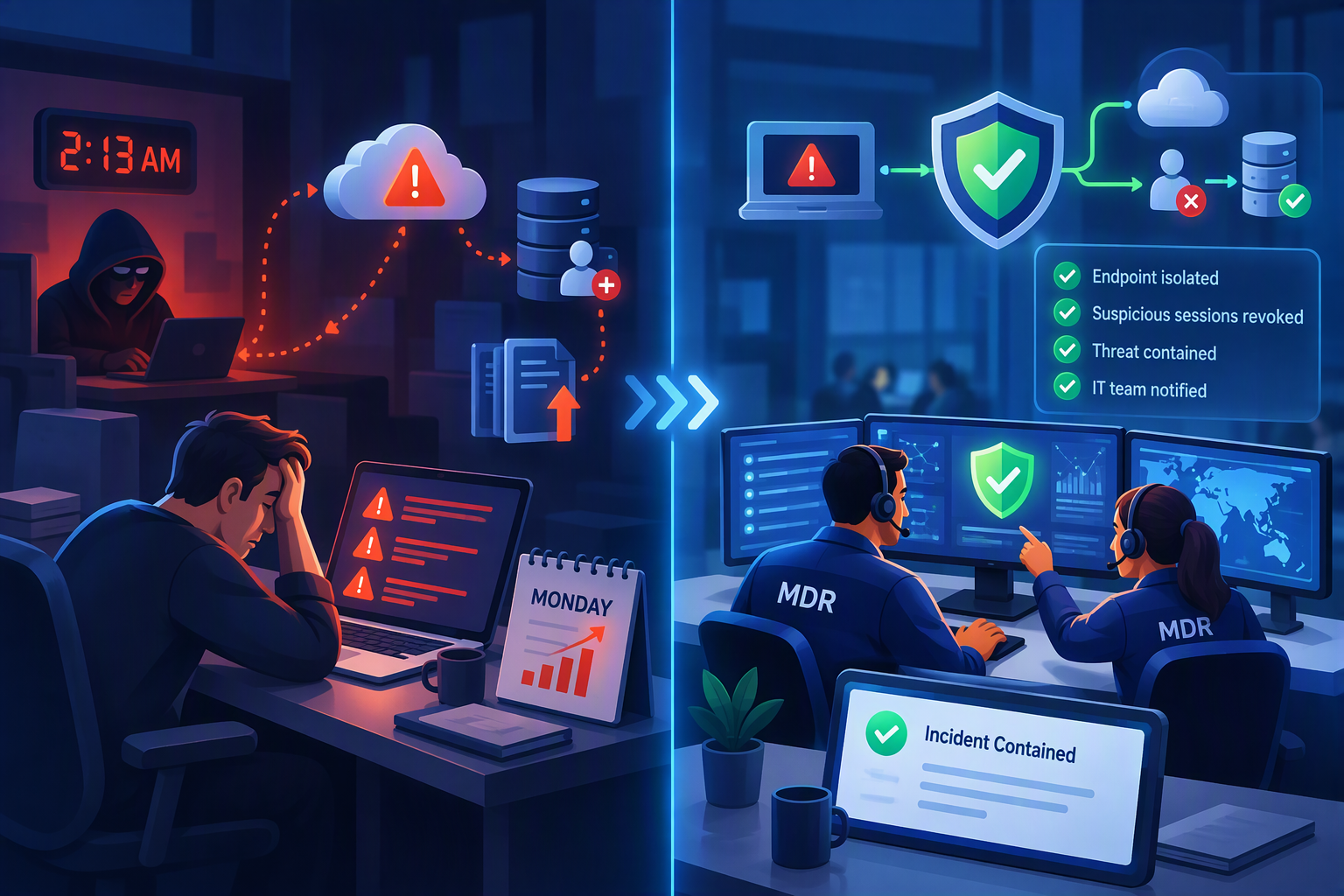
At 2:13 a.m. on a Saturday, an endpoint protection platform generates several alerts indicating suspicious PowerShell activity on a remote employee's laptop. The alerts are logged, but no one is actively monitoring them. By Monday morning, the attacker has used compromised credentials to access cloud resources, create a privileged account, and begin extracting sensitive customer data.
Without a managed detection and response (MDR) service, the organization spends days investigating the incident, restoring systems, notifying customers, and answering compliance questions. The direct recovery costs are significant, but the larger impact comes from operational disruption, customer concerns, and lost productivity.
Now consider the same scenario with a mature MDR service in place. Security analysts correlate endpoint alerts with cloud identity activity, identify anomalous access patterns, and determine that the activity represents a real threat. Following predefined response procedures, the compromised endpoint is isolated, suspicious sessions are revoked, and the IT team is notified with a clear summary of the incident. The attack is contained before it escalates into a business disruption.
The difference is not the alert itself. The difference is having the visibility, expertise, and response capability to act on the alert before it becomes an incident.
Why This Matters
Cybersecurity risks rarely become costly because organizations lack security tools. More often, losses occur because threats go undetected for too long or because teams cannot respond quickly enough when alerts appear.
The best managed detection solutions help bridge this gap by combining technology, threat intelligence, and experienced analysts who can distinguish genuine threats from routine noise. This enables organizations to:
- Detect attacks earlier and reduce response times.
- Minimize downtime caused by ransomware, account compromise, or malicious activity.
- Reduce alert fatigue for internal IT and security teams.
- Improve visibility across endpoints, cloud platforms, identities, networks, and business-critical applications.
- Strengthen compliance efforts through documented investigations and incident evidence.
- Gain access to 24/7 security operations expertise without building an internal security operations center.
- Translate security findings into practical improvements that reduce future risk.
As cyber threats continue to target organizations of every size, MDR is becoming less about adding another security tool and more about ensuring the business has the operational capability to respond when it matters most.
Frequently Asked Questions (FAQ)
1. What is the difference between MDR and traditional security monitoring?
Traditional monitoring tools generate alerts when potentially suspicious activity occurs. MDR combines those tools with security analysts, threat intelligence, investigation, validation, and response actions. Instead of simply reporting alerts, MDR helps determine which events are real threats and assists with containment and remediation.
2. Can MDR replace an internal security team?
No. MDR is best viewed as an extension of your existing team rather than a replacement. It provides specialized expertise and around-the-clock monitoring, while your internal staff continue to own business processes, governance, risk management, and strategic security decisions.
3. What systems should an MDR service monitor?
A comprehensive MDR deployment should cover endpoints, servers, cloud environments, identity providers, email platforms, firewalls, VPNs or zero-trust solutions, and critical business applications. The more complete the visibility, the more effective incident detection and response become.
4. How quickly can an MDR provider respond to a threat?
Response times vary by provider and service agreement. Mature MDR services operate 24/7 and can often investigate threats within minutes, escalating incidents or taking predefined containment actions immediately when authorized.
5. Is MDR enough to achieve compliance requirements such as SOC 2, HIPAA, or PCI DSS?
No. MDR supports compliance by providing continuous monitoring, incident investigation, and audit evidence. However, compliance also requires documented policies, access controls, risk management processes, employee awareness training, asset management, and other organizational controls beyond MDR alone.

Written by Yavor Y. Zlatev
CEO & Founder at Advanced Vision IT Ltd | Published on
Yavor advises executive leadership teams on cybersecurity strategy, NIS2 compliance, and cloud operating models to build resilient IT environments.