



Business Continuity Testing Guide for IT Teams
A recovery plan that has never been tested is an assumption, not an operational capability. A business continuity testing guide gives IT leaders a disciplined way to prove that people, processes, applications, and infrastructure can withstand disruption without creating unnecessary risk during the test itself.
For small and mid-sized organizations, continuity testing is often delayed because the environment feels too complex or the team is too lean. That delay can be costly. A ransomware event, failed cloud deployment, regional outage, lost SaaS dependency, or unavailable key employee can expose gaps that a written plan never revealed. The goal is not to simulate every possible disaster. It is to validate the recovery paths that protect your most critical business services.
What Business Continuity Testing Actually Proves
Business continuity testing verifies more than whether backups exist. It answers whether the organization can continue priority operations at an acceptable level when normal systems, facilities, vendors, or staff are unavailable.
That requires testing across several connected layers. Infrastructure teams need to know whether workloads can be restored or failed over. Application owners need to confirm that services function after recovery. Security teams need to verify that access controls, logs, and incident procedures remain effective. Business leaders need clarity on which services are restored first, who makes decisions, and how customers, employees, and vendors will be informed.
A successful test produces evidence, not reassurance. Evidence may include recovery timestamps, restored data validation, DNS change records, access logs, incident communications, and an issue register with owners and due dates. If the team cannot show what happened, how long it took, and where the process failed, the exercise has limited value.
Start With Business Impact, Not a Disaster Scenario
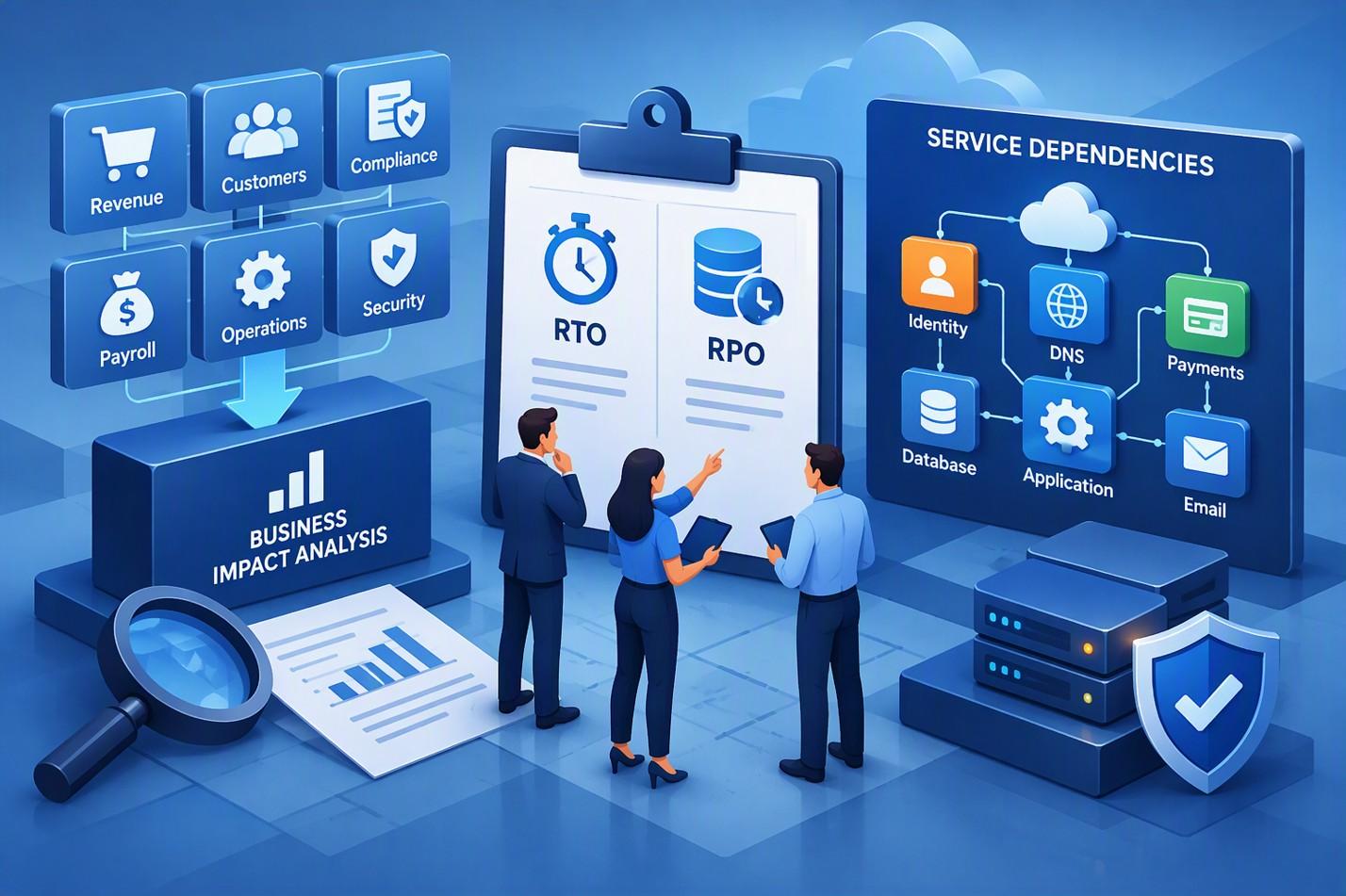
The most useful tests begin with a business impact analysis. Identify the services that directly support revenue, customer commitments, regulatory obligations, payroll, operations, and security. Then define the consequences of losing each service for several hours, one day, or longer.
For each critical service, establish two practical targets. The recovery time objective, or RTO, is the maximum acceptable time to restore the service. The recovery point objective, or RPO, defines how much data loss the business can tolerate. A customer portal may need a four-hour RTO and a 15-minute RPO, while an internal archive may tolerate recovery the next business day.
These targets should drive architecture and testing scope. There is little value in claiming a one-hour RTO if backups run nightly, restoration requires manual approvals, and the only person who understands the process is unavailable. Similarly, multi-region AWS architecture can improve availability, but it increases operational complexity and cost. The right design depends on the business impact of downtime, not on a generic uptime target.
Map Dependencies Before You Test
Critical services rarely operate alone. A cloud application may rely on identity providers, DNS, payment processors, email, source code repositories, API gateways, managed databases, endpoint devices, and third-party support contracts. A recovery test that restores only the primary compute environment can still fail if users cannot authenticate or the application cannot reach a required external service.
Create a dependency map that identifies upstream and downstream systems, service owners, escalation contacts, credentials, configuration repositories, and recovery order. Include manual workarounds. For example, can customer support continue operating with a read-only export if the primary CRM is down? Can finance process urgent payments through an approved alternate procedure?
This mapping exercise often reveals the highest-risk gaps before the first test begins. It also gives technical and business stakeholders a shared view of what “recovered” actually means.
Choose the Right Business Continuity Testing Method
Not every test should begin with a full production failover. Testing should mature in stages, with each stage providing useful assurance at an appropriate level of operational risk.
A walkthrough is a structured review of the continuity plan. Participants confirm responsibilities, contacts, decision points, runbooks, and escalation procedures. It is low risk and useful after major organizational or technology changes, but it does not prove that systems will recover.
A tabletop exercise introduces a realistic scenario, such as a ransomware event affecting shared file storage or an AWS regional service disruption. Teams discuss their actions in real time, including who declares an incident, how access is restricted, what is communicated, and how recovery is approved. Tabletop sessions are especially effective for uncovering unclear authority and communication failures.
A technical recovery test validates a defined component or service. Examples include restoring a database to an isolated environment, rebuilding infrastructure from Terraform, recovering a virtual machine from backup, or validating that a CI/CD pipeline can deploy a known-good version. This is where teams measure actual recovery timing and detect configuration drift.
A full failover or simulation tests an end-to-end service recovery path. It provides the strongest assurance but can affect users, transactions, support capacity, and cloud spend. Schedule it carefully, define rollback conditions, and avoid combining it with unrelated production changes. For many growing organizations, annual end-to-end exercises supported by quarterly component tests provide a sensible balance.
Build a Test Plan That Operations Can Execute
A continuity test should be run like a controlled operational change. State the objective in measurable terms: restore the customer-facing application in a separate recovery environment within four hours, using infrastructure as code and data no older than 30 minutes. Avoid vague objectives such as “test disaster recovery.”
The plan should name a test leader, technical owners, business approvers, communications lead, security representative, and executive decision-maker. Define the test window, affected systems, expected user impact, stop conditions, rollback procedure, and success criteria before work begins.
Use current runbooks, not institutional memory. Good runbooks include exact recovery steps, required permissions, account or subscription details, backup locations, validation checks, and escalation paths. Store them where authorized responders can access them during an outage, including when single sign-on or the primary collaboration platform is unavailable.
Automation improves repeatability. Terraform and Ansible can rebuild defined infrastructure, while CI/CD workflows can redeploy approved application versions. Observability platforms such as New Relic can confirm application health, error rates, latency, and dependency behavior after recovery. Automation does not eliminate the need for testing, however. It must be tested too, particularly after platform, identity, or network changes.
Run the Test and Measure What Matters
During execution, record timestamps and decisions as they happen. Measure the elapsed time to detect the incident, declare the event, notify stakeholders, begin recovery, restore service, validate data, and formally return to normal operations. These measurements identify whether the limiting factor is technology, access, coordination, or decision-making.
Validation must go beyond a green infrastructure dashboard. Confirm that authorized users can sign in, core transactions complete, integrations exchange data, security monitoring remains active, and backup data meets the stated RPO. If the recovery environment is isolated, verify that required network routes, certificates, secrets, and firewall rules are present without exposing the environment unnecessarily.
Security deserves special attention in ransomware scenarios. Restoring compromised systems without confirming the attack path, credential status, and malware containment can recreate the incident. Test immutable or protected backup recovery where appropriate, validate endpoint security coverage, rotate credentials according to the incident plan, and preserve logs needed for investigation.

Turn Findings Into Resilience Improvements
The value of a test is realized after the test window closes. Hold a short, blameless review while details are fresh. Separate findings into technical defects, process gaps, documentation issues, vendor dependencies, and training needs. Assign each action an owner, priority, due date, and verification method.
Common findings include expired recovery credentials, undocumented DNS dependencies, backup jobs that completed without application-consistent data, insufficient cloud service quotas, and unclear approval authority. None of these are unusual. The problem is leaving them unresolved until a real incident makes them urgent.
Track continuity metrics over time. Recovery time achieved versus target, recovery point achieved versus target, percentage of critical services tested, open corrective actions, and repeated test failures give leadership a meaningful view of resilience. These metrics also support compliance discussions and budget decisions with evidence rather than fear-based estimates.
Advanced Vision IT helps organizations align continuity testing with AWS architecture, security controls, observability, and managed operations. Whether the environment is cloud-native, hybrid, or in transition, the priority is the same: recovery procedures must work under pressure and support the business outcomes they were designed to protect.
Schedule the next test around a real business service, keep its scope focused, and measure the result honestly. Each verified recovery step reduces uncertainty when your team can least afford it.
User Story: When a Recovery Plan Meets Reality
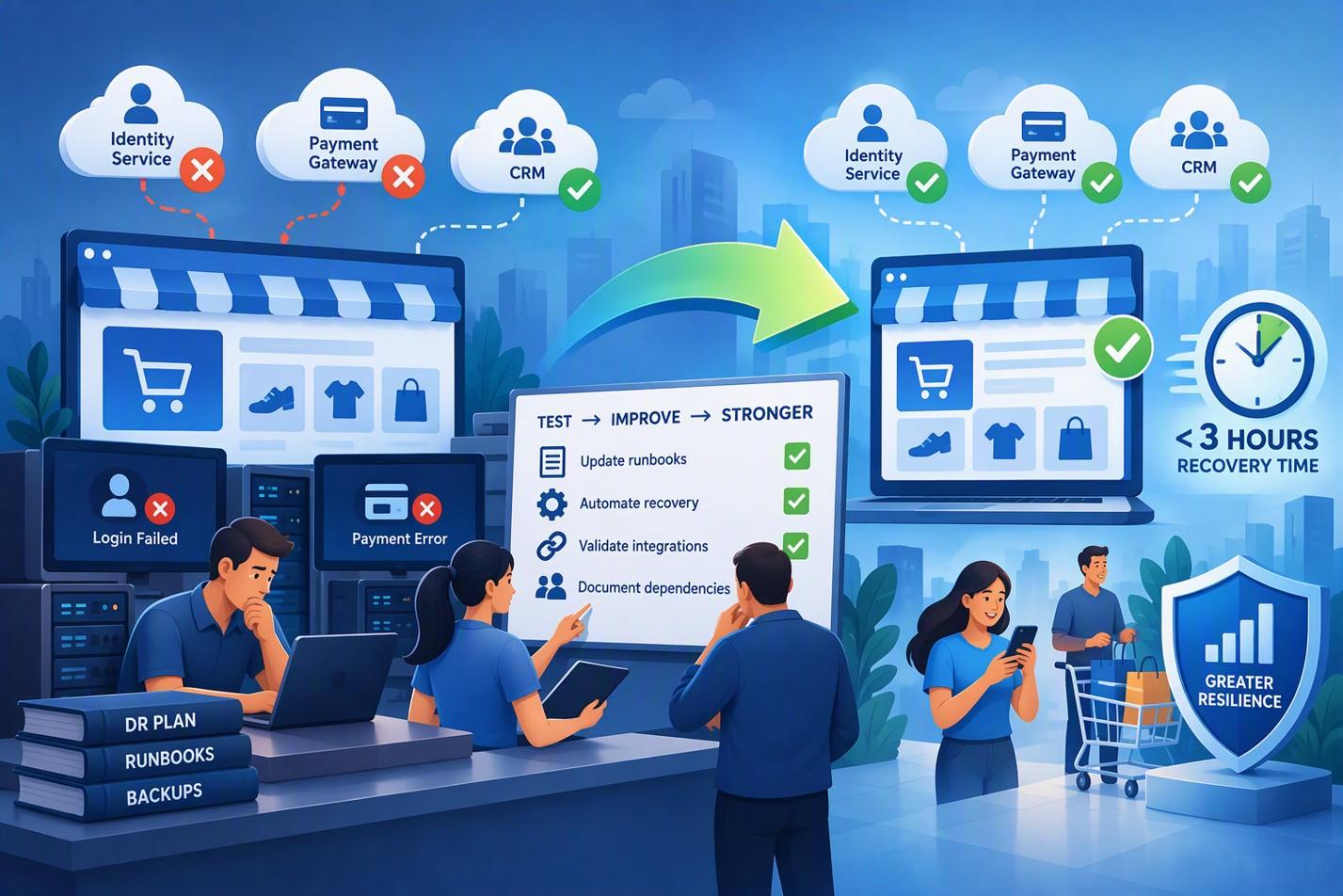
Consider a growing e-commerce retailer that relies on a customer portal, payment processing platform, and cloud-based CRM to handle daily sales and customer support.
The company had documented disaster recovery procedures, nightly backups, and a cloud architecture designed for resilience. Leadership believed they could recover from a major disruption within four hours. However, during their first business continuity test, the team discovered several unexpected issues. The application restored successfully, but users could not log in because a critical identity service configuration was missing. A payment gateway integration failed due to outdated credentials, and the only administrator familiar with part of the recovery procedure was on vacation.
Instead of viewing the exercise as a failure, the organization treated it as a success because it exposed weaknesses in a controlled environment rather than during a real incident. By updating runbooks, documenting dependencies, automating infrastructure recovery, and validating third-party integrations, the company reduced its actual recovery time from over eight hours to less than three hours during subsequent tests.
This is the true purpose of business continuity testing: discovering operational gaps before customers, revenue, or regulatory obligations are affected.
Why This Matters
Business continuity testing is no longer just a compliance exercise. Organizations depend on increasingly interconnected systems, cloud services, third-party providers, and remote teams. A disruption that affects any one of these components can quickly impact business operations.
Regular continuity testing helps organizations:
- Validate that recovery plans work in practice, not just on paper.
- Confirm that Recovery Time Objectives (RTOs) and Recovery Point Objectives (RPOs) are achievable.
- Identify hidden dependencies across applications, vendors, networks, and personnel.
- Reduce financial losses caused by downtime and service interruptions.
- Improve coordination between IT, security, operations, and business stakeholders.
- Strengthen resilience against ransomware, cloud outages, human error, and infrastructure failures.
- Generate measurable evidence for auditors, regulators, customers, and executive leadership.
- Increase confidence that critical business services can continue operating during disruptive events.
Most importantly, continuity testing transforms uncertainty into actionable knowledge. Every validated recovery step reduces risk and improves organizational preparedness for the disruptions that inevitably occur.
Frequently Asked Questions (FAQ)
1. How often should business continuity testing be performed?
The frequency depends on the organization's risk profile, regulatory requirements, and rate of change. As a general guideline, critical business services should be tested at least annually, with component-level recovery tests and tabletop exercises performed quarterly or after significant infrastructure, application, or organizational changes.
2. What is the difference between business continuity testing and disaster recovery testing?
Business continuity testing evaluates whether the organization can continue delivering critical services during a disruption, including people, processes, communications, and technology. Disaster recovery testing focuses primarily on restoring IT systems, applications, and data after an outage or failure.
3. Do small and mid-sized businesses really need continuity testing?
Yes. Smaller organizations are often more vulnerable because they have fewer staff, limited redundancy, and greater dependence on key individuals. Even a single unavailable system, cloud service, or employee can significantly disrupt operations if recovery procedures have not been validated.
4. Which metrics should be measured during a test?
Organizations should track metrics such as recovery time achieved versus target (RTO), recovery point achieved versus target (RPO), incident detection time, stakeholder notification time, service restoration time, validation results, corrective actions identified, and unresolved issues discovered during testing.
5. What are the most common issues uncovered during continuity tests?
Typical findings include undocumented dependencies, expired credentials, incomplete recovery documentation, failed application integrations, insufficient backup validation, cloud configuration drift, inadequate permissions, unclear decision-making authority, and gaps in communications procedures. These issues are common and are much easier to address during a planned test than during a real incident.

Written by Alexander Boychev
Business Executive & Digital Marketing Manager at Advanced Vision IT Ltd | Published on
Alexander advises insights on business development, strategic key account management, and digital marketing in the IT sector.