



Cloud Governance That Controls Cost and Risk
A cloud bill that rises without a clear owner, an overly broad administrator role, or a production change made outside the normal deployment process are not isolated technical issues. They are signs that cloud governance is missing or has been treated as a document rather than an operating discipline. For growing businesses, cloud governance creates the guardrails needed to use AWS and other cloud platforms quickly without accepting avoidable financial, security, and compliance risk.
The goal is not to make every engineering decision pass through a committee. Effective governance makes the right path easier: approved account structures, reusable infrastructure modules, clear ownership, measurable policies, and alerts that reach people who can act. When those elements are in place, cloud operations become more predictable as the environment, team, and customer base grow.
What Cloud Governance Means in Practice
Cloud governance is the set of decisions, policies, technical controls, and operating processes that define how an organization uses cloud resources. It answers practical questions: Who can create a new AWS account? Which data can be stored in which environment? How are production changes approved and recorded? Who owns an unexpected cost spike at 2 a.m.? What happens when an employee with privileged access leaves the company?
Governance sits at the intersection of cloud architecture, security, finance, and operations. It is broader than identity and access management, although IAM is central to it. It is also more than cloud cost optimization, even though financial accountability is a major outcome. A useful governance model gives leadership confidence that cloud spending supports business priorities while giving technical teams a repeatable way to build, deploy, monitor, and recover services.
The scope should reflect the business. A startup with one application and a small engineering team does not need the same approval matrix as a regulated company running dozens of workloads. But both need defined ownership, secure access, reliable backups, visibility into spend, and a process for managing change.
Why Fast-Growing Teams Need Governance Early
Cloud platforms reduce the time between an idea and a deployed service. That speed is valuable, but it can conceal operational debt. A developer can provision a database in minutes, yet the organization may not know whether it contains sensitive data, has a tested backup, or is included in the correct cost center. The problem usually appears later, during an audit, incident, acquisition review, or major cost increase.
Early cloud governance prevents the most expensive kind of rework: rebuilding controls around services that are already business-critical. It also reduces dependence on tribal knowledge. If one engineer is the only person who understands account access, network routing, Terraform state, or an application’s recovery procedure, the business has a continuity risk.
There is a trade-off. Heavy manual approvals can slow delivery and encourage workarounds. Too little control makes every team responsible for interpreting security and compliance requirements differently. The right approach is policy-backed automation. For example, a Terraform module can create a standardized AWS environment with encryption, logging, tags, backup settings, and approved networking already in place. Teams move faster because they do not have to rebuild those decisions for every deployment.
The Core Components of Cloud Governance
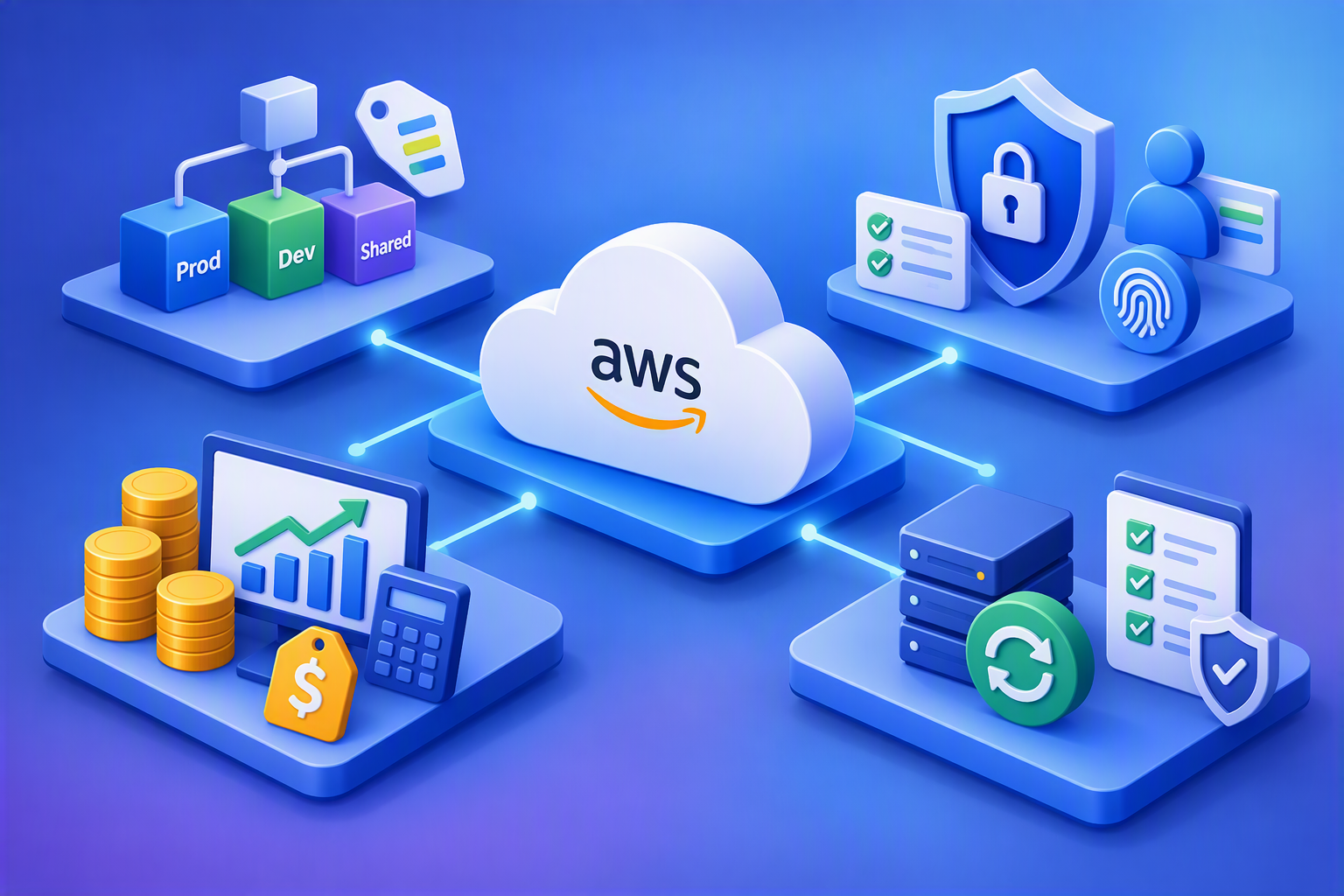
A workable model usually begins with four connected areas:
- Account and resource organization: Separate production, development, security, logging, and shared services where appropriate. Use naming standards and mandatory tags so every resource can be tied to an application, environment, owner, and cost center.
- Identity and security controls: Apply least-privilege access, multi-factor authentication, role-based permissions, centralized logging, encryption standards, and regular review of privileged access.
- Financial accountability: Set budgets, anomaly alerts, allocation tags, purchasing policies, and regular cost reviews. Finance needs clear reporting, while engineering needs timely, actionable data.
- Operational reliability and compliance: Define change processes, monitoring requirements, backup and recovery expectations, incident response roles, and evidence collection for applicable frameworks.
These components should work together rather than exist as separate initiatives. A tag that identifies the business owner of a workload supports cost allocation, incident escalation, lifecycle management, and audit evidence. Centralized logs support security investigations as well as troubleshooting. A well-designed landing zone provides a consistent foundation for both governance and delivery.
Build Guardrails Into the Delivery Process
The strongest governance controls are built into the way infrastructure is delivered. Asking engineers to remember a long list of requirements is less reliable than enforcing key standards through CI/CD pipelines, Infrastructure as Code, and cloud-native policies.
Terraform and Ansible are particularly useful because they turn expected configurations into version-controlled, repeatable code. Instead of creating resources manually, teams can use approved modules for networks, compute, databases, and identity roles. Changes are reviewed before deployment, recorded after deployment, and easier to reproduce during recovery or expansion.
Policy checks should focus on meaningful risks. Common examples include blocking public storage buckets, requiring encryption for data stores, preventing unapproved regions, enforcing required tags, and identifying security groups that expose sensitive ports to the internet. Not every exception is a failure. Some workloads legitimately need different controls, but exceptions should be documented, approved by the right owner, and reviewed on a defined schedule.
Observability is another essential control. Monitoring platforms such as New Relic can connect service performance, error rates, infrastructure health, and user impact. Governance becomes more useful when it shows whether a policy is protecting a critical service or creating friction without measurable benefit. Alerts should be routed with intent, not sent broadly until teams learn to ignore them.
Create Clear Ownership Without Creating Bottlenecks
Cloud governance fails when responsibility is vague. Security may assume engineering owns patching. Engineering may assume a managed service provider monitors backups. Finance may receive a monthly bill without knowing which product or department generated the spend. Every critical control needs an accountable owner, even when execution is shared.
A lightweight responsibility model is often enough. Platform or cloud operations teams can own common infrastructure patterns, identity foundations, and account-level controls. Application teams can own their service configuration, data classification, runtime costs, and remediation of application-level findings. Security can define standards, validate risk decisions, and lead incident preparedness. Business leaders should own budget priorities and approve material trade-offs.
This is not an argument for centralizing every decision. Central teams should provide paved roads: documented patterns that are secure, observable, supportable, and cost-aware. Product teams should retain the ability to choose services and ship improvements within those boundaries. If a new requirement falls outside the standard pattern, there should be a fast route for review rather than an indefinite queue.
Measure What Your Governance Program Changes
Policies alone do not prove governance is working. Use operational measures that show whether controls are improving outcomes. Useful indicators include the percentage of resources with complete ownership tags, the number of public exposure findings, time to remove inactive privileged accounts, backup recovery success rates, unallocated cloud spend, and the percentage of infrastructure deployed through approved automation.
Cost metrics need context. Lower spend is not always a win if it reduces reliability or delays revenue-generating work. A better question is whether the organization can explain its spend, identify idle or oversized resources, forecast material changes, and make intentional commitments such as Savings Plans or Reserved Instances. Cost optimization is a recurring management practice, not a one-time cleanup project.
For regulated environments, measure the time required to produce evidence for access reviews, configuration standards, patching, and recovery testing. If proving a control requires weeks of screenshots and manual data gathering, the control is not operating efficiently. Automated evidence collection reduces audit disruption and improves confidence between audits.
Start With the Risks That Matter Most
A practical first step is a focused assessment of the current cloud environment. Review account structure, IAM roles, network exposure, logging, backup coverage, resource tags, spend patterns, Infrastructure as Code adoption, and incident procedures. Map the findings to the systems that carry the greatest customer, financial, or regulatory impact.
From there, prioritize a small number of high-value improvements. Many organizations begin by centralizing identity, enforcing multi-factor authentication, establishing a multi-account strategy, enabling security logging, applying mandatory tags, and setting budgets with actionable alerts. The next phase can standardize CI/CD controls, develop recovery testing, mature observability, and formalize compliance evidence.
Advanced Vision IT approaches cloud governance as an ongoing operating model, not a compliance checklist. The work may include AWS architecture, Well-Architected Reviews, Terraform automation, security monitoring, cost visibility, and managed support, depending on where the organization needs the most help.
The most useful governance program is the one your teams can follow under pressure. Build clear guardrails, automate them where possible, review exceptions honestly, and keep refining the model as the business changes. That is how cloud control supports growth instead of becoming another obstacle to it.
User Story: From Cloud Sprawl to Controlled Growth
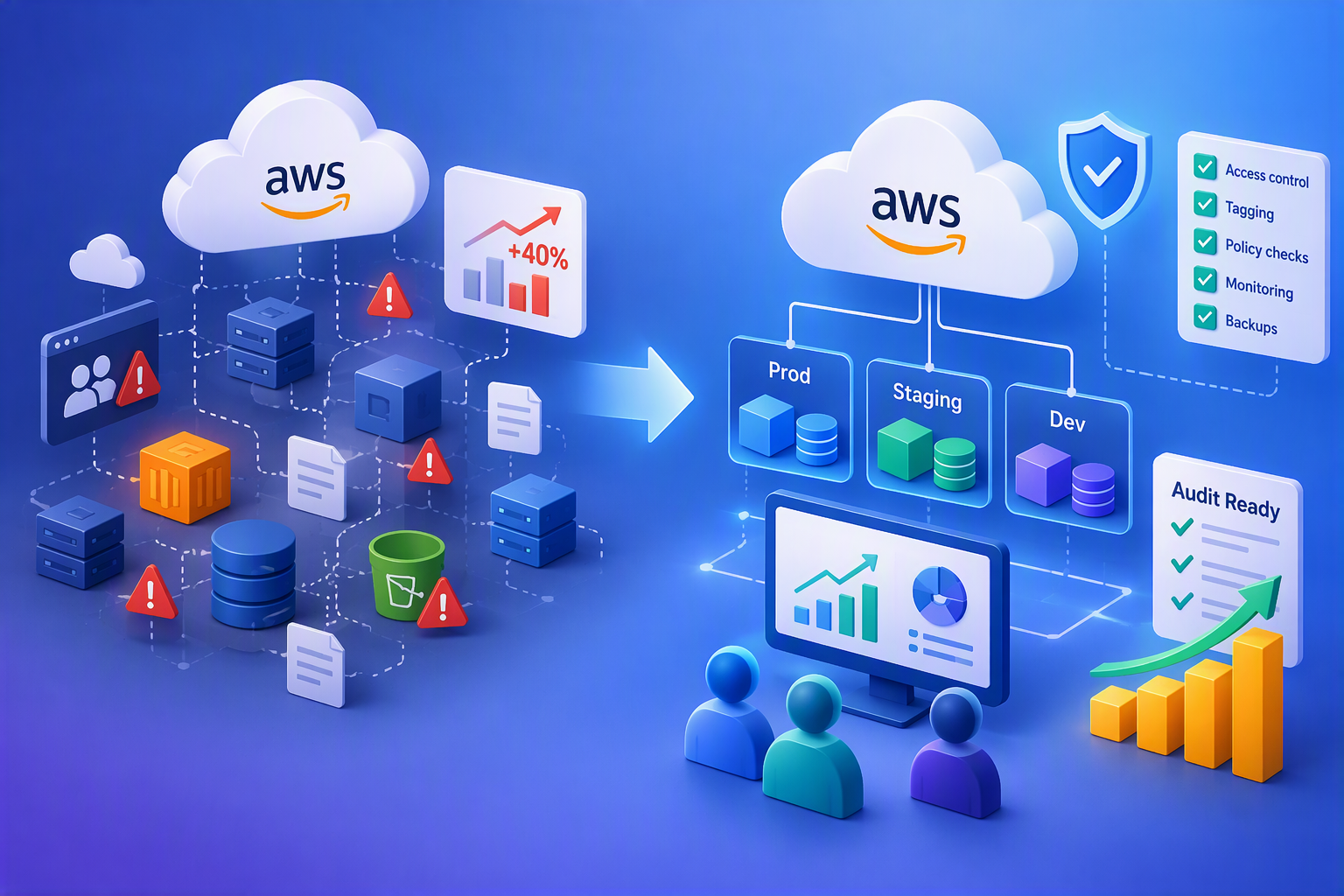
Consider a software company that grew from 20 to 150 employees in less than two years. Its engineering teams adopted AWS quickly, creating new environments, databases, and services whenever the business needed to launch a feature or support a new customer. The speed helped the company expand, but governance never kept pace.
Over time, cloud costs increased by nearly 40% without a clear explanation. Several production resources lacked ownership tags, multiple administrators held broad permissions they no longer needed, and critical backups were configured differently across applications. When a major customer requested security and compliance evidence during a procurement review, the company spent weeks gathering information manually.
The organization responded by implementing a cloud governance model built around standardized account structures, mandatory resource tagging, role-based access controls, Infrastructure as Code, centralized logging, and automated policy checks. Within six months, cloud spend became easier to track, privileged access was significantly reduced, audit preparation time decreased, and engineering teams were able to deploy new workloads faster using approved Terraform modules rather than building infrastructure from scratch.
The biggest benefit was not technical. Leadership gained confidence that cloud investments were supporting business growth while reducing operational and compliance risk.
Why This Matters
Cloud governance is often viewed as a security or compliance initiative, but its business impact is much broader. As organizations scale, the cloud becomes deeply connected to customer experience, operational resilience, financial performance, and regulatory obligations.
Without governance, businesses frequently encounter:
- Rising cloud costs with no clear ownership or accountability.
- Security weaknesses caused by excessive privileges and inconsistent controls.
- Slower audits due to missing documentation and fragmented evidence.
- Increased operational risk from undocumented infrastructure and tribal knowledge.
- Delays during incidents because teams lack clear ownership and response procedures.
When governance is implemented as an operational discipline rather than a policy document, organizations gain:
- Better visibility into cloud spending and resource ownership.
- More consistent security across teams and environments.
- Faster deployment through standardized, automated infrastructure.
- Improved resilience through tested backup and recovery processes.
- Greater confidence during audits, customer assessments, and regulatory reviews.
Ultimately, cloud governance enables businesses to scale cloud adoption without losing control. It provides the foundation for growth while reducing the likelihood of costly surprises.
Frequently Asked Questions (FAQ)
1. What is the primary goal of cloud governance?
The primary goal of cloud governance is to ensure cloud resources are used securely, efficiently, and in alignment with business objectives. It establishes clear rules, ownership, and controls while allowing teams to innovate and deliver services quickly.
2. Is cloud governance only important for large enterprises?
No. While large enterprises often have more complex requirements, startups and small businesses also benefit from governance. Even a small cloud environment requires ownership, access controls, backup procedures, and visibility into costs to avoid future operational and security issues.
3. How does cloud governance differ from cloud security?
Cloud security focuses on protecting systems, applications, and data from threats. Cloud governance is broader and includes security, financial management, compliance, operational processes, resource ownership, and decision-making frameworks that guide how cloud services are used.
4. What role does Infrastructure as Code (IaC) play in governance?
Infrastructure as Code tools such as Terraform and Ansible help enforce governance by making infrastructure deployments standardized, repeatable, and reviewable. Governance requirements can be built directly into deployment processes rather than relying on manual checks.
5. How can an organization start improving cloud governance?
A practical starting point is to assess the current environment and focus on high-impact areas such as identity management, multi-factor authentication, account structure, logging, backup coverage, resource tagging, and cost monitoring. From there, organizations can gradually introduce automation, policy enforcement, and governance metrics to mature their program over time.

Written by Alexander Boychev
Business Executive & Digital Marketing Manager at Advanced Vision IT Ltd | Published on
Alexander advises insights on business development, strategic key account management, and digital marketing in the IT sector.