



How to Centralize IT Operations Without Disruption
When an outage requires three vendors, five dashboards, and a chain of unclear approvals, the problem is not simply technical complexity. It is an operating-model problem. Learning how to centralize IT operations gives growing businesses a practical way to reduce that friction without forcing every workload, team, or tool into a single platform.
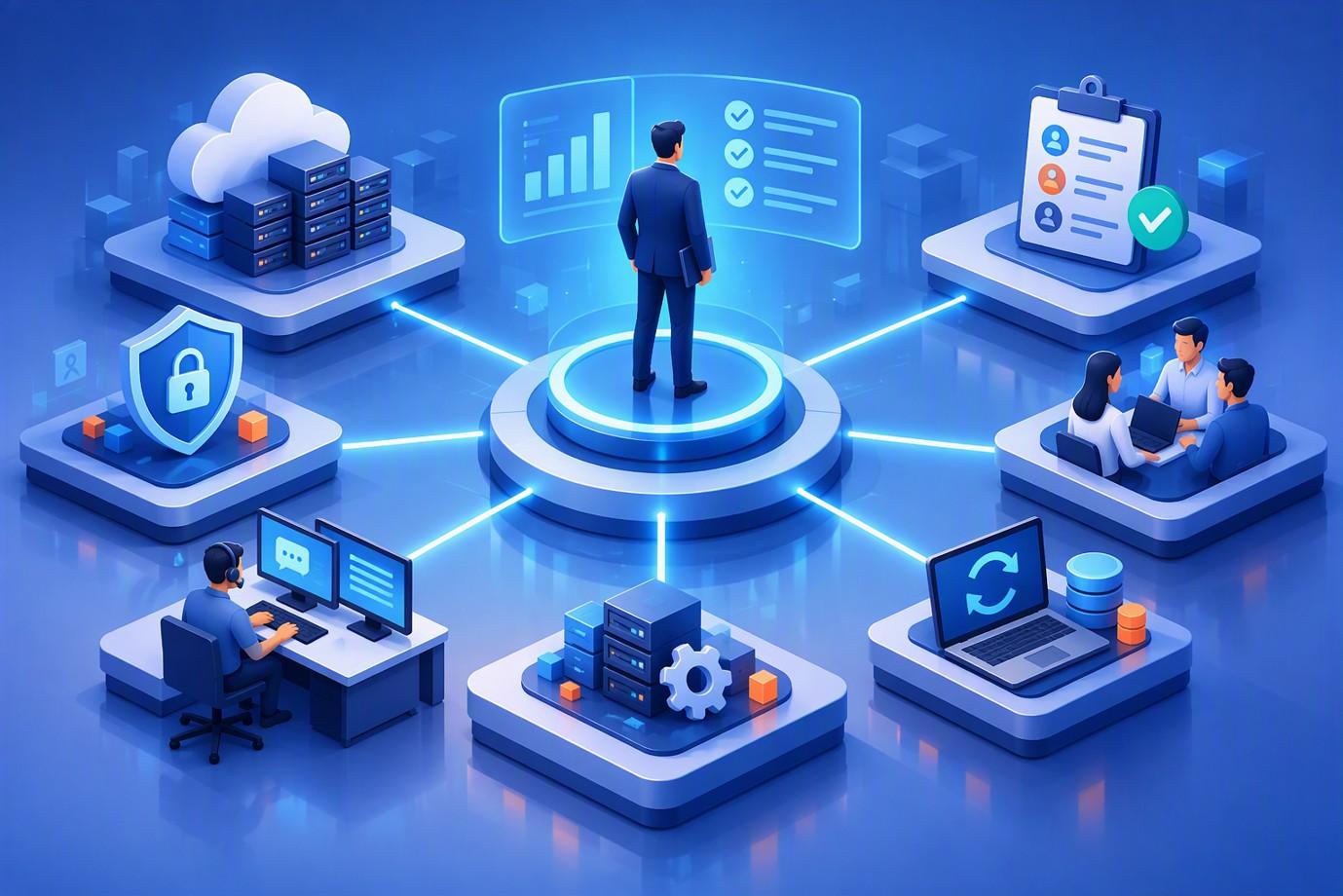
Centralization means creating one accountable operating model for infrastructure, security, support, cloud spend, and change management. The goal is not rigid control for its own sake. It is faster decisions, consistent standards, clearer ownership, and a dependable view of what is happening across the environment.
Define What Centralization Should Solve
Before consolidating tools or providers, identify the operational failures that are costing the business time, money, or confidence. A mid-sized company may have AWS infrastructure managed by engineering, endpoint security handled by an outside provider, SaaS administration assigned to finance, and support tickets routed through an internal generalist. Each function may work independently, but no one owns the complete service outcome.
That fragmentation shows up in predictable ways: security alerts are missed, cloud costs rise without context, deployment changes create avoidable incidents, and executives cannot get a clear answer about system risk. Centralization should address those specific gaps.
Set measurable outcomes early. For example, a business may want one incident escalation path, full asset visibility, defined recovery objectives for critical applications, standardized access reviews, and a monthly cloud cost forecast. These outcomes become the foundation for decisions about people, processes, and technology.
Centralization does not always mean eliminating every specialized vendor. A company with regulated workloads may retain a dedicated compliance adviser or a niche application partner. What matters is that one team has the authority and visibility to coordinate those relationships, enforce standards, and own the final operational result.
How to Centralize IT Operations Around Accountability
The first step is to establish a single accountable owner for IT operations. Depending on the organization, that may be a CTO, IT director, operations leader, or a managed technology partner operating as an extension of the internal team. This owner needs the mandate to prioritize work across infrastructure, cybersecurity, support, and cloud engineering.
Accountability should be documented in practical terms. Define who approves production changes, who responds to security events, who maintains the asset inventory, who owns vendor performance, and who communicates during an incident. A responsibility matrix is useful, but it only works when it reflects how work is actually performed rather than an idealized org chart.
For growth-stage businesses, this often means separating strategic ownership from daily execution. Internal leadership can retain authority over budget, risk tolerance, and product priorities while a managed operations team handles monitoring, patching, backups, infrastructure maintenance, and escalation. That structure provides control without requiring a large in-house operations department.
The key is avoiding shared accountability. When several parties believe someone else is responsible for a failed backup, delayed security patch, or expired certificate, no one is truly accountable. Centralized operations establish one point of coordination and one clear escalation path.
Build a Shared Source of Operational Truth
Centralization depends on visibility. Teams cannot manage what they cannot see, and scattered spreadsheets are not an operational system. Build a current inventory that covers cloud accounts, servers, endpoints, network devices, SaaS applications, domains, data stores, integrations, owners, and business criticality.
For cloud environments, this should include AWS accounts, IAM roles, VPCs, security groups, EC2 instances, container workloads, databases, storage, backups, and logging configurations. Tagging standards are especially valuable because they connect technical resources to business context. A resource tagged with an owner, environment, application, cost center, and data classification is far easier to govern and optimize.
A shared source of truth also needs service documentation. Record dependencies, support contacts, maintenance windows, recovery procedures, and known operational risks. Documentation is often treated as an administrative task, but during a production incident it becomes a direct contributor to uptime.
The right level of detail depends on the environment. A 40-person software company does not need the same documentation burden as a healthcare organization with strict compliance requirements. It does need enough information for an authorized engineer to troubleshoot a critical service without relying on institutional memory.
Consolidate Monitoring, Security, and Service Management
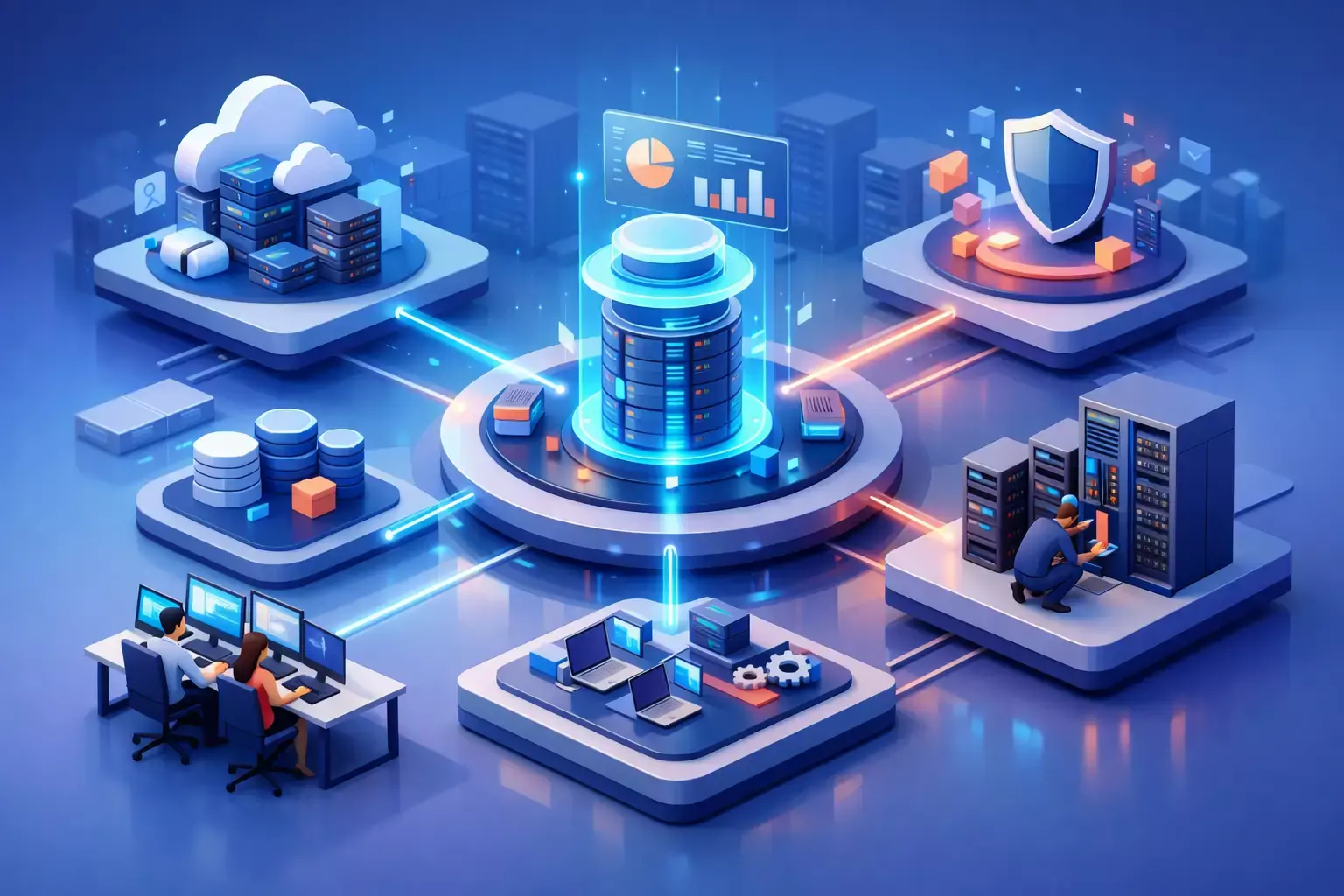
Most fragmented IT environments have too many alerts and too little signal. Infrastructure metrics may live in one tool, logs in another, application performance data in a third, and security events in a separate console. Centralizing operations requires a monitored service model that connects those signals.
Start by defining the services that matter most to the business. For a customer-facing application, that could include availability, latency, error rates, database health, deployment status, and security events. Observability platforms such as New Relic can correlate application performance with infrastructure behavior, while centralized logging and alert routing help teams identify the source of an issue faster.
Security monitoring should be integrated into the same response structure, not isolated as a compliance checkbox. Centralized identity management, multi-factor authentication, least-privilege access, endpoint protection, vulnerability management, and audit logging establish a baseline. Security events then need documented triage rules, escalation timelines, and evidence retention procedures.
Service management brings the human side together. Use one service desk process for incidents, service requests, changes, and recurring problems. This does not require one ticketing tool for every department. It requires a consistent workflow so requests do not disappear in email, chat threads, or vendor portals.
Standardize Changes Through Automation
Manual infrastructure changes are difficult to review, repeat, and recover. As environments expand, they also create configuration drift: systems that appear similar but behave differently because of undocumented changes over time.
Infrastructure as code is a practical answer. Terraform can define cloud resources consistently across development, staging, and production environments. Ansible can standardize server configuration and patching. CI/CD pipelines can apply automated testing and approval gates before application or infrastructure changes reach production.
Automation should be introduced where repetition and risk are highest. Common early candidates include account provisioning, access removal, backup validation, patch deployment, environment builds, security baseline checks, and cloud resource tagging. The objective is not to automate every task immediately. Poorly designed automation can spread errors quickly, so mature teams test, review, and monitor automated workflows just as carefully as application code.
A centralized change process should also include exceptions. Emergency changes may need a faster path during an outage, but they should still be recorded, reviewed afterward, and incorporated into future standards. Speed and governance are not opposites when the process is designed for real operational conditions.
Create a Unified Cloud and Cost Governance Model
Cloud costs become difficult to manage when teams can provision resources without common standards or ownership. Centralized cloud operations connect spending to architecture decisions, application demand, and business value.
Set budgets and alerts at the account, application, or department level. Review idle resources, oversized compute, unneeded storage, and data transfer patterns. Reserved capacity or savings plans may reduce predictable workload costs, but they require informed commitment decisions. For variable workloads, rightsizing and autoscaling may provide more value than long-term reservations.
Governance should not block engineering teams from delivering. A practical model gives teams approved infrastructure patterns, policy guardrails, and self-service deployment paths. It also provides a clear process for exceptions. This supports innovation while protecting the business from unmanaged cost growth and insecure configurations.
Periodic AWS Well-Architected Reviews can help leadership assess operational excellence, security, reliability, performance efficiency, cost optimization, and sustainability. The value is not the review itself. It is the prioritized remediation plan that follows.
Measure the Results and Refine the Model
Centralization is an operating discipline, not a one-time migration project. Measure whether the new model is improving service quality and decision-making. Useful indicators include mean time to detect and resolve incidents, patch compliance, backup recovery success, change failure rate, critical vulnerability age, cloud spend variance, and ticket resolution performance.
Review these measures with technical and business stakeholders. A leadership team may care most about uptime, risk exposure, and budget predictability. Engineers may focus on deployment reliability, alert quality, and time spent on repetitive work. Both perspectives are necessary because centralization should improve business resilience without creating unnecessary delivery bottlenecks.
Advanced Vision IT approaches centralized operations as a connected service model: cloud architecture, DevOps automation, observability, cybersecurity, compliance, and managed support working under shared standards and accountable ownership. The exact toolset can change as the business evolves. The operating discipline should remain consistent.
Start with the service that would hurt the business most if it failed tomorrow. Give it a clear owner, measurable reliability targets, documented recovery steps, centralized monitoring, and a tested change process. That first improvement creates the proof and momentum needed to bring the rest of the IT environment under control.
User Story: From Fragmented IT to Accountable Operations
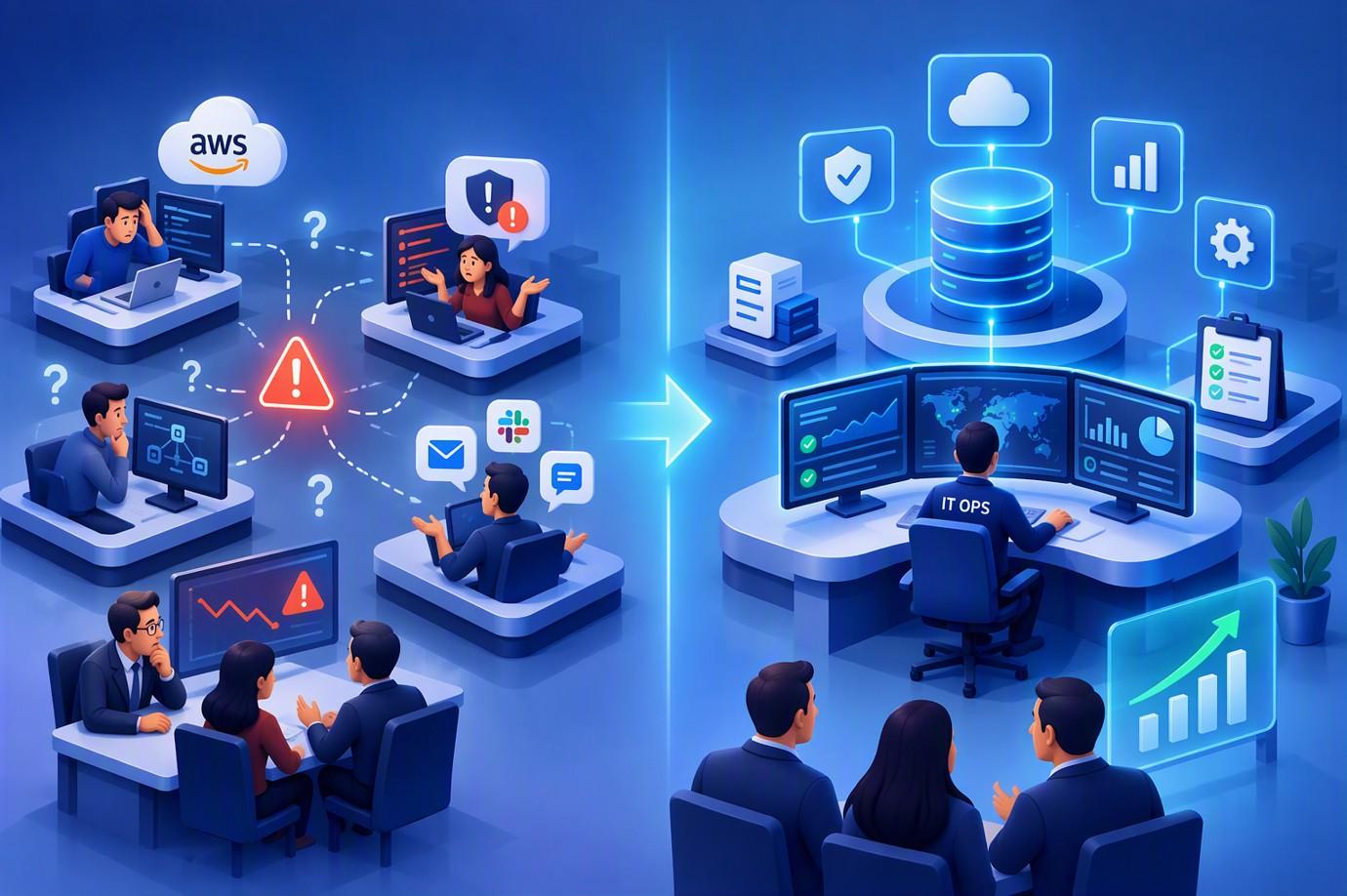
Consider a growing SaaS company with 120 employees operating across multiple regions. During a critical outage that affected customer logins, the application team blamed the cloud provider, the cloud provider pointed to network configuration changes, and the security partner was investigating unrelated alerts. With infrastructure monitoring in one platform, security events in another, and support tickets spread across email and chat, nobody had a complete picture of the incident.
As the outage continued, customer complaints increased, executives asked for updates that no one could confidently provide, and several teams spent hours duplicating troubleshooting efforts. The root cause ultimately turned out to be an undocumented infrastructure change combined with a failed automated backup process.
After centralizing IT operations, the company established a single operational owner, implemented centralized monitoring and logging, created a shared asset inventory, and introduced standardized change-management procedures. The next major incident was identified within minutes, escalated through a defined process, and resolved significantly faster because every team worked from the same source of operational truth.
The lesson was not that technology had failed. The problem was a lack of ownership, visibility, and coordination. Centralized IT operations transformed a reactive environment into an accountable operating model where responsibility was clear, decisions were faster, and business risk was easier to manage.
Why This Matters
Modern businesses rarely suffer from a lack of technology. More often, they struggle with disconnected tools, overlapping responsibilities, and fragmented operational processes. As organizations grow, these gaps create hidden costs that directly affect productivity, security, customer experience, and profitability.
Centralizing IT operations matters because it helps organizations:
- Reduce downtime and accelerate incident resolution by creating a single escalation path and clear ownership model.
- Improve cybersecurity posture through consistent access controls, monitoring, vulnerability management, and response procedures.
- Control cloud spending by introducing governance, visibility, tagging standards, and cost accountability.
- Increase operational resilience with documented recovery procedures, tested backups, and standardized change management.
- Support business growth without requiring a proportional increase in internal IT headcount.
- Improve executive decision-making by providing accurate reporting, asset visibility, and measurable operational metrics.
- Eliminate accountability gaps where multiple parties assume someone else is responsible for critical operational tasks.
Ultimately, centralization is not about consolidating every technology into a single platform. It is about creating a unified operating model that enables the business to operate securely, efficiently, and predictably as it scales.
Frequently Asked Questions (FAQ)
1. Does centralizing IT operations mean using only one vendor or one platform?
No. Centralization focuses on governance, accountability, and visibility rather than vendor consolidation. Organizations can continue using specialized providers when necessary, provided there is a single operating model coordinating all parties and owning the overall service outcome.
2. What is the first step in centralizing IT operations?
The first step is identifying operational challenges that are creating risk, inefficiency, or unnecessary cost. From there, assign a single accountable owner responsible for coordinating infrastructure, security, support, cloud operations, and vendor relationships.
3. Will centralization reduce flexibility for engineering and business teams?
Not when implemented correctly. Effective centralization provides standards, guardrails, and approved processes while still allowing teams to innovate and deploy solutions quickly. The goal is controlled agility, not bureaucracy.
4. How can a business measure whether centralization is successful?
Success can be measured using metrics such as mean time to detect and resolve incidents, change failure rate, patch compliance, cloud cost variance, backup recovery success rates, security risk reduction, and overall service availability.
5. Is centralized IT operations only suitable for large enterprises?
No. Small and mid-sized organizations often benefit the most because they typically operate with limited resources and rely on multiple vendors or generalist IT teams. A centralized operating model helps these organizations scale efficiently while maintaining operational control and reducing risk.

Written by Alexander Boychev
Business Executive & Digital Marketing Manager at Advanced Vision IT Ltd | Published on
Alexander advises insights on business development, strategic key account management, and digital marketing in the IT sector.