



How to Improve Cloud Visibility Across Your Stack
A production incident starts with a customer report, an AWS alarm, or a finance question about an unexpected bill. The real problem often appears later: no one can quickly connect the symptom to the service, deployment, infrastructure change, owner, security exposure, and cost impact behind it. Learning how to improve cloud visibility means building that connected operational picture before the next high-pressure event.
For growing businesses, cloud visibility is not a dashboard project. It is the ability to answer practical questions with confidence: What is running? Who owns it? Is it healthy and secure? What changed? What is it costing? And what needs attention now? When those answers are scattered across AWS accounts, SaaS tools, tickets, spreadsheets, and individual knowledge, teams react slowly and make decisions with incomplete context.
A real-world visibility challenge
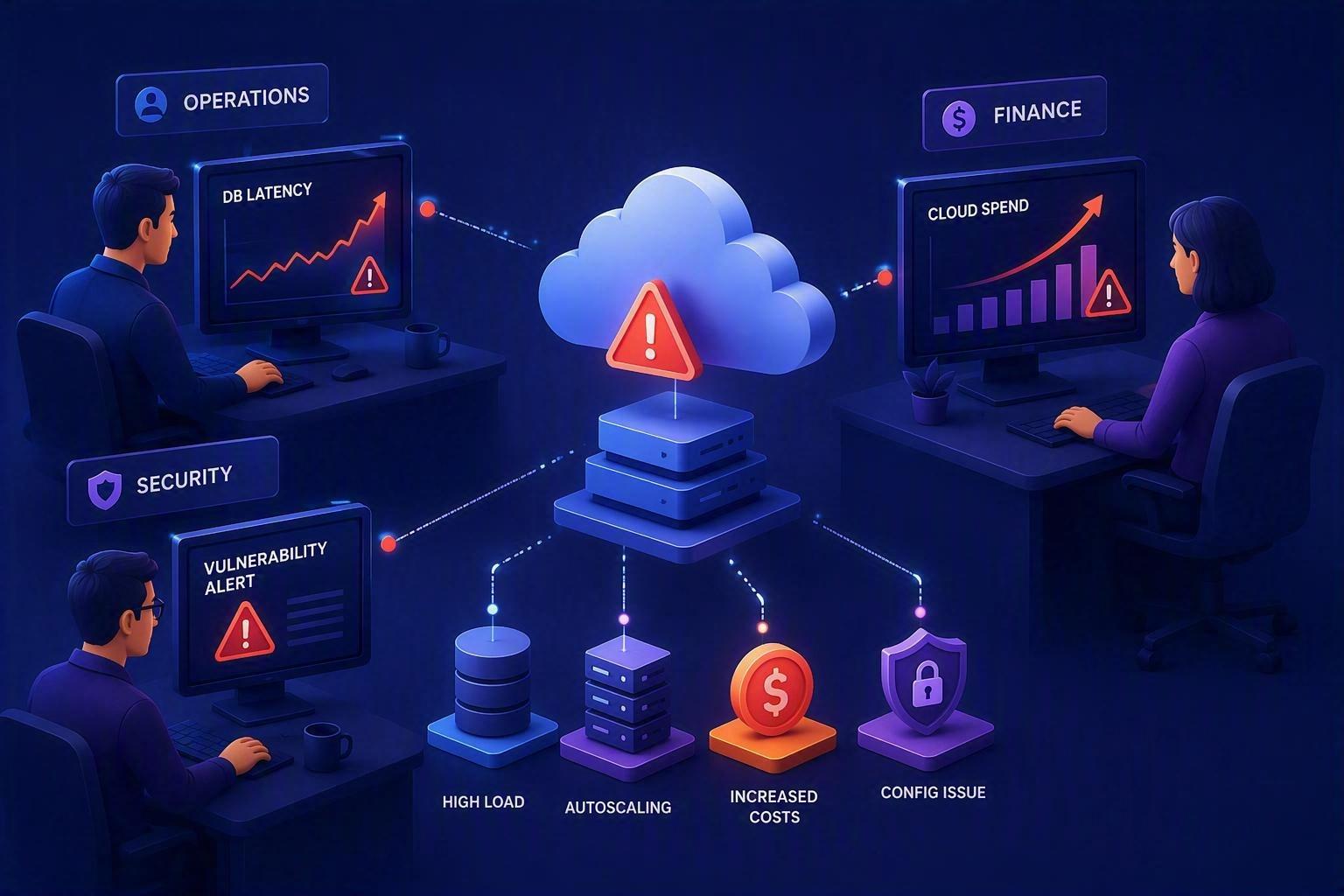
Consider a growing SaaS company running dozens of workloads across multiple AWS accounts. Late on a Friday afternoon, customers begin reporting slow application performance. Operations teams receive alerts showing increased database latency, while finance notices a sudden spike in cloud spending. At the same time, security teams are investigating a new vulnerability alert affecting a production environment.
Each team can see part of the problem, but no one can immediately connect the dots. It takes hours to determine that a recent infrastructure change created excessive database load, triggered autoscaling, increased cloud costs, and exposed a configuration issue that amplified application delays. By the time the root cause is identified, customer satisfaction has already been affected.
With strong cloud visibility in place, teams could have traced the issue to its source within minutes, understood the operational and financial impact, identified the responsible owners, and coordinated a response before customers experienced significant disruption.
What cloud visibility should give your business
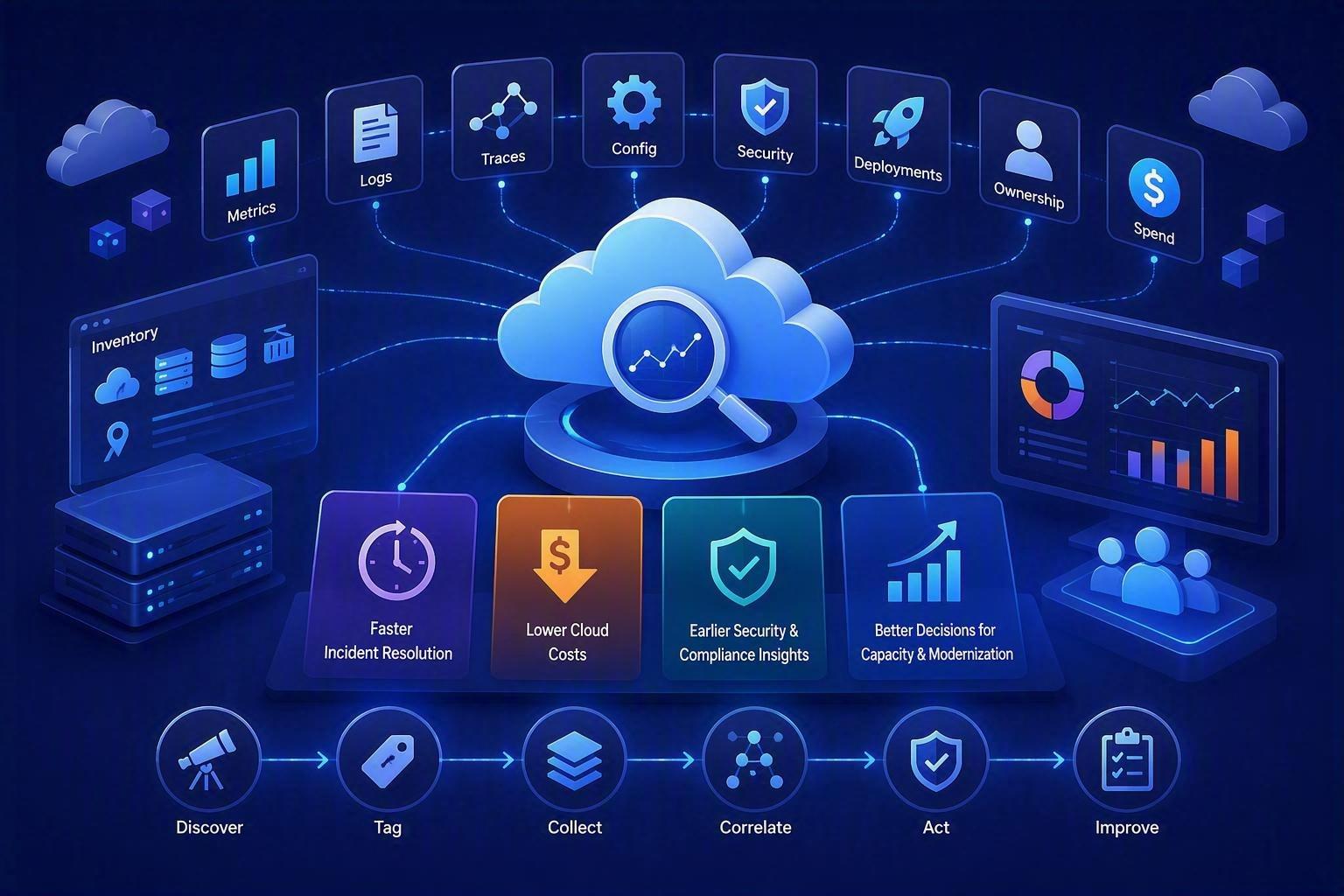
Cloud visibility is broader than infrastructure monitoring. Monitoring tells you whether a metric crossed a threshold. Visibility combines metrics, logs, traces, configuration data, security findings, deployment history, asset ownership, and spend data so teams can understand the operational state of their environment.
A useful visibility program supports four outcomes. It shortens incident resolution, reduces avoidable cloud spend, exposes security and compliance gaps earlier, and gives leaders reliable information for capacity and modernization decisions. The priority will vary by organization. A digital product company may begin with application performance and release reliability, while a regulated business may need identity, configuration, and audit evidence first.
The goal is not to collect every possible signal. Excess data creates alert fatigue and higher observability costs. The goal is to collect the signals that allow the right person to make a timely, defensible decision.
Start with an inventory you can trust
You cannot observe what you do not know exists. Most cloud environments accumulate resources quickly: multiple AWS accounts, temporary test workloads, inherited virtual machines, managed databases, storage buckets, containers, serverless functions, third-party integrations, and remote access paths. An inventory built once in a spreadsheet becomes outdated almost immediately.
Use cloud-native discovery and configuration services to establish a current baseline of accounts, regions, resources, identities, network components, and data stores. For AWS environments, this commonly includes AWS Config, CloudTrail, IAM reporting, resource tagging data, and account-level inventory processes. The result should identify both active assets and unmanaged exceptions.
Define a minimum tagging standard
Tags make technical data usable by operations, finance, security, and engineering. At a minimum, require tags for application or service, environment, business owner, technical owner, cost center, and data classification where appropriate. Add a lifecycle tag for temporary or experimental resources.
Tagging discipline should be automated rather than dependent on memory. Enforce required tags through infrastructure-as-code templates, CI/CD checks, policy controls, and periodic remediation. There will be exceptions for shared networking, platform services, and legacy systems, but exceptions should be documented and owned. A tag standard that is too complex will be ignored, so begin with fields that drive real decisions.
Centralize telemetry without centralizing every team
Teams need a common operational view, but they do not need to surrender application ownership. A practical model centralizes telemetry while preserving service-level responsibility. Platform or managed services teams operate the observability foundation, while application owners define meaningful service indicators and response procedures.
Bring together four primary telemetry types: metrics for health and capacity, logs for detailed events, traces for request paths across services, and events for deployments, configuration changes, and incidents. A platform such as New Relic can consolidate these views, while AWS CloudWatch remains valuable for native service signals. The right toolset depends on existing investments, retention requirements, and the skills of the team that must operate it.
Do not treat a single-pane-of-glass promise as the requirement. Some security, network, and business data will remain in specialized systems. What matters is that responders can pivot from an alert to the information needed to investigate it, without spending the first 30 minutes locating data.
Measure services from the customer outward
Infrastructure metrics alone can look healthy while users experience errors or slow transactions. Define service-level indicators around user-facing outcomes, such as API success rate, checkout completion, queue processing time, page response time, or time to generate a report.
Then map those indicators to the supporting components: load balancers, containers, databases, message queues, DNS, and external dependencies. Distributed tracing is especially valuable for microservices and hybrid applications because it shows where time and failures accumulate across boundaries. For simpler workloads, carefully selected logs and metrics may provide enough insight at a lower cost.
Use service-level objectives to establish what acceptable performance means. A target should be specific enough to guide action but realistic enough to preserve engineering focus. If a service has no defined customer impact, every alert can appear equally urgent.
Connect changes to operational behavior
A large share of cloud incidents follow a change: a software release, Terraform update, access policy edit, certificate rotation, autoscaling adjustment, or vendor integration. Visibility improves sharply when deployment and infrastructure changes appear alongside performance and error data.
Integrate CI/CD pipelines with your observability platform. Record release versions, deployment times, feature-flag changes, and infrastructure plan outcomes. Terraform and Ansible can provide a clear, reviewable history of intended configuration changes, while CloudTrail helps verify what changed in the environment. During an incident, this context helps teams test a likely cause instead of searching blindly.
This does not mean every change caused the issue. Correlation is a starting point, not proof. Teams still need disciplined investigation, rollback criteria, and post-incident review. But a reliable change timeline eliminates a common operational blind spot.
Make security and compliance visible in daily operations
Security findings often live in a separate console until an audit, customer questionnaire, or incident forces attention. That separation creates risk. Cloud visibility should show whether critical assets have public exposure, overly broad identity permissions, missing encryption, vulnerable images, unapproved regions, or logging gaps.
Aggregate high-priority findings from identity, endpoint, cloud security posture, and vulnerability tools into an operational workflow with clear owners and due dates. Avoid routing every low-severity finding to the same on-call channel. Severity should reflect business context, including data sensitivity, internet exposure, exploitability, and the role of the affected system.
For compliance-focused organizations, visibility should also support evidence collection. Configuration baselines, access logs, policy exceptions, backup status, and remediation records are easier to produce when controls are continuously monitored. A Well-Architected Review can help identify gaps across security, reliability, performance efficiency, cost optimization, and operational excellence before they become audit findings or outages.
Put cost data next to technical decisions
Cloud bills are a lagging indicator when finance receives them without service context. Teams need cost visibility by account, product, environment, owner, and workload so they can see what a technical decision means financially.
Create budgets and anomaly alerts, then review spend alongside utilization and application demand. An idle development environment, oversized database, unused load balancer, or excessive log retention may be easy to identify once cost and usage data are connected. Rightsizing can lower spend, but it should not weaken resilience by removing capacity needed for predictable peak demand or recovery.
The most useful cost reviews are recurring and cross-functional. Engineering understands workload behavior, finance understands planning constraints, and leadership can set priorities. Chargeback may fit some organizations; showback is often a better starting point because it creates accountability without turning every platform conversation into an internal billing dispute.
Build an operating model around ownership and response
Visibility tools do not resolve incidents. People with clear authority, documented procedures, and enough context resolve incidents. Every critical workload should have an accountable technical owner, a business owner, an escalation path, and an agreed recovery expectation.
Create dashboards for different decisions. Executives need service availability, risk posture, and cost trends. Operations teams need active alerts, capacity, and dependency health. Engineering teams need detailed traces, error patterns, and deployment context. A single executive dashboard filled with container-level metrics is not visibility - it is noise.
Review alert quality regularly. Alerts should be actionable, routed to an owner, and tied to a response expectation. Retire alerts that do not lead to action. For recurring issues, create runbooks that explain the impact, likely causes, verification steps, escalation path, and safe remediation options. This reduces dependency on a few experienced individuals and makes support more predictable.
A practical path to improve cloud visibility
A phased approach produces better results than a broad tooling rollout. First, identify critical services and establish an accurate inventory. Next, apply ownership and tagging standards. Then centralize high-value telemetry, beginning with customer-facing services and their dependencies. Add deployment context, security findings, and cost allocation as the operational foundation matures.
At each stage, test whether teams can answer a real question faster than before: Can we identify the owner of a failing service? Can we prove what changed before latency increased? Can we see whether a security finding affects a production workload? Can we explain a cost increase by application and environment? If the answer is still no, add context before adding more dashboards.
Advanced Vision IT helps organizations design and operate this foundation across AWS, DevOps automation, observability, cybersecurity, and managed support. The right implementation is tailored to the environment, team capacity, and business risk - not forced into a rigid toolset.
Better cloud visibility is ultimately a habit of operational clarity. When ownership, telemetry, security, changes, and costs stay connected, your team can spend less time assembling the picture and more time making the next decision with confidence.
Why this matters
Cloud environments become more complex as organizations grow. New applications, cloud services, environments, integrations, and security requirements create more dependencies and more opportunities for blind spots. Without visibility, teams spend valuable time searching for information rather than solving problems.
The business impact extends beyond technical operations. Poor visibility can result in longer outages, delayed incident response, unexpected cloud costs, compliance challenges, and slower decision-making. When leaders lack confidence in operational data, modernization projects, scaling initiatives, and investment decisions become more difficult to justify.
Effective cloud visibility creates a shared understanding across engineering, operations, security, and finance teams. It allows organizations to move from reactive troubleshooting to proactive management by connecting performance, security, changes, ownership, and cost data into a single operational context.
The organizations that gain the most value from the cloud are often not those with the most tools, but those with the clearest view of how their technology supports business outcomes. Visibility transforms cloud operations from a collection of isolated signals into actionable intelligence that enables faster responses, better governance, and more confident decision-making.
Frequently Asked Questions (FAQ)
1. What is cloud visibility, and how is it different from infrastructure monitoring?
Cloud visibility goes beyond monitoring infrastructure metrics. While monitoring alerts you when a metric crosses a threshold, cloud visibility combines metrics, logs, traces, configuration data, security findings, ownership information, deployment history, and cost data. This gives teams the context needed to understand what is happening, why it is happening, and who should respond.
2. Why is a complete cloud inventory important?
You cannot manage or secure resources you do not know exist. A current cloud inventory helps organizations identify all accounts, resources, identities, network components, and data stores. This visibility reduces operational blind spots, improves security, and ensures teams can quickly locate the systems involved in an incident or cost increase.
3. What role do tagging standards play in cloud visibility?
Tags help connect technical resources to business context. By consistently tagging assets with details such as application, environment, owner, cost center, and data classification, organizations can improve operational management, cost allocation, security oversight, and accountability across teams.
4. How can cloud visibility help reduce incident resolution times?
Cloud visibility allows teams to quickly connect alerts, service health data, deployment changes, logs, traces, and infrastructure updates in one operational view. This reduces the time spent searching for information and helps responders identify probable causes, impacted services, and responsible owners faster during an incident.
5. How does cloud visibility support cost optimization and security?
By linking cost data with technical and operational information, organizations can identify unused resources, oversized infrastructure, and unexpected spending patterns. At the same time, visibility into security findings, access permissions, configuration drift, and compliance status helps teams detect and address risks before they lead to incidents, audits, or business disruption.

Written by Yavor Y. Zlatev
CEO & Founder at Advanced Vision IT Ltd | Published on
Yavor advises executive leadership teams on cybersecurity strategy, NIS2 compliance, and cloud operating models to build resilient IT environments.