



IT Compliance Requirements That Scale With Growth
A customer security questionnaire lands in your inbox. A larger prospect asks for proof of access controls. A regulator requests records after an incident. In each case, IT compliance requirements stop being a policy document and become an operational test: can your business show how its systems are secured, who has access, and what happens when something goes wrong?
For growth-stage businesses, the challenge is rarely a lack of intent. It is that infrastructure changes quickly. Cloud accounts expand, SaaS tools multiply, engineers ship new code, and responsibilities become distributed across internal teams and vendors. Compliance must keep pace without turning delivery into a bottleneck.
What IT compliance requirements actually cover
IT compliance requirements are the technical, administrative, and evidentiary obligations an organization must meet under laws, contracts, industry standards, or internal governance policies. The applicable requirements depend on your business model, the data you handle, your customers, and where you operate.
A healthcare software provider may need controls aligned with HIPAA. A company processing card payments will face PCI DSS obligations. A SaaS provider selling to enterprise customers may pursue SOC 2 to demonstrate that its security practices are independently examined. Privacy laws, including state privacy rules and international requirements, can add obligations around data handling, retention, and access.
The framework matters, but the operating reality matters more. Compliance is not achieved because a policy says multifactor authentication is required. It is achieved when multifactor authentication is enforced across identity systems, exceptions are documented, access is reviewed, and records show that the control operated as intended.
That distinction explains why organizations can have a strong set of written policies yet struggle during an audit or customer review. Auditors and sophisticated buyers look for consistency between what the business says, what its systems enforce, and what evidence it can produce.
Start with scope, not a control checklist
The fastest way to create unnecessary cost is to apply every possible control to every system. Effective compliance begins with a clear scope: which applications, cloud environments, endpoints, vendors, teams, and data types are relevant to the requirement at hand.
Map the flow of sensitive data from collection through processing, storage, backup, and deletion. Identify where credentials are managed, where logs are retained, and which third parties receive or process information. In AWS, that often means documenting accounts, regions, IAM roles, storage services, network paths, CI/CD pipelines, and managed services that support a production workload.
Scope should also account for shared responsibility. AWS secures the underlying cloud infrastructure, but your organization remains responsible for identity configuration, workload security, encryption choices, application code, logging, and data governance. The exact split varies by service, which is why a generic cloud compliance statement is not enough.
A focused scope lets a business prioritize meaningful work. If a legacy internal tool never handles regulated data, it may not require the same level of formal evidence as a customer-facing platform. That does not mean it can be ignored. It means controls should be proportional to risk and documented decisions should explain the difference.
The control areas that deserve operational ownership
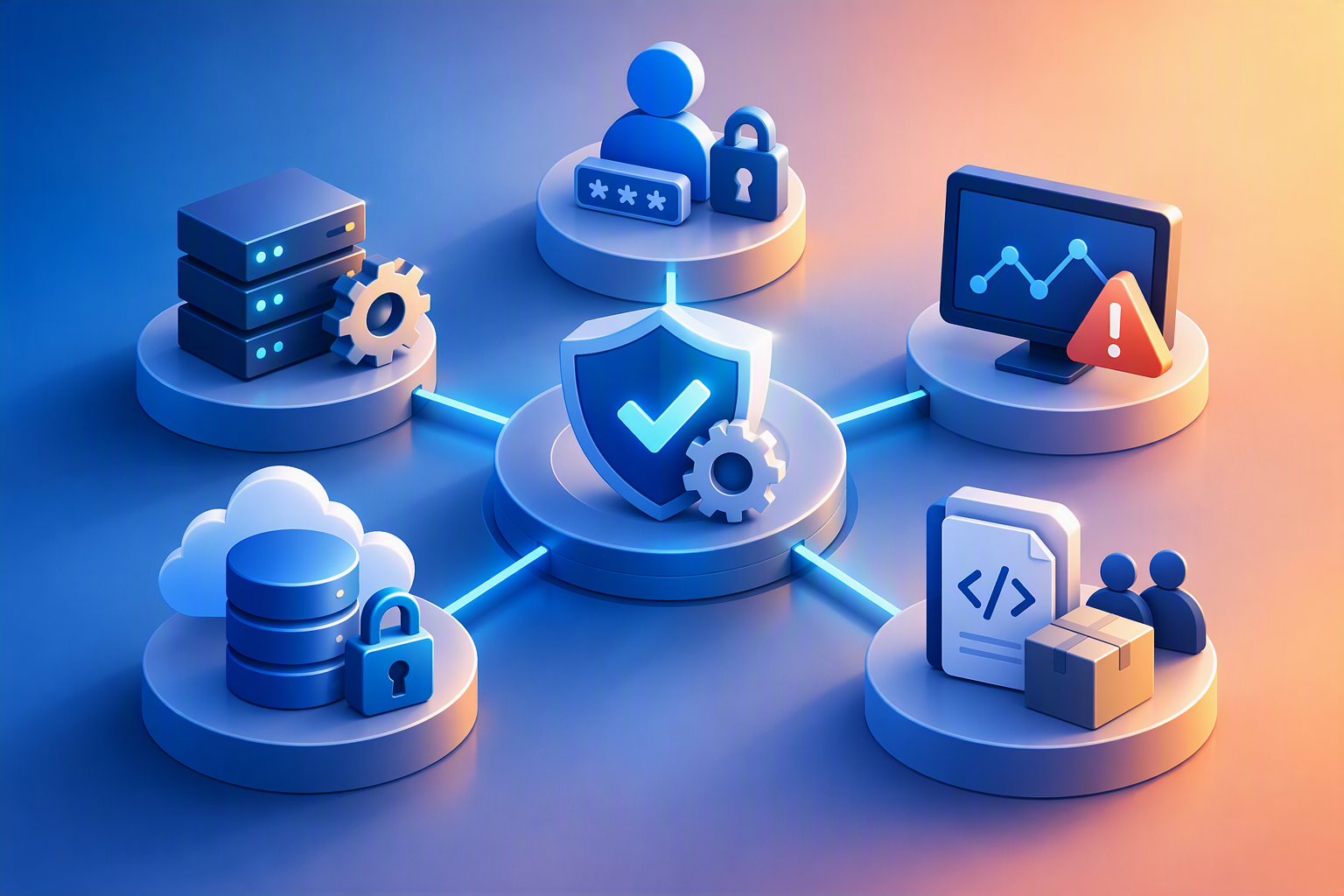
Most IT compliance requirements converge around a common set of control areas. The implementation details change by framework, but these capabilities should have clear owners, repeatable processes, and evidence that can be retrieved without a last-minute scramble.
- Identity and access management: Enforce least-privilege access, multifactor authentication, centralized identity, timely offboarding, and periodic access reviews. Privileged access should be especially visible and tightly controlled.
- Asset, configuration, and change management: Maintain an inventory of systems and software, define secure configuration baselines, and record changes to production environments. Infrastructure as code with Terraform or Ansible can make approved configurations repeatable and reviewable.
- Security monitoring and incident response: Collect meaningful logs, monitor alerts, define escalation paths, and test the incident response process. Observability platforms such as New Relic can support operational visibility, but they do not replace a documented response plan or accountable decision-makers.
- Data protection and resilience: Classify sensitive data, encrypt it appropriately, manage keys carefully, test backups, and establish recovery objectives. A backup that has never been restored is an assumption, not a recovery capability.
- Vendor and software risk: Review vendors that handle sensitive data or support critical operations. For internally developed software, integrate code review, dependency scanning, secrets management, and release controls into the CI/CD process.
The common failure is assigning these controls to “IT” as a broad concept. A better model identifies named owners. Engineering may own deployment controls, IT may own endpoint management, security may own alerting standards, legal or privacy leaders may own data-use decisions, and executives may accept defined risks. In a smaller company, one person can hold multiple responsibilities, but the responsibilities should still be explicit.
Build evidence while work happens
Evidence collection should be a byproduct of good operations, not an annual project. When a new employee is onboarded through a ticketed workflow, the ticket is evidence. When a pull request is reviewed and deployed through a controlled pipeline, the repository and CI/CD records are evidence. When access reviews occur on a schedule, the review records are evidence.
This approach reduces audit fatigue and reveals weak processes earlier. If your team cannot prove that a control ran last quarter, either the evidence is scattered or the control is not operating reliably enough.
Automation helps, particularly in cloud environments. Centralized CloudTrail logging, configuration monitoring, vulnerability scanning, policy checks, and backup reports can create a consistent trail across accounts. However, automation needs governance. Alerts without ownership become noise, and compliance dashboards can create false confidence if teams do not investigate exceptions.
Keep evidence organized by control, owner, review frequency, and system scope. A practical control register can show the requirement, the control objective, the procedure, the responsible party, the source of evidence, and the date of the last review. It is simple, but it connects policy language to real operations.
Treat exceptions as decisions, not hidden debt
Not every requirement can be implemented immediately. A legacy application may not support modern authentication. A critical customer integration may require a temporary network exception. A startup may lack the staffing for continuous internal monitoring.
The wrong response is to quietly work around the gap. The better response is to record the exception, assess the risk, add compensating controls where possible, assign an accountable approver, and establish an expiration or remediation date. This gives leadership visibility into accepted risk and prevents temporary workarounds from becoming permanent architecture.
Trade-offs are real. A highly restrictive change process can reduce configuration risk but slow product releases. Centralizing every decision can improve consistency but overload a small security team. The objective is not maximum process. It is a control environment that protects the business while allowing it to operate and grow.
Make compliance part of cloud and software delivery
Compliance performs best when it is built into architecture and delivery decisions early. During an AWS migration, for example, teams should define account boundaries, logging, encryption, network segmentation, identity patterns, backup strategy, and recovery testing before workloads are moved. Retrofitting these fundamentals after production migration is usually more expensive and more disruptive.
The same principle applies to software development. Security and compliance checks belong in the delivery path: peer review before merge, automated tests before release, controlled secrets, environment separation, and traceable deployments. A Well-Architected Review can help identify gaps across security, reliability, operational excellence, performance efficiency, cost optimization, and sustainability, but remediation still requires engineering ownership.
For organizations without a dedicated compliance or cloud security team, a managed partner can provide structure, monitoring, and implementation capacity. Advanced Vision IT helps clients connect AWS architecture, DevOps practices, managed operations, and security controls so compliance work supports resilience rather than sitting apart from it.
Review the program when the business changes
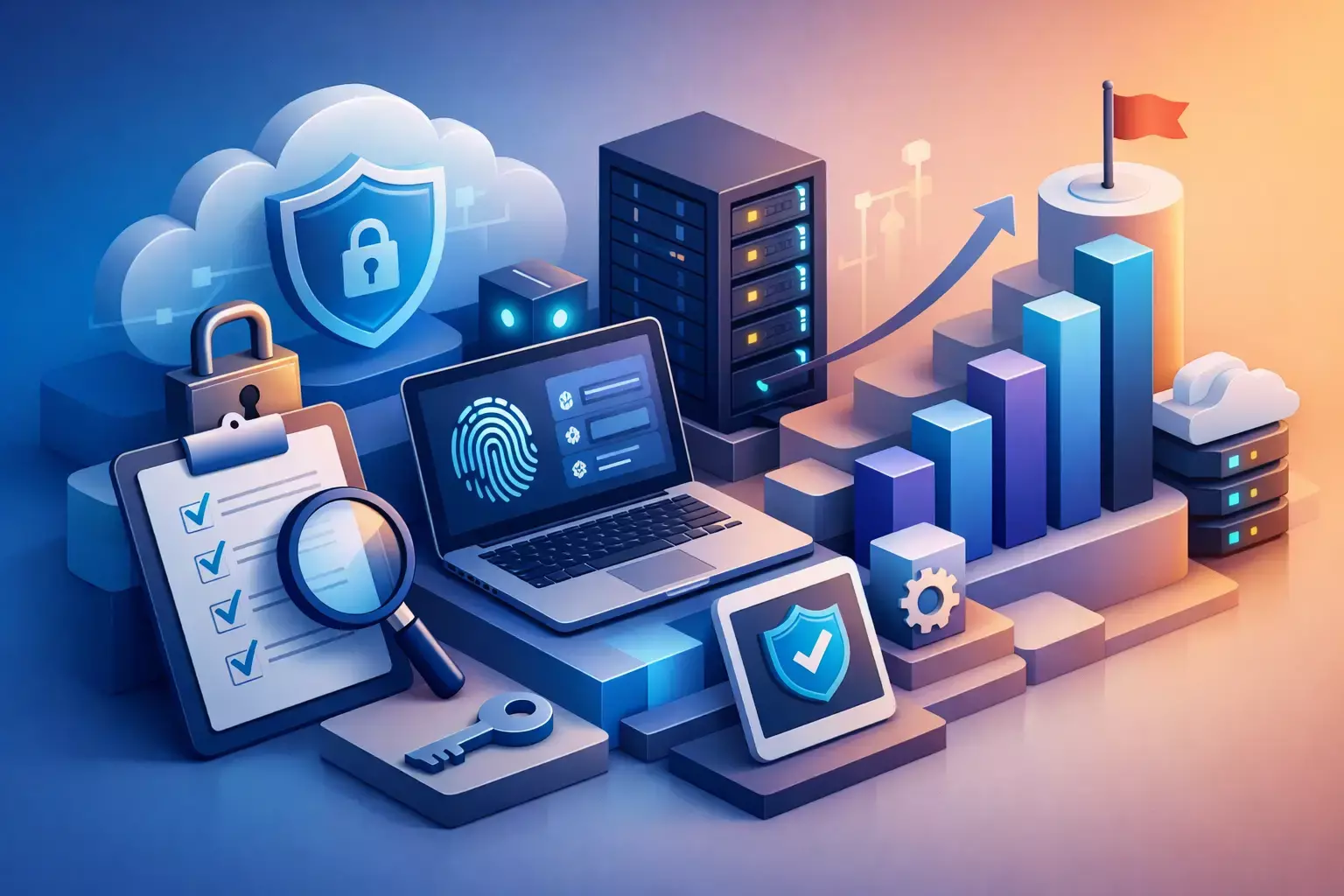
A compliance program that fit a 20-person company may not fit a 200-person company, a new product line, or a move into a regulated market. Review scope and controls after major events such as acquisitions, cloud migrations, new data categories, significant vendor changes, or enterprise customer commitments.
Use incidents and near misses as useful input. If an access issue took days to investigate because logs were incomplete, that is not only an operational problem. It is evidence that the control design or evidence process needs improvement. If an audit repeatedly finds the same exception, the organization should address the underlying workflow rather than polish the documentation.
The most useful compliance program is one your technical teams can run with confidence on an ordinary Tuesday. Build controls into the way systems are designed, changed, monitored, and recovered, and the next customer review or audit becomes a demonstration of disciplined operations instead of a disruptive fire drill.
User Story: From Audit Panic to Audit Readiness
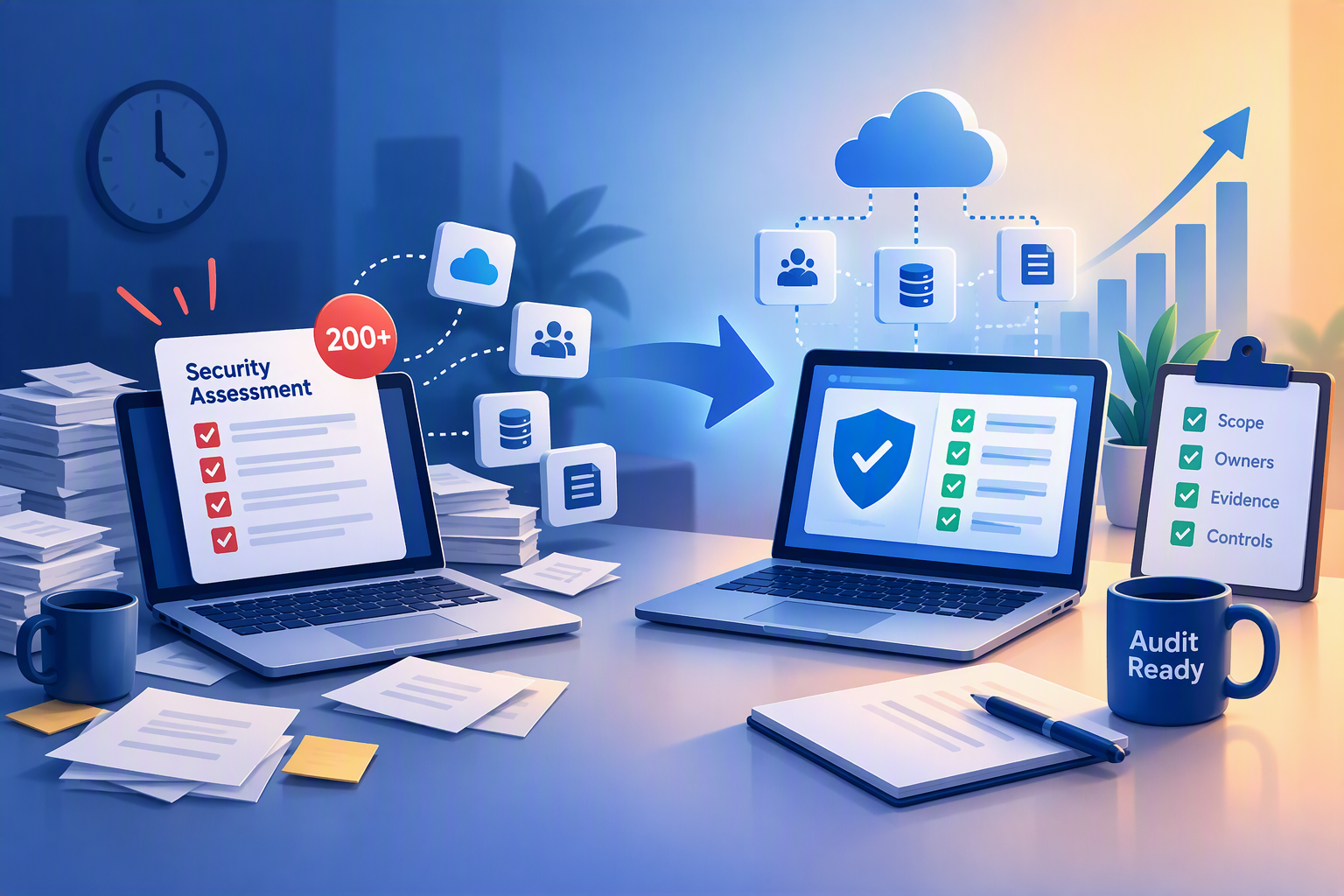
Consider a growing SaaS company with 75 employees preparing to close its largest enterprise deal. Just weeks before contract signing, the prospect's security team sends a 200-question security assessment and requests evidence of access reviews, incident response testing, backup validation, and cloud logging practices.
The company's engineering team is confident that most security controls exist. Multifactor authentication is enabled, backups run daily, and production changes move through a CI/CD pipeline. The challenge is proving it. Access reviews were performed informally, backup restoration testing was not documented, and audit logs were stored across multiple systems without a centralized process for retrieval.
Instead of treating the request as a documentation exercise, the company mapped its compliance scope, assigned control owners, centralized evidence collection, and created a control register linking policies to operational records. Within weeks, security questionnaires that previously required days of investigation could be answered using documented evidence and repeatable processes.
The result was more than passing a customer review. Engineering teams spent less time searching for records, leadership gained visibility into operational risk, and future compliance requirements became easier to manage because controls were embedded into daily operations rather than handled as one-time audit projects.
Why This Matters
IT compliance requirements are often viewed as obligations imposed by regulators, auditors, or customers. In reality, they serve a broader business purpose: creating confidence that critical systems, data, and processes can be trusted.
A mature compliance program helps organizations:
- Accelerate sales cycles by responding quickly to customer security reviews and due diligence requests.
- Reduce operational risk by ensuring access controls, monitoring, backups, and recovery procedures are consistently applied.
- Improve accountability through clearly assigned ownership of controls and exceptions.
- Support cloud and software growth without losing visibility into security and governance.
- Minimize audit disruption by collecting evidence continuously rather than scrambling for documentation at review time.
- Demonstrate organizational maturity to enterprise customers, investors, partners, and regulators.
Organizations that build compliance into daily operations are often more resilient during incidents, better prepared for growth, and able to adapt more easily when regulatory or customer expectations change.
Frequently Asked Questions (FAQ)
1. What are IT compliance requirements?
IT compliance requirements are the technical, administrative, and documentation obligations that organizations must meet under regulations, industry standards, customer contracts, or internal policies. These requirements typically cover areas such as access control, data protection, monitoring, risk management, and evidence collection.
2. How do I determine which compliance requirements apply to my organization?
The answer depends on the type of business you operate, the data you process, your industry, your customer base, and where you conduct business. Healthcare organizations may face HIPAA requirements, payment processors must address PCI DSS obligations, and SaaS providers often pursue SOC 2 to satisfy enterprise customer expectations.
3. Is compliance the same as security?
No. Security focuses on protecting systems and data, while compliance demonstrates that security and governance controls meet defined requirements and can be verified through evidence. An organization can have security tools in place yet still struggle with compliance if controls are not consistently documented, reviewed, or enforced.
4. What is the most common compliance mistake for growing businesses?
One of the most common mistakes is treating compliance as an annual audit exercise rather than an ongoing operational practice. When evidence collection, access reviews, change management, and monitoring are not built into routine workflows, audits become difficult and gaps are often discovered too late.
5. How can cloud environments make compliance easier?
Cloud platforms can simplify compliance through centralized logging, automated policy checks, infrastructure-as-code, configuration monitoring, backup reporting, and identity controls. However, organizations remain responsible for governing these tools, investigating exceptions, and ensuring controls operate effectively under the shared responsibility model.

Written by Alexander Boychev
Business Executive & Digital Marketing Manager at Advanced Vision IT Ltd | Published on
Alexander advises insights on business development, strategic key account management, and digital marketing in the IT sector.