



Managed Detection Response Guide for Growing Teams
A ransomware alert at 2:13 a.m. is not a staffing problem your business can solve at 8:00 a.m. It is a decision problem: who validates the signal, contains the threat, preserves evidence, and tells leadership what happened? This managed detection response guide explains how MDR services address that gap and how to choose coverage that fits your infrastructure, risk profile, and operating model.
What Managed Detection and Response Actually Delivers
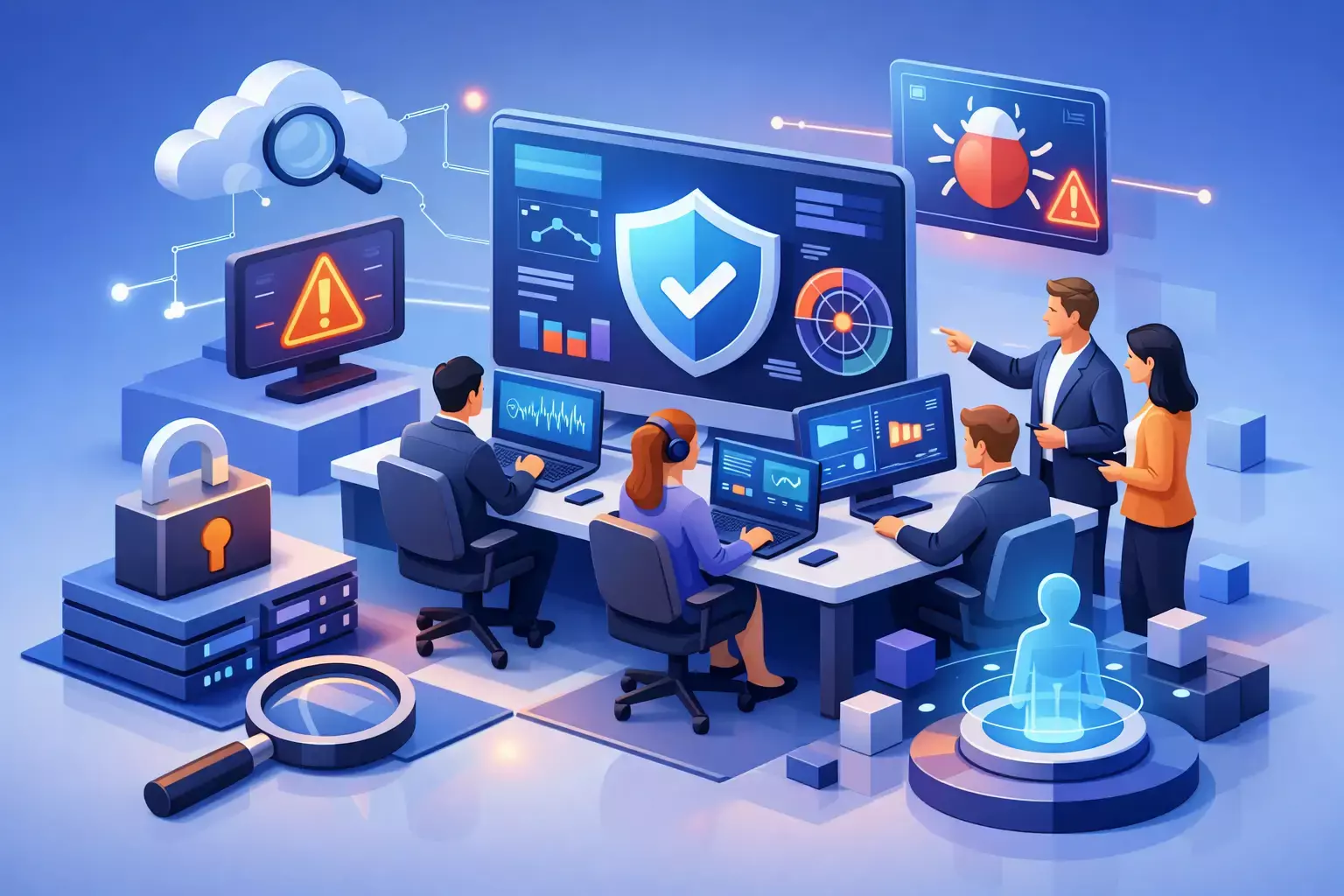
Managed detection and response, commonly called MDR, combines security technology with human-led monitoring, investigation, and response. The provider collects telemetry from endpoints, identities, cloud accounts, networks, and other relevant systems. Its analysts then investigate suspicious behavior and, based on the agreed operating model, recommend or perform containment actions.
The distinction matters because alerts are not outcomes. A business can own endpoint protection, a SIEM, and cloud-native security tools yet still lack the people and processes required to identify a real intrusion quickly. MDR turns a stream of security events into triaged incidents, prioritized actions, and documented evidence.
For a growing organization, the practical value is often 24/7 coverage without building a full security operations center. That does not mean MDR replaces internal IT, cloud engineering, or leadership accountability. It gives those teams a specialized escalation function that can act when an event requires immediate attention.
A capable service should provide more than an inbox full of notifications. Expect analysts to correlate signals, explain why an activity is suspicious, identify affected users or assets, and give your team a clear next action. Mature offerings also support active containment, such as isolating an endpoint, disabling a compromised account, or blocking a known malicious indicator under preapproved procedures.
MDR, EDR, SIEM, and MSSP: Where Each Fits
Security terminology often causes buyers to compare tools and services that solve different problems. EDR, or endpoint detection and response, is technology installed on laptops, servers, and sometimes virtual machines. It generates endpoint telemetry and can enable containment. EDR is frequently a foundation for MDR, but it is not a managed security team by itself.
A SIEM centralizes and analyzes logs from multiple systems. It can be valuable for compliance investigations, cloud visibility, and custom detection use cases. However, a SIEM requires careful log engineering, tuning, retention planning, and ongoing analyst attention. Buying a SIEM without operational ownership can create a costly source of alerts rather than better security.
An MSSP may manage firewalls, vulnerability scanning, log monitoring, or broader IT security functions. Some offer MDR capabilities, while others primarily notify customers when their monitoring tools detect suspicious activity. Ask directly whether the service includes hands-on threat investigation and response, not just monitoring.
MDR is most useful when the provider can investigate across the systems where your business operates. For an AWS-centric organization, that can include CloudTrail, GuardDuty, identity activity, workload logs, endpoint telemetry, and application signals. For hybrid environments, it may also need to account for on-premises servers, Microsoft 365, VPN access, SaaS identities, and network controls.
Start With Your Real Attack Surface
The best MDR service is not necessarily the one with the longest feature list. It is the one that covers the paths an attacker is most likely to use in your environment and can respond within the authority you are prepared to grant.
Begin with a straightforward inventory. Identify where sensitive data lives, which platforms host customer-facing workloads, how administrators authenticate, and which systems would materially disrupt operations if compromised. Include cloud accounts, endpoints, identity providers, source code platforms, backup systems, email, and critical SaaS applications.
Then consider the incidents that would create the most business damage. A credential theft event may lead to fraudulent invoices or unauthorized access to customer data. A compromised cloud key may allow an attacker to create infrastructure, exfiltrate data, or disable logging. Malware on a finance endpoint may become a ransomware incident if isolation is delayed. The priority is not to predict every threat. It is to ensure detection and response align with the consequences you cannot accept.
This exercise also exposes coverage gaps. Many organizations protect employee endpoints but have limited visibility into cloud identities and workloads. Others collect extensive cloud logs but have no clear owner for endpoint containment. A provider should be able to map its telemetry sources and response capabilities to these gaps before a contract is signed.
Managed Detection Response Guide: Questions to Ask Providers
A sales demonstration can make most security platforms look complete. Evaluation should focus on the service operating model, the quality of investigations, and what happens during a confirmed incident. Ask for direct answers to these questions:
- What telemetry sources are included, and which require additional licensing or professional services?
- Are analysts available 24/7 for investigation and escalation, or is coverage limited to automated alerting outside business hours?
- What response actions can the provider take without waiting for approval, and how are those permissions documented?
- How does the team investigate cloud identity activity, AWS workloads, email, and SaaS applications alongside endpoint events?
- What are the target response times for high-severity incidents, and how is performance reported?
- Will we receive incident reports that explain scope, actions taken, root cause indicators, and recommended remediation?
Also ask to see anonymized incident examples. A useful report should show the timeline of activity, evidence used to reach a conclusion, assets affected, containment steps, and remaining work. Vague language such as “suspicious activity detected” is not enough for an IT manager who must make operational decisions.
Vendor fit depends on your environment. A standardized MDR package may be appropriate for a company with a consistent endpoint fleet and limited cloud complexity. A business running multi-account AWS workloads, containerized applications, CI/CD pipelines, and regulated data may need a partner that can connect detection work to cloud architecture, identity design, observability, and compliance controls.
Define Response Before an Incident Happens
The response component of MDR is where many engagements succeed or fail. If every containment action requires a chain of approvals, the provider may identify an active threat quickly but still be unable to limit damage. If permissions are too broad without guardrails, a well-intended action could disrupt a production system.
Build an incident response matrix during onboarding. Define severity levels, business contacts, after-hours escalation paths, and actions that can be taken automatically or with verbal approval. For example, endpoint isolation may be preauthorized for suspected ransomware, while disabling a privileged cloud account might require immediate notification to a designated internal owner. Production workload changes generally require more caution than isolating a user workstation.
This is also the time to align MDR with backup, disaster recovery, and business continuity procedures. Security containment can affect availability. If a compromised server must be removed from service, your team should know whether a tested recovery path exists and who validates that the restored workload is clean.
Integrations Determine Detection Quality
MDR is only as informed as the data it can analyze. Endpoint telemetry is essential, but it rarely tells the full story. Identity logs can reveal impossible travel, privilege escalation, or malicious OAuth activity. Cloud audit trails can show unauthorized changes to IAM policies, security groups, or logging configurations. DNS, firewall, email, and application logs add context that helps analysts separate a real attack from harmless noise.
More data is not automatically better. High-volume logs without a clear detection purpose increase cost and can complicate investigations. Start with sources that support your highest-risk scenarios, then expand based on incident findings, compliance obligations, and architecture changes.
For cloud environments, logging must be designed as an operational capability, not a box-checking exercise. Centralized AWS logging, protected audit trails, appropriate retention, and alerting for changes to security controls help ensure an MDR provider has trustworthy evidence. Infrastructure as code through Terraform or Ansible can also make it easier to apply consistent security configuration as environments grow.
Measure the Service Beyond Alert Volume
A monthly report showing hundreds of blocked events may sound reassuring, but it does not prove that security operations are improving. Focus on metrics that connect service performance to risk reduction: time to acknowledge high-severity incidents, time to contain confirmed threats, percentage of critical assets covered, recurring root causes, and completion of remediation recommendations.
Review incidents with the provider on a regular cadence. Look for patterns such as repeated risky sign-ins, unmanaged endpoints, excessive administrator privileges, or cloud accounts that lack required logging. The goal is not merely to close tickets. It is to reduce the number of ways an attacker can reach a critical system.
Cost should be evaluated in the same way. Per-endpoint pricing may look attractive until cloud coverage, log ingestion, incident response retainers, or premium integrations are added. Compare the total operating cost against the internal staffing, tooling, and expertise required to achieve equivalent coverage. For many small and mid-sized businesses, the right answer is a blended model: internal teams retain architecture and business context while an MDR partner provides continuous detection expertise.
Make MDR Part of Operations, Not a Separate Security Layer
MDR works best when it is connected to the teams that operate your environment. Security findings should feed into IT service management, cloud backlog planning, vulnerability remediation, and executive risk discussions. If an analyst identifies a risky IAM pattern or exposed workload, the issue should have an accountable owner and a deadline, not disappear after the incident ticket closes.
A hands-on technology partner can help connect these disciplines. Advanced Vision IT approaches security alongside AWS architecture, observability, DevOps automation, compliance, and managed IT operations, so detection findings can become practical infrastructure improvements rather than isolated alerts.
The right MDR engagement gives your business more than another dashboard. It creates a reliable path from suspicious activity to informed action, while helping your internal team spend less time chasing noise and more time building systems that are harder to compromise.
Frequently Asked Questions (FAQ)
1. What is Managed Detection and Response (MDR)?
Managed Detection and Response (MDR) is a cybersecurity service that combines advanced security technologies with human expertise to continuously monitor, investigate, and respond to security threats. MDR providers analyze data from endpoints, cloud environments, identities, networks, and other systems to identify real threats and either recommend or execute response actions.
2. How is MDR different from EDR, SIEM, and MSSP services?
EDR (Endpoint Detection and Response) is a security tool that collects and analyzes endpoint activity, while SIEM (Security Information and Event Management) centralizes logs for monitoring and analysis. MSSPs (Managed Security Service Providers) may offer broader security services such as firewall management and vulnerability scanning. MDR goes beyond monitoring by providing active threat investigation, expert analysis, and incident response capabilities.
3. Why is 24/7 MDR coverage important?
Cyberattacks do not follow business hours. A ransomware attack or account compromise can occur at any time, and delayed response can significantly increase business impact. MDR provides around-the-clock monitoring and incident response, ensuring threats are investigated and contained as quickly as possible, even outside normal working hours.
4. What should businesses consider when selecting an MDR provider?
Organizations should evaluate whether the provider supports the systems they use, including endpoints, cloud platforms, identities, email, SaaS applications, and network infrastructure. Key considerations include 24/7 analyst availability, response capabilities, telemetry coverage, incident response times, reporting quality, and the provider's ability to support the organization's specific environment and risk profile.
5. How do businesses measure the success of an MDR service?
MDR effectiveness should be measured using security outcomes rather than alert volume. Important metrics include time to acknowledge incidents, time to contain confirmed threats, coverage of critical assets, recurring security issues identified, and the completion rate of remediation actions. Regular reviews should demonstrate measurable reductions in risk and improvements in overall security posture.

Written by Yavor Y. Zlatev
CEO & Founder at Advanced Vision IT Ltd | Published on
Yavor advises executive leadership teams on cybersecurity strategy, NIS2 compliance, and cloud operating models to build resilient IT environments.