



MSSP vs In-House Security: Which Fits Your Business?
A ransomware alert at 2:00 a.m. does not wait for the IT manager to return from vacation. That operating reality is at the center of the MSSP vs in house security decision. For small and mid-sized businesses, the question is rarely whether security matters. It is whether the organization can consistently fund, staff, monitor, and improve the capabilities required to protect cloud environments, endpoints, identities, and sensitive data.
The right answer depends on risk exposure, existing technical depth, regulatory obligations, and growth plans. Some businesses need a fully owned security function. Others gain stronger coverage and faster access to specialized expertise by working with a managed security services provider. Many will get the best results from a hybrid model.
MSSP vs In-House Security: The Core Difference
An in-house security model places responsibility for strategy, operations, incident response, and security tooling primarily on internal employees. The organization recruits security professionals, selects and manages platforms, defines procedures, and retains day-to-day ownership of security operations.
An MSSP provides outsourced security capabilities under a managed service agreement. Depending on the engagement, those services can include 24/7 monitoring, endpoint detection and response, vulnerability management, identity protection, firewall management, cloud security posture management, log analysis, incident response support, and compliance reporting.
The distinction is not simply external versus internal. It is a decision about how an organization obtains coverage and accountability. Internal teams offer closer organizational context and direct control. An MSSP can provide broader expertise, proven operating processes, and coverage that would be difficult or expensive to build internally.
When an In-House Security Team Makes Sense
Building internally is often appropriate for larger organizations with substantial security budgets, highly specialized risk profiles, or complex environments that require deep institutional knowledge. A company developing regulated software, operating a large enterprise data platform, or supporting a mature engineering organization may need dedicated security architects, cloud security engineers, governance specialists, and incident responders on staff.
The principal advantage is control. Internal personnel understand the company’s applications, business processes, exception handling, and technical debt in greater detail than an outside provider can learn during onboarding. They can also work directly with engineering and operations teams to embed security into architecture reviews, CI/CD pipelines, infrastructure-as-code practices, and product roadmaps.
However, control has a cost. Security hiring remains competitive, and one or two generalists rarely equal a complete security operations function. A capable program requires more than a security tool administrator. It needs people who can investigate alerts, tune detections, manage vulnerabilities, test recovery procedures, assess cloud configurations, document compliance evidence, and guide leaders through incident decisions.
Coverage also becomes a practical constraint. Internal staff need time off, may be pulled into other projects, and cannot reasonably provide 24/7 monitoring without a properly staffed rotation. For many mid-market organizations, the security program looks sufficient on a staffing chart but becomes fragile during an actual incident.

Where an MSSP Delivers Stronger Value
An MSSP is most effective when a business needs dependable security operations but cannot justify building a round-the-clock team. It can provide access to analysts, security engineers, cloud specialists, and incident response processes at a cost that is more predictable than recruiting several full-time employees.
This model is particularly useful when a business is moving workloads to AWS, supporting distributed employees, handling customer data, or preparing for frameworks such as SOC 2, HIPAA, PCI DSS, or CMMC. These environments generate ongoing work: reviewing identity permissions, monitoring suspicious activity, remediating exposed services, assessing vulnerabilities, and producing evidence that controls are operating as intended.
A well-run provider also brings operational discipline. Alert queues, escalation paths, ticket ownership, response procedures, reporting schedules, and service-level expectations should be defined before a security event occurs. That structure reduces the risk that critical signals sit unnoticed because the internal IT team is focused on help desk tickets, a migration, or an infrastructure outage.
The trade-off is that an MSSP must be actively managed as a partner. A provider cannot protect an environment it does not understand, and generic monitoring is not enough. The service should be tailored to the organization’s systems, critical assets, business hours, cloud accounts, access model, and tolerance for disruption. Clear escalation contacts and regular service reviews matter as much as the technology itself.
Cost Is More Than a Salary Comparison
The financial comparison often begins with headcount, but salaries are only part of the equation. An internal security program also requires recruiting time, training, management oversight, software licensing, log storage, endpoint agents, threat intelligence, audits, and replacement coverage when employees leave.
An MSSP shifts a portion of those expenses into an operating cost. This can make planning easier, especially for organizations that need monitoring and expertise now but are not ready to hire a security operations center. Still, the lowest monthly price is not necessarily the lowest risk. A service that only forwards alerts without investigation, context, or remediation guidance can create more work for an already stretched IT team.
Evaluate total value by asking what is included after an alert is generated. Does the provider investigate? Who contains the threat? Is support available outside business hours? Are cloud logs, endpoints, identities, and network controls covered? Are monthly findings tied to remediation priorities and business risk? The answers reveal whether the service is a meaningful security function or simply another dashboard.
Compare Control, Coverage, and Context
The best choice becomes clearer when leadership evaluates four operating questions:
- Coverage: Can the organization monitor and respond to meaningful threats across endpoints, identity systems, networks, SaaS applications, and cloud workloads at all required hours?
- Expertise: Does the team have current skills in areas such as AWS security, SIEM operations, endpoint detection and response, incident handling, vulnerability prioritization, and compliance?
- Context: Who understands which systems are business-critical, what normal activity looks like, and which changes can safely be made during an incident?
- Accountability: Are responsibilities documented for detection, triage, containment, recovery, communication, and post-incident improvement?
In-house teams usually lead on context. MSSPs often lead on coverage and access to specialized expertise. Accountability should be shared carefully, not assumed. If a provider detects suspicious behavior, the organization must know who can disable an account, isolate a device, approve emergency changes, communicate with leadership, and preserve evidence.
The Hybrid Model Is Often the Practical Answer
For many growth-stage organizations, MSSP vs in-house security is not an either-or choice. A hybrid model keeps security ownership, business context, and strategic decision-making inside the company while outsourcing areas that require continuous coverage or specialized skills.
An internal IT or engineering leader might own policy, risk acceptance, application priorities, and architecture decisions. An MSSP can monitor signals, manage selected security platforms, investigate alerts, support incident response, and provide recurring risk reporting. This structure gives internal teams more time to address the issues that actually improve resilience instead of spending every day reviewing low-value alerts.
The hybrid approach works best when responsibilities are explicit. The provider should know what it manages, what it monitors, what it can change, and when it must escalate. Internal leaders should receive clear reporting on open risks, response performance, recurring weaknesses, and remediation progress. Security becomes an operating discipline, not a collection of disconnected tools.

How to Choose the Right Security Operating Model
Start with the systems that would cause the greatest damage if compromised or unavailable. For a cloud-native company, that may include AWS accounts, source code repositories, CI/CD pipelines, production databases, identity providers, and customer-facing applications. For a services business, email, financial systems, endpoint devices, and customer records may be the priority.
Then assess the realistic capabilities of the existing team. A strong infrastructure engineer can be highly security-aware, but security operations requires sustained attention and dedicated processes. Do not base the decision on what the team could do during a quiet month. Base it on what it can do during a production incident, an audit deadline, and a major cloud project happening at the same time.
Finally, choose a model that can mature with the business. Advanced Vision IT helps organizations align managed security, cloud operations, observability, and compliance work so security is integrated with the infrastructure it is meant to protect. The goal is not to outsource responsibility. It is to establish dependable coverage, clear ownership, and a practical path to stronger operations.
The most useful next step is a candid review of your current detection, response, and recovery capabilities. If a critical security event happened tonight, clarity about who acts first may be more valuable than another security tool.
User Story: When a Small IT Team Meets a 2:00 a.m. Security Alert
Consider a growing professional services company with 150 employees and a lean IT team of three people. The organization recently migrated key workloads to AWS, supports remote employees across multiple locations, and stores sensitive customer information.
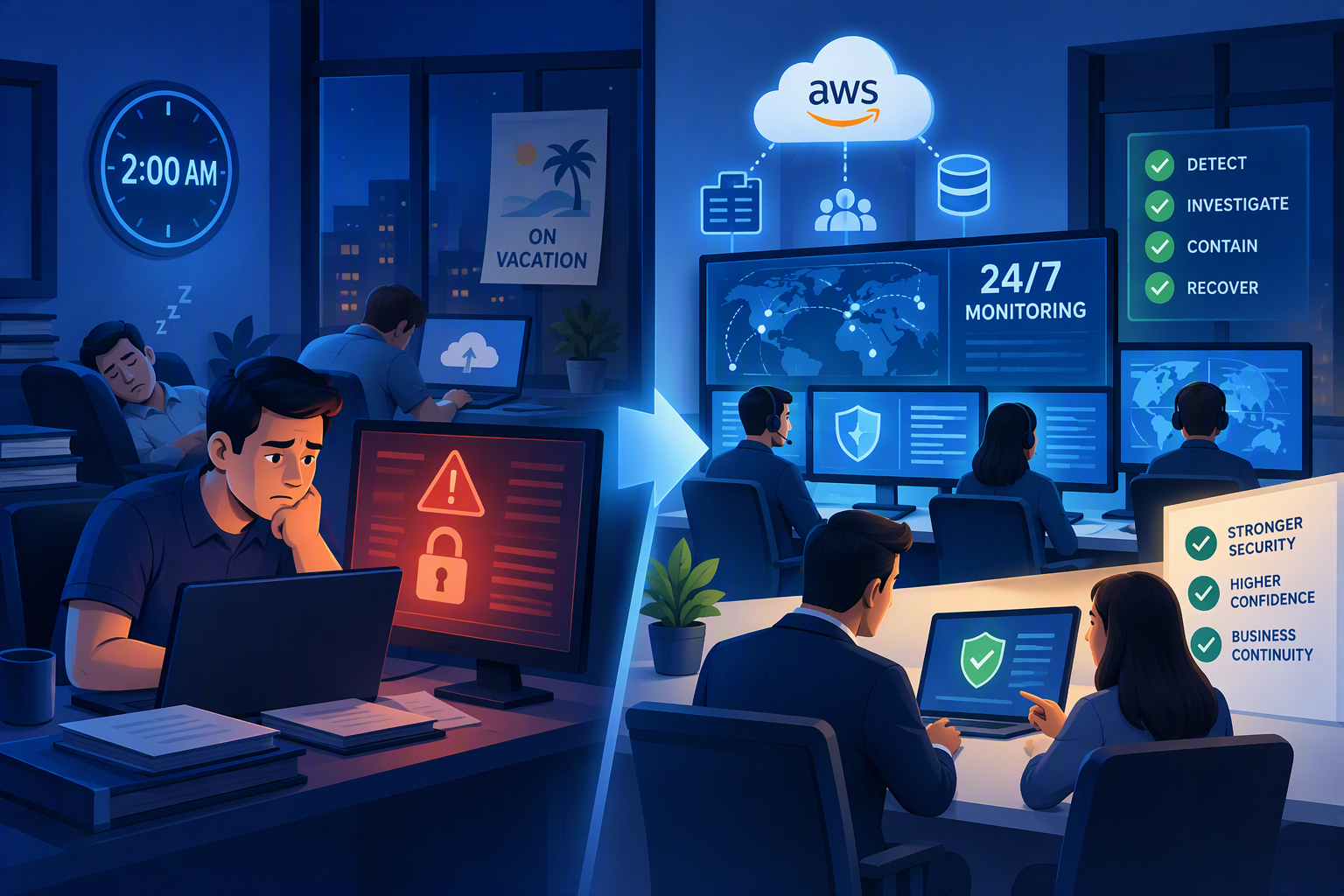
For months, security responsibilities were handled internally alongside infrastructure management, user support, and cloud administration. Then one night at 2:00 a.m., a ransomware-related alert appeared in the company's monitoring platform. The IT manager was on vacation, one administrator was asleep, and the remaining team member was focused on a major cloud migration project scheduled for the next morning.
The alert turned out to be a legitimate threat. While the team eventually responded, several critical hours passed before proper investigation and containment began. The incident exposed a hard truth: having security tools is not the same as having a security operations capability.
After reviewing the event, leadership evaluated multiple options. Hiring additional security specialists would improve coverage but significantly increase costs and recruitment challenges. Instead, the company adopted a hybrid model. Internal staff maintained ownership of security strategy, business context, and technology decisions, while a managed security services provider (MSSP) delivered 24/7 monitoring, threat investigation, incident response support, and compliance reporting.
Six months later, another high-priority security event occurred during a holiday weekend. This time, the MSSP immediately investigated the alert, escalated validated findings, and provided recommended containment actions. Internal leadership was informed quickly, business disruption was minimized, and the company gained confidence that security operations no longer depended on a single employee being available at the right moment.
This scenario reflects the challenge many SMBs face when comparing MSSP vs in-house security. The question is not simply who owns the tools. It is who can reliably detect, investigate, and respond when a real incident occurs.
Why This Matters
Cybersecurity failures rarely happen during convenient business hours. Organizations today must defend cloud environments, endpoints, identities, applications, and customer data continuously. As companies grow, security demands often outpace the capacity of small IT teams.
Choosing the right operating model affects:
- Business continuity by ensuring threats are detected and addressed before they escalate into outages or data loss.
- Risk reduction through access to the skills, processes, and monitoring coverage required to identify emerging threats.
- Regulatory compliance by supporting frameworks such as SOC 2, HIPAA, PCI DSS, CMMC, and other industry requirements.
- Operational efficiency by allowing internal teams to focus on strategic initiatives rather than constantly reviewing alerts.
- Cost predictability through a realistic understanding of staffing, tooling, training, coverage, and response requirements.
- Leadership confidence because roles, responsibilities, and escalation paths are clearly defined before an incident occurs.
Ultimately, the MSSP vs in-house security decision is not about purchasing technology. It is about ensuring the organization can respond effectively when security becomes a business-critical event rather than an IT problem.
Frequently Asked Questions (FAQ)
1. What is the main difference between an MSSP and an in-house security team?
An in-house security team consists of employees who manage security operations, policies, tools, and incident response internally. An MSSP provides outsourced security expertise and operational capabilities under a service agreement, often including 24/7 monitoring and response support.
2. Is an MSSP cheaper than hiring internal security staff?
In many cases, yes. An MSSP can provide access to multiple security specialists, monitoring platforms, and established processes for less than the cost of recruiting and retaining a full internal security operations team. However, the true comparison should consider overall risk reduction and service quality, not just monthly cost.
3. When should a company build an in-house security team?
Organizations with large security budgets, highly specialized environments, strict operational requirements, or sensitive intellectual property often benefit from dedicated internal security personnel who possess deep knowledge of the business and its systems.
4. What is the biggest advantage of using an MSSP?
The most significant advantage is continuous coverage. MSSPs can provide around-the-clock monitoring, threat investigation, and access to specialized expertise that many SMBs would struggle to build internally.
5. Is a hybrid security model better than choosing one approach?
For many mid-sized and growth-stage organizations, yes. A hybrid model combines internal business knowledge and strategic oversight with the monitoring, expertise, and operational scale of an MSSP. This often delivers a practical balance of control, coverage, and cost efficiency.

Written by Alexander Boychev
Business Executive & Digital Marketing Manager at Advanced Vision IT Ltd | Published on
Alexander advises insights on business development, strategic key account management, and digital marketing in the IT sector.