



Ransomware Recovery Steps That Protect Operations
A ransomware alert is not a routine IT ticket. The first ransomware recovery steps taken in the opening hour can determine whether an incident remains contained or becomes a prolonged business outage. For organizations that depend on cloud workloads, SaaS platforms, customer data, and always-on operations, recovery requires disciplined technical action, clear decision-making, and reliable evidence.
The goal is not simply to get systems running again. It is to restore trustworthy operations without reintroducing the attacker, corrupting data, or creating compliance exposure. That requires a recovery plan that connects incident response, backup validation, infrastructure rebuilding, identity security, and business continuity.
1. Contain the Incident Without Destroying Evidence
Immediately isolate affected endpoints, servers, and network segments. Remove compromised systems from the network, disable remote access paths that may be under attacker control, and pause automated synchronization jobs that could spread encrypted or corrupted files into cloud storage or backups.
Isolation does not always mean powering every device off. Shutting down a system can erase volatile memory evidence that may help determine how the attacker gained access and what they did. If an endpoint is actively encrypting shared data or communicating with known malicious infrastructure, disconnect it from the network. For critical servers, involve qualified incident response personnel before making irreversible changes whenever possible.
At the same time, preserve logs from firewalls, endpoint detection tools, identity providers, VPN platforms, cloud audit trails, email security platforms, and backup systems. This data supports containment, forensic investigation, insurance requirements, legal obligations, and future security improvements.
2. Activate an Incident Command Structure
Ransomware recovery breaks down when teams work in parallel without a shared operating picture. Assign an incident lead with authority to coordinate IT, security, leadership, legal, finance, communications, and affected business units. Establish a secure out-of-band communication channel in case email, chat, or collaboration platforms are unavailable or compromised.
The incident lead should maintain a simple, current record of affected systems, service owners, business impact, recovery status, and key decisions. This prevents duplicated work and makes it easier to prioritize systems based on operational dependency rather than who raises the loudest request.
For a growth-stage business, this structure may be compact: an IT leader, an executive sponsor, a security partner, and application owners. The principle is the same. Recovery needs clear ownership and an agreed process for approving high-risk actions, such as restoring production databases or rotating enterprise credentials.
3. Identify the Scope and Entry Point
Before restoring systems, establish what was affected and whether the threat actor still has access. Review endpoint telemetry, authentication logs, privileged account activity, cloud control-plane events, network connections, and recent changes to security configurations.
Common entry points include phishing, exposed remote desktop services, unpatched VPN appliances, stolen credentials, compromised third-party access, and vulnerable public-facing applications. Attackers may also move laterally through poorly segmented networks or use legitimate administrative tools to avoid detection.
Scope assessment should answer practical questions: Which identities were used? Were domain controllers, identity platforms, backup consoles, cloud management accounts, or hypervisors accessed? Was data exfiltrated before encryption? Which production services depend on the compromised environment?
Do not assume an encrypted workstation is the full incident. A visible ransom note often appears after days or weeks of reconnaissance, credential theft, privilege escalation, and data collection.
4. Protect Backup Copies Before You Restore
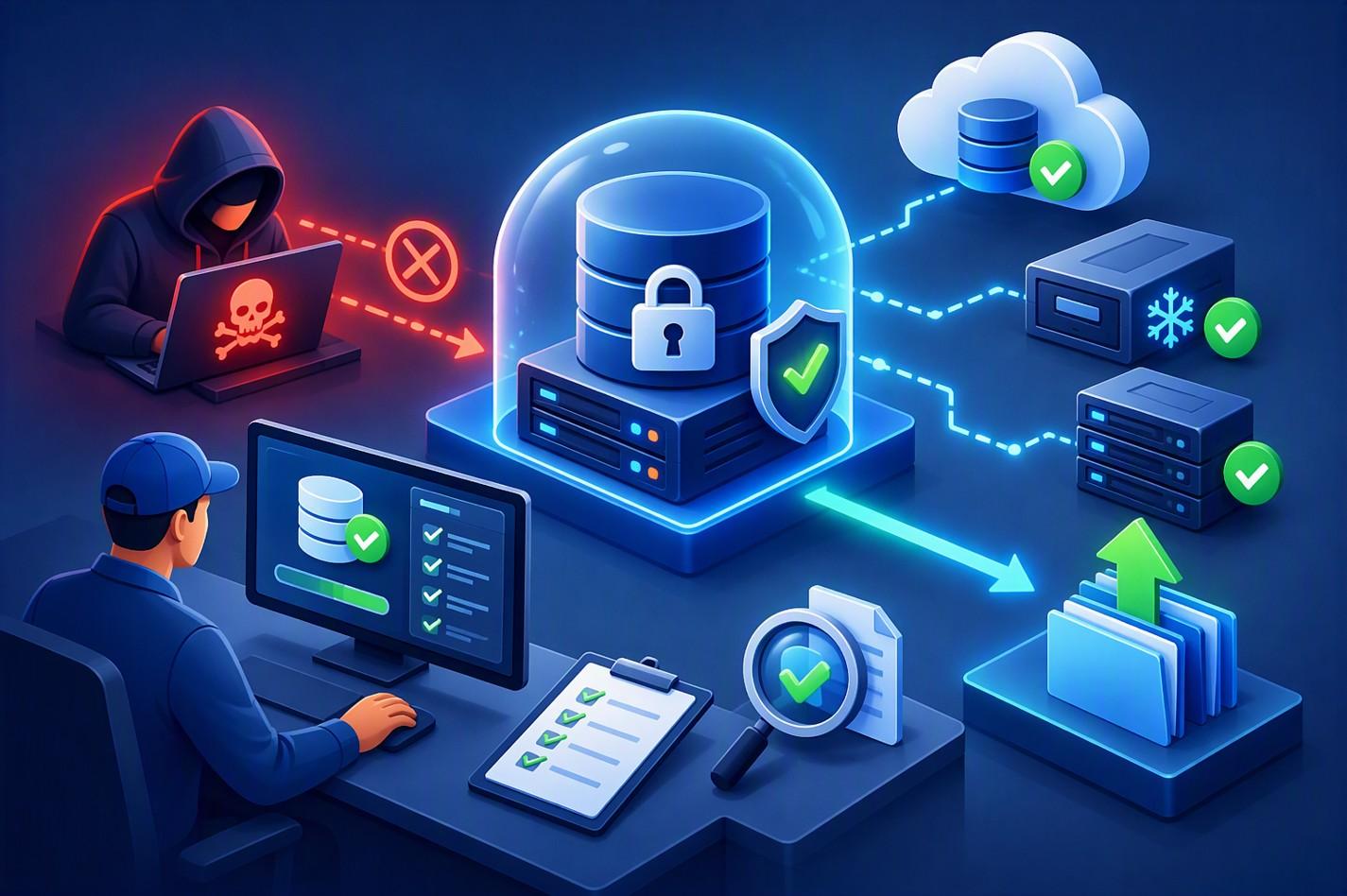
Backups are only useful if they are isolated, intact, and recoverable. Before initiating a restore, verify that backup repositories, retention policies, administrative accounts, and immutable storage settings have not been modified. Attackers increasingly target backup infrastructure early because they know a functioning recovery path reduces pressure to pay.
Use the 3-2-1-1-0 approach as a practical benchmark: maintain multiple copies of data, on different media, with one copy offsite, one copy offline or immutable, and zero unresolved errors after recovery testing. The exact architecture depends on workload requirements, but the operating principle is clear: backups should not share the same credentials, network exposure, or failure domain as production.
Validate recovery points before using them. Scan restored files where appropriate, check application consistency, and confirm that the backup predates the initial compromise. Restoring the newest backup can be risky if the attacker had access before encryption began.
5. Rebuild Trusted Systems, Not Just Encrypted Ones
A fast restore is not necessarily a safe restore. If a server, virtual machine, or endpoint was compromised, rebuilding it from a known-good image is generally safer than attempting to clean it manually. This is especially true for systems with administrative access, exposed services, or evidence of lateral movement.
For cloud and hybrid environments, infrastructure as code provides a major recovery advantage. Terraform, CloudFormation, Ansible, and hardened image pipelines can recreate networks, compute resources, security groups, monitoring agents, and baseline configuration consistently. Rather than treating recovery as a series of one-off fixes, teams can restore an environment that aligns with approved architecture standards.
Start with foundational services: identity, DNS, networking, security tooling, backup access, and monitoring. Then restore applications in dependency order. A customer portal cannot operate reliably if its identity provider, database, API gateway, or secrets management layer remains compromised or unavailable.
6. Reset Identity and Privileged Access
Identity is often the control plane of a ransomware event. Resetting passwords alone may not be enough if attackers have registered malicious multifactor authentication devices, created persistence accounts, issued API keys, or altered conditional access policies.
Prioritize privileged accounts, domain administrators, cloud root accounts, break-glass accounts, backup administrators, service accounts, and remote access users. Revoke active sessions and tokens, rotate secrets, regenerate access keys, review OAuth application consent, and remove unfamiliar devices or authentication methods.
Use this moment to enforce least privilege and multifactor authentication across administrative workflows. Where possible, move privileged activity into just-in-time access models and separate daily user accounts from administrator accounts. These controls reduce the chance that a single stolen credential can become an enterprise-wide compromise.
7. Restore in Business Priority Order
Technical recovery should follow business recovery objectives. Work with department leaders to identify the systems that support revenue, customer commitments, payroll, regulated data, operations, and internal communications. Recovery time objectives and recovery point objectives should guide the sequence.
A practical order might begin with core identity and security services, then customer-facing applications, transaction systems, communications platforms, and lower-priority internal tools. But it depends on the organization. A healthcare provider, manufacturer, professional services firm, and SaaS company will have different critical paths.
Before each application returns to production, test functionality, permissions, integrations, data integrity, and monitoring. Confirm that logs are flowing to a centralized platform such as New Relic or a security information and event management system. A restored service that cannot be observed is difficult to trust during an active recovery window.
8. Communicate With Precision
Employees, customers, partners, insurers, and regulators may need timely updates. Avoid speculation about attribution, data exposure, or restoration timelines before facts are confirmed. Communications should be accurate, approved, and appropriate for the audience.
Internally, give employees direct instructions: do not reconnect isolated devices, do not reset credentials through unapproved channels, and report suspicious emails or login prompts. Externally, focus on the operational impact, actions underway, and what stakeholders should expect next. Legal counsel and breach-response specialists should guide notification obligations, particularly when regulated or personal data may be involved.
Paying a ransom is a business, legal, and risk decision, not a recovery strategy. Payment does not guarantee decryption, complete data return, deletion of stolen information, or removal of attacker access. Organizations should consult legal counsel, cyber insurance representatives, and qualified incident responders before making decisions that may carry sanctions, regulatory, or contractual implications.
9. Validate Security Before Declaring Recovery Complete
Systems are not fully recovered when users can log in. They are recovered when the environment has been verified, monitored, and hardened against the path the attacker used.
Conduct targeted vulnerability scanning, review firewall and security group changes, confirm endpoint protection coverage, validate patch levels, and test backup restoration again. Review cloud audit logs, CI/CD credentials, code repositories, and third-party integrations for unauthorized changes. If the incident involved AWS, inspect IAM roles, access keys, CloudTrail events, S3 policies, security groups, and organization-level controls.
A post-incident review should produce specific improvements with owners and deadlines. That may include immutable backups, network segmentation, phishing-resistant MFA, endpoint detection and response, centralized observability, patch automation, tabletop exercises, and a Well-Architected Review. The value comes from closing the gaps that turned a single compromise into a business disruption.

Turn Recovery Into a Resilience Program
The strongest ransomware recovery capability is built before an attacker arrives. Advanced Vision IT helps organizations design recoverable cloud and hybrid environments, automate secure infrastructure, validate backups, improve observability, and align controls with operational and compliance requirements.
Recovery plans should be tested under realistic conditions, not left as documents that only work in theory. A scheduled restore test, an access-loss scenario, and an executive tabletop exercise reveal weaknesses while the business still has time to correct them. That preparation gives technical teams something more valuable than a checklist during an incident: a proven path back to trusted operations.
User Story: From Ransomware Alert to Trusted Recovery
Consider a fast-growing SaaS provider that relies on cloud infrastructure, customer databases, and 24/7 service availability. At 6:30 a.m., employees begin reporting inaccessible files and unusual login activity. Within minutes, security teams discover ransomware has encrypted several production systems and compromised privileged accounts.
Rather than rushing to restore from backups, the organization follows a structured recovery process. A dedicated incident lead is appointed, affected systems are isolated while forensic evidence is preserved, and backup repositories are verified before any restoration begins. Investigation reveals the attackers gained access through a compromised VPN account weeks earlier and had already accessed administrative systems.
Using infrastructure-as-code templates, the IT team rebuilds trusted environments from known-good configurations, rotates privileged credentials, removes unauthorized access, and restores critical business applications according to predefined recovery priorities. Throughout the incident, leadership communicates clearly with employees, customers, legal advisors, and insurers.
As a result, the company restores operations without paying a ransom, avoids reintroducing the attackers during recovery, maintains customer trust, and gains valuable security improvements that strengthen future resilience.
This scenario illustrates an important truth: successful ransomware recovery is not about how quickly systems come back online. It is about how confidently an organization can trust those systems after they return.
Why This Matters
Ransomware incidents have evolved beyond simple file encryption. Modern threat actors often spend days or weeks inside environments stealing credentials, escalating privileges, disabling backups, and exfiltrating sensitive data before launching encryption attacks.
Without a disciplined recovery process, organizations risk:
- Restoring infected systems and allowing attackers to regain access.
- Recovering from compromised backups that contain malicious changes.
- Missing evidence required for regulatory, legal, cyber insurance, or forensic investigations.
- Extending business downtime through uncoordinated recovery efforts.
- Exposing customers and stakeholders to additional operational and security risks.
- Creating compliance issues related to data protection and breach notification obligations.
A successful recovery strategy helps organizations:
- Restore systems safely and confidently.
- Preserve business continuity during crisis situations.
- Protect customer data and organizational reputation.
- Meet regulatory and contractual requirements.
- Validate that attackers have been fully removed.
- Turn a security incident into an opportunity for long-term resilience improvement.
The difference between a temporary disruption and a prolonged business crisis often depends on the decisions made during the first few hours of recovery.

Frequently Asked Questions (FAQ)
1. Should we immediately restore systems from backups after a ransomware attack?
Not necessarily. Before restoring, organizations should verify that backups are intact, uncompromised, and created before the attacker gained access. Restoring too quickly can reintroduce malware, persistence mechanisms, or corrupted data into the environment.
2. Is paying the ransom the fastest path to recovery?
Not always. Payment does not guarantee successful decryption, return of stolen data, or removal of attacker access. Organizations should evaluate legal, regulatory, insurance, and operational implications before considering payment and should treat it as a business decision rather than a recovery strategy.
3. Why is identity security so important during ransomware recovery?
Modern ransomware groups frequently compromise privileged accounts, cloud identities, service accounts, and multifactor authentication settings. If identities remain compromised, attackers may regain access even after systems have been restored.
4. What systems should be restored first?
Recovery should follow business priorities rather than technical convenience. Foundational services such as identity platforms, networking, DNS, security tooling, monitoring, and backup access are typically restored first, followed by applications that support critical business operations.
5. How do we know when recovery is truly complete?
Recovery is complete only after systems have been validated, monitored, and secured against the original attack path. Organizations should confirm patch levels, review security configurations, validate access controls, test backups, and conduct a post-incident review before declaring the incident closed.

Written by Yavor Y. Zlatev
CEO & Founder at Advanced Vision IT Ltd | Published on
Yavor advises executive leadership teams on cybersecurity strategy, NIS2 compliance, and cloud operating models to build resilient IT environments.