



RTO vs RPO Planning for Business Continuity
A six-hour outage may be inconvenient for a marketing site and financially devastating for an order-processing platform. A missed hour of data may be tolerable for an internal reporting system but unacceptable for customer transactions. That distinction is the point of RTO vs RPO planning: recovery decisions should reflect the actual business impact of disruption, not a generic promise to restore everything quickly.
For growing businesses, recovery planning is often complicated by hybrid infrastructure, SaaS dependencies, cloud workloads, lean IT teams, and compliance expectations. A practical plan translates those realities into recovery targets that engineering teams can build, test, monitor, and fund.
What RTO and RPO Actually Measure
Recovery Time Objective, or RTO, is the maximum acceptable time a service can be unavailable after an incident. It answers: how long can this system be down before the business suffers unacceptable consequences?
Recovery Point Objective, or RPO, is the maximum acceptable amount of data loss measured in time. It answers: if the system must be restored, how far back can the recovered data be? An RPO of 15 minutes means the organization can tolerate losing up to 15 minutes of data created or changed before the failure.
The terms are related, but they solve different problems. RTO is about restoring availability. RPO is about preserving data currency. A workload may need a four-hour RTO but a 15-minute RPO, such as a customer portal whose data changes frequently but can operate from a temporary fallback process while recovery is underway.
Neither objective is a technical setting by itself. They are business requirements that drive architecture, operating procedures, vendor commitments, backup schedules, monitoring, and incident response.
Why RTO vs RPO Planning Cannot Be One-Size-Fits-All
It is tempting to assign the same targets to every application. That approach creates unnecessary cost for lower-priority systems and leaves critical workflows underprotected. A file archive, an employee training portal, a production database, and an identity provider do not carry the same operational risk.
Start with business impact, not infrastructure labels. Ask what fails when a service is unavailable, who is affected, whether work can continue manually, how quickly revenue or customer trust is affected, and whether the outage creates a contractual or regulatory issue. The resulting answers create a defensible basis for recovery tiers.
For example, a business may decide that its e-commerce checkout and payment services require an RTO of one hour and an RPO of five minutes. Its internal analytics environment may accept a 24-hour RTO and RPO. The difference is not a sign of weaker IT discipline. It is a deliberate allocation of resilience investment where it matters most.
There are trade-offs. Tighter objectives usually require more frequent replication, higher-performing storage, standby environments, automation, and more rigorous testing. Those capabilities increase cloud consumption and operational complexity. The right targets are not the smallest possible numbers. They are the targets the business can justify, implement, and reliably meet.
Build Recovery Targets From Critical Business Services
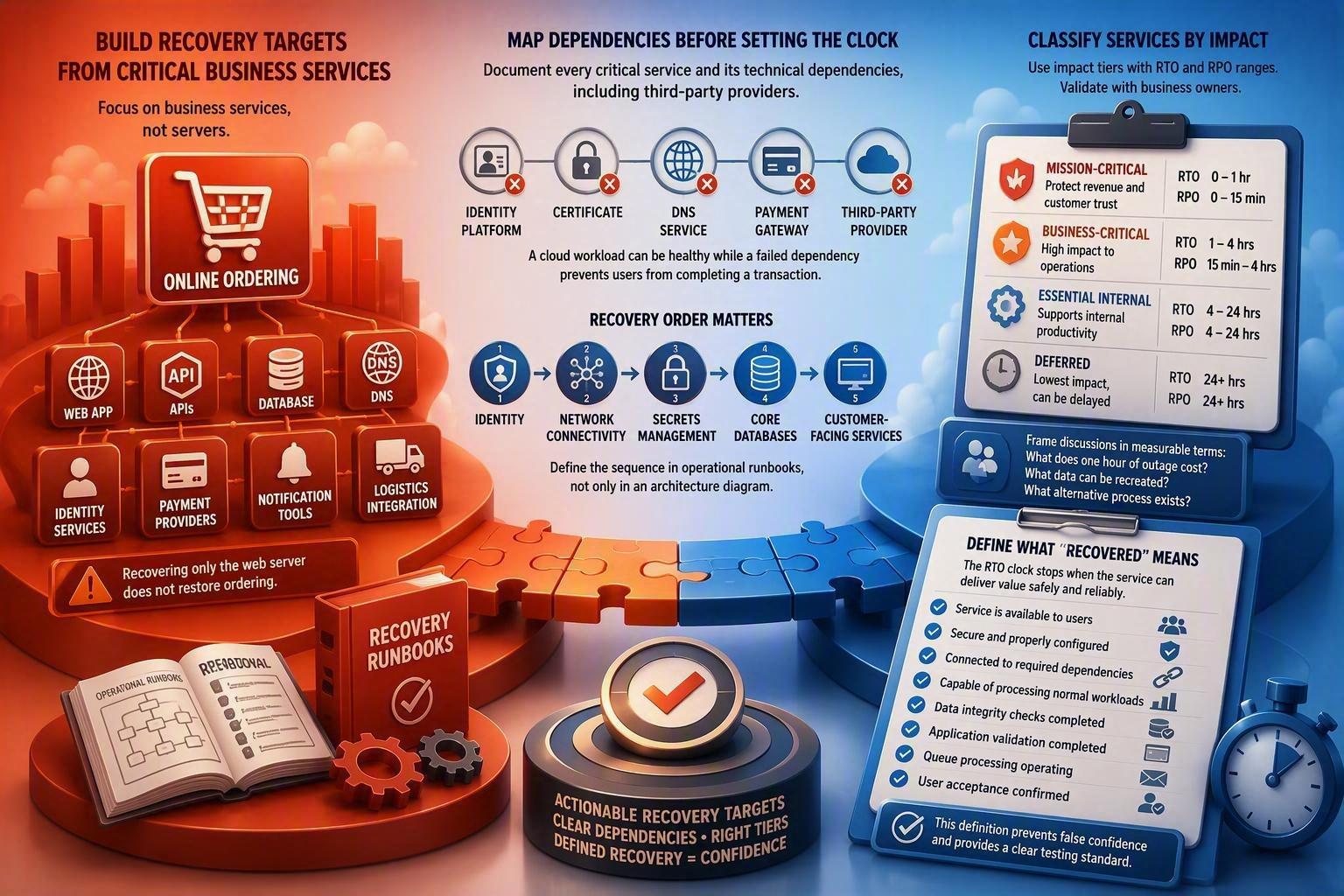
A strong recovery plan begins by identifying business services rather than making a list of servers. “Online ordering” is a business service. It may depend on a web application, APIs, a database, DNS, identity services, payment providers, notification tools, and a logistics integration. Recovering only the web server does not restore ordering.
Map Dependencies Before Setting the Clock
Document each critical service and its technical dependencies, including third-party providers. A cloud workload can be healthy while a failed identity platform, expired certificate, unavailable DNS service, or disconnected payment gateway prevents users from completing a transaction.
Dependency mapping also reveals recovery order. Identity, network connectivity, secrets management, and core databases often need restoration before customer-facing services can return. Define this sequence in operational runbooks, not only in an architecture diagram.
Classify Services by Impact
Many organizations use three or four recovery tiers. A practical model might identify mission-critical services, business-critical services, essential internal services, and deferred services. Each tier receives target RTO and RPO ranges, then individual services are validated with business owners.
Avoid treating department requests as final requirements. Stakeholders may ask for near-zero downtime because it feels safest, without understanding the cost and design implications. Technology leaders should frame the discussion in measurable terms: what does one hour of outage cost, what data can be recreated, and what alternative process exists during recovery?
Define What “Recovered” Means
An RTO clock should not stop when a virtual machine powers on. Recovery is complete when the service is available, secure, connected to required dependencies, and capable of processing normal workloads. For a database-backed application, that may include data integrity checks, application validation, queue processing, and user acceptance confirmation.
This definition prevents false confidence during an incident. It also gives teams a clear testing standard.
Match Architecture to the Recovery Requirement
The recovery design should meet the stated objectives without creating an unnecessarily expensive permanent footprint. In AWS environments, the appropriate approach may range from encrypted backups in a separate account or Region to pilot-light infrastructure, warm standby, or active-active deployment.
Backups are necessary, but they do not automatically deliver a low RTO. Restoring large databases, rebuilding infrastructure, applying configuration, validating applications, and redirecting traffic can take longer than expected. If the business requires rapid recovery, the plan may need infrastructure-as-code, pre-provisioned capacity, tested database replication, and automated DNS or traffic-routing procedures.
Terraform and Ansible can help rebuild consistent environments and reduce manual recovery steps. CI/CD pipelines can make application deployment repeatable. Observability platforms such as New Relic can provide the telemetry needed to confirm that a recovered service is performing correctly, not merely responding to a health check.
Security must remain part of the design. Recovery environments need the same identity controls, encryption, logging, network segmentation, patching standards, and secrets management as production. Restoring quickly into an insecure configuration replaces one operational problem with another.
Turn Recovery Objectives Into an Operable Plan
A recovery strategy fails if it exists only as a policy document. Teams need ownership, runbooks, access, communications procedures, and a schedule for proving the plan works.
A useful runbook identifies the incident commander, technical recovery owners, decision makers, vendor contacts, communications responsibilities, and escalation paths. It should also specify the evidence used to declare an incident, the conditions for failover, and the conditions for returning to the primary environment.
Measure the plan during tests. Record the actual time to detect the failure, decide on recovery, restore dependencies, deploy or fail over workloads, validate data, and reopen the service. Compare those results against the RTO. Verify the most recent recoverable data point against the RPO.
Tabletop exercises are valuable for exposing unclear responsibilities, but they are not enough. Perform controlled restore tests and failover exercises on the systems that matter most. Test realistic failure modes: accidental deletion, ransomware, application deployment errors, database corruption, regional disruption, and a critical SaaS provider outage. Each scenario may expose a different gap.
Common Gaps That Put Recovery Targets at Risk
The most common issue is confusing backup completion with recoverability. A backup job can report success while permissions, encryption keys, retention settings, dependency versions, or restoration procedures prevent timely recovery. Restore testing is the only meaningful proof.
Another gap is relying on undocumented tribal knowledge. If one engineer knows the sequence for restoring a production environment, the organization has a key-person risk. Capture the process, automate repeatable steps, and ensure authorized team members can access the necessary accounts and credentials during an emergency.
Finally, recovery targets can become stale. A system that was once internal-only may become customer-facing. Data volumes grow, integrations multiply, and compliance obligations change. Review RTO and RPO targets after major migrations, acquisitions, application releases, regulatory changes, and material shifts in business operations.

Make Recovery Planning a Managed Capability
RTO and RPO should be visible operational commitments, not values buried in a continuity plan. Track backup success, replication lag, recovery test results, alert coverage, infrastructure drift, and unresolved resilience risks through regular service reviews.
For organizations modernizing AWS or hybrid environments, Advanced Vision IT can help connect business impact analysis to cloud architecture, automation, observability, and tested recovery operations. The goal is not to add complexity for its own sake. It is to make recovery predictable when the pressure is highest.
The best time to challenge a recovery target is before an outage turns an assumption into a deadline. Set objectives that match the business, test them under realistic conditions, and keep refining the plan as the environment changes.
User Story: When Recovery Targets Become Business Decisions
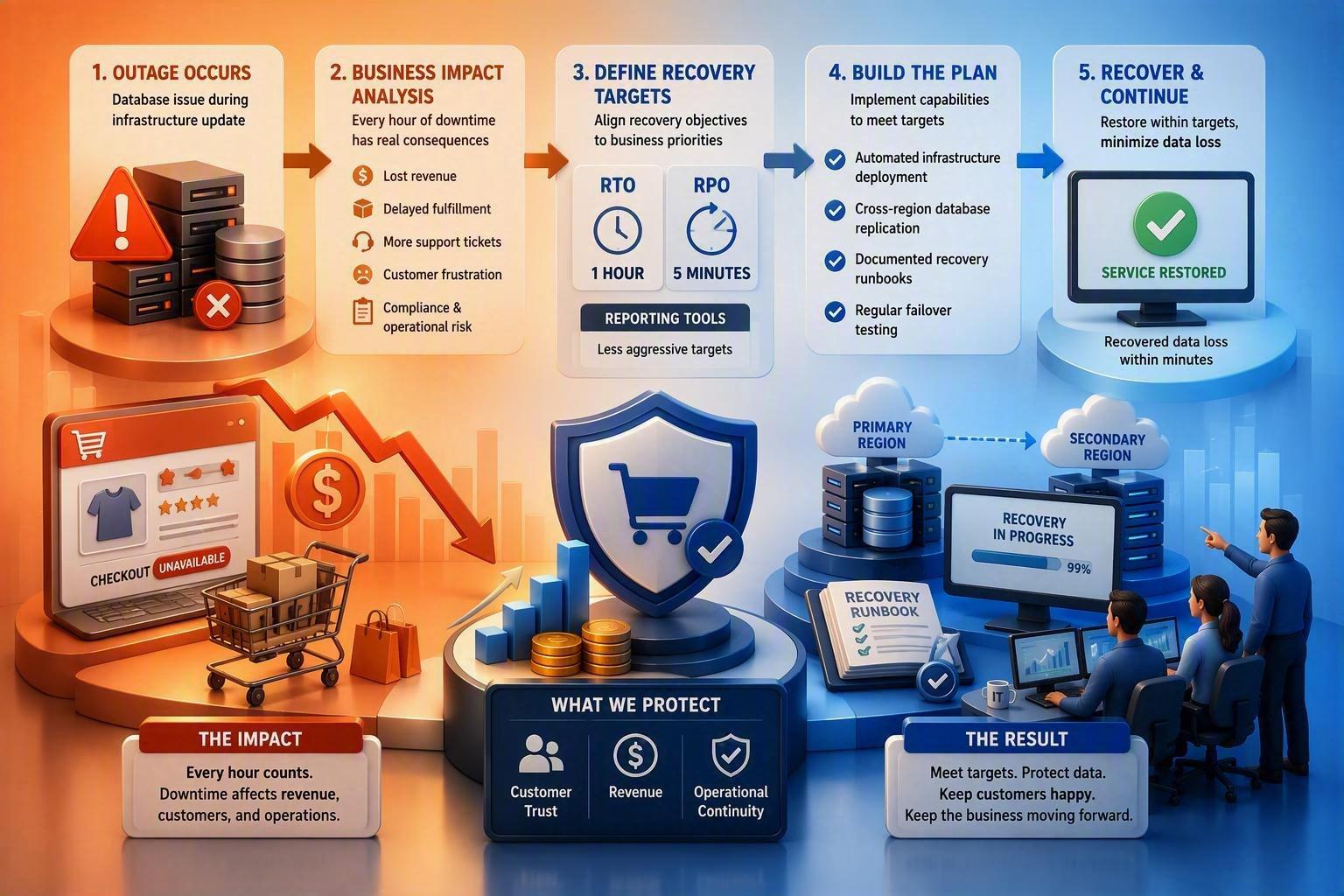
Consider a growing e-commerce retailer that processes hundreds of online orders each day through a cloud-based platform. During a routine infrastructure update, a database issue makes the ordering system unavailable.
Before defining recovery objectives, the IT team assumed that nightly backups were sufficient. After conducting a business impact analysis, they discovered that every hour of downtime resulted in lost revenue, delayed fulfillment, increased support requests, and growing customer frustration. They also learned that losing several hours of order data would require manual reconstruction of transactions, creating operational risk and potential compliance concerns.
As a result, the company established a one-hour RTO and a five-minute RPO for its checkout and payment systems while assigning less aggressive recovery targets to internal reporting tools. To achieve those objectives, the organization implemented automated infrastructure deployment, cross-region database replication, documented recovery runbooks, and regular failover testing.
Several months later, a service outage affected a critical component of the ordering platform. Because recovery procedures had already been designed around clearly defined RTO and RPO targets, the team restored service within the required timeframe and recovered all but minutes of transactional data. What could have become a prolonged business disruption was reduced to a manageable operational incident.
The lesson was simple: recovery objectives were not just technical metrics. They were business decisions that directly protected revenue, customer trust, and operational continuity.
Why This Matters
Organizations often invest heavily in backups, cloud services, and security controls but never define how quickly systems must recover or how much data loss is acceptable. Without clear RTO and RPO objectives, recovery efforts can become inconsistent, expensive, and misaligned with business priorities.
Effective RTO vs RPO planning helps organizations:
- Minimize revenue loss during outages.
- Protect customer experience and brand reputation.
- Meet contractual and regulatory obligations.
- Prioritize resilience investments where they deliver the most value.
- Create realistic recovery expectations across business and IT teams.
- Reduce incident response uncertainty through tested procedures.
- Align disaster recovery architecture with actual business risk.
Ultimately, recovery planning is not about achieving the lowest possible recovery numbers. It is about understanding which systems matter most, determining what level of disruption the business can tolerate, and designing recovery capabilities that can be reliably delivered when an incident occurs.
FAQ
1. What is the difference between RTO and RPO?
RTO (Recovery Time Objective) defines the maximum acceptable downtime for a service after an incident. RPO (Recovery Point Objective) defines the maximum acceptable amount of data loss measured in time. RTO focuses on restoring availability, while RPO focuses on preserving data.
2. How do I determine the right RTO and RPO for my business?
Start with a business impact analysis rather than a technical assessment. Evaluate factors such as revenue impact, customer experience, operational disruption, regulatory requirements, and available workarounds. These considerations help establish realistic and justifiable recovery targets.
3. Does having backups automatically guarantee a low RTO?
No. Backups help support recovery but do not guarantee fast restoration. Rebuilding infrastructure, restoring databases, validating applications, and reconnecting dependencies can take significant time. Organizations requiring rapid recovery often need automation, replication, and preconfigured recovery environments.
4. How often should RTO and RPO targets be reviewed?
Recovery objectives should be reviewed whenever significant business or technical changes occur, including cloud migrations, application releases, acquisitions, regulatory updates, major architecture changes, or shifts in customer-facing services. At minimum, an annual review is recommended.
5. What are the most common mistakes in disaster recovery planning?
Common mistakes include assuming backups equal recoverability, failing to document recovery procedures, overlooking third-party dependencies, relying on a single expert's knowledge, and not performing regular recovery testing. Organizations frequently discover these gaps only during a real incident, when remediation becomes much more difficult and costly.

Written by Alexander Boychev
Business Executive & Digital Marketing Manager at Advanced Vision IT Ltd | Published on
Alexander advises insights on business development, strategic key account management, and digital marketing in the IT sector.