



When to Use Managed Detection for Better Coverage
A critical alert at 2:13 a.m. is only useful if someone can validate it, understand the affected systems, and act before an attacker moves further. That is the practical question behind when to use managed detection. Most organizations do not struggle to collect security alerts. They struggle to investigate and respond to the right ones consistently, across cloud accounts, endpoints, identities, and business applications.
Managed detection gives internal IT and security teams access to ongoing threat monitoring, investigation, and guided or active response from experienced security practitioners. It is most valuable when the risk, complexity, or required response speed has outgrown what an in-house team can reliably support.
What managed detection actually solves
Managed detection is often discussed alongside managed detection and response, or MDR. While services vary by provider, the core purpose is consistent: turn raw telemetry into security decisions and actions.
Your existing tools may already generate signals from endpoint protection, firewall logs, AWS CloudTrail, identity platforms, email security, vulnerability scanners, and SIEM or observability platforms. The gap appears when those signals need correlation. A suspicious login may look minor on its own. Combined with unusual API activity, privilege changes, data access, and endpoint behavior, it may indicate account compromise.
A managed detection service brings people, process, and technology together to investigate that sequence. The service should prioritize credible threats, document findings, help contain incidents, and continuously improve detection coverage. For a lean IT organization, this reduces alert fatigue without requiring a full internal security operations center.
It is not a substitute for sound architecture, patch management, identity controls, backups, or employee awareness. It is the operational layer that helps identify when those controls have failed, been bypassed, or need adjustment.
When to use managed detection
The right time to adopt managed detection is rarely after a major breach. By that point, the organization is already managing disruption, customer concerns, potential legal exposure, and recovery costs. The better trigger is an honest assessment of your current coverage.
Managed detection is usually justified when one or more of these conditions are true:
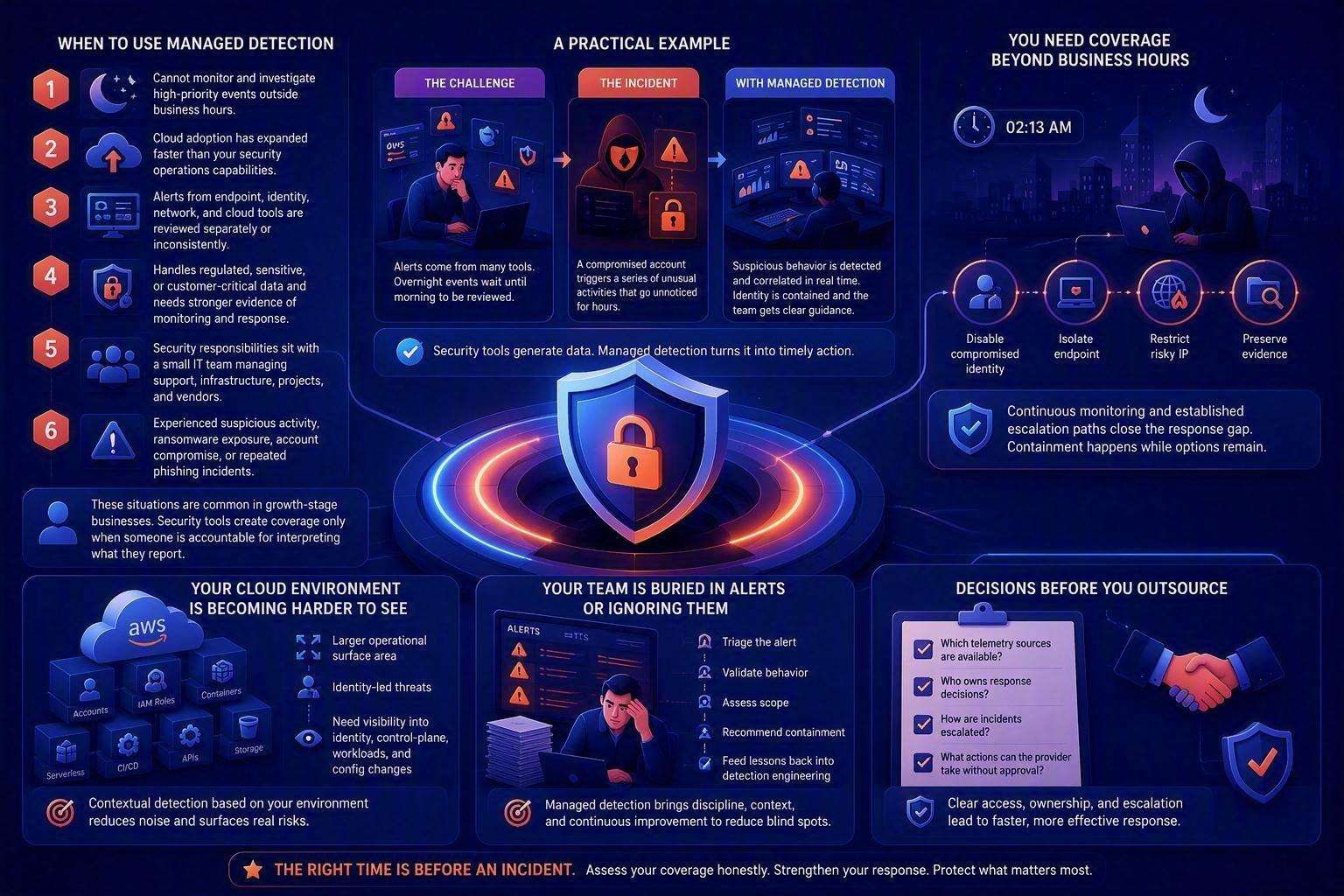
- Your team cannot monitor and investigate high-priority security events outside business hours.
- Cloud adoption has expanded faster than your security operations capabilities.
- Alerts from endpoint, identity, network, and cloud tools are reviewed in separate consoles or inconsistently.
- Your organization handles regulated, sensitive, or customer-critical data and needs stronger evidence of monitoring and response.
- Security responsibilities sit with a small IT team that is also responsible for support, infrastructure, projects, and vendor management.
- You have experienced suspicious activity, ransomware exposure, account compromise, or repeated phishing incidents that revealed response gaps.
These situations are common in growth-stage businesses. A company may have solid endpoint protection and MFA, yet still lack a clear owner for reviewing identity anomalies, AWS configuration changes, or unusual data movement. Security tools create coverage only when someone is accountable for interpreting what they report.
A practical example
Consider a growing software company with a small internal IT team responsible for infrastructure, user support, cloud operations, and vendor management. As its AWS environment expanded across multiple accounts and applications, security alerts began coming from endpoint protection, identity systems, cloud logs, and third-party services. Most alerts were reviewed during business hours, while overnight events often waited until the next morning.
One weekend, a compromised user account triggered a series of unusual activities, including repeated authentication attempts, privilege changes, and access to sensitive cloud resources. Each event appeared low-risk when viewed separately. Together, they indicated an active account compromise. Because no one was actively monitoring the environment at the time, the activity continued for several hours before being identified.
After adopting a managed detection service, the organization gained continuous monitoring and investigation support. Similar suspicious behavior was later detected and correlated in real time. The incident was escalated immediately, the affected identity was contained, and the internal team received clear guidance on next steps. Instead of spending hours piecing together events from multiple systems, they could focus on remediation and business continuity.
This scenario illustrates a common challenge: security tools may already be generating the necessary data, but effective protection depends on having the visibility, expertise, and operational coverage to turn that data into timely action.
You need coverage beyond business hours
Attackers do not align their activity with your support schedule. They often work during weekends, holidays, and low-activity windows because suspicious behavior is less likely to be noticed immediately.
If a high-confidence alert arrives overnight and your process is to review it the next morning, there is a meaningful response gap. Managed detection can provide continuous monitoring and established escalation paths, so an incident receives attention while containment options are still available. That might mean disabling a compromised identity, isolating an endpoint, restricting a risky IP address, or preserving evidence before systems are changed.
Not every company requires a fully staffed internal 24/7 SOC. But any company with customer-facing systems, sensitive data, cloud workloads, or material downtime exposure should decide whether its current after-hours model is acceptable.
Your cloud environment is becoming harder to see
AWS makes it possible to deploy infrastructure quickly. That speed is valuable, but it creates a larger operational surface area: new accounts, IAM roles, containers, serverless functions, CI/CD pipelines, APIs, storage buckets, and third-party integrations.
Cloud threats are frequently identity-led rather than perimeter-led. A compromised credential, overly permissive role, exposed access key, or risky deployment change can create impact without triggering traditional network security controls. Effective detection needs visibility into identity events, control-plane activity, workload behavior, and configuration changes.
This is a strong case for a provider that understands cloud-native operations. Detection rules should reflect how your AWS environment is designed, which workloads are critical, which administrative actions are expected, and which ones require immediate review. Generic alerting creates noise. Contextual detection creates useful response priorities.
Your team is buried in alerts or ignoring them
Alert volume is not proof of security maturity. In many organizations, it is evidence that the tools are poorly tuned or that nobody has enough time to investigate them.
When teams repeatedly close alerts without context, postpone review, or disable noisy detections, the organization is accepting blind spots. Managed detection can help establish a more disciplined workflow: triage the alert, validate the behavior, assess scope, recommend containment, and feed lessons back into detection engineering.
The trade-off is that a provider needs enough access and environmental knowledge to do this well. Before outsourcing, define which telemetry sources are available, who owns response decisions, how incidents are escalated, and what actions the provider may take without waiting for approval. Faster response depends on those decisions being settled before an event occurs.
Managed detection versus more security tools
A common mistake is buying another platform when the real problem is operational capacity. Adding a SIEM, EDR, cloud security posture tool, or threat intelligence feed can improve visibility, but it also adds another source of data to manage.
Managed detection may be the better next step when your current tools are underused. A capable provider can integrate with the technology you have, identify gaps, improve logging, and make sure alerts translate into repeatable action. In some cases, new tooling will still be needed. In others, the best return comes from properly operating the controls already in place.
This is why vendor-neutral guidance matters. The goal should not be to force every environment into a single security stack. It should be to build coverage around actual risk, architecture, compliance obligations, and budget.
What to expect from a capable provider
Not all managed detection services offer the same depth. Some primarily forward alerts. Others provide active investigation, threat hunting, response support, reporting, and detection tuning. For an organization that depends on cloud infrastructure, the distinction matters.
Look for a service that begins with onboarding and asset context, not just agent deployment. The provider should understand your AWS accounts, critical applications, identity model, endpoint fleet, network boundaries, and incident response contacts. They should also explain what is monitored, what is excluded, and how quickly critical events are handled.
Clear communication is equally important. Security findings should identify the business impact, affected systems, evidence, containment recommendation, and next action. A monthly report full of alert counts has limited value if it does not show risk trends, coverage gaps, and improvements made.
For organizations with compliance requirements, managed detection can also support more defensible operations. Centralized logs, documented investigations, response records, and regular reviews provide evidence that security monitoring is not merely a written policy. They do not guarantee compliance on their own, but they strengthen an overall control environment.
Why this matters
Cyber incidents rarely become costly because an alert was missed entirely. More often, they become costly because the right signals were not investigated quickly enough. Modern attacks frequently move across identities, endpoints, cloud workloads, and business applications, making it difficult for overstretched teams to see the full picture before damage occurs.
Managed detection helps close that gap by providing continuous oversight, threat correlation, and incident response support. For organizations operating in AWS and other cloud environments, this means reducing the time between detection and action, improving visibility into high-risk activity, and strengthening the organization's ability to contain threats before they disrupt operations.
The business impact extends beyond security. Faster response can help minimize downtime, protect customer trust, support compliance requirements, and reduce the operational burden on internal teams. As cloud adoption accelerates and attack surfaces expand, the ability to investigate and respond consistently becomes just as important as the preventive controls already in place.
Ultimately, managed detection is not about generating more alerts. It is about ensuring that the alerts that matter receive the attention they require, when they require it most.
Build managed detection into an operating model
The most effective approach is not to hand security over and forget about it. Treat managed detection as an extension of your operating model.
Start by identifying your crown-jewel systems: customer data, production AWS workloads, source code repositories, finance platforms, privileged identities, and systems that would materially disrupt operations if compromised. Then confirm that the relevant logs are collected and that detection priorities reflect those assets.
Next, establish incident roles. Your provider may investigate and recommend containment, but internal leaders still need to decide who can approve downtime, communicate with customers, engage legal counsel, or restore a service from backup. Tabletop exercises are useful here because they expose unclear ownership before a real incident forces fast decisions.
Finally, use the service to improve the broader environment. Repeated alerts about risky IAM activity may signal a need for stronger least-privilege controls. Endpoint incidents may reveal patching gaps. Suspicious deployment behavior may justify tighter CI/CD permissions, infrastructure-as-code reviews, or more complete observability. Detection should create feedback that makes the environment more resilient over time.
Advanced Vision IT approaches managed security as part of the same operational picture as cloud architecture, DevOps automation, observability, and compliance. That broader view helps businesses avoid fragmented tools and disconnected response processes.
The decision is not whether every organization needs an oversized security operation. It is whether your current team can see, investigate, and contain the threats most likely to affect your business. If the answer is uncertain, managed detection is worth evaluating before uncertainty becomes an incident.
Frequently Asked Questions
1. What is managed detection, and how does it help organizations?
Managed detection is a security service that continuously monitors, investigates, and responds to potential threats across environments such as cloud platforms, endpoints, identities, and business applications. It helps organizations turn large volumes of security alerts into actionable insights and enables faster, more effective incident response.
2. When should a business consider using managed detection?
Organizations should consider managed detection when they lack 24/7 monitoring capabilities, struggle to investigate alerts consistently, have growing cloud environments, manage sensitive data, or have a small IT team balancing multiple responsibilities. It is particularly valuable when security risks and operational complexity exceed the capacity of internal resources.
3. Does managed detection replace existing security tools?
No. Managed detection complements existing tools such as endpoint protection, firewalls, SIEM platforms, and cloud security solutions. Rather than replacing these technologies, it helps organizations maximize their value by correlating alerts, prioritizing threats, and supporting effective response actions.
4. Why is managed detection important for cloud environments like AWS?
Cloud environments introduce new risks related to identities, permissions, APIs, workloads, and configuration changes. Managed detection provides visibility into these activities and helps identify suspicious behavior, such as compromised credentials, excessive privileges, or unauthorized changes, before they result in significant business impact.
5. What should organizations look for in a managed detection provider?
A strong managed detection provider should offer more than alert forwarding. Look for services that include threat investigation, incident response support, detection tuning, threat hunting, and clear communication. The provider should also understand your environment, define escalation procedures, and provide meaningful reporting that highlights risks, trends, and improvements.

Written by Alexander Boychev
Business Executive & Digital Marketing Manager at Advanced Vision IT Ltd | Published on
Alexander advises insights on business development, strategic key account management, and digital marketing in the IT sector.