



DevSecOps Adoption Without Slowing Delivery
A critical vulnerability found days before a release can turn a planned launch into an expensive business decision. Engineering loses momentum, operations absorbs the disruption, and leadership is left asking why a preventable issue reached the finish line. DevSecOps adoption addresses that failure point by putting practical security controls into the same workflows teams already use to build, test, deploy, and operate software.
For growing organizations, this is not a mandate to buy every security tool on the market or turn every developer into a security specialist. It is an operating model: clear security ownership, automated checks where they add value, and reliable feedback before small defects become production incidents or compliance problems.
Why DevSecOps Adoption Matters to Growing Teams
Traditional security models often place review at the end of delivery. Developers complete the work, a security team reviews it, findings arrive late, and remediation becomes a rushed negotiation between release timing and risk. That process may be manageable for infrequent releases. It breaks down when teams deploy frequently across AWS accounts, containers, APIs, third-party services, and infrastructure defined as code.
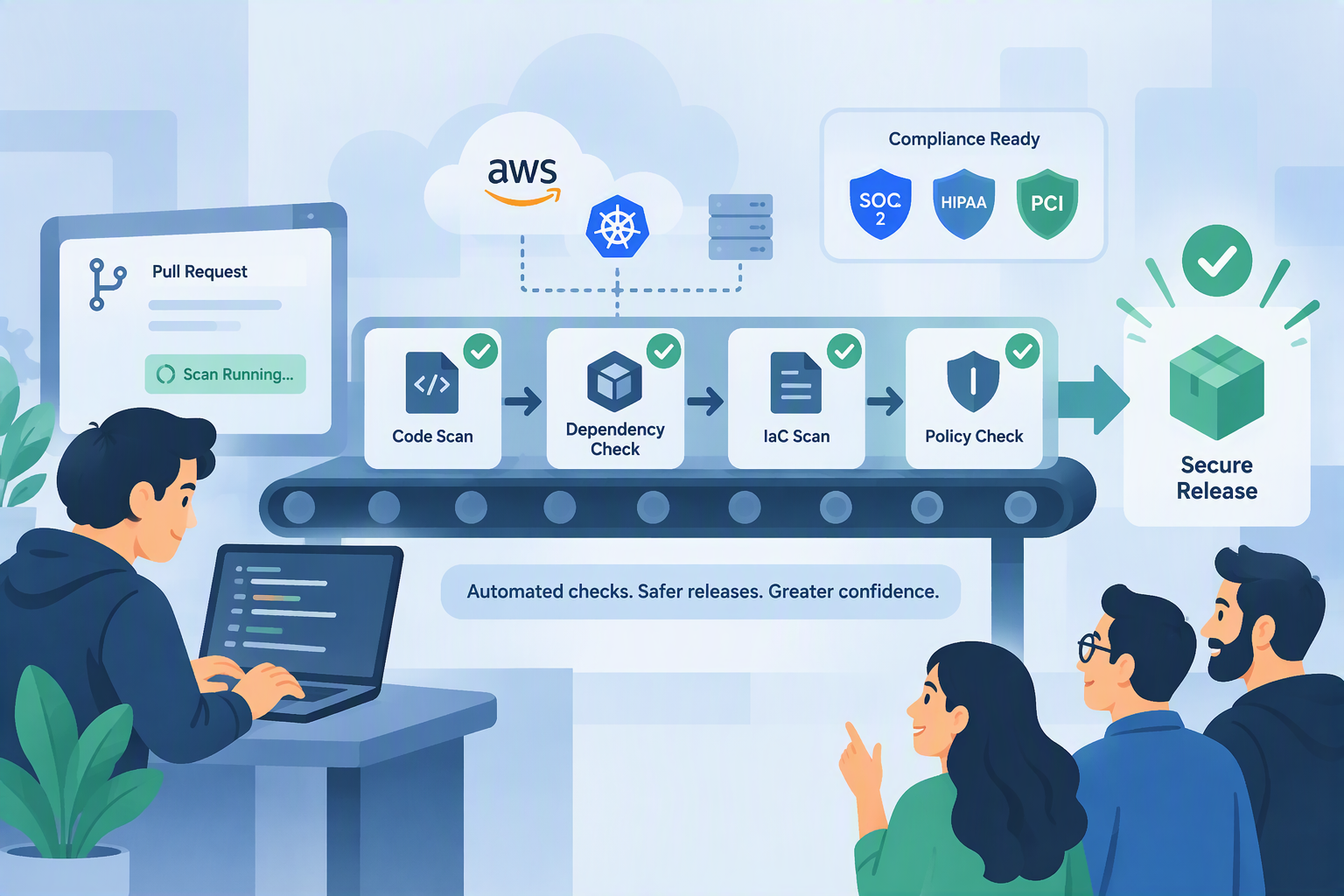
A well-executed DevSecOps model moves the highest-value checks earlier. Source code is scanned before merge. Dependencies are reviewed for known vulnerabilities. Terraform, CloudFormation, or other infrastructure-as-code templates are checked for risky configuration before resources are created. Deployment pipelines validate the conditions that matter to the business.
The benefit is not simply fewer alerts. It is faster, better-informed decisions. Teams can identify a public storage bucket, an overly permissive IAM policy, a vulnerable package, or a hardcoded secret while the developer still has context. Fixing the issue at that point is usually cheaper than investigating it after deployment.
There is also a governance benefit. Organizations pursuing SOC 2, HIPAA, PCI DSS, or customer security reviews need evidence that security practices are repeatable. Manual processes can work at a small scale, but they create gaps when staff change, releases increase, or systems become more distributed. Automated controls and documented workflows make evidence collection more credible and less disruptive.
Start With Risk and Delivery Reality
The strongest DevSecOps programs are designed around actual systems and business exposure. A fintech platform handling payment data needs different guardrails than a B2B SaaS product processing limited customer profile information. A team running a single AWS account has different priorities than one managing a multi-account environment with Kubernetes, serverless workloads, and hybrid infrastructure.
Before selecting tools, establish a practical baseline. Identify where code is stored, how changes reach production, which cloud accounts and environments exist, where secrets are managed, and who has elevated access. Review logging coverage, backup and recovery practices, dependency management, network exposure, and incident response responsibilities.
This assessment should also expose delivery friction. If developers are already waiting days for pipeline feedback, adding several blocking scans will not build support for the program. If the team lacks a clear process to triage findings, a new scanner may only create a larger backlog. Security controls must be calibrated to risk, maturity, and the team’s ability to act.
Define a Minimum Viable Control Set
Early progress comes from a small number of controls that prevent common, high-impact failures. For many cloud-based teams, that includes secret detection in source repositories, software composition analysis for third-party dependencies, code scanning for major application flaws, and infrastructure-as-code checks for insecure cloud configurations.
The delivery pipeline should also enforce basic release hygiene: protected branches, peer review for meaningful changes, traceable build artifacts, and controlled production deployment permissions. In AWS environments, identity and access management deserves special attention. Broad administrator access, long-lived access keys, and unclear cross-account roles can undermine otherwise mature development practices.
Not every finding should block a release. High-confidence issues involving exposed credentials, critical vulnerabilities in an internet-facing service, or clear privilege escalation paths should receive immediate attention. Lower-severity findings may be tracked with an owner and remediation deadline. The key is to make the policy visible, consistent, and defensible.
Build Security Into the CI/CD Pipeline
CI/CD is where DevSecOps becomes operational rather than aspirational. Each stage should provide focused feedback and produce records that support troubleshooting, audit readiness, and continuous improvement.
At the commit and pull request stage, teams can scan for secrets, test code quality, and inspect dependencies. Fast checks belong here because developers need feedback in minutes, not hours. More intensive analysis can run after merge or on scheduled jobs, especially for large repositories.
During build and packaging, use trusted base images, generate a software bill of materials where appropriate, and scan container images or artifacts before promotion. A package that passes application tests may still contain an outdated library with a serious known vulnerability. The pipeline should identify that condition before the artifact becomes widely deployed.
Infrastructure deployment deserves equivalent treatment. Terraform plans and Ansible playbooks can be reviewed automatically for encryption settings, public network exposure, missing logging, weak security groups, and resource tagging requirements. This is one reason infrastructure as code is valuable beyond speed: it turns infrastructure changes into reviewable, testable, auditable work.
After deployment, security does not stop. Cloud configurations drift, new vulnerabilities are disclosed, permissions expand, and unusual behavior emerges over time. Centralized logs, cloud-native monitoring, endpoint protection, and observability platforms such as New Relic help teams detect problems in production and understand their operational impact. The goal is not to bury staff in telemetry. It is to connect alerts to services, owners, and a response process.
People and Ownership Determine Whether It Sticks
Technology can automate detection, but it cannot establish accountability. Developers should own the security quality of the code and configurations they create. Platform and DevOps teams should own secure, reusable delivery patterns. Security specialists should define standards, help prioritize risk, investigate complex findings, and improve controls based on what the organization learns.
This shared-responsibility model works best when security teams act as enablers rather than a final approval gate. Reusable pipeline templates, approved infrastructure modules, secure reference architectures, and short remediation guidance reduce the burden on engineering teams. A developer should not have to interpret a vague scanner warning alone or rebuild the same secure configuration for every project.
Leadership has a role as well. Teams need permission to spend time reducing security debt, not only shipping features. Metrics should reward meaningful improvement rather than raw alert volume. Useful measures include critical vulnerability remediation time, percentage of repositories covered by core scans, number of production changes using approved pipelines, mean time to detect and respond, and recurring causes of failed controls.
Common DevSecOps Adoption Mistakes
The most common mistake is treating DevSecOps as a tool procurement project. A new platform may improve visibility, but it will not fix undefined ownership, weak change management, or a pipeline nobody trusts. Start with workflows and risk decisions, then select tools that fit them.
Another mistake is attempting a full transformation in a single quarter. Broad rollout can create resistance if every team receives new policies, new scanners, and release-blocking rules at once. A pilot with one representative application or service allows the organization to tune thresholds, document exceptions, and prove value before scaling.
False positives are another practical concern. If developers repeatedly receive low-quality findings, they will learn to ignore them. Review alert quality, suppress validated noise carefully, and prioritize rules tied to real exposure. Suppression should be governed, time-bound where possible, and visible to the right stakeholders rather than becoming a way to hide risk.
Finally, avoid designing the program around a single environment. Many businesses operate hybrid systems, legacy applications, SaaS platforms, and multiple cloud services. DevSecOps should establish consistent principles across the estate while recognizing that implementation details will differ. A legacy application may need compensating controls and more monitoring before it can support the same pipeline gates as a modern containerized service.
A Practical Path to Scale
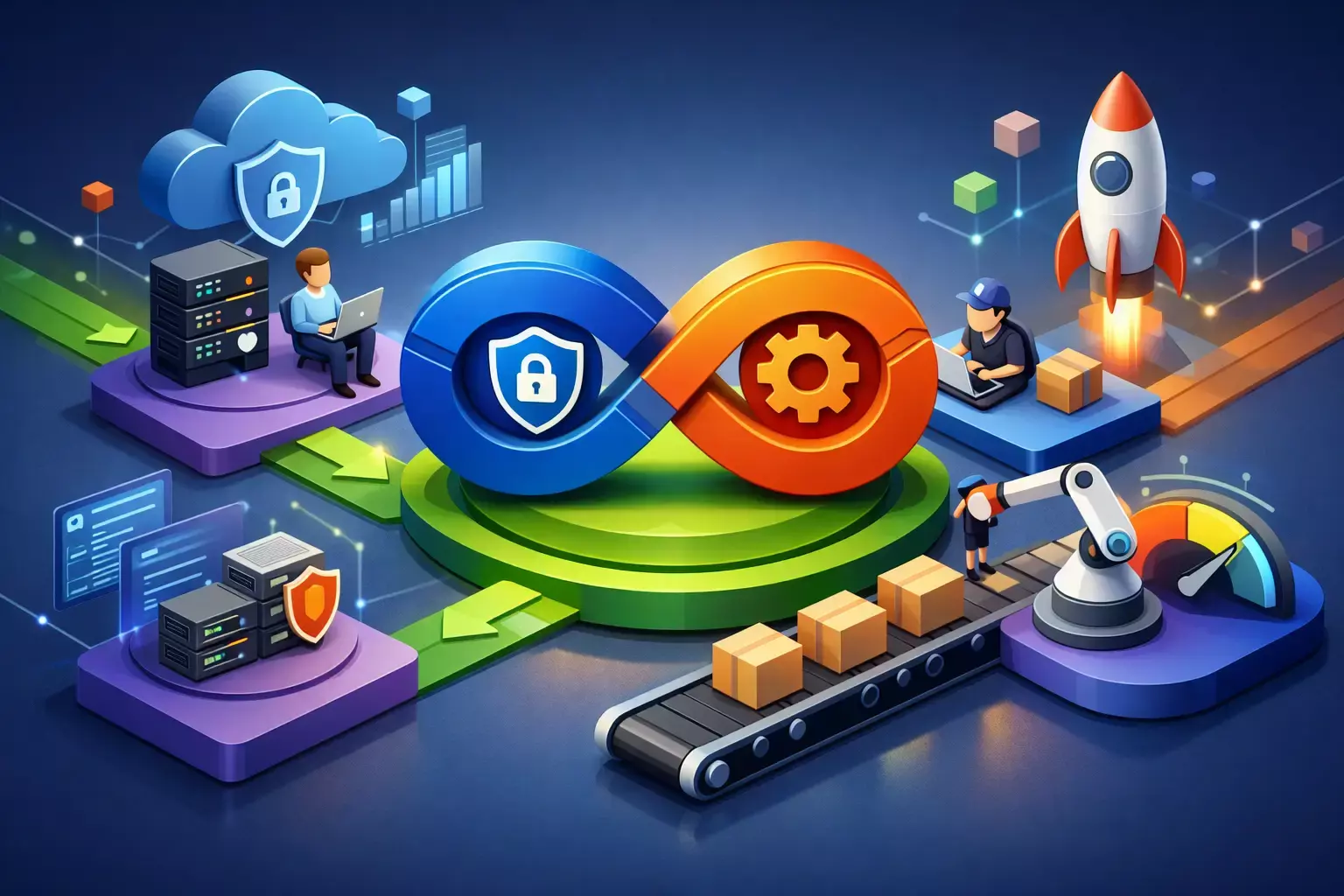
Begin by choosing one production workload that reflects the organization’s normal delivery process. Map its code, infrastructure, access, data flows, deployment pipeline, and monitoring. Add a small control set, establish clear severity rules, and measure how findings affect delivery. Then standardize what works into reusable templates and operating procedures.
As coverage expands, integrate DevSecOps with broader cloud governance: AWS account structure, centralized logging, backup standards, patching, incident response, vulnerability management, and compliance evidence. This is where a hands-on technology partner can help align cloud architecture, CI/CD automation, observability, and managed security operations instead of leaving separate vendors to solve disconnected portions of the problem.
The right pace depends on your application portfolio, regulatory obligations, internal skills, and release cadence. The next useful step is not a sweeping policy statement. It is a clear view of one delivery path, one set of material risks, and one improvement that makes secure delivery easier to repeat.
User Story: From Last-Minute Security Fire Drill to Predictable Releases
A growing SaaS company was preparing a major product release for a key customer. The development team had spent weeks building new features, QA testing was complete, and the launch date had already been communicated to customers.
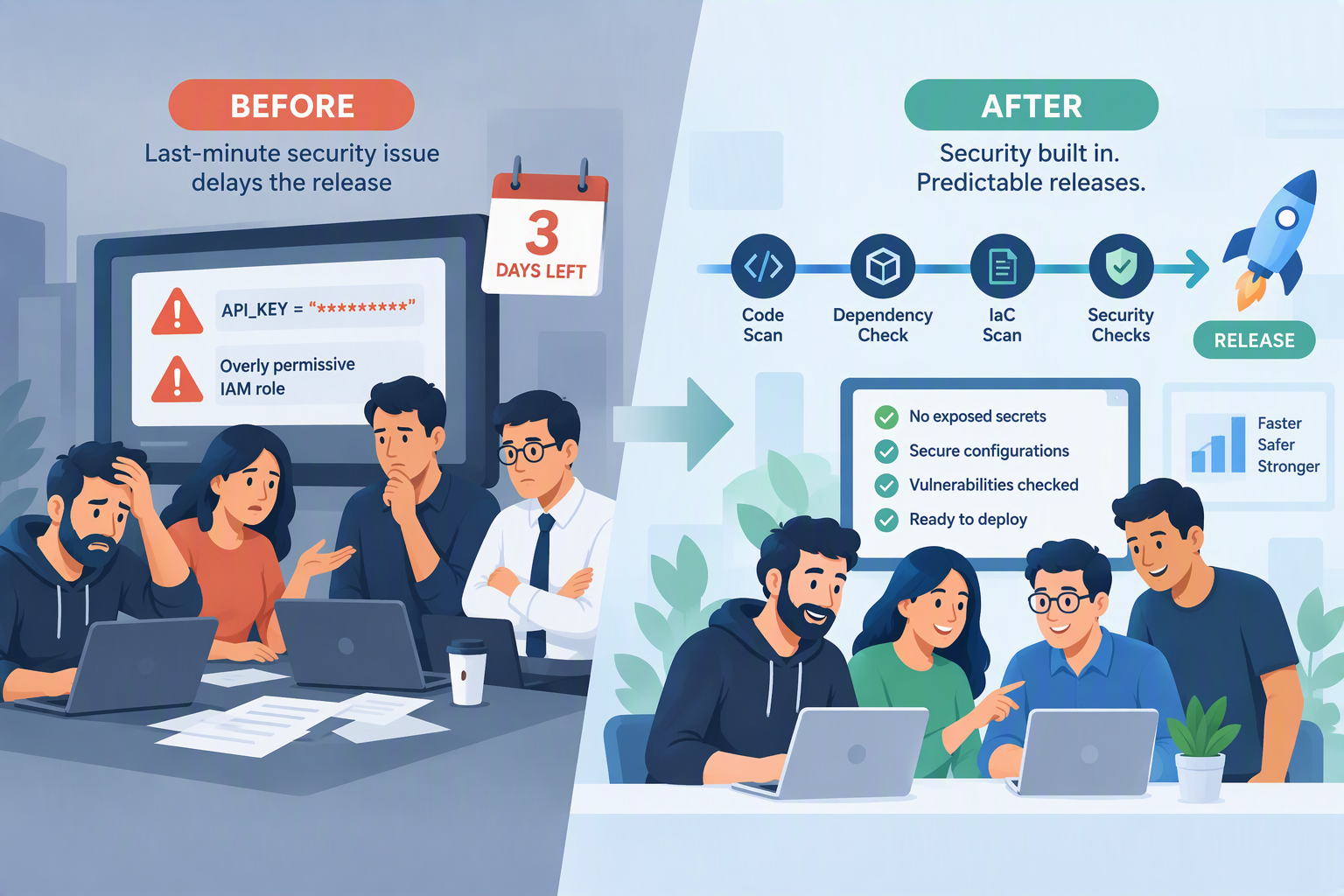
Three days before deployment, a manual security review identified a hardcoded API credential in the source repository and an overly permissive IAM role in the deployment environment. The findings required immediate investigation, delayed the release, and created tension between engineering, operations, and management. Developers argued the issues should have been identified earlier, while security teams questioned why they reached production readiness in the first place.
Following the incident, the organization adopted a practical DevSecOps approach. Secret scanning was added to pull requests, infrastructure-as-code templates were automatically reviewed for risky permissions, and dependency scanning became part of the CI/CD pipeline. Security findings were categorized by severity, with only critical issues blocking releases.
Six months later, the team was releasing software more frequently with fewer emergency escalations. Security issues were identified while developers were actively working on the code, remediation times decreased, and leadership gained greater confidence in release readiness. Rather than slowing delivery, security became part of the delivery process itself.
Why This Matters
DevSecOps is often misunderstood as a security initiative. In reality, it is a business enablement strategy that helps organizations scale software delivery without allowing security risk, compliance requirements, and operational complexity to grow unchecked.
For growing teams, the cost of fixing problems increases dramatically when vulnerabilities are discovered late in the development lifecycle. A security flaw identified during code review may take minutes to resolve, while the same issue discovered after deployment can require emergency response, downtime, customer communication, and audit review.
Embedding security into development workflows helps organizations:
- Reduce costly release delays and production incidents.
- Detect vulnerabilities before they become customer-facing problems.
- Improve collaboration between engineering, operations, and security teams.
- Create auditable processes that support SOC 2, HIPAA, PCI DSS, and other compliance frameworks.
- Scale cloud and application environments without relying on manual reviews.
- Strengthen customer confidence during security assessments and procurement reviews.
- Maintain delivery velocity while improving risk management.
Ultimately, DevSecOps is not about adding more security checkpoints. It is about creating a predictable, repeatable, and measurable process for delivering software securely at scale.
Frequently Asked Questions (FAQ)
1. What is DevSecOps in simple terms?
DevSecOps is the practice of integrating security into the software development and delivery lifecycle. Instead of performing security reviews only at the end of a project, security checks are automated and embedded throughout development, testing, deployment, and operations.
2. Will DevSecOps slow down software releases?
When implemented correctly, DevSecOps typically accelerates delivery rather than slowing it down. By identifying vulnerabilities earlier, teams spend less time handling emergency fixes, release delays, and production incidents.
3. Does every security finding need to block a deployment?
No. Effective DevSecOps programs prioritize findings according to risk. Critical issues such as exposed credentials, severe vulnerabilities, or privilege escalation paths may block releases, while lower-risk findings can follow a scheduled remediation process.
4. What are the first controls organizations should implement?
Many teams start with a small set of high-impact controls, including:
- Secret detection in source code repositories
- Software composition analysis (SCA) for dependencies
- Static application security testing (SAST)
- Infrastructure-as-code (IaC) scanning
- Protected branches and peer-review requirements
- Controlled production deployment permissions
5. How does DevSecOps support compliance initiatives?
DevSecOps creates documented, repeatable, and auditable security processes. Automated scans, deployment records, access controls, and workflow evidence help organizations demonstrate compliance with frameworks such as SOC 2, HIPAA, PCI DSS, ISO 27001, and customer security requirements without relying heavily on manual evidence collection.

Written by Yavor Y. Zlatev
CEO & Founder at Advanced Vision IT Ltd | Published on
Yavor advises executive leadership teams on cybersecurity strategy, NIS2 compliance, and cloud operating models to build resilient IT environments.