



How to Build Compliance Controls That Scale
A compliance audit rarely fails because a company had no policies. It fails because the policy was disconnected from the systems, people, and evidence needed to prove it was followed. Learning how to build compliance controls means turning broad requirements into repeatable technical and operational practices that reduce risk without slowing the business down.
For growing organizations, this work is especially urgent. A cloud environment that was manageable with a small engineering team can quickly become difficult to govern as new AWS accounts, SaaS applications, endpoints, vendors, and customer requirements are added. Effective controls give leaders visibility into what is happening, who is accountable, and where corrective action is needed.
Start With Business Risk, Not a Framework Checklist
SOC 2, HIPAA, PCI DSS, ISO 27001, CMMC, and state privacy laws all introduce requirements, but a framework should not become the sole design document. Checklists can identify gaps, yet they do not explain which controls matter most to your operations or which failure would create the greatest business impact.
Begin by identifying the systems and processes that support critical outcomes: customer data handling, payment processing, production application availability, financial reporting, software releases, and employee access. Then assess the risks associated with each one. A compromised administrator account, an untested backup, or an unreviewed production change may have very different consequences depending on the business.
This risk-first approach helps teams prioritize. A 20-person SaaS company processing sensitive customer data may need to focus first on identity management, encryption, logging, secure development, and vendor oversight. A healthcare provider may need tighter controls around protected health information, device management, and access reviews. The framework still matters, but it becomes a map for demonstrating compliance rather than a substitute for risk management.
How to Build Compliance Controls Around Real Operations
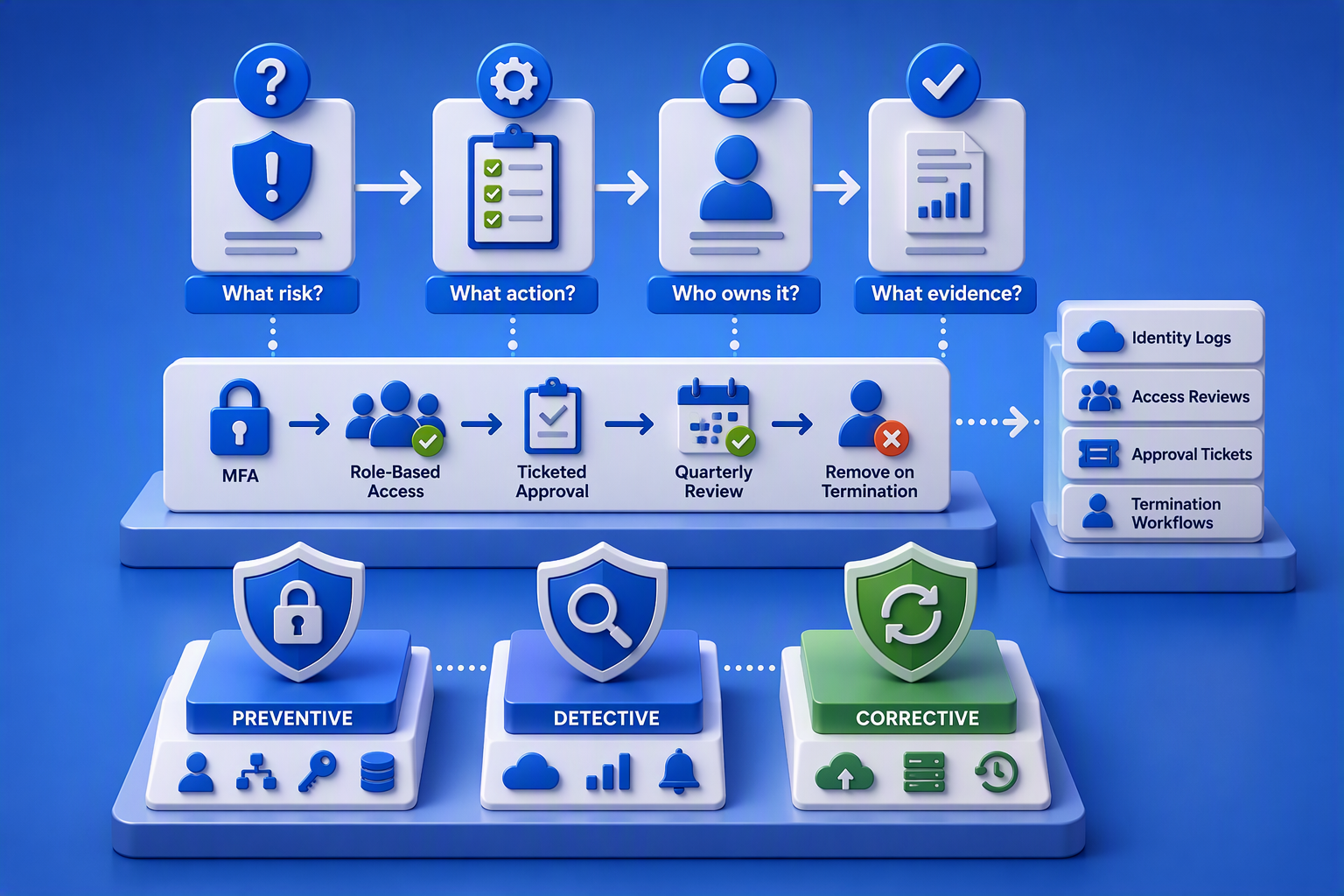
A compliance control should answer four practical questions: what risk does it address, what action must occur, who owns that action, and what evidence proves it happened? If any of those answers are unclear, the control will be difficult to operate and even harder to audit.
Consider a common requirement: limit access to sensitive systems. A weak control statement might say, "Access is restricted to authorized users." It sounds reasonable, but it gives operations teams little direction. A stronger control defines the process: access is granted through a ticketed approval workflow, protected by multi-factor authentication, assigned through role-based groups, reviewed quarterly, and removed promptly when employment ends. The supporting evidence may include identity provider logs, access review records, approval tickets, and termination workflows.
The goal is not to create overly detailed documentation for every technical setting. It is to establish a clear, repeatable operating standard that can survive personnel changes, rapid growth, and audit scrutiny.
Design preventive, detective, and corrective layers
Most effective control environments use more than one type of safeguard. Preventive controls reduce the chance of an incident occurring. Examples include multi-factor authentication, least-privilege IAM policies, network segmentation, encryption standards, and protected CI/CD deployment gates.
Detective controls identify when something unexpected has occurred. Centralized logging, AWS CloudTrail monitoring, endpoint alerts, vulnerability scanning, New Relic observability, and privileged access reviews all help teams find conditions that require attention.
Corrective controls define how the organization responds and recovers. Tested backups, incident response procedures, rollback plans, patch remediation workflows, and disaster recovery exercises fall into this category. A preventive control may fail. The ability to detect and correct that failure limits the operational and financial impact.
Build a Control Inventory That Teams Can Use
A control inventory is the operational record of your compliance program. It should be understandable to security, engineering, IT, operations, and leadership. Avoid maintaining it as a static spreadsheet that is opened only before an audit.
For each control, document the objective, applicable framework requirements, owner, frequency, systems in scope, implementation method, evidence source, and testing approach. Also identify dependencies. For example, a quarterly access review depends on accurate identity records, defined application owners, and a documented process for resolving exceptions.
Control ownership deserves special attention. Security may define a standard, but infrastructure teams might manage AWS configurations, engineering may own code review enforcement, HR may initiate offboarding, and finance may oversee vendor approvals. Assigning a single accountable owner prevents controls from becoming shared responsibilities that no one actually manages.
A practical inventory also tracks control status. Is the control designed but not implemented? Implemented but not consistently operated? Operating effectively but missing evidence? These distinctions help leadership direct resources toward the gaps that create the most exposure.
Automate Evidence Where It Improves Reliability
Manual evidence collection is one of the fastest ways for a compliance program to become expensive and fragile. When a team must gather screenshots, export logs, and chase approvals at audit time, the result is often incomplete evidence and unnecessary disruption.
Cloud-native platforms provide opportunities to collect evidence continuously. AWS CloudTrail can record account activity. AWS Config can evaluate resource configurations against defined rules. Identity providers can report on multi-factor authentication, user provisioning, and sign-in events. Ticketing platforms can retain approvals and change records. CI/CD tools can demonstrate code review, testing, and deployment history.
Automation does not mean every control must be enforced through code. Some controls require human judgment, such as annual policy review, vendor risk acceptance, or incident postmortems. The better question is whether the evidence can be produced consistently and whether the control can be monitored without relying on memory.
Infrastructure as code is particularly valuable for cloud controls. Terraform or Ansible can standardize baseline configurations for logging, encryption, networking, and identity permissions. Version-controlled changes create an auditable history while reducing drift between environments. However, automation must be governed. A misconfigured deployment pipeline can propagate risk at the same speed it delivers improvements.
Connect Compliance Controls to Change Management
Rapid delivery and compliance are not competing priorities when controls are integrated into the engineering lifecycle. They become competitors when security reviews are introduced only at the end of a project, after architecture decisions and implementation work are already complete.
Build controls into planning, development, deployment, and operations. During design, teams should classify data, define trust boundaries, and consider recovery requirements. During development, use code review, dependency scanning, secrets management, and secure coding practices. During deployment, require approvals appropriate to the risk of the change and preserve release records. In operations, monitor performance, availability, vulnerabilities, and security events against defined thresholds.
The level of formality should match the risk. An emergency production fix cannot always wait for a standard change advisory meeting. In that case, a documented emergency path with retrospective review is better than an informal exception. Similarly, a low-risk website content update should not require the same approval process as a database schema change affecting customer records.
Test Controls Before an Auditor Does
A control that exists on paper is not necessarily operating effectively. Internal testing confirms whether the process works under normal conditions and whether evidence is available when needed.
Set a testing cadence based on risk and control frequency. High-risk automated controls may need continuous monitoring. Quarterly access reviews should be tested each quarter. Annual policy controls may only need annual validation. Test samples should be representative, and failures should be documented rather than quietly corrected.
When a test identifies a gap, record the root cause, remediation owner, target date, and validation method. A missed access review may point to an unclear owner, incomplete application inventory, weak HR integration, or inadequate escalation. Fixing the underlying process is more valuable than simply completing the overdue review.
Metrics help leadership see whether compliance is becoming more reliable. Useful measures include privileged accounts without multi-factor authentication, overdue vulnerability remediation, backup restore success rates, access review completion, unresolved audit findings, and percentage of infrastructure managed through approved code. The right metrics connect control performance to business risk rather than rewarding teams for producing documentation.
Keep the Program Proportionate as You Grow
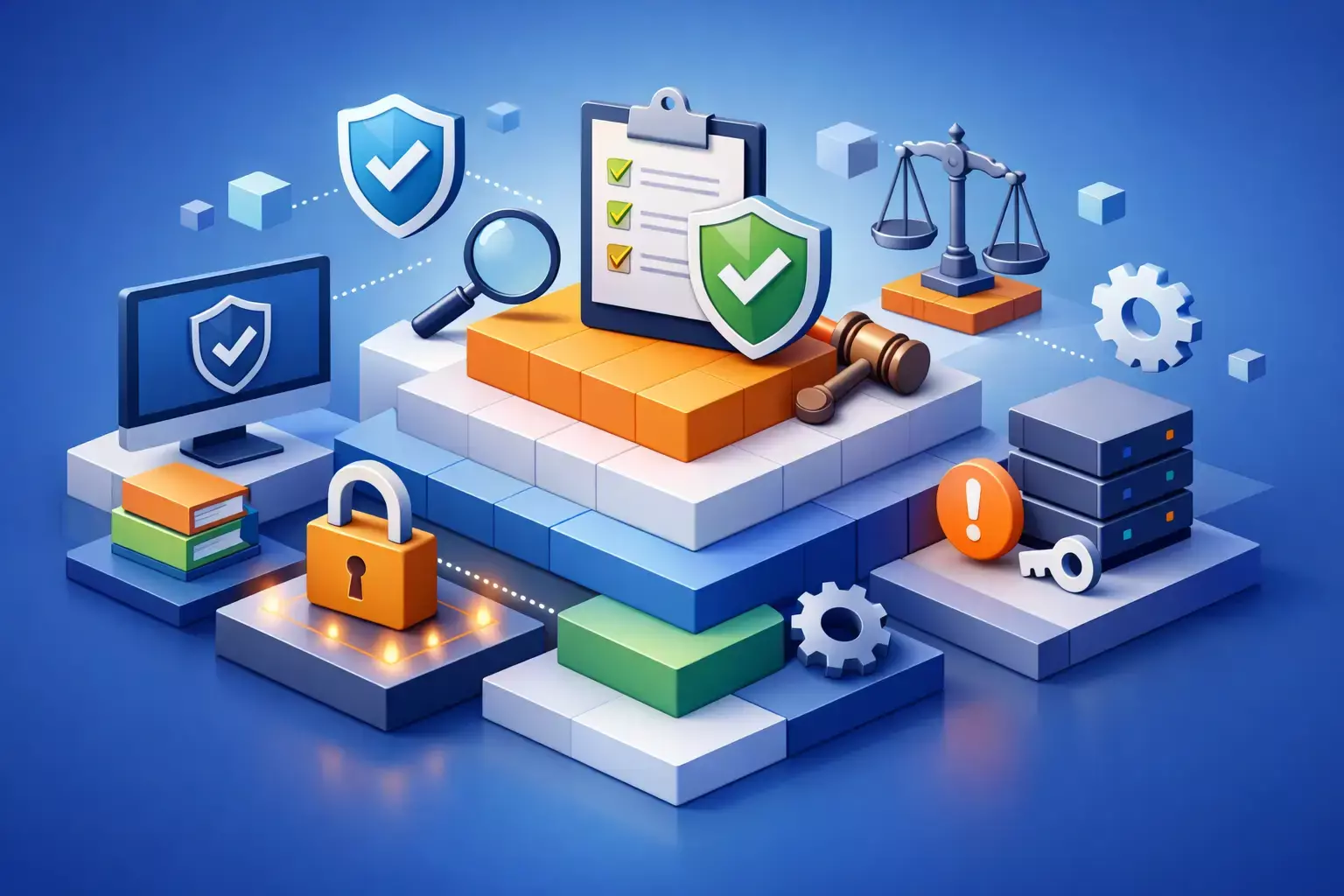
The strongest compliance program is not the one with the most controls. It is the one that provides credible assurance while allowing the organization to operate efficiently. Overly complex workflows invite workarounds, while underspecified controls leave teams guessing.
As systems, regulations, and customer commitments change, revisit scope and risk assumptions. A new product, acquisition, international customer, or migration to AWS can change the control environment significantly. Regular Well-Architected Reviews, security assessments, and operational reviews help identify where existing controls need to evolve.
Advanced Vision IT helps organizations connect cloud architecture, managed operations, cybersecurity, and compliance execution so controls are practical in daily use, not just present for an audit. The long-term value comes from building habits of accountable, observable operations that make the business easier to trust as it scales.
User Story: From Audit Stress to Continuous Compliance
A rapidly growing SaaS company had expanded from 15 to more than 100 employees in less than two years. During that growth, the organization added multiple AWS accounts, several SaaS platforms, remote employees, and a larger engineering team. Compliance requirements for SOC 2 became increasingly important as enterprise customers began asking for proof of security controls during procurement reviews.
At first, the company believed it was prepared. Policies existed, user access procedures were documented, and security responsibilities had been assigned. However, during a readiness assessment, leadership discovered that many controls were not consistently enforced. Access reviews were performed irregularly, employee offboarding evidence was difficult to locate, and configuration changes across cloud environments were not centrally tracked.
Rather than creating more policies, the company focused on building operational controls tied directly to business risk. Identity and access management was standardized, AWS CloudTrail logging was enabled across all accounts, quarterly access reviews were assigned to specific owners, and evidence collection was automated through cloud and ticketing platforms.
When the SOC 2 audit began, teams no longer needed to spend weeks gathering screenshots and manually recreating historical records. Auditors were provided with consistent evidence from approved systems, and leadership gained better visibility into compliance performance throughout the year. More importantly, the controls improved security and operational accountability, not just audit readiness.
The lesson was simple: successful compliance came from embedding controls into daily operations rather than treating audits as isolated events.
Why This Matters
Building compliance controls is about much more than passing audits. Organizations that connect controls to real business processes gain measurable advantages:
- Reduced operational risk through consistent enforcement of security, access, and change management practices.
- Faster audit preparation because evidence is collected and maintained continuously rather than gathered manually at the last minute.
- Greater accountability by clearly assigning control ownership across security, IT, engineering, HR, finance, and operations teams.
- Improved visibility into security posture through monitoring, testing, metrics, and automated reporting.
- Better scalability as processes remain effective even when the business grows, adds new systems, enters new markets, or faces additional regulatory requirements.
- Increased customer trust because compliance efforts demonstrate that security controls are actively operating rather than existing only on paper.
Ultimately, well-designed controls transform compliance from a reactive exercise into a strategic capability that supports growth, resilience, and customer confidence.
Frequently Asked Questions (FAQ)
1. What is the difference between a policy and a compliance control?
A policy defines what the organization intends to do, while a compliance control defines how the requirement is implemented, monitored, and evidenced. Policies provide direction; controls provide measurable execution.
2. How do I determine which compliance controls should be implemented first?
Start with business risk rather than framework requirements alone. Prioritize controls that protect critical assets such as customer data, production systems, financial processes, privileged accounts, and cloud infrastructure.
3. Why is evidence collection important for compliance?
Auditors need proof that controls are operating effectively. Without reliable evidence such as access review records, change approvals, logs, and monitoring reports, even well-designed controls may fail audit testing.
4. Can compliance controls be automated?
Many controls can be partially or fully automated using cloud-native services, identity providers, ticketing platforms, monitoring tools, and infrastructure-as-code. Automation improves consistency, reduces manual effort, and makes evidence easier to collect.
5. How often should compliance controls be tested?
Testing frequency should match the level of risk and how often the control operates. High-risk controls may require continuous monitoring, while quarterly reviews, annual policy validations, and periodic disaster recovery testing should follow documented schedules and be consistently tracked.

Written by Miroslav Sultanov
Technical Account Management Team Lead & Senior SEO Specialist at Advanced Vision IT Ltd | Published on
Miroslav advises strategic digital marketing insights, search optimization strategies, and technical team leadership.