



Kubernetes Security Hardening Guide for Teams
A Kubernetes cluster can be healthy, scalable, and still expose the business to serious risk. An overly permissive service account, a public API endpoint, or a container running with unnecessary privileges can turn a routine deployment issue into an incident. This Kubernetes security hardening guide focuses on the controls that matter most for teams operating production workloads in AWS, hybrid environments, or managed Kubernetes platforms.
Hardening is not a one-time configuration project. It is an operating model that combines secure architecture, policy enforcement, workload standards, and continuous visibility. The objective is straightforward: reduce the paths an attacker can use, limit the blast radius when something fails, and make risky changes visible before they reach production.
Kubernetes Security Hardening Guide: Start With the Control Plane
The control plane is the cluster's highest-value target. If an attacker gains broad access to the Kubernetes API, they can create workloads, read secrets, modify networking, and potentially move into connected cloud services. Treat API access as privileged infrastructure access, not just another application login.
Use centralized identity providers and require multifactor authentication for human users. Avoid shared administrator accounts and remove standing cluster-admin access for day-to-day engineering work. Teams should receive narrowly scoped Role-Based Access Control permissions based on their namespace, environment, and operational responsibilities.
Review RBAC regularly, especially bindings that grant cluster-wide permissions. Wildcard verbs and resources are convenient during initial setup, but they create excessive authority that often remains in place long after a project changes. A developer who only needs to view pods and retrieve logs should not be able to modify admission policies, create privileged pods, or read secrets across every namespace.
For managed services such as Amazon EKS, keep the Kubernetes version and supporting components within supported release windows. Apply control plane updates deliberately, test add-on compatibility, and maintain a documented rollback plan for application changes. Restrict access to the API endpoint through private networking or approved IP ranges where practical. The right choice depends on how administrators, CI/CD runners, and incident responders access the cluster, but an unrestricted public endpoint is rarely justified.
Enforce Secure Workload Defaults
Most Kubernetes compromises begin at the workload layer. A vulnerable image, exposed application, or misconfigured pod can provide an initial foothold. The practical goal is to make insecure deployment configurations difficult to create and easy to detect.
Apply Kubernetes Pod Security Admission with a baseline that reflects the sensitivity of each environment. Production namespaces should generally move toward the restricted standard, with documented exceptions for workloads that have a legitimate operational need. Do not apply restrictive controls blindly to legacy workloads without testing. Some monitoring agents, storage drivers, and infrastructure components require elevated permissions, and the safer approach is to isolate and justify those exceptions rather than weaken policy across the cluster.
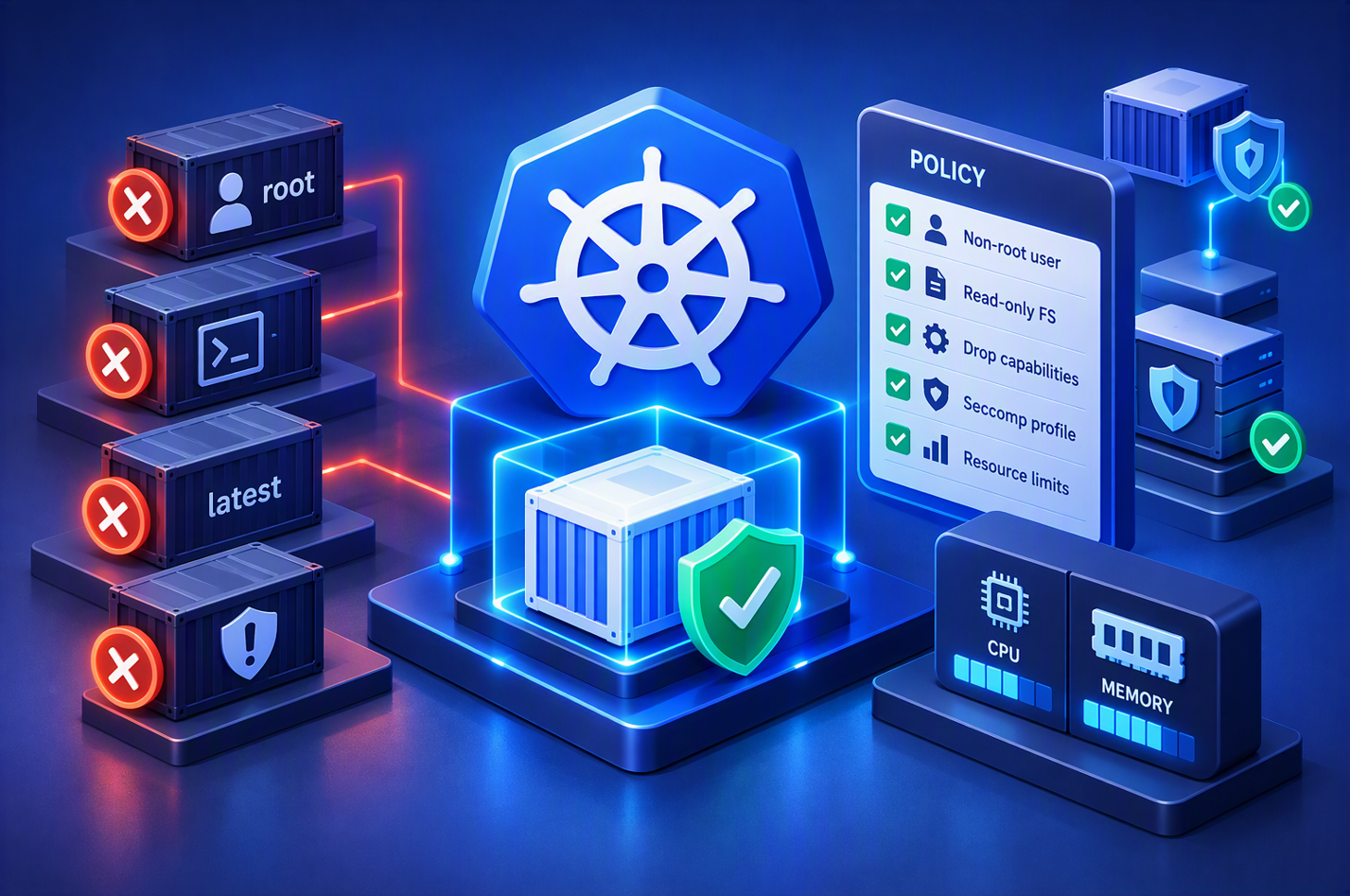
Every application workload should run as a non-root user whenever possible. Set runAsNonRoot, use a read-only root filesystem where the application supports it, drop Linux capabilities that are not required, and apply a seccomp profile. Privileged containers, host networking, host PID access, and hostPath mounts should be treated as exceptions that require security review.
Resource requests and limits also support security. They prevent a malfunctioning or malicious workload from consuming node capacity and disrupting neighboring services. Pair resource controls with namespace quotas and limit ranges so that a single deployment cannot create an unplanned infrastructure problem.
Admission policies provide the guardrails. Tools such as Kyverno or Open Policy Agent-based controls can prevent deployments that use the latest tag, lack resource limits, request privileged mode, or pull images from unapproved registries. Start with audit mode to understand existing violations, then move high-confidence policies into enforcement. This staged approach keeps security improvements from becoming a source of avoidable delivery friction.
Secure the Software Supply Chain
A container image is production software, not a disposable artifact. Build images from minimal, supported base images and remove shells, package managers, and debugging tools that are not needed at runtime. Smaller images reduce both the attack surface and the effort required to patch known vulnerabilities.
Scan images in CI/CD before they are promoted. Define clear severity thresholds, but do not rely solely on a vulnerability score. A critical finding in an unreachable development package may warrant a different response than an actively exploitable library used by an internet-facing service. Engineering and security teams need a process for documenting accepted risk, ownership, and remediation deadlines.
Use immutable image tags or image digests in deployment manifests. A mutable tag can point to different code over time, making incident investigation and rollback far more difficult. Image signing and provenance verification add another meaningful control by allowing the cluster to accept artifacts only from trusted build pipelines.
Software bills of materials are also valuable for operational response. When a new vulnerability is announced, teams should be able to identify affected workloads without manually inspecting repositories and registries. This is where DevOps automation creates a direct security benefit: the same pipelines that accelerate releases can enforce consistent evidence, approvals, scanning, and artifact traceability.
Segment Networks and Limit Egress
Kubernetes networking is permissive by default in many environments. Without network policies, a compromised pod may be able to connect freely to applications, databases, and internal services throughout the cluster.
Begin with default-deny ingress and egress policies for production namespaces, then explicitly allow the traffic each workload needs. For example, a public API may accept traffic only from an ingress controller and communicate with a specific backend service. That backend may need database access but no direct internet access. These boundaries reduce lateral movement and make intended application dependencies clear.
Egress deserves special attention. Workloads frequently need access to DNS, cloud APIs, package repositories, payment providers, or other third-party services. Allowing all outbound traffic is simpler, but it gives compromised workloads an easy path to command-and-control services or data exfiltration. Use controlled egress, approved destinations, and logging for sensitive workloads. The implementation may involve Kubernetes network policies, cloud firewall rules, private endpoints, or an egress proxy, depending on the platform and application design.
Keep production, staging, and development workloads separated. Separate clusters offer the strongest isolation, while namespace separation may be appropriate for smaller environments with mature policy controls. The right model depends on compliance requirements, tenant sensitivity, release cadence, and budget, but production credentials should never be casually accessible from lower environments.
Treat Secrets as Short-Lived Credentials
Kubernetes Secrets are base64-encoded objects, not a complete secret-management strategy. Anyone with permission to read a secret can decode it. Avoid storing long-lived credentials in Git repositories, Helm values files, or plain deployment manifests.
Use an external secrets platform such as AWS Secrets Manager or a comparable enterprise vault, and grant workloads access through workload identity rather than static cloud keys. On EKS, this can mean assigning tightly scoped AWS permissions to a specific Kubernetes service account. The application retrieves only the secrets it needs, and cloud credentials do not need to be embedded in the container image or pod specification.
Enable encryption at rest for Kubernetes secrets, control access through RBAC, and rotate sensitive credentials on a defined schedule. Rotation is only effective when applications can consume updated values safely, so test the operational behavior before enforcing aggressive expiration periods. Database passwords, API tokens, certificates, and webhook secrets all require different rotation patterns.
Monitor Runtime Behavior and Make Response Repeatable
Preventive controls reduce risk, but they will not catch every issue. Centralize Kubernetes audit logs, cloud activity logs, container logs, and security alerts in an observability platform where teams can investigate behavior across infrastructure and applications. Alerts should focus on meaningful events: new cluster-admin bindings, privileged pod creation, unexpected exec sessions, unusual API activity, failed authentication patterns, and sensitive secret access.
Runtime detection is particularly useful for identifying behavior that policy checks cannot predict, such as a container spawning an unexpected shell, making unusual outbound connections, or accessing files outside its normal operating pattern. Establish an incident runbook that states who can isolate a namespace, revoke access, capture evidence, rotate credentials, and restore a workload. During an incident, unclear ownership costs more time than a missing dashboard.
Advanced Vision IT typically approaches hardening as an integrated operational practice, combining AWS architecture, Terraform-based configuration control, CI/CD policy checks, and ongoing monitoring. That approach helps security standards remain consistent as clusters, teams, and application portfolios grow.
Turn Hardening Into a Managed Operating Practice
The most effective hardening programs are measurable. Track the percentage of workloads running as non-root, the number of privileged exceptions, policy violations by team, patch compliance, image vulnerability remediation time, and network policies protecting production namespaces. These metrics reveal whether controls are improving real exposure or merely producing more alerts.
Start with the highest-impact gaps: excessive access, public control-plane exposure, privileged workloads, unrestricted network paths, and unmanaged secrets. Then build security checks into the same engineering workflows that create infrastructure and release software. When secure configurations become the default path, teams spend less time negotiating exceptions and more time delivering reliable services.
A well-hardened cluster should not feel difficult to operate. It should give engineering teams clear boundaries, faster evidence during incidents, and the confidence to scale without creating hidden security debt.
User Story: Why Kubernetes Security Hardening Became a Business Priority
A global food manufacturing company had successfully modernized its operations using Kubernetes across AWS and on-premises environments. Development teams could deploy applications quickly, infrastructure scaled automatically during seasonal demand, and operational metrics looked healthy.
However, during a routine security assessment, the company discovered several hidden risks:
- Multiple service accounts had permissions far beyond what applications actually required.
- Several workloads were running as root users.
- Production namespaces had no enforced network segmentation.
- The Kubernetes API endpoint was accessible from the public internet.
- Long-lived cloud credentials were stored inside deployment configurations.
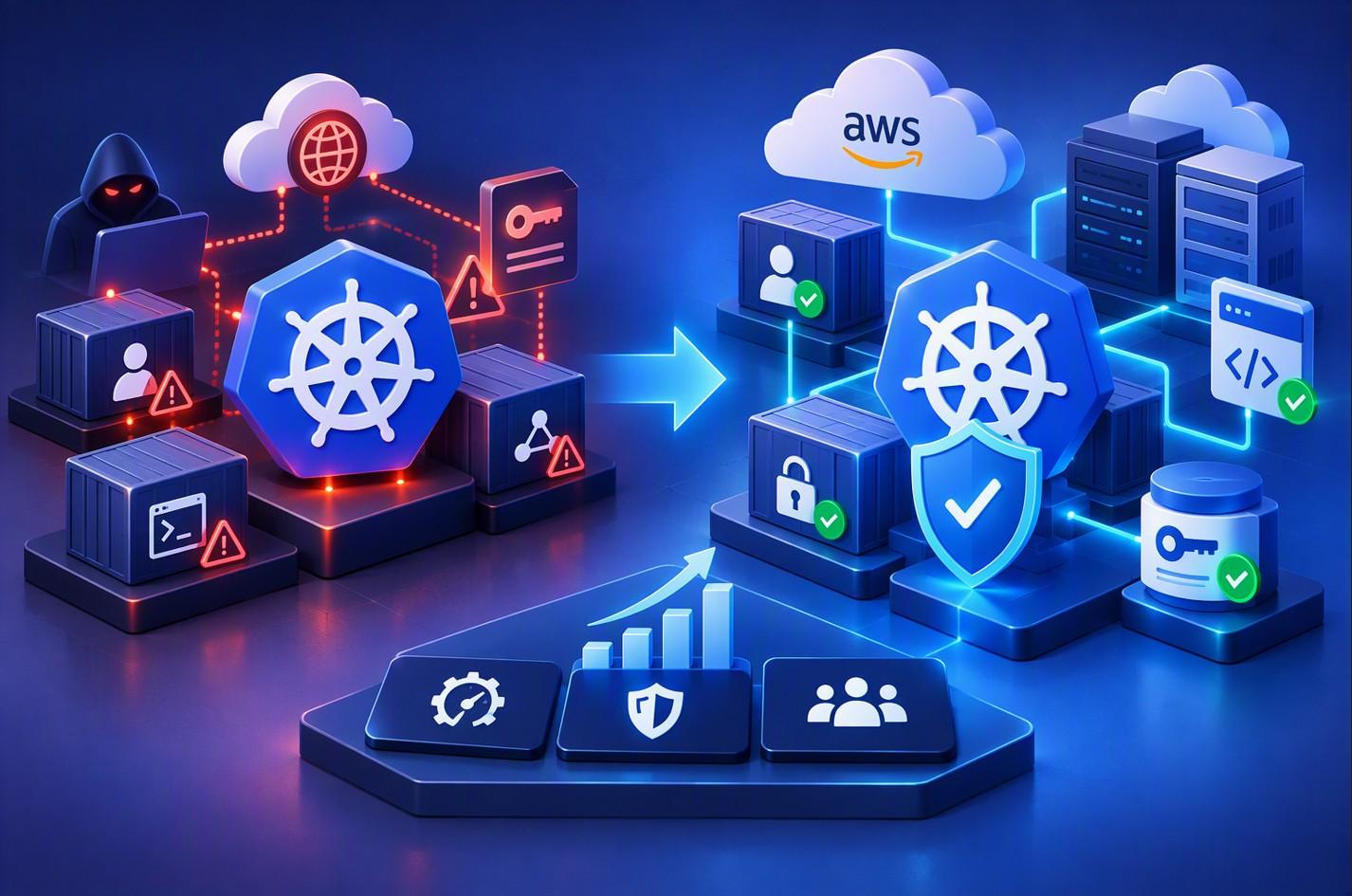
None of these issues had caused an outage, and the cluster appeared to be operating normally. But the assessment revealed that if a single application vulnerability were exploited, an attacker could potentially access sensitive data, move laterally across environments, retrieve secrets, or gain broader access to connected AWS services.
The organization responded by implementing a structured Kubernetes security hardening program. RBAC permissions were reduced to least privilege, Pod Security Admission policies were enforced, secrets were migrated to AWS Secrets Manager, network policies restricted unnecessary communication, and security controls were integrated into CI/CD pipelines.
Within months, the company reduced privileged workloads by more than 80%, shortened vulnerability remediation times, improved audit readiness, and gained confidence that future growth would not introduce unmanaged security debt.
The result was not simply a more secure Kubernetes environment. It was a platform that allowed engineering teams to move faster while maintaining consistent security standards across the entire application lifecycle.
Why This Matters
Kubernetes has become the foundation for many modern applications, but its flexibility can also create significant security exposure when controls are not consistently enforced.
Security incidents rarely begin with a full cluster compromise. More often, they start with a small weakness such as an over-privileged service account, an unpatched container image, an exposed secret, or unrestricted network connectivity. In highly connected cloud-native environments, these seemingly minor issues can quickly escalate into larger operational and business risks.
Effective Kubernetes hardening matters because it helps organizations:
- Reduce attack surface by eliminating unnecessary privileges, access paths, and exposed services.
- Limit blast radius when applications are compromised through workload isolation, network segmentation, and least-privilege access controls.
- Improve compliance readiness by demonstrating consistent security controls, auditability, and governance.
- Protect cloud resources by preventing Kubernetes workloads from becoming a pathway into connected AWS or hybrid infrastructure.
- Accelerate incident response through centralized visibility, logging, and repeatable response procedures.
- Enable secure growth by embedding security controls into infrastructure-as-code and CI/CD processes rather than relying on manual reviews.
- Build trust with customers and stakeholders by reducing the likelihood of service disruptions, data breaches, and regulatory violations.
Ultimately, Kubernetes security hardening is not just an infrastructure concern. It directly supports business continuity, regulatory compliance, operational resilience, and the ability to scale applications safely.
Frequently Asked Questions (FAQ)
1. How often should Kubernetes security hardening be reviewed?
Security hardening should be treated as a continuous process rather than a one-time project. Organizations should perform ongoing monitoring, quarterly permission reviews, regular vulnerability assessments, and security validation after significant infrastructure or application changes.
2. What is the most common Kubernetes security mistake?
One of the most common issues is excessive permissions. Overly permissive RBAC roles, cluster-admin access, and unrestricted service accounts frequently create opportunities for privilege escalation and lateral movement within a cluster.
3. Is Kubernetes security different in managed services such as Amazon EKS?
Yes. While cloud providers secure portions of the underlying infrastructure, customers remain responsible for workload security, RBAC configuration, secrets management, network policies, image security, monitoring, and access governance. Managed Kubernetes reduces operational complexity but does not eliminate security responsibilities.
4. Which hardening activities provide the fastest risk reduction?
Organizations typically see the greatest immediate benefit by addressing:
- Publicly exposed control planes
- Excessive administrator privileges
- Privileged containers
- Unrestricted network communication
- Poor secret management practices
- Unpatched container images
These controls often mitigate the highest-impact risks with relatively manageable implementation effort.
5. Can security hardening slow down development teams?
Not when implemented correctly. Modern approaches use policy-as-code, infrastructure-as-code, automated image scanning, and CI/CD guardrails to make secure configurations the default. This reduces manual reviews, prevents misconfigurations earlier in the lifecycle, and enables developers to move faster with fewer production risks.

Written by Yavor Y. Zlatev
CEO & Founder at Advanced Vision IT Ltd | Published on
Yavor advises executive leadership teams on cybersecurity strategy, NIS2 compliance, and cloud operating models to build resilient IT environments.