



SECaaS vs In-House Security: Which Is Right?
A security incident rarely exposes just one technical gap. It exposes unanswered alerts, unclear ownership, delayed patching, weak identity controls, and a team that was already stretched thin. That is why the SECaaS vs in-house security decision is not simply a choice between outsourcing and hiring. It is a decision about how your business will maintain security coverage, respond under pressure, and keep pace with cloud and compliance requirements.
For small and mid-sized businesses, the right model depends on the complexity of the environment, the sensitivity of the data, the maturity of the internal IT team, and the level of accountability leadership needs. Many organizations ultimately use a blended model, pairing internal ownership with specialized managed security capabilities.
What SECaaS and In-House Security Actually Mean
Security as a Service, or SECaaS, provides security capabilities through an external provider on an ongoing basis. The scope may include endpoint protection, identity and access management, vulnerability management, cloud security monitoring, SIEM operations, incident response support, compliance reporting, and security policy guidance. The provider supplies the platform expertise, operating processes, and often the people required to run those controls consistently.
In-house security means the organization hires, trains, and retains its own security personnel while selecting and operating its own tools. This can range from a single IT administrator handling security responsibilities to a dedicated security operations center with engineers, analysts, architects, and compliance specialists.
Neither definition tells the whole story. A company may retain an internal IT manager who owns risk decisions and vendor relationships while using a managed team for 24/7 monitoring and incident triage. That arrangement is often more practical than treating security as an all-or-nothing function.
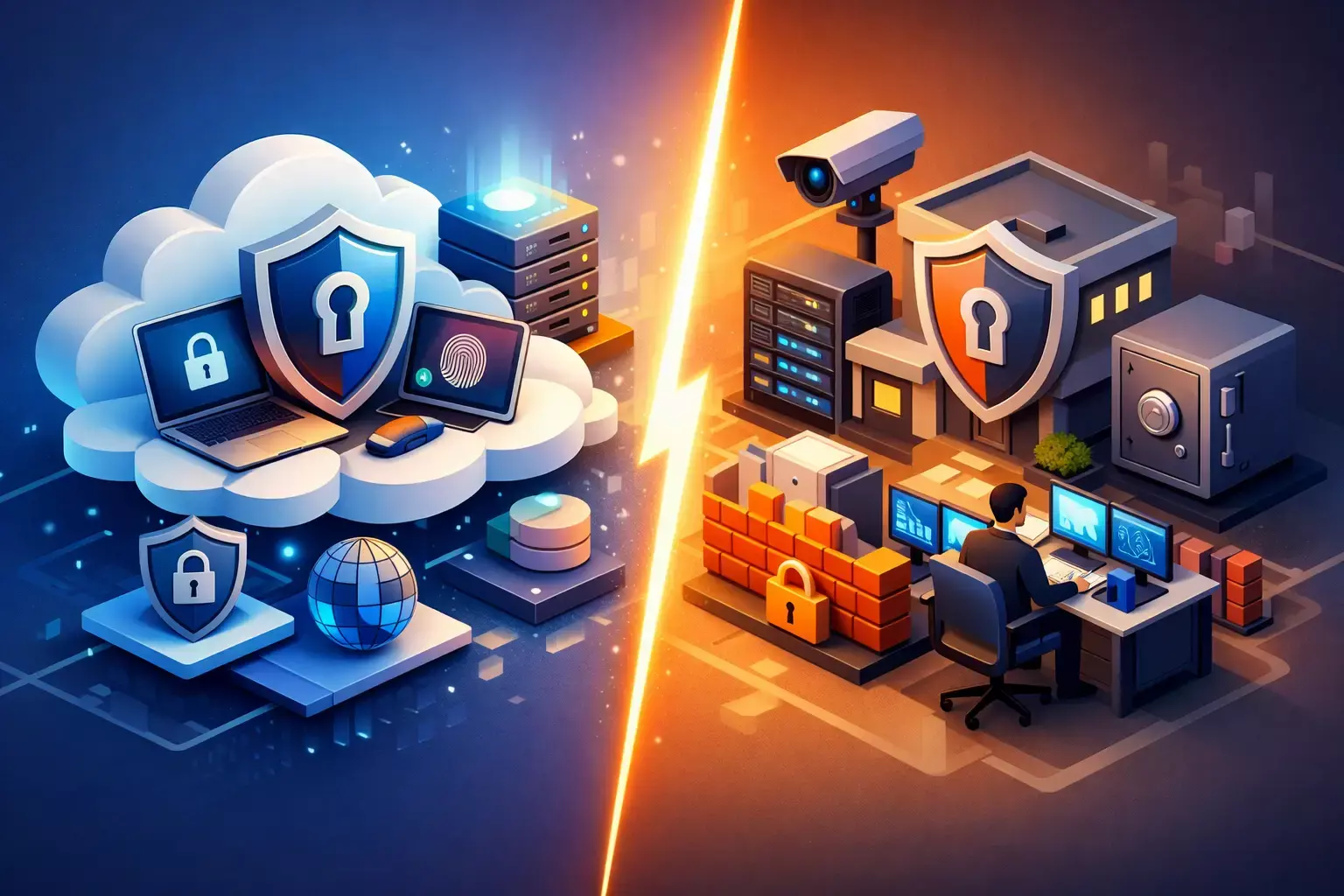
SECaaS vs In-House Security: The Core Trade-Offs
The biggest difference is not whether security is “better” inside or outside the company. It is where expertise, operational responsibility, and fixed costs sit.
Cost: predictable service fees versus staffing overhead
An in-house team gives an organization direct control, but the real cost extends well beyond salaries. Security requires coverage across engineering, monitoring, vulnerability remediation, governance, cloud configuration, incident response, and audit preparation. A single security hire cannot credibly cover every discipline or provide continuous coverage.
SECaaS converts much of that staffing burden into a recurring operating cost. It can provide access to multiple specialists, established procedures, and enterprise-grade tools without requiring the business to recruit for every role. This is particularly valuable when a company needs better security operations now, rather than after a long hiring cycle.
However, managed services are not automatically cheaper in every case. An organization with a mature internal security department, stable staffing, and highly customized requirements may find it more economical to operate selected functions internally. The key is to compare total operating cost, not just the price of a service contract or an individual salary.
Coverage: specialist depth versus institutional knowledge
Security work is broad. Cloud identity, endpoint security, email protection, network controls, application security, threat detection, log management, and compliance each require different experience. A well-designed SECaaS engagement brings depth across these areas and helps ensure that monitoring, alert handling, and reporting are not dependent on one employee’s availability.
Internal teams bring a different strength: deep knowledge of the company’s systems, business processes, users, and risk tolerance. They understand which application supports revenue operations, which privileged access request is unusual, and which outage would create the greatest customer impact.
The strongest operating model combines both forms of knowledge. An external security partner should have documented escalation paths and regular access to the internal stakeholders who understand the business context. Without that connection, even strong technical detection can lead to slow or poorly prioritized response.
Speed: immediate capability versus direct control
SECaaS is often faster to deploy because the provider already has analysts, playbooks, management processes, and technology experience in place. This matters when an organization is moving workloads to AWS, responding to an audit finding, integrating a new acquisition, or recovering from a security event.
In-house programs can move quickly when they are well-funded and well-staffed. But building that capability from scratch takes time. Teams must select tools, integrate telemetry, define alert workflows, tune detections, document response procedures, and maintain the environment as systems change.
Direct internal control can be necessary in highly specialized environments. Yet control without sufficient capacity can create a false sense of security. An alert that no one reviews overnight is not meaningful protection.
Scalability: service elasticity versus internal expansion
Growth changes the security workload. New cloud accounts, remote employees, SaaS platforms, customer data, CI/CD pipelines, and compliance obligations all expand the attack surface. SECaaS can scale with that change by adding monitoring scope, users, endpoints, or cloud workloads without redesigning the entire security organization.
An in-house team can scale as well, but each expansion usually requires additional hiring, training, and management. That may be appropriate for companies with a large or highly regulated footprint. For growth-stage organizations, it can divert leadership attention and budget from product development and core operations.
When SECaaS Is Usually the Better Fit
SECaaS is a strong fit when a business needs broader security coverage than its current team can provide. It is especially useful for organizations that have cloud infrastructure but lack dedicated cloud security engineers, need support meeting customer or regulatory expectations, or cannot justify a full internal security operations team.
Consider a managed approach when several of these conditions are true:
- Security responsibilities sit with a small IT team that also manages support tickets, infrastructure, and employee onboarding.
- The business needs continuous monitoring, but cannot staff nights, weekends, and incident response rotations.
- AWS, Microsoft 365, SaaS applications, endpoints, and remote access create a distributed environment that needs centralized visibility.
- Compliance requirements such as SOC 2, HIPAA, PCI DSS, or customer security questionnaires are consuming too much internal time.
- Leadership needs clearer reporting on vulnerabilities, risk trends, control status, and remediation progress.
A capable SECaaS provider should not merely install tools and send alerts. It should help define the operating model: what gets monitored, who is notified, which events require immediate action, how evidence is retained, and how recurring weaknesses are remediated. This is where hands-on consultation matters as much as the technology itself.
When In-House Security Makes More Sense
A dedicated in-house model may be the right choice when security is central to the product, the organization has unusual operational requirements, or regulations require extensive internal control over sensitive processes. Financial institutions, large software platforms, defense-adjacent firms, and companies with substantial proprietary environments may need resident security leadership and specialized engineering teams.
It also makes sense to build internally when a company has enough scale to support defined roles. A security leader, cloud security engineer, governance specialist, and incident response capability can create a durable program when they have executive backing and the authority to influence engineering and operations.
Even then, external expertise can remain valuable. Independent assessments, penetration testing, 24/7 monitoring, and surge incident-response support can complement the internal team without replacing it. Internal security should not have to solve every specialized problem alone.
The Hybrid Model Often Produces Better Results
For many businesses, the practical answer to SECaaS vs in-house security is not either-or. Internal leaders should own business risk, budget priorities, data classification, and decisions that affect customers or operations. A managed partner can operate security tooling, provide specialized cloud and compliance expertise, and extend coverage beyond normal business hours.
This division creates clearer accountability. Your internal team remains close to the business, while the service provider brings repeatable operating discipline and cross-environment experience. It also avoids a common failure mode: buying expensive security tools that no one has time to configure, monitor, or improve.
At Advanced Vision IT, this approach can connect managed security with the systems security depends on, including AWS architecture, DevOps workflows, observability, endpoint management, and compliance operations. Security findings are more useful when the team responsible for remediation understands the infrastructure behind them.
How to Make the Decision Without Guesswork
Start with a candid inventory of your current environment. Identify critical systems, data types, cloud accounts, endpoints, identity providers, third-party applications, and regulatory commitments. Then assess how quickly your team can detect, investigate, contain, and recover from a realistic security incident.
Next, define the outcomes you need. Those may include 24/7 monitoring, faster patching, better AWS configuration management, audit-ready evidence, incident-response planning, or more reliable executive reporting. Avoid selecting a model based only on a tool list. The operating process behind those tools determines whether they reduce risk.
Finally, clarify ownership before signing a contract or opening a requisition. Who approves access changes? Who investigates suspicious activity? Who coordinates communications during an incident? Who closes remediation items? Clear answers matter more than whether the person doing the work is an employee or a managed specialist.
The right security model is the one your organization can operate consistently when priorities shift and pressure rises. Build around accountable ownership, tested processes, and the expertise required by your actual environment. That foundation will serve the business better than a security strategy designed only to look complete on paper.
FAQ
1. What is the main difference between SECaaS and in-house security?
SECaaS (Security as a Service) delivers security capabilities through an external provider that supplies expertise, tools, and operational support. In-house security relies on an organization's own employees to manage security tools, monitoring, incident response, and compliance activities. The key difference is where security expertise, operational responsibility, and costs are managed.
2. Is SECaaS more cost-effective than building an internal security team?
For many small and mid-sized businesses, SECaaS can be more cost-effective because it provides access to multiple security specialists and enterprise-grade tools without the expense of hiring, training, and retaining a full security team. However, organizations with mature security programs and highly specialized needs may find some internal functions more economical to manage in-house.
3. When is SECaaS the best choice for a business?
SECaaS is often the best fit when organizations need broader security coverage, 24/7 monitoring, cloud security expertise, compliance support, or faster deployment of security capabilities. It is especially valuable for companies with limited internal security resources or rapidly growing IT environments.
4. What advantages does an in-house security team provide?
An in-house security team offers deep knowledge of the organization's systems, users, business processes, and risk priorities. This familiarity can improve decision-making, incident response, and alignment between security initiatives and business objectives, particularly in highly specialized or regulated environments.
5. Can a business combine SECaaS and in-house security?
Yes. Many organizations adopt a hybrid model that combines internal ownership of security strategy, risk management, and business decisions with external support for monitoring, threat detection, compliance assistance, and specialized expertise. This approach often provides the best balance of control, scalability, and operational coverage.

Written by Alexander Boychev
Business Executive & Digital Marketing Manager at Advanced Vision IT Ltd | Published on
Alexander advises insights on business development, strategic key account management, and digital marketing in the IT sector.